The Echo of the Uninvited: Finding the Hidden Quiet within a Neighborhood’s Loudest, Most Fractured Summer
CHAPTER 1: The Uninvited Bloom
The first bass note rattled the framed photos in the hallway, the glass vibrating with a metallic shiver that traveled straight into my teeth. It wasn’t the rhythmic thrum of a car passing by; it was a heartbeat that didn’t belong in my driveway. I stood in the center of the living room, the coffee in my mug still warm, its steam curling in the early light. The silence I had cultivated, the deliberate, worn-in peace of this house, felt suddenly fragile.
I stepped to the window. My hand touched the blinds, the plastic slightly yellowed by years of morning sun. I pulled them back, expecting a neighborhood kid or perhaps a wayward delivery truck. Instead, the world had been painted over.
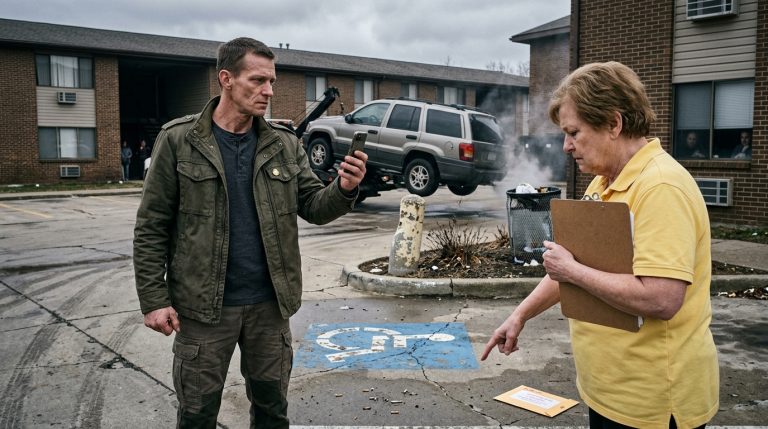
A stretch of industrial-grade red carpet was pinned to the gravel of my driveway. It was unnervingly vibrant, a color that didn’t exist in the natural palette of the cul-de-sac. Beside it, a man in a polo shirt—dark with sweat—was wrestling with a cotton candy machine, the wire trailing like a tail toward my exterior outlet. And there, standing in the center of the chaos, was a woman.
She wore heels that looked like weapons in the morning gravel, oversized sunglasses, and a sash of glittering, cheap material that caught the light with every sharp movement she made. She was pointing at my truck, her finger a rigid accusation.
I didn’t reach for a weapon, though my pulse had that familiar, cold efficiency. Instead, I walked out. The screen door creaked—a sound I had meant to oil for three years—and then I was on the porch. The air smelled of burnt sugar and something metallic, like ozone.
The woman turned. She didn’t look like a trespasser; she looked like an actress who had walked onto the wrong stage and was blaming the set designer. She scanned me, her eyes lingering on my joggers, then on the shovel I had mindlessly dragged along with me.
“You,” she said, her voice sharp enough to cut the humid air. “You’re blocking the entrance.”
“The entrance,” I repeated, my voice sounding flat, hollow against the sudden, forced noise of a rental van being unloaded.
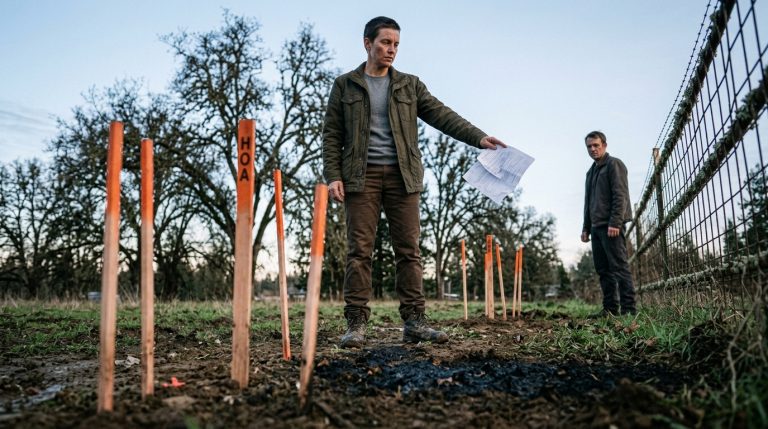
“To my event,” she said, as if I were a slow-witted child. “This is a charity gala. We cleared it with the HOA.”
She turned away before I could respond, already shouting instructions to the workers who were setting up speakers on the grass I had spent weeks cultivating. I looked at my driveway, at the heavy, honest stone beneath the cheap red fabric, and felt a strange, chilling realization: this wasn’t just a mistake. This was a complete displacement of my reality. And as the bass hammered into the frame of my home, I realized I didn’t know if the silence would ever return.
CHAPTER 2: The Frayed Edge of Patience
I stood on the porch, the screen door vibrating against my shoulder with a low, rhythmic thrum. My feet, bare against the painted wood, felt the tremor of the bass deep in the joists of the house. The woman didn’t wait for me to process her accusation. She had already spun back toward her “event,” her heels sinking slightly into the soft, rain-dampened earth near the hydrangeas. She moved with a strange, frantic energy—not the smooth grace of a professional, but the jagged haste of someone who felt they were being pursued.
“You’re making a mistake,” I said. My voice was steady, trained to project without shouting. It was a command tone, the kind that usually stopped a conversation dead in its tracks.
She didn’t stop. She reached into a cardboard box and pulled out a stack of flimsy, brightly colored flyers, holding them out to a teenager who was struggling to unfurl a banner nearby. The sun hit the glitter on her sash, casting jagged, cheap reflections onto the siding of my home. The light here was different today; it felt tired, washed out by the artificial glare of her setup.
“The permits are clearly displayed,” she called back, her voice tinged with a hysterical edge that didn’t quite reach her eyes. Those eyes, shielded by oversized, plastic lenses, kept darting toward the street, scanning the line of sight as if she were waiting for a ghost.
I took a step off the porch. The gravel crunched—a solid, grounding sound that felt like an anchor in the sudden sea of nonsense. I was looking at the setup now, really looking at it. There were no chairs for guests. There was no catering. There were only rows of empty folding chairs facing toward my garage, the banners draped haphazardly over my fence line, and that humming, sweating cotton candy machine. It was a stage set for an audience that wasn’t coming.
“Who told you this was allowed?” I asked, closing the distance. My intent wasn’t to argue the law—I knew the law—it was to see if there was a human being beneath the desperation.
Before she could answer, the roar of a delivery truck engine cut through the bass. A bright, unbranded white van pulled up to the curb, its brakes squealing. A man hopped out, slamming the door, and began unloading heavy crates of bottled water. He didn’t look at me. He didn’t look at her. He marched straight for the center of the driveway, dropping the crates with a heavy thud that rattled the base of the inflatable swan she had somehow managed to anchor.
“Delivery for the gala,” the man barked, his face a mask of bored indifference. He looked like he’d been doing this all day, moving from one fraudulent setup to the next.
The woman practically lunged for the crates, her hands shaking as she clawed at the plastic wrap. She wasn’t preparing for guests; she was hoarding. The movement was primal, a sudden, sharp lapse in her polished facade. She wasn’t just a nuisance; she was a woman trying to fortify a castle made of sand, using my property as her foundation.
The weight of it hit me then. This wasn’t malice, at least not the kind I was used to dealing with. This was the frantic, clumsy scramble of someone who had nowhere else to turn, someone who had convinced herself that if she just curated the right aesthetic, the world would finally stop trying to move her along.
“Ma’am,” I said, my voice softer now, though no less firm. The man from the van was already retreating, leaving her with the water and the rising anxiety of a mounting debt she couldn’t pay. I could see the sweat beading on her forehead, dampening the foundation of her makeup. The “glittery” sash looked frayed at the edges, the letters peeling away like dead skin.
She turned to face me, and for a split second, the sunglasses slipped. Her eyes weren’t the eyes of a scammer. They were the eyes of someone who had been running for a very long time, and had finally tripped over the threshold of a house that refused to budge.
“You don’t understand,” she whispered, the sharp edges of her earlier arrogance replaced by a hollow, tremulous pitch. “Everything depends on this. The zoning, the prestige… if the event doesn’t happen, they’ll take everything.”
“Who is ‘they’?” I asked.
But the question was too direct. The mask slammed back into place. She adjusted the sunglasses, took a deep, shivering breath, and pointed a manicured finger toward the street. “You’re being hostile. I have documentation. I’ll have the authorities remove you from your own driveway if you don’t step aside.”
The absurdity of it shouldn’t have been funny, but I felt a tight, hard knot of pity forming in my chest—a dangerous, unfamiliar feeling. I took a slow breath, letting the familiar scent of iron and dry, baked earth fill my lungs. I needed the documentation. I needed the paper trail. I turned away, not in retreat, but to head toward the one place where reality was still kept in folders: my home office. I was done asking questions. It was time to start building a case, not just for the law, but for the truth of why this woman was trying to bury her life in my front yard.
As I walked back toward the porch, I could hear her behind me, frantically shouting at the delivery driver to bring back more chairs, more ice, more shade. The sound of her desperation was beginning to drown out the bass, and I knew that by the time I opened those files, the real work—the work of dismantling a life built on ghosts—would have only just begun.
CHAPTER 3: The Architecture of Deception
The transition from the blinding exterior light to the dim, climate-controlled silence of my home office felt like descending into a tomb. I didn’t lock the door—locking it would have been a concession, an admission that I was afraid of the woman currently shouting on my lawn. Instead, I left the door cracked just enough to hear the occasional vibration of the generator and the muffled, frantic cadence of her voice.
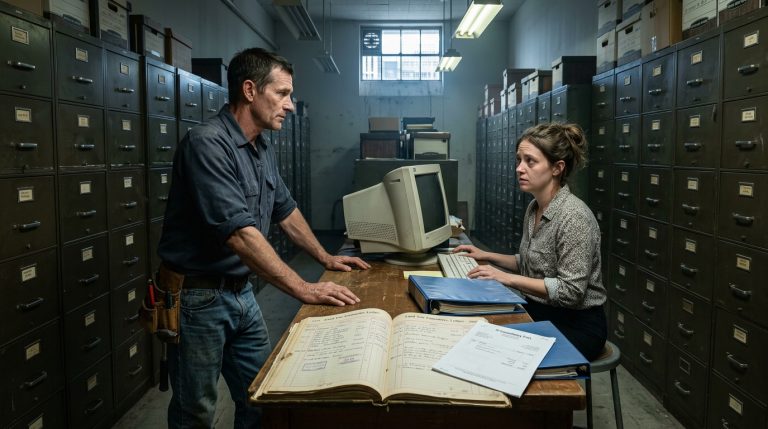
My desk was a sanctuary of order. In a life that had often felt like a series of uncontrolled variables, these drawers held the only constants: survey maps, property tax assessments, and the original deed, signed and sealed. I slid the top drawer open, the wood gliding on polished runners, and pulled out the file labeled ‘Property Maintenance.’
The smell of old paper—vanilla, dust, and the faint, dry scent of ink—filled the room, a sharp antithesis to the synthetic, burnt-sugar stench of the cotton candy machine outside. I spread the documents across the mahogany surface. I didn’t need to read them; I knew the boundaries of my land by heart. I knew every foot of gravel, every inch of topsoil.
I began to sift through the papers, looking for a template, a standardized form, or anything that might explain the ‘permit’ she had brandished like a weapon. My fingers paused on a stack of incident reports from a previous dispute with a utility company. I pulled out a blank form I had kept as a reference, then compared it to a photocopy I’d made earlier from the woman’s own papers, which she had carelessly dropped in the gravel when the delivery van arrived.
The discrepancy wasn’t large, but to an eye trained by years of military oversight, it was a siren. The seal on her document was a slightly different shade of blue, and the typeface—a modern, clean sans-serif—clashed with the official, dated architectural font used by the city. It wasn’t just a forgery; it was a cheap imitation, printed on equipment that hadn’t been calibrated for government standards.
I leaned back, the leather of my chair creaking. The silence of the house seemed to press against my ears, magnifying the tension. If she were a professional grifter, she would have mastered the details. This was the work of someone acting out a role they didn’t understand, a performance where the script was crumbling in real-time.
My gaze shifted to the monitor on my desk—my security system. I tapped a key, and the screen blinked to life, displaying a grid of camera feeds. I isolated the driveway. The footage was crisp, high-definition. I watched her. She was currently standing by the inflatable swan, her shoulders hunched, her hands buried in the pockets of her jacket. She wasn’t directing anyone anymore. She was just… standing.
There was a profound, aching vulnerability in her posture that made my stomach tighten. It was the same way I had seen soldiers stand after a mission had gone sideways, when the adrenaline finally bottomed out and they realized there was nowhere left to run.
I picked up the landline. I didn’t reach for my phone; there was something about the weight of the handset, the tether to the wall, that felt necessary. I dialed the number for Nate at County Code Enforcement. As the phone rang, I kept my eyes on the screen. She had walked to the edge of the property line, right where the gravel met the pavement, and she was looking down the street—not at the neighborhood, but at the horizon, as if she were expecting something to arrive and save her.
“Nate,” I said, when the line clicked open. “It’s Marshall. We have a situation. And I think it’s bigger than a simple zoning issue.”
I didn’t wait for his response. I walked to the window, peering through the gap in the blinds. The afternoon light was shifting, casting long, bruised shadows across the lawn. The red carpet, once a vibrant, aggressive crimson, now looked muted, dusty, and lonely.
I realized then that I wasn’t just defending my driveway. I was observing the slow-motion collision of two different worlds: my world of rigid, documented reality, and her world of frantic, manufactured hope. I had built my life on the idea that if you maintain your boundaries, you stay safe. But standing there, watching her tremble in the breeze, I felt a familiar, sharp pang of recognition.
I remembered a time, long ago, when I had been the one trying to build something out of nothing, when I had thought that if I just did everything correctly—if I followed the rules and kept my head down—the walls would never fall. But they always fell.
The weight of that memory, a ghost I had spent years burying, moved through the room like a cold draft. I looked at the forged permit in my hand, then out at the lawn. My boundaries weren’t just protecting me from her. They were keeping me from seeing what she was truly running from. And as the phone line hummed with Nate’s voice, I knew that the investigation I was about to start wouldn’t just expose her deception—it would, inevitably, force me to open the door to the things I had spent so long trying to keep out.
CHAPTER 4: The Tipping Point
Nate didn’t speak for a long moment. Through the earpiece, I could hear the faint, hollow static of his patrol car radio and the steady, rhythmic clicking of a turn signal. When he finally answered, his voice had lost its earlier, casual curiosity. It was hardened by the specific, weary pragmatism of a man who dealt with the erosion of social order every day.
“Marshall,” Nate said, his tone low. “I’m looking at the city’s master permit registry right now. There isn’t a single event listed for your street. Not for this weekend, not for this month. And that name—’Derek W.’—it’s been popping up on a series of reports from the next county over. Fraudulent vendor registrations, bounced checks, unlicensed staging. If that woman is using his name, she’s not just a neighbor with a bad sense of boundaries. She’s part of a loop.”
I watched the screen. On the live feed, the woman—the one I had decided to call Karen—was pacing the red carpet. She looked like a trapped animal, her movements jagged and uncoordinated. She stopped at the edge of my lawn and began frantically rearranging the folding chairs, her face flushed, her hands trembling so violently that one of the metal legs clattered against the pavement.
“She’s unraveling, Nate,” I said, my voice barely above a whisper. “But she’s dangerous because she’s desperate. She’s not just here for a party. She’s trying to hold onto something that’s already gone.”
“I’m ten minutes out,” Nate replied. “Stay inside. Don’t engage. If she’s part of the ‘Derek’ loop, she’s liable to do something erratic when the pressure hits. Don’t give her the conflict she’s looking for.”
I hung up the phone and looked out the window. The memory surfaced unbidden—a flashback to a field operation in the service, the sight of a panicked civilian trying to rebuild a demolished storefront with nothing but pieces of scrap wood and sheer, blinding denial. It was the same look. That same, terrifying certainty that if you just kept working, just kept the appearance of normalcy, the tragedy wouldn’t be real.
I felt a sharp, metallic taste of bitterness. My desire to stay detached, to remain the “sovereign protector” of my own quiet plot of land, began to chafe against the reality of what was happening on my lawn. I had spent years meticulously curating this life to avoid the chaos of the world, but in doing so, I had forgotten that the world doesn’t care about the integrity of your property lines. It leaks. It floods.
I stepped out of the office and onto the front porch. I didn’t mean to go back outside, but the sound of her voice had changed. It wasn’t the sharp, demanding tone of a customer anymore; it was a high, thin wail of genuine terror.
She was on the ground now, trying to gather the scattered flyers that a sudden gust of wind had whipped across the grass. The red carpet was curling at the corners, revealing the grit of my driveway underneath. She looked small—unbearably small—against the backdrop of my house.
“Stop,” I called out, my voice cutting through the hum of the generator.
She froze, clutching a handful of damp paper to her chest. She looked up at me, her eyes wide and rimmed with red. The oversized sunglasses were gone, revealing the exhaustion etched into her skin like deep fissures in parched earth.
“They’re coming,” she said, her voice hollow. It wasn’t a threat; it was a surrender. “They told me if I could just show them the location, if I could just prove the community wanted it, they would stop the foreclosure. They said this neighborhood was a ‘prime asset.'”
The air on the porch suddenly felt thin. The deception wasn’t just a scam to steal electricity; it was an attempt to inflate the property value of a dying dream, a desperate leverage play against a bank that didn’t even know she existed. She was trying to sell my house to save her own.
“Who told you that, Karen?” I asked, using her name not as an insult, but as a recognition of her personhood.
She didn’t answer. She stood up, her legs shaking, and looked at the house as if seeing it for the first time—not as a venue, but as a home that had been invaded. The realization seemed to hit her with the force of a physical blow. She began to back away toward the street, her eyes fixed on the front door, the place where I lived, where I existed, where I had built my walls.
“I’m sorry,” she whispered, a broken sound that barely made it over the wind.
Before I could reach her, before I could offer the smallest shred of grace, the screech of tires announced Nate’s arrival. A patrol car pulled onto the apron of the driveway, the lights silent but the presence absolute. The spell was broken. The “gala” was no longer a stage; it was a crime scene.
As Nate stepped out of the car, I felt the familiar, cold shift in my own demeanor. The pity was there, but the protector in me—the part that demanded order—had taken the wheel. I stood on the porch, a silent observer of the inevitable collision, knowing that while this battle for my driveway was reaching its peak, the real, much more painful confrontation was only just beginning to surface in the silence between us.
CHAPTER 5: The Weight of the Aftermath
Nate stepped out of the cruiser, his boots crunching rhythmically on the gravel. He didn’t rush. There was no need. The woman, Karen, had stopped moving. She stood motionless near the curb, her shoulders slumped, the vibrant red carpet now just a discarded, dirt-streaked strip of fabric. The inflatable swan, partially deflated, listed to the side in the cooling breeze, its synthetic neck bent at a sorrowful angle.
I walked down the steps of the porch. The air felt heavy, saturated with the quiet that only follows a prolonged, high-pitched struggle. Nate moved with a practiced, somber efficiency, his hand hovering near his belt—not as a threat, but as a habit. He didn’t approach her with the hostility she might have expected; he approached her with the weary resignation of an officer who had seen this exact scene play out in a hundred different variations across the county.
“Ma’am,” Nate said, his voice level. “I’m Officer Nate. I think you know why we’re here.”
She didn’t look at him. Her gaze was fixed on the space between her feet, where a single, discarded flyer—the one for her imaginary gala—was being worried by the wind. She looked smaller than she had even moments ago, as if the air were literally being squeezed out of her persona. “It was just… it was supposed to be perfect,” she murmured, her voice stripped of its earlier, frantic modulation. It was flat, hollow.
I stopped a few feet away, close enough to intervene if things turned volatile, but far enough to maintain the space I had fought so hard to protect. I looked at her, and the judgment I had carried in my throat since that first morning felt suddenly, inexplicably heavy. I had wanted order. I had wanted the disruption to be erased, to have my driveway returned to its quiet, predictable state. But seeing her now, standing amidst the ruins of her staging, I didn’t feel the triumph of a protected boundary. I felt the hollow echo of my own insulation.
“The permits, please,” Nate prompted, his voice gentle but firm.
She reached into her oversized bag and pulled out the stack of forged documents. As she held them out, a gust of wind caught the top sheet, tearing it from her grip. It fluttered across the driveway, landing face-up at my feet. I looked down at the fake city logo, the skewed font, the desperate attempt to mimic authority.
I knelt and picked it up. My fingers touched the paper, the texture rougher and cheaper than any document I kept in my office. As I held it, a sudden, piercing realization hit me: this was exactly how I had treated my own life. I had spent years building a paper trail of ‘proper conduct,’ a set of boundaries meant to mimic a life, while underneath, I was just as empty, just as terrified of being exposed as a fraud in my own skin.
“Marshall?” Nate called out, sensing my hesitation.
I looked up. The woman was watching me. For the first time, our eyes met, and there was no antagonism there—only a mirror. She knew. In that shared, silent moment, the veneer of our roles—the wronged homeowner and the desperate grifter—shattered. She had tried to project an image of success to survive; I had tried to project an image of impregnability to hide the fact that I had failed to protect the one thing that actually mattered, years ago.
“The documentation is illegitimate, Nate,” I said, my voice sounding foreign to my own ears. I handed the paper back to him. I didn’t look at the woman again. I couldn’t.
Nate took the documents, his expression unreadable. He began the process—the recitation of rights, the slow, clinical motion of hands behind the back. It was a rhythmic, mechanical dance, devoid of any real humanity. I watched, my arms folded across my chest, as he guided her toward the rear of the cruiser. She didn’t fight. She didn’t call for a lawyer. She walked with the leaden steps of someone who had finally stopped running.
The driveway was quiet again. The bass, the shouting, the manic energy of the morning—all of it had been replaced by the steady, low-frequency hum of the patrol car’s engine. I watched them pull away, the red lights casting fleeting, rhythmic pulses of color against the side of my house.
I stood there for a long time, listening to the silence. It wasn’t the peaceful quiet I had craved; it was a cold, sterile void. I looked down at the gravel driveway—my gravel, my land, my property. It felt strangely unfamiliar now, as if the disruption had not just scuffed the surface, but reached deep into the soil. I had won. The intrusion was over. But as I turned to walk back toward the house, I realized that the boundaries I had spent years constructing were just as fragile, and perhaps just as fraudulent, as the ones she had tried to build.
CHAPTER 6: The Quiet After the Storm
The morning air smelled of wet gravel and the faint, sweet decay of a crushed hydrangea. I stood on the porch, my hands resting on the railing, and watched the sunrise paint the neighborhood in soft, muted tones of gold and gray. The driveway, which only days ago had been a stage for a chaotic, artificial performance, was back to its raw, unvarnished state. The red carpet, the balloon arch, and the inflatable swan were gone, leaving only faint, ghost-like indentations in the crushed stone where they had been anchored.
I looked at the house. It stood solid, weathered, and honest. The damage to the garden was minor, a few snapped stems and trampled soil, but the psychological breach felt much wider. I reached into my pocket and felt the cool, smooth edges of the metal sign I had spent the last few hours painting. It was heavy—a simple, pragmatic warning meant to deter the chaos that had nearly consumed my life.
“Respect boundaries,” I whispered the words to the stillness. They felt less like a threat now and more like a prayer.
I walked down the steps, the gravel shifting under my feet with a familiar, grounding crunch. My progress was slow, deliberate. I had spent the last few weeks in a state of high-alert, a ‘sovereign protector’ locked in a battle for my territory, but in the wake of Karen’s arrest, the armor I had donned was beginning to feel unbearably heavy. I remembered the look in her eyes as Nate had led her away—the mirror she had held up to my own isolation.
I reached the end of the driveway, where I had cleared a patch of dirt next to the street. I hammered the post into the ground, the rhythmic thud of the mallet echoing through the quiet cul-de-sac. Each strike felt like a closing of a chapter, a way to anchor my reality against the drifting currents of the world. But as I finished, I didn’t feel the surge of pride I had expected. Instead, I felt a quiet, hollow sadness.
My neighbor, Mr. Henderson, stepped out onto his porch across the street. He hesitated, then walked over, his slippers shuffling softly on the asphalt. He looked at the sign, then at me. “Hard work,” he said, his voice raspy from disuse. “That woman… she was a piece of work, wasn’t she?”
I looked at him. I could have agreed—I could have played the part of the victor, the man who had defended his home and won. But the memory of the forge, of the desperation in her movements, stayed with me. “She was just trying to stay afloat,” I said, the words surprising me. “She was running from a collapse she didn’t know how to stop.”
Henderson nodded slowly, a sympathetic crinkle forming around his eyes. “We’re all just trying to keep our balance, Marshall. Some of us just lose our footing a little more publicly than others.”
We stood there for a long time in the morning sun, two men on the edge of a property line, sharing the kind of silence that only comes after the storm has passed. I realized then that the boundaries I had built weren’t meant to be walls that shut the world out—they were meant to be the space where I could finally invite the world in, on my own terms.
I turned back to the house. I had work to do. The garden needed tending, the screen door needed its hinges oiled, and I needed to spend time in the rooms I had been avoiding—the rooms that held the memories of the people I had failed to save, the people whose absence had driven me to build these walls in the first place.
I walked back to the porch and sat down on the step, my body settling into the wood with a sigh. I thought about the bakery down the street, and the cupcake they had named after the disaster. I smiled—a genuine, small thing—and felt the weight in my chest begin to lift, just a fraction.
The driveway was mine. The quiet was mine. But for the first time in years, the house behind me didn’t feel like a fortress. It felt like a foundation. I looked up at the sky, the clouds beginning to disperse, revealing a wide, clear blue. There would be more challenges, more people like Karen who would test the strength of the lines I had drawn, but I knew now that I could handle them without losing the stillness of my own heart. I took a deep breath, the air clean and cold, and began to plan my next task. The work of healing—the real work—was only just beginning.