The Quiet Boundary: A Hard-Earned Peace Built on the Foundation of Indisputable Paperwork and Iron Will
CHAPTER 1: The First Mark
The sun had barely scraped the horizon when the machinery started. I didn’t reach for my phone; I reached for the digital recorder on the nightstand, my thumb hitting the button with practiced muscle memory. The foreman was already out there, a man in a neon-yellow vest standing over the smooth, black surface of my driveway. He held a stencil, his boots scuffing the pavement as he positioned it.
I stepped onto the porch. The air was cool, biting at my bare skin, but the heat in my chest was colder, sharper.
“Ma’am, you said the owner approved,” the foreman called out to someone behind him.
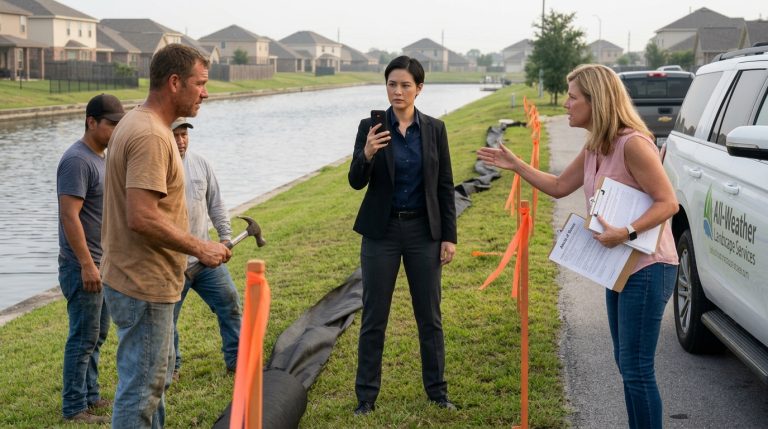
I walked down the steps, my boots making no sound on the gravel. Karen Dubois stood near the tree line, her posture stiff, a clipboard clutched to her chest like a shield. She didn’t flinch when she saw me. She simply adjusted her grip and held my gaze, her expression an rehearsed mask of professional concern.
“County mandated emergency marking,” she said, her voice steady, pitching for the recorder I was holding. “Please don’t interfere with the crew, it’s for public safety.”
I kept the camera steady, pointing it not at her, but at the wet white paint blooming onto my asphalt. “What’s the permit number, Karen?”
Her smile didn’t reach her eyes; it only tightened, a hairline fracture in her composure. “It’s in process. The board has authorized this under the safety directive. Keep going,” she commanded the foreman, not breaking her stare.
I didn’t argue. I didn’t raise my voice. I turned and let out a low, two-note whistle. Behind me, the shadow in the doorway detached itself from the gloom. Ranger moved with the fluidity of a wolf, his harness camera blinking a soft, rhythmic red. He didn’t rush. He walked to the boundary stake I’d pounded into the earth weeks ago, sat, and turned his focus toward the crew.
He was the anchor. I was the ledger.
The foreman hesitated, his hand hovering over the nozzle, his eyes flickering between the encroaching stencil and the dog that sat with absolute, unyielding stillness. The silence stretched, heavy with the weight of pending trespassing charges. Karen’s smile faltered for the first time, a nervous tic jumping at the corner of her mouth. She hadn’t expected the dog to be part of the documentation. She hadn’t expected me to be this quiet.
“I told you he was difficult,” she snapped at the foreman, her voice rising, losing its curated edge. “Keep going.”
I zoomed in on the stencil—the sharp, artificial lines of the ‘Fire Access’ text—then shifted the frame to the contractor’s logo on the back of the foreman’s vest. Every motion was calculated. Every second of the intrusion was being captured, stamped, and logged into a file that was already thick enough to sink her.
I felt the sudden, irrational urge to step forward and stop the paint, to grab the nozzle and drag it away, but I locked that impulse down. To engage was to give her the drama she craved. To record was to give her the rope she needed.
I took a slow breath, tasting the chemical sting of the paint, and waited. The foreman reached for the trigger again, but he kept his eyes on the dog. I knew then that the foundation of her empire wasn’t concrete; it was painted plastic, and it was already starting to peel.
CHAPTER 2: The Paper Trail
The foreman pulled his hand back from the spray nozzle, his eyes darting to the foreman’s truck idling near the road. The crew didn’t leave, but they stopped painting. Karen stood firm, her fingers drumming a nervous, erratic rhythm against the hard plastic of her clipboard. She was waiting for me to react, to shout, to lunge—to give her the ‘hostile adjacent owner’ narrative she had already pre-sold to the board.
I gave her nothing but silence. I turned and walked back toward the house, Ranger pacing at my heel like a metronome. I could feel Karen’s gaze tracking us, a prickling sensation against my neck, a phantom touch that made me want to scrub my skin raw. It was the same feeling I got when I found something out of place in my garage—a tool moved an inch, a seal on a box broken. It was the mark of someone who didn’t just want access; they wanted to colonize.
Inside the quiet of my home, the atmosphere shifted. The sunlight filtering through the windows caught dust motes, turning them into floating debris over my desk. I didn’t reach for a coffee; I reached for the thick, black binder labeled “Parcel Integrity.”
I pulled my laptop forward. The digital recorder went on the desk, the audio file already converting to a timestamped waveform. I started the process. The forensic nature of it was grounding. I didn’t need to be right in the eyes of the neighborhood; I needed to be bulletproof in the eyes of the county.
I navigated to the local government’s GIS portal. My parcel map was there, a simple, unadorned polygon of land defined by precise survey coordinates. I compared it to the ‘Emergency Access’ flyer Karen had handed out—the one with the red line crudely drawn across my shoulder. When I overlaid the two images, the discrepancy wasn’t just a mistake; it was a fabrication. The red line encroached five feet into my private property, cutting across the corner of my deeded footprint. It wasn’t an access lane; it was a land grab.
My internal monologue shifted into a cold, mechanical cadence. The enemy is using the appearance of authority to generate the reality of authority.
I opened the email client. I didn’t draft a response to Karen. I drafted a formal request for information to the County Permits Office, citing the specific date and the observed activity. I attached the screenshots of the crew, the photo of the stencil, and a PDF copy of my deed. Every sentence was stripped of emotion, stripped of frustration. It was a statement of fact, intended for an audience of regulators who didn’t care about neighborhood drama—only about compliance.
But.
The thought nagged at me. Why this specific route? My driveway wasn’t the only one in the vicinity. I pulled up the aerial topography. My driveway connected to the primary ridge road, but it also cut through a natural depression in the terrain—a perfect spot for a drainage culvert or a utility easement that the HOA might be eyeing for their upcoming project.
I felt a sudden, sharp ache in my temple—the V-2 phantom. I remembered a conversation I’d overheard months ago at the mailbox cluster, someone mentioning a “redesign of the infrastructure” for the Whispering Pines perimeter. Karen wasn’t just obsessed with controlling my driveway; she was building a map of leverage. If she could establish an ’emergency easement’ on my land now, she could claim that same footprint for the utility lines later, bypassing the need for a costly private survey or a purchase agreement.
I stood up and walked to the window. The crew was still there, sitting in their truck, smoking. They weren’t leaving. They were waiting for Karen to decide if she wanted to press the issue or regroup.
I picked up the phone. I didn’t call the police again. I dialed a records search firm, one that specialized in old, dusty filings—the kind of obscure municipal records that rarely made it to a digital portal. I needed to know who owned the mineral rights and the original drainage access for this parcel back to the 1970s.
If they wanted a paper trail, I would give them a labyrinth.
I sat back down, the silence of the room pressing in, thick and heavy. The air felt stagnant, the scent of the wet paint still clinging to my clothes. I started the second email, this one to the county recorder’s office, requesting every easement filing ever associated with the parcel numbers surrounding Whispering Pines.
I was no longer just defending a driveway. I was preparing to dismantle the entire foundation of their local empire. The work was slow, methodical, and exhausting, but for every document I filed, the ground beneath my feet felt a little more solid. I didn’t look at the clock. There was no time, only the next receipt, the next email, the next layer of evidence.
Ranger let out a soft huff, resting his chin on my boot. He knew the drill. The quiet was earned, but it wasn’t free. I had to pay for it with every hour of research, with every perfectly punctuated demand for documentation. The driveway was my property, but the truth was my weapon, and I was just beginning to sharpen the blade.
CHAPTER 3: The Proxy
I didn’t answer the door immediately. I watched the live feed on my monitor first. It was the same property manager from the association—the one with the stiff collar and the nervous, flickering eyes. He was standing on my porch, his posture too rehearsed, his smile already pinned to his face before the storm door had even clicked open. He held a clipboard against his chest, the edges of the papers crisp and white.
I turned the porch light off, plunging the space into the gray, washed-out light of the overcast afternoon, and then I stepped out. I kept the storm door between us, the metal frame a physical barrier that felt like a line drawn in the dirt.
“We just need your signature, sir,” he started, his voice pitched to sound conciliatory, the practiced tone of a man who dealt in small favors and larger lies. “It’s just an acknowledgment. Standard procedure for the emergency access lane updates. It protects everyone.”
I didn’t reach for the pen he held out. I looked at the form. It was a slick, multi-part document with a thick, bold header that read: Owner Agreement to Shared Access Corridor.
“Show me the easement,” I said. My voice was low, devoid of the annoyance he was likely expecting. I wasn’t playing the role of the angry neighbor; I was playing the role of the obstructionist—the one who refused to be moved by social pressure.
The manager’s smile twitched, just once, a tiny misalignment of his features. “It’s a board-approved safety measure, sir. The association has the authority to ensure responder access. This is just to streamline the process so we don’t have to go through the county for every individual drive.”
“If you have the authority,” I countered, leaning slightly against the inner doorframe, “you don’t need my signature. If you need my signature, you don’t have the authority.”
He shifted his weight, the gravel crunching under his shoes. He was starting to sweat despite the chill in the air. “I’m just the messenger. If you don’t sign, the board is going to have to escalate this to their legal counsel. It’s just paperwork, sir. Don’t make it harder than it needs to be.”
“Then deliver this,” I said, my hand closing around the edge of the storm door. “Stop trying to buy consent with paperwork. Leave.”
I didn’t wait for him to finish his rebuttal. I stepped back and let the storm door click shut. Through the glass, I watched him stand there for three full seconds, his face darkening with a sudden, unprofessional flash of irritation, before he turned and stomped down the porch steps.
I didn’t move until his vehicle was at the end of the driveway, the dust settling back onto the gravel. Only then did I pull the harness-mounted camera off the porch hook where I’d left it running. I walked back to the office and sat down, my heartbeat steady, the adrenaline of the encounter dissipating into the familiar, cold clarity of the work ahead.
I imported the footage. I grabbed a still of the form he had offered—the ‘Owner Agreement.’ I zoomed in on the fine print at the bottom. It wasn’t a standard association form; it was a customized, one-page document. I compared it against a template I’d pulled from the county’s public filings for other, legitimate easements.
The differences were subtle but damning. The formatting was slightly off, the font kerning inconsistent. It was a document designed to look legal to a layman but disintegrate under the scrutiny of a judge.
I spent the next three hours mapping the connections. I traced the property manager’s company, a shell firm registered in a different county, with a history of ‘consulting’ for HOAs that suddenly found themselves needing ‘infrastructure upgrades.’ The breadcrumbs were all there, leading back to a singular nexus of influence: Karen Dubois.
She wasn’t just the board president; she was the architect. She was leveraging these contractors to perform work that didn’t exist under legal permits, charging the HOA for ‘consulting fees’ that likely filtered back through these shell companies. The driveway was just the testing ground, the point of least resistance she had hoped would collapse under the weight of her performance.
I felt a tightening in my chest, a physical manifestation of the realization. This wasn’t about safety. It was about the profit motive hidden behind the mask of community welfare. The safety narrative was the shield, and the falsified documents were the sword.
I reached out to the retired nurse who had sent me the email thread days earlier. I sent a short, coded message—a request for any previous ‘safety’ requests she had received. Ten minutes later, she sent back a document from six months ago. It was a request for a ‘safety fence’ around her garden, accompanied by a nearly identical ‘Owner Agreement’ form, drafted by the same shell company.
I printed both documents, side by side, and highlighted the discrepancies in red. The same ‘board approval’ clause, the same vague, threatening language about ‘liability exposure.’
The sun began to dip below the ridge, casting long, bruised shadows across my desk. I leaned back, my eyes gritty from hours of staring at the screen. The room felt smaller, the silence deeper. I had the connection now. I had the proof of a recurring pattern of coercion. I wasn’t just waiting for the next move; I was anticipating it.
I saved the files in three separate locations: the local drive, an encrypted cloud partition, and a physical flash drive hidden inside the hollow of my desk leg. I had learned the hard way that when someone like Karen wants to control your environment, they don’t stop at the property line. They try to wipe the slate clean.
I walked to the kitchen and made a quick meal, eating it standing up, my eyes constantly flicking toward the window that overlooked the driveway. The driveway was empty, the white stencil marks stark and mocking in the fading light. They were still there, a smear of unauthorized paint on my soul. But I knew exactly how to wash them away.
The phone buzzed. An email from the county recorder’s office: Records request processed.
I didn’t open it yet. I wanted to sit with the knowledge that the trap was set. They thought I was the victim, the ‘difficult neighbor’ they could steamroll into compliance. They didn’t realize that in this standoff, the only person who was actually in danger was the one who was trying to play god with a property map.
I was the anchor, and the storm was coming. I was ready.
CHAPTER 4: The False Path
My finger hovered over the ‘send’ key, the cursor blinking with an aggressive, rhythmic pulse. The PDF on the screen was the final piece of the architecture. I had compared the metadata of the ‘revised’ plat map—the one the contractor’s foreman had blindly forwarded—against the original county records. The ‘kuba’ tag wasn’t a county surveyor’s code; it was a username, one I’d cross-referenced through a public domain search tied to the HOA’s management software. It was Karen’s personal login.
She hadn’t just requested the change. She had engineered the document herself, forging the county seal and the professional surveyor’s stamp, and then transmitted it as ‘official’ correspondence. It was a felony, plain and simple, but in the gray, rusted world of HOA politics, a felony was just another tool in the box.
I hit ‘send’. The confirmation beep was painfully loud in the empty room.
I didn’t wait for the reply. I went to the window, watching the street. The orange cones were still there, huddled on the shoulder of my driveway like plastic sentinels of a regime that was already rotting from the inside out. I felt the weight of the last few days settling into my joints—a heavy, grinding fatigue that made every movement feel like wading through deep, dry sand.
Ranger nudged my hand with his cold, wet nose. He knew the shifts in the air, the way the atmosphere grew charged when I was preparing for a move. I knelt down and brushed his fur, the texture of the coarse, protective hair grounding me.
“Not yet,” I whispered, though there was no one else to hear.
The phone rang. It was the contractor’s foreman. I answered on speaker, my voice kept strictly neutral.
“I got your message,” the foreman said, his tone strained, lacking the breezy confidence he’d shown the day he painted the stencil. “I opened the file you sent. Are you saying this plat isn’t official?”
“It’s not,” I said, watching a squirrel dart across the driveway, pausing right on the wet white paint before scrambling up an oak. “Check the metadata, if you know how. It was created on a personal terminal, not by the county surveyor’s office. You’ve been working off a forgery, and you’ve been doing it under the authorization of someone who doesn’t have the authority to grant it.”
There was a long silence on the other end, just the faint, tinny sound of wind rushing past his microphone. “I’m a contractor, not a lawyer. I just follow the work orders. If this is a forgery, I’m out. I’m not touching that drive again until I have a signed letter from the county.”
“Do that,” I said, “and keep every email she sent you. You’re going to need them when the inspector calls.”
I hung up. I had successfully severed the arm of the machine. Without the contractor, Karen was just a woman with a clipboard and a dream of jurisdiction she didn’t possess. But I knew her—I had spent enough time watching her maneuvers to know that she wouldn’t retreat quietly. She was a mirror, a reflection of the control I possessed, just warped by a desperate, driving need to dominate the space around her.
I sat back in my chair, the screen reflecting in my eyes. I felt a sudden, sharp tremor of anxiety, the V-3 variance—an unexpected surge of doubt. What if I was wrong? What if there was some bizarre, arcane local statute I’d missed? I forced myself to walk away from the desk, moving to the kitchen. I needed to move, to act. I grabbed a rag and a bottle of mineral spirits from the garage.
I walked out to the edge of the driveway. The sun was setting, the sky a bruised purple that mirrored the growing tension in the air. I knelt by the stencil. The white paint was thick, a stubborn, artificial layer over my dark asphalt. I began to scrub, the mineral spirits eating into the paint, the smell sharp and chemical in the cool evening air.
I didn’t try to wipe it all away yet—that was for the final reckoning—but I rubbed a clean, raw hole right through the middle of the word ‘FIRE’.
It was a small act of defiance, a visual scarring of her ‘official’ plan. I looked down the road toward the Whispering Pines entrance. A car was parked there, idling. A silhouette moved behind the windshield. Karen was watching. She had to be. She was waiting for me to break, to step out into the road and start shouting, to give her that one, final piece of evidence she needed to paint me as the dangerous, unstable neighbor.
I ignored her. I stood up, wiped the rag on my jeans, and walked back inside, leaving the scarred stencil as a silent, ugly reminder of the lie.
I went back to the office and opened the email from my attorney. It was short. We have sufficient evidence to file for a Temporary Restraining Order. I’m submitting it to the district court in the morning. Stay silent, stay documented, and do not communicate with her directly.
I closed the laptop. The room went dark, the only light coming from the streetlamp outside reflecting off the driveway. I had reached the pivot point. The decoy had been stripped away, and the core of the conflict was now laid bare. She was cornered, and the cornered, as I knew well, were the most dangerous.
The weight of the coming confrontation felt like a physical pressure against my chest. This wasn’t going to end with a polite apology. It was going to end with a dismantling. And I was the one who had to hold the hammer.
CHAPTER 5: The Final Hearing
The morning air was brittle, the kind of cold that seemed to settle into the marrow of your bones. I stood on my porch, Ranger sitting perfectly still beside me, his gaze fixed on the entrance of the driveway. The county inspector’s sedan pulled in first, kicking up a light spray of gravel that rattled against the undercarriage. Behind him came the Deputy’s cruiser, its light bar dark but imposing.
And then, bringing up the rear, the familiar silver SUV belonging to Karen Dubois. Two of her board members sat in the back, their faces pale, their eyes darting toward my house as if expecting a trap.
I didn’t wait for them to exit their vehicles. I walked down the steps, the gravel crunching under my boots—a sound that felt like a gavel striking a block.
Karen stepped out of her SUV first, her clipboard already in hand, her posture stiff and practiced. She looked at the inspector, then at the Deputy, then finally at me. Her smile was gone, replaced by a tight, thin line of forced composure. “We are here to resolve this, once and for all,” she announced, her voice pitched for the official record, loud and clear. “The corridor is a public safety necessity, and we have the board resolution to prove it.”
She moved toward the inspector, extending a document with a flourish. “This authorizes the work,” she said.
The inspector didn’t take it. He stood on the edge of my driveway, looking down at the scarred asphalt—the raw, scraped hole I’d carved into the stencil. He glanced at the Deputy, who was already walking toward me, his hand resting casually near his utility belt.
“Report is on file,” the Deputy said, his voice clipped and professional.
I didn’t speak. I simply stepped aside, leaving the center of the driveway clear, and laid three items on the tailgate of my truck. The first was the printout of the county’s official email—the one that stated no permits existed. The second was the recorder’s notification—the one that confirmed no easement existed. The third was the high-resolution still of the metadata evidence, the one tagged with Karen’s own login.
The inspector walked over, his eyes scanning the documents. He picked them up, his gloved fingers moving slowly, methodically.
Karen stepped forward, her voice rising. “That’s not the complete file! The board resolution holds legal weight!”
The inspector looked up at her. His expression wasn’t angry; it was worse. It was entirely unimpressed. “Ma’am,” he said, his voice flat, “a board resolution does not override a county parcel map. It does not create an easement. And it certainly does not authorize the alteration of private property.”
He held up the metadata printout, the one showing the forged file. “Where did this come from?”
Karen hesitated. The board members in the back of the SUV had gone deathly still, one of them already reaching for the door handle, looking to distance himself from the vicinity. The air around the driveway seemed to drain of oxygen, the silence becoming suffocating, heavy with the weight of her unraveling narrative.
“It was a clerical suggestion,” she began, her voice losing its edge, the rehearsed authority fracturing. “We were trying to facilitate safety…”
“You were trying to fabricate a legal right where none exists,” the inspector cut her off. He turned to the Deputy. “The work on this driveway is officially halted. Permanently. The stop-work order is non-negotiable.”
He walked over to the cone I had been documenting for days and slapped a bright, laminated red ‘Stop Work’ order directly over the ‘Fire Access’ stencil. The adhesive crunched as it hit the asphalt.
“Restore the shoulder,” the inspector ordered, his voice echoing in the crisp morning air. “Remove all markings from this pavement. Submit proof of restoration to the county office by end of business tomorrow. If you return here without a permit and the owner’s written, notarized consent, you are inviting immediate enforcement and maximum civil penalties. Do you understand?”
Karen stood frozen, her clipboard slipping from her fingers and clattering onto the gravel. She looked at me then, really looked at me, and for the first time, I saw the truth behind the mask. It wasn’t malice; it was an all-consuming fear—the terror of a woman who had built her entire identity on the illusion of control and had just watched the floor fall out from under her.
“Do you understand?” the inspector repeated.
Karen nodded, a sharp, jerky movement. She didn’t look at the board members. She didn’t look at the Deputy. She stared at the red stop-work order as if it were a brand.
I didn’t gloat. I didn’t say a word. I just watched as the board member in the back seat climbed out, his face turned away, his gait hurried as he walked toward the inspector, already trying to frame himself as a bystander.
The battle wasn’t just won; it was being erased. The paperwork I had spent weeks filing, the emails I had saved, the hours of quiet, methodical observation—it had all converged on this one, quiet moment on my driveway. The rust was falling away, revealing the solid, immovable ground beneath.
The Deputy tipped his hat to me, a gesture of silent acknowledgment. “Report is on file,” he repeated, then turned back to his cruiser.
As they began to pull away, one by one, the sound of the tires on the gravel seemed muted, like the sound of a closing door. I stood there, Ranger at my side, and watched the taillights disappear around the bend.
The driveway was mine again. The stencil was effectively dead. And the silence—the deep, heavy, beautiful silence—was the only thing left.
CHAPTER 6: The Quietude
The restoration was a physical labor, a rhythmic, grinding process that demanded a final accounting of the conflict. By the next morning, the contractor’s crew—now sobered by the threat of county-level enforcement—returned with industrial strippers and heavy-duty sanders. I stood on the porch, a silent observer, watching as they worked the white paint from the asphalt. Each pass of the machine sent a plume of fine, white dust into the crisp morning air, settling on the grass like a ghost of the battle I had just finished.
I didn’t take my eyes off them. I had the harness camera active, the red light a steady, reassuring pulse, but it was just a formality now. The war was over; this was just the cleanup. The foreman, a man who had previously been all bluster and board-approved directives, barely met my gaze. He moved with a hurried, apologetic efficiency, desperate to be done with the property and to be forgotten by the county records office.
When they finally packed the last of their equipment—the stencils, the spray guns, the cones—and the foreman handed me the invoice stamped ‘Paid in Full’ by the HOA’s own management company, I didn’t feel a rush of triumph. I felt a profound, heavy settling of weight. The driveway was clean. The black surface was uniform again, a dark, unbroken ribbon that led from the county road to my door, unburdened by lines, markers, or false authority.
I walked the length of it, Ranger trotting beside me, his head low, sensing the shift in the air. The asphalt was cool beneath my soles. It was just a road, but for the first time, it felt like an extension of the house itself—private, sovereign, and quiet.
Back at the office, the final emails arrived. The HOA management company had issued a formal, written correction to the resident list, a dry, legalistic paragraph that essentially stripped the ’emergency corridor’ of its existence. It was the bureaucratic equivalent of a surrender. I saved it, archived the headers, and finally closed the thick, black binder on my desk.
That evening, the doorbell rang. It wasn’t the hard, demanding rap of a proxy, nor the insistent urgency of a property manager. It was a gentle, hesitant tap. I opened the door to find Lewis, a neighbor from two plots over, holding a foil-wrapped plate.
“My wife made ribs,” he said, his voice quiet, almost respectful. He looked past me toward the driveway, his eyes lingering on the pristine, unblemished surface. “Figured you deserve dinner after you beat them with the paperwork.”
I took the plate, the warmth radiating through the foil into my hands. “I appreciate it, Lewis.”
“We saw it,” he added, his tone shifting, becoming more candid. “We all saw what she was doing. Nobody wanted to be the one to challenge it, but… well. It’s quiet again.”
He left without asking to come in, and I didn’t offer. I went to the porch and ate, the flavors grounded and real. Ranger stretched out in the tall grass at the edge of the lawn, the setting sun casting long, golden shadows that felt like a benediction.
There was a profound satisfaction in the aftermath. The Layer 2 truth was no longer a hidden, pulsating anxiety—it was just a fact. Karen had never cared about fire access or safety. She had been a collector of small powers, a woman who needed to feel the world bend to her specific, flawed geometry. She had seen my independence as a challenge to that geometry, and she had failed because she assumed that everyone would eventually trade their boundaries for a seat at her table.
I went back inside and walked to the wall where I had repaired the minor damage to the porch trim—an object I had touched and fixed when the conflict was at its highest, a symbol of the home I was defending. It was solid, the wood grain seamless. I ran my hand over it, the tactile reality of the repair a closing chapter.
The house was still. The world outside, the HOA, the neighborhood gossip, the power plays—they were all moving on, finding new ruts to run in. But here, on my parcel, the boundaries were exactly where they had always been: defined, respected, and quiet.
I sat down at the desk one last time. I didn’t open the files. I just looked at the screen, the cursor blinking in the darkness of the room. The evidence was there, a digital archive of a battle fought in the most mundane of theaters, but it didn’t feel like a weapon anymore. It felt like a receipt for the peace I had purchased.
I had learned the most vital lesson of all: you don’t fight the fire with more heat. You fight it with the weight of the facts, with the cold, unyielding pressure of the record, and with the refusal to be part of anyone else’s narrative.
I turned off the monitor, the room slipping into total, comfortable darkness. I didn’t need to check the cameras anymore. I didn’t need to log the timestamps. The driveway was clean, the dust was settled, and for the first time in months, the only thing on the horizon was the quiet, steady arrival of the night.