The Weight of the Line: One Man’s Quiet Siege Against a Crumbling Community’s Fatal Pride
CHAPTER 1: THE GEOMETRY OF NEGLECT
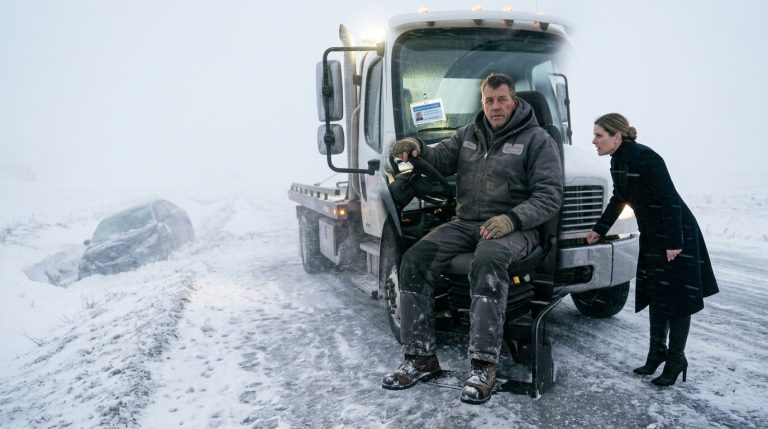
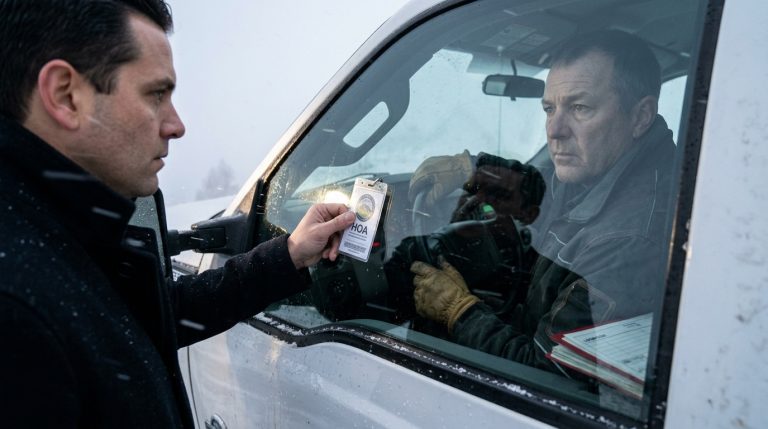
The wind didn’t just howl through the parking lot; it raked across the asphalt, stripping away the thin veneer of order that kept this community from sliding into the abyss. I watched from the window as the red Mercedes GLE pulled over the painted markers. It wasn’t a reckless mistake; it was a deliberate claim of territory. The tires, caked in slush, ground down the protective cover of the gas line until I heard the faint, sickening crack of plastic buckling under the weight.
I stepped outside, the cold hitting my skin like a physical blow. The air was sharp, smelling faintly of sulfur and dry earth. Lena Caldwell stood by the door, her coat a vibrant, defiant red against the gray monotony of the blizzard. She didn’t look down at the cracked cover. She didn’t look at the warning markers. She looked at me, her eyes tracking my movement with a predatory calculation.
“Five minutes,” she said, her voice cutting through the wind. She didn’t care that the ground beneath her was compromised. To her, the parking space was a resource to be defended, not a hazard to be avoided.
I looked at the crack. It was small, a spiderweb of fracture lines in the hard plastic, but the smell was already beginning to rise—a low, greasy chemical odor that the wind couldn’t quite disperse. My internal clock clicked into gear. Therefore: The line was compromised. But: I had no authority to stop her.
“The line is exposed, Lena,” I said, my voice steady, stripped of emotion. I didn’t plead; I stated the physics of the situation. “You’re sitting on a shut-off valve.”
She smirked, a sharp, metallic expression that belonged to the rusted reality of this place. “You’re always counting something, aren’t you?” She didn’t wait for a reply. She turned her back, the friction of her boots on the ice echoing the growing tension in my own chest.
I retreated to my house, the cold creeping in through the doorframe. As I locked it, the silence felt heavy, layered with the weight of things left unsaid. I didn’t try to fix the line. I didn’t reach for tools. I grabbed my phone, opened the camera, and began to record. This was the first move in a game I didn’t want to play, but one I was forced to defend. My screen flickered with the timestamp—the first piece of evidence in a paper trail that had yet to be written. The air in my living room was still warm, but I knew, with a certainty that settled in my marrow, that the cold was coming.
CHAPTER 2: THE PAPER TRAIL OF FROST
The interior of my house was no longer a home; it was a holding pattern. I sat at my desk, the laptop screen casting a pale, sickly light over the room. The heat had died hours ago, and the cold was working its way into the floorboards. I could feel it through the soles of my boots—a slow, relentless creeping. My breath misted in the air, a rhythmic puff of white that reminded me exactly how much time I had before the pipes became the next casualty.
I checked the timestamp on my latest file. 11:42 PM. I had been sitting in the dark for three hours. The memory of Lena’s smirk—that sharp, metallic expression—kept looping in my mind. It wasn’t just arrogance; it was a desperate, frantic need to be seen as the ultimate authority, regardless of the physical reality of the leaking line. It reminded me of a winter five years ago, when the building manager at my old place had ignored a leaking roof until the drywall collapsed in the middle of the night. Don’t worry, he’d said then, just like Lena now. It’s just water. It’ll dry. But when it finally gave way, the rot behind the paint was black, thick, and irreversible.
Lena was doing the same thing. She was painting over the rot of this community with her own ego.
I didn’t reach for a heater. I reached for the digital files. My fingers were stiff, the joints aching from the drop in temperature, but I moved with a cold, calculated efficiency. I pulled up the latest HOA budget report, the one that had been sent out in the general email blast last Tuesday. On the surface, it was a dry, uninteresting document—columns of numbers, maintenance fees, and vague line items for “Emergency Infrastructure Operations.”
I opened a separate tab and cross-referenced the vendor listed for the “Infrastructure Remediation” contract. A quick search of the city’s business registry brought up the company name: Apex Utility Services. My gut tightened. The address listed for Apex was a vacant lot two towns over, a registered shell corporation.
I started downloading everything I could find. The history of the HOA’s contract awards over the last three years showed a pattern that felt less like maintenance and more like an extraction. Every time a major issue arose—a pipe burst, a fence collapse, a wiring failure—the HOA awarded the repair to Apex. And every time, the costs were bloated, the work was subpar, and the “emergency” would mysteriously recur a few months later.
This wasn’t just negligence. It was a closed loop. They were funneling the community’s dwindling reserve funds into these shell companies, and the “Emergency Authority” Lena wielded was just the tool to ensure no one questioned the bills. The gas leak wasn’t an inconvenience to her; it was an opportunity to justify an “emergency” repair payment that would never actually fix the pipe, just line the pockets of whoever was behind Apex.
The realization sat in my chest like a cold stone. I wasn’t just fighting a neighbor; I was fighting an accounting ledger that required my silence to balance.
My phone buzzed against the desk, the vibration harsh in the absolute stillness of the room. A new email. From the HOA board. Subject: URGENT: MANDATORY MEETING REGARDING COMMON AREA OBSTRUCTION.
I clicked it. They were escalating. They were calling a meeting for 8:00 AM tomorrow, a session to discuss “Community Compliance” and “Penalties for Obstruction of Service.” They were going to try to vote on a motion to forcibly remove the warning signs and clear the “obstruction” so their preferred vendor could get in and start the “repairs.”
I looked at the photos I had taken of the cracked protective cover. Then, I looked at the registry data for Apex Utility Services. I stood up, my coat already pulled tight around my shoulders. I didn’t need heat to think clearly; the necessity of the situation provided all the warmth I needed. If I didn’t get these files into the hands of someone—not the HOA, not the board, but someone outside the loop—the “repair” would go ahead, the money would disappear, and the leak would eventually turn the entire lot into a crater.
I grabbed my bag, the weight of my laptop a familiar, grounding presence. I stepped out of my front door and into the hallway. The building was quiet, the air in the corridor smelling of damp concrete and the faint, lingering scent of frozen metal. The real work wasn’t in the complaining anymore. It was in the documentation.
I paused by the stairs. I needed to see the site one more time, not to confront Lena—not yet—but to understand the physical reality of what they were trying to hide. The ground was still packed tight, the snow crusting over the spot where the propane line snaked through the dark, frozen earth. I needed to know if they had already started digging, or if they were waiting for the vote to create a legal cover for the destruction.
I walked toward the exit, my boots crunching on the cold floor. The logic was simple: Therefore, if they were pushing for a vote, the “repair” was a fabrication. But, if I could prove the vendor was a fraud before the meeting, the authority they were using to justify the emergency would evaporate, leaving them exposed and alone in the cold.
I opened the heavy exit door. The wind hit me instantly, biting and relentless, but I didn’t flinch. I had a clear target, a piece of evidence, and a long night of digital digging ahead of me. The game had shifted from survival to investigation, and for the first time since the frost settled, I felt the sharp, stinging potential of a win.
CHAPTER 3: THE ANATOMY OF AN EMERGENCY
The darkness wasn’t just an absence of light; it was a physical weight. I stood frozen in the hallway, my hand still gripping the cold metal of the exit door handle. The sudden silence that followed the light’s failure was worse than the wind. It felt like the building itself was holding its breath, waiting to see what I would do next. I pulled my phone from my pocket, the screen’s low-battery warning pulsing a soft, urgent red in the gloom. I didn’t turn on the flashlight yet. I didn’t want to alert anyone in the lobby that I was moving through the service corridors.
I adjusted my grip on the bag. The files were on the hard drive, a digital weight that felt heavier than lead. If I could get to the secondary maintenance stairwell, I could bypass the lobby entirely and reach the outdoor kiosk where the community’s primary data hub was located. It was an older unit, rarely maintained, but it was the only way to hard-wire the evidence into the municipal system.
I moved forward, my boots finding the familiar unevenness of the carpeted floor. Each step was a measured calculation. The hallway was a narrow artery of the complex, lined with doors that looked identical in the dark. Therefore: The power was out. But: Was it a coincidental grid failure, or were they throttling the building’s utility to make any unauthorized movement easier to track? The distinction was vital. If they were watching, every sound I made was a liability.
I reached the turn for the maintenance stairwell just as a faint, rhythmic scraping sound echoed from the far end of the corridor. It wasn’t the wind. It was the sound of someone—or something—moving with deliberate, slow care. I pressed my back against the wall, the plaster rough and freezing against my spine. I held my breath, letting the stillness of the room become my shield.
A shadow shifted in the gloom—a silhouette that didn’t match the geometry of the architecture. It was too broad, too stiff. It stopped, and for a heartbeat, I heard the faint, metallic clink of keys. Not a ring, but a heavy, master-key fob. It was someone with access, someone who belonged to the management side of the thin, fraying reality of this development.
My heart hammered against my ribs—a frantic, uneven beat. I realized then that my investigation wasn’t a secret. The digital trail I had been following was a two-way street; if I could track them, they could track the server access from my unit. They knew.
I didn’t wait to see who it was. I slipped through the service door, the heavy metal frame groaning softly as I pushed it open. I descended the stairs, not with speed, but with a fluid, silent motion born of necessity. Each step down was a decision: stay in the open and risk being identified, or move into the subterranean layers of the building where the rust and the pipes lived. I chose the latter.
The stairwell opened into the sub-basement, a place of exposed iron and the constant, low-frequency thrum of the water main. The air here was thicker, tasting of dry, oxidized earth and the faint, biting sharpness of the leaking propane. I knew this area. I had spent hours studying the architectural schematics before I moved in, a precaution that now felt less like paranoia and more like a lifeline.
I moved past the massive, vibrating turbines of the HVAC system. The rust on the pipes was extensive, flaking off in jagged scales that crunched under my feet. Everything here was decaying, a slow-motion collapse that no amount of “emergency” paint could hide. I reached the secondary access panel to the kiosk. It was locked with a heavy-duty padlock, a recent addition that hadn’t been there when I first moved in.
I didn’t have a key, but I had the knowledge of the system. I pulled a small, multi-tool from my bag, the steel cold and reassuring in my grip. I didn’t need to break the lock. I needed to bypass the hinge pins, a mechanical shortcut I had practiced during the long, freezing hours of the previous night. The metal was brittle from the cold, making it easier to manipulate, but every scrape of the tool against the steel sounded like a gunshot in the cavernous space.
I stopped every three seconds to listen. The scraping above—in the hallway—had stopped. Now, there was a new sound: the low, persistent vibration of an elevator car descending toward the sub-basement.
Panic threatened to bloom in my throat, a sharp, metallic taste of fear. I forced it down, focusing entirely on the tension of the pin. Therefore: They were coming down. But: I was already inside the utility grid. If I could get the data into the hub, it would trigger an automated report to the city’s utility board. It didn’t matter if they caught me, as long as the upload completed.
The pin slid free with a tiny, sharp click. I eased the hinge forward, just enough to slip my hand behind the access panel and pull the network cable from its housing. I plugged the drive into the interface. The red light on the drive blinked—slow, then fast, then a steady, rhythmic pulse. The upload began.
I stood there, surrounded by the smell of iron and decay, watching the bar on my screen crawl toward one hundred percent. The elevator reached the basement floor. The doors slid open with a long, drawn-out grind of metal on metal. Footsteps—slow, heavy, and purposeful—began to cross the concrete floor toward the utility panel.
I didn’t hide. There was no point. I stayed pressed against the wall, the drive dangling by the cable, the data cascading into the system. The footsteps stopped a few feet away. A flashlight beam cut through the dark, swinging wide, catching the rust on the pipes, the shadows of the machinery, and finally, the back of my coat.
“You should have stayed in your unit,” a voice said. It was calm, professional, and entirely devoid of heat. It was the voice of someone who viewed me not as an enemy, but as a maintenance issue—something to be corrected, cleared, and forgotten.
The upload bar reached ninety-five percent. I didn’t turn around. I kept my eyes on the screen, my hand hovering over the cable, waiting for the final, critical confirmation.
CHAPTER 4: THE DECOY DEBT
I didn’t turn. I yanked the drive from the slot, the plastic casing biting into my palm, and shoved it into my jacket pocket. The footsteps behind me stopped. The beam of the flashlight locked onto the back of my neck, the glare reflecting off the damp, rusted pipes to create a halo of blinding white light.
“The meeting isn’t until eight,” the man said. His voice wasn’t an interrogation; it was a recitation, as if he were reading from a script he had memorized for this exact moment. He moved closer, the boots crunching over flakes of rusted iron—a sound like grinding bone.
I turned slowly. He wasn’t security. He was the maintenance supervisor, a man named Henderson I’d seen in the lobby a dozen times, usually ignoring the lobby’s flickering lights. His uniform was immaculate, a sharp contrast to the subterranean decay of the sub-basement. He held a master key fob in his left hand, the indicator light blinking a steady, rhythmic green.
“I found a leak,” I said, my voice sounding thin and hollow in the cavernous, pipe-filled space. I kept my posture loose, my hands visible, though my heart was kicking against my ribs with a frantic, primitive rhythm. “The line is compromised. I was documenting it for the city.”
Henderson tilted his head. He didn’t look at me; he looked at the open access panel, his eyes scanning the wiring I had manipulated. “The line was repaired yesterday, Mr. Thorne. Or perhaps you didn’t check the logs?”
He reached into his breast pocket and pulled out a manila folder, sliding it onto a nearby workbench. I recognized the label: Emergency Maintenance Log – Apex Utility. He opened it to the middle, his thumb pressing down on a series of invoices. The signatures were illegible, the dates blurred by ink-smudges, but the numbers were stark: thousands of dollars, billed in three-hour increments for ‘Site Clearance and Risk Mitigation.’
“This is the record,” he said, his tone devoid of malice. “The HOA board approved these. The work is finished. There is no gas leak. There is no obstruction.”
I looked at the invoices. They were clean—too clean. I flipped through the pages, looking for the hardware receipts, the technical specs of the pressure testing, anything that would verify the repair. They were missing. The entire back half of the folder, where the technical certifications should have been, was empty.
“The invoices don’t match the work,” I said, pointing to the empty space where the technical data should be. “You billed for a full system replacement, but the cover is still cracked. I saw it. I have the photos.”
Henderson stepped forward, the flashlight beam wavering as he moved. “Photos are just static images, Mr. Thorne. They lack context. They lack the authority of the board.” He signaled toward the elevator. “The board is concerned about your… agitation. You’ve been interfering with community operations. We’re asking you to stay in your unit until the morning meeting.”
He wasn’t threatening me. He was managing me. It was the same tone Lena used, the same bureaucratic dampening of reality. The “Emergency Authority” wasn’t just a legal loophole; it was a psychological wall, designed to make anyone who saw the truth feel like they were losing their mind.
I moved away from the access panel, keeping the workbench between us. “If the work is finished, why is the area still cordoned off? Why are the barriers still there?”
Henderson’s expression didn’t change, but his eyes narrowed, the light reflecting in them like oil on water. “We’re waiting for the weather to clear for final inspection. Safety protocols. Surely, you understand safety protocols?”
He took another step, closing the distance. My hand drifted to my pocket, touching the drive. If the upload hadn’t finished, if the municipal servers didn’t see the files, I was trapped in a conversation with a man who could erase me just as easily as he erased the maintenance records.
“I’m going back to my unit,” I said, making it a statement rather than a request.
“I’ll walk with you,” Henderson replied. “It’s dark in the halls. Wouldn’t want you to trip.”
He wasn’t letting me go. He was escorting me, turning a detention into a courtesy. I walked past him, the smell of his cologne—faint, synthetic, and overpriced—clashing with the rot of the sub-basement. As we reached the elevator, I looked back once at the access panel. The red light on the server, previously blinking with the urgency of the data transfer, was now a solid, unmoving amber.
The upload hadn’t finished. The network had been severed the moment he walked into the basement.
I stepped into the elevator, the small, enclosed space feeling like an iron coffin. Henderson pressed the button for the lobby. The car began to rise, the cables humming a low, grinding song of friction. I realized then that the decoy—the invoices, the shell company, the bribery—wasn’t the end of the story. It was the distraction. They weren’t just stealing money; they were masking a total, structural failure of the building itself, and they were using the emergency as a way to clear the residents out—one by one—to avoid the liability of a condemnation.
I looked at my reflection in the elevator doors. I looked tired, small, and entirely out of my depth. But as the floor numbers ticked upward, I felt the sharp, jagged edge of the drive in my pocket. I hadn’t lost. I had just found the real lock.
CHAPTER 5: THE WEIGHT OF THE COLLAPSE
The elevator doors retracted, revealing the lobby. It was a space designed for prestige—tall ceilings, recessed lighting, and a concierge desk that stood like a bastion of order. But tonight, the air was stagnant. The silence was too thick, the kind of stillness that usually preceded a major structural event. Henderson stepped out first, his movements fluid and unhurried. He didn’t look back to see if I was following. He knew I was trapped by the sheer logistics of the building; the only exit was through the lobby, and the lobby was now a staged theater.
Lena Caldwell was waiting by the concierge desk. She wasn’t shouting anymore. She was composed, her hands resting on the granite countertop, her posture echoing the architectural rigidity of the room. She looked at me, not with the heat of the parking lot confrontation, but with a chilling, clinical indifference.
“You’ve had a very long night, Mr. Thorne,” she said. Her voice didn’t carry across the room; it seemed to inhabit the very air around us.
I kept my hand on the drive in my pocket, the sharp corner of the plastic cutting into my skin. I stepped out, the soles of my boots ringing against the marble. The lobby was empty of neighbors, empty of the night staff. It was just the three of us, suspended in the amber of the building’s managed reality.
“The invoices are fraudulent,” I said, my voice steadying as I drew on the cold, hard logic of the evidence in my pocket. “And the work wasn’t performed. This building isn’t being repaired. It’s being drained.”
Lena smiled, a slow, patient expression. “You are obsessed with the plumbing, aren’t you? It’s a very small, very narrow way to look at a structure that is failing in ways you couldn’t possibly imagine.”
She turned to Henderson. “Is the perimeter cleared?”
“The residents are being notified that there’s a total grid failure,” Henderson replied, his gaze fixed on a point just past my left shoulder. “Evacuation protocols are underway. We’ve told them the structural integrity is compromised—which, technically, is true. The building is being condemned as of midnight.”
The gravity of his words hit me, grounding me to the marble. Condemned. They weren’t just stealing money; they were liquidating the entire development. By triggering a controlled condemnation, they could write off the insurance, bypass the maintenance requirements entirely, and walk away with the remaining reserve funds before the city inspector even had a chance to verify the structural report. The gas leak was the catalyst—the “emergency” that gave them the legal right to force an evacuation and seize control.
“You can’t condemn the building without a city audit,” I said, though the words felt useless even as I spoke them.
“The city is already here,” Lena said, gesturing toward the glass doors. Outside, in the swirling whiteout of the blizzard, blue-and-red light pulsed—not from fire trucks, but from private security vehicles, their logos obscured by heavy blankets of snow. “We own the inspection firm. We own the report. And by tomorrow morning, this address will be nothing more than a debt on a spreadsheet.”
I took a step back, my mind racing through the causality of the last few hours. Therefore: The emergency was a pretext. But: If I could reach the street—if I could bypass their private security—I could get the drive to the actual municipal office. I didn’t need to save the building anymore. I needed to burn their exit plan to the ground.
“You’re going to walk out the front door, and you’re going to hand me that drive,” Lena said, her tone suddenly devoid of the polite, managed veneer. She wasn’t asking; she was dictating the physics of my reality. “If you do, you walk out of here with a settlement package that covers your losses. If you don’t, you stay in this building until the final inspection is completed. And I wouldn’t recommend being inside when the structural audit concludes.”
She was threatening to lock me in. A trap in the most literal sense.
I looked at the lobby’s glass doors. The private security guards were standing just outside, their faces obscured by the glare of the lights. They were the muscle behind the ledger, the physical manifestation of the corruption I had been tracking. My hand tightened on the drive. I looked at Henderson, then at Lena, seeing them for the first time not as managers, but as the final, desperate components of a failing machine.
“You don’t understand,” I said, stepping toward the emergency stairwell instead of the lobby. “The upload wasn’t the evidence. It was the trigger.”
I moved before they could react. I didn’t go for the door. I lunged for the fire alarm pull-station behind the concierge desk. The logic was instantaneous: if the city’s automatic response systems were tied into the building’s fire code, then a total alarm wouldn’t just signal the fire department—it would force an automated, municipal data-handshake between the building’s core and the city’s emergency grid.
My hand slapped the glass. The alarm shrieked, a high-pitched, piercing wail that tore through the artificial stillness of the lobby. The strobe lights began to flash, turning the room into a chaotic, rhythmic pulse of blinding white and shadow.
Lena screamed—a raw, unmanaged sound—as the lobby’s security system went into emergency lockout mode. The heavy steel shutters over the glass doors slammed down, trapping the security guards outside, while the fire doors to the stairwell swung open with a pneumatic hiss. I didn’t wait to see the outcome. I didn’t wait to see if they would try to stop me. I bolted for the stairs, the sound of the alarm screaming like a warning, a desperate, final piece of evidence being sent directly into the heart of the city’s grid.
CHAPTER 6: THE FINAL RECKONING
The stairwell was a vertical tunnel of concrete and cold. I didn’t stop for breath. My legs burned with the effort of the climb, each step a testament to the adrenaline that had fueled me since the sub-basement. I wasn’t just running from Henderson or Lena anymore; I was running toward the only thing that mattered—the roof access where the signal would be unobstructed and the city’s emergency hub would have a clear line of sight to the building’s data broadcast.
Behind me, the door rattled violently, a metallic boom that echoed up the shaft. Henderson was throwing his weight against it. The lock held, but the frame groaned—a high, stressed screech of metal under pressure. He wasn’t going to get through quickly, but he didn’t need to; he just needed to keep me trapped on the stairs.
I reached the final landing and slammed into the push-bar of the roof door. It gave way with a sharp, pneumatic hiss, and I stumbled out into the blizzard.
The cold was absolute. It hit me like a wall of needles, instantly freezing the sweat on my forehead. The rooftop was a desolate, windswept expanse of gravel and ventilation housing, buried in a thick, drifts of white. I scrambled toward the central communications array, my feet crunching in the deep, frozen powder. I pulled the drive from my pocket, my fingers numbing in the sub-zero air, and fumbled to connect it to the maintenance port of the array.
The screen on the drive pulsed blue. Data Uplift: 10%… 20%…
The roof door behind me exploded open. Henderson emerged, his face a mask of cold, professional rage. He didn’t run; he walked, his movements deliberate, his hand reaching into his jacket. He wasn’t reaching for a weapon—he was reaching for the remote override for the building’s security grid.
“You’re making a mistake, Thorne,” he said, his voice barely audible over the howl of the wind. “Even if you upload that, it’s just a file. It’s an accusation. It doesn’t fix the fact that this building is already off the grid.”
“The city is already tracking the alarm,” I shouted back, my eyes fixed on the progress bar. 50%… 60%… “They know the building is locked down. They know the emergency was fake.”
“The city doesn’t care about a building that’s already written off as a total loss,” Henderson replied, closing the distance. He stood ten feet away, the wind whipping his coat like a flag. “We’re not the ones losing money here. You are.”
He triggered the override. The roof’s lighting—normally dim, security-rated bulbs—blazed to life, blinding me. The sound of the ventilation fans spiked, a deep, resonant rumble that shook the rooftop gravel. It was a physical assault, a wave of vibration intended to disorient.
I felt the structural vibration through my boots. It wasn’t just the fans. The building’s foundation was shifting. The “emergency” evacuation they had been managing wasn’t just for control; they were planning to trigger a controlled collapse of the underground utility vault to clear the site entirely.
80%… 90%…
Henderson lunged. I didn’t try to fight him; I pivoted, using the low, heavy mass of the ventilation housing to trip him. He went down, his boot catching on a drainage pipe, and he slid across the gravel, the remote override skittering out of reach toward the edge of the roof.
I lunged for the drive as the progress bar hit 100%. Upload Complete.
The rooftop went silent. The heavy rumble of the ventilation fans cut out instantly as the municipal signal override took control of the building’s core systems. The lights snapped from a blinding, aggressive white to a soft, steady emergency red.
Henderson scrambled to his feet, but he stopped when he heard the drone of engines overhead. Through the thick, swirling snow, the rotating searchlights of a police helicopter cut through the dark—not one, but three. They weren’t coming for a gas leak. They were coming for a corporate crime scene.
Lena appeared in the doorway, her composure shattered. She looked at the helicopter searchlights, then at me, then at the empty, frozen rooftop. She knew. The bankruptcy, the fake invoices, the forced condemnation—it was all laid bare in the metadata now. The city wouldn’t just see the theft; they would see the structural report she had tried to bury.
She turned to run, but there was nowhere left to go. The roof was a circle of white, and the helicopter lights pinned her in the center, a stark, harsh spotlight that stripped away every layer of her authority. Henderson just stood there, his shoulders slumping as the fight drained out of him. He looked like what he was: a man who had traded his conscience for a set of invoices that no longer held any weight.
The aftermath was slow. The police took them into custody in silence, the only sound the steady, rhythmic thrum of the helicopters overhead. I sat on the gravel, my hands shaking uncontrollably, watching the city emergency teams swarm the rooftop, their gear reflecting the red emergency lights.
A firefighter—the same one who had reinforced the barricades that first night—walked over to me. He didn’t offer a platitude. He just reached out and helped me up. “We’ve got the site secured,” he said. “The building is stable. You were right.”
I looked down at the protective cage around the gas line, now clearly marked and reinforced with heavy-duty steel. It was just a pipe, but it felt like a monument. I walked over to the edge of the roof, the air finally feeling crisp and clean, the sharp, toxic smell of the leak replaced by the cold, biting scent of fresh snow.
The building was still standing. The people inside were safe. The system hadn’t just held; it had finally, after days of struggle, worked exactly the way it was supposed to. I felt a deep, quiet exhaustion settle into my bones, a weight that wasn’t heavy, but balanced.
I looked up at the stars, visible for the first time through the thin, clearing clouds. The fight was over. The truth was out, documented, and beyond reach. I didn’t need to look for secrets anymore. I just needed to walk down the stairs, go into my apartment, and sleep in a room that finally felt like it belonged to me again. The rust, the rot, the artificial emergencies—they were all behind me now, dissolving into the quiet, indifferent peace of the night.