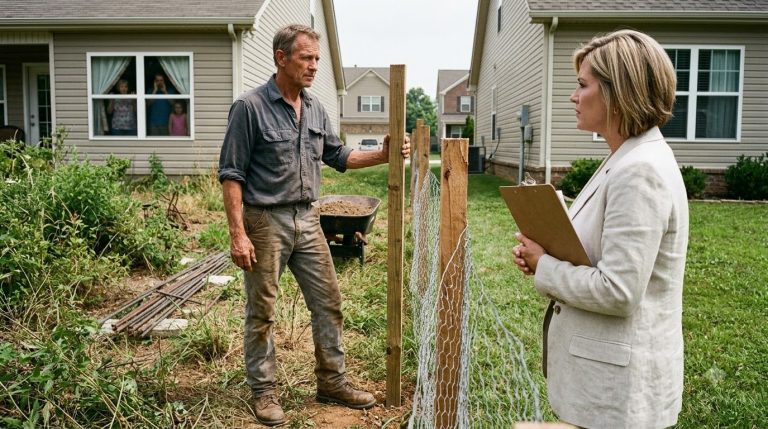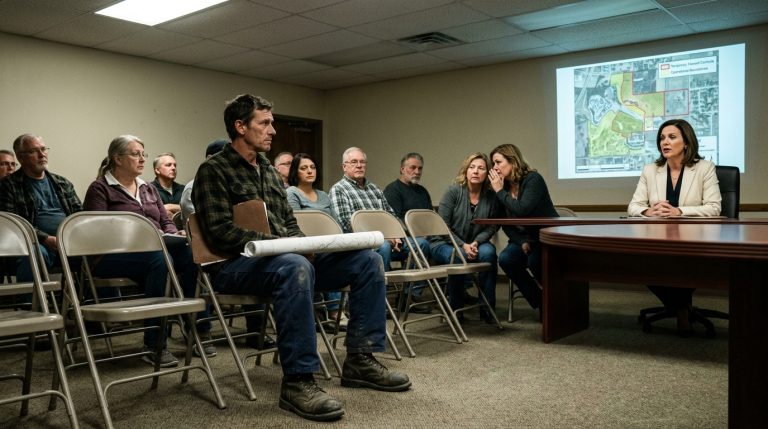
A Cold Claim on Asheford Hill: The Architect of Order Against a Queen of False Authority
CHAPTER 1: The Kitchen Intruder
The silence of the house was wrong. It wasn’t the heavy, resting silence of an empty Victorian, but a thin, buzzing quiet that vibrated with the presence of someone else.
I didn’t move. My hand remained on the doorframe, knuckles white, calculating the distance between the foyer and the kitchen. The morning light didn’t feel like my light—the way it slanted across the east-facing windows felt harsher, almost intrusive.
I took a step, my boots silent on the original oak floors I had sanded down with my own hands three years ago. The smell was stronger now. It wasn’t just the eggs; it was the faint, floral undercurrent of a perfume I didn’t recognize. A cheap, aggressive scent that didn’t belong in the air I had cultivated.
I rounded the corner to the kitchen.
She was sitting in my chair. The heavy, mahogany chair I’d picked up at an estate sale in 2005 and refinished myself. Karen Mossfield. She was wearing a silk robe that looked entirely too expensive for her salary, staring down at her phone with an expression of intense, proprietary focus. A plate of half-eaten eggs rested on the counter in front of her. My plate. My vintage ceramic mug was steaming nearby, and beside it, a list written on one of my personalized notepads—her grocery list, scrawled in her jagged, impatient handwriting.
The world narrowed to a single, pulsing point of clarity. My legal brain, dormant for weeks, snapped to attention with the sudden, sharp violence of a spring being released.
I didn’t shout. I didn’t reach out to grab her. I simply stood there, watching the way she leaned into my chair, the way she treated my property as if it were a hotel she had booked for the season. She didn’t hear me enter, but the air in the room changed, or perhaps it was just the intensity of my focus that made the hair on the back of her neck stand up.
She looked up, eyes snapping toward me. For a split second, the facade of confidence flickered, replaced by a jagged, animal flash of panic. Then, she surged to her feet, dropping the phone onto the counter with a metallic clatter.
“Who are you?” she demanded, her voice climbing in pitch, a desperate attempt to seize the moral high ground before I could speak. “What are you doing in here?”
I didn’t look at her face. I looked at the keys resting beside her plate—a heavy, silver ring that caught the morning light. A master key.
“I live here,” I said, my voice sounding unnervingly steady to my own ears.
She opened her mouth to retort, but her eyes darted to the side, scanning the room for something—an exit, a weapon, or perhaps an explanation that hadn’t yet occurred to her. I noticed then that the pantry door, which I always kept tightly latched, was standing a few inches ajar.
Something shifted in the room. A draft from an open window upstairs, perhaps. Or the realization that I wasn’t leaving. The phone on the counter buzzed—a short, insistent vibration. She didn’t look at it, but her hand twitched toward it, a reflex that felt far more significant than the argument she was currently losing.
I moved one step closer, feeling the floorboards shift beneath me, the familiar groan of the wood grounding me in reality. “This is my house, Karen,” I whispered, the name tasting like copper. “And you have made a very specific, very expensive mistake.”
She took a sharp breath, her gaze locking onto my chest, as if she could see the erratic rhythm of my heart. She reached out, gripping the back of the chair as if it were the only thing holding her up, and then her eyes drifted toward the pantry door, her expression tightening into a mask of pure, unadulterated fear.
CHAPTER 2: The Weight of Documentation
The silence between us wasn’t empty. It was pressurized, the kind of stillness that precedes a structural failure. Karen Mossfield stood paralyzed, her fingers white-knuckled against the mahogany back of the chair I had spent three months restoring. The air—my air—was heavy with the smell of scorched eggs and the chemical sharpness of her perfume.
She looked small, suddenly, or perhaps she was just shrinking under the scrutiny of someone who knew exactly what the wood and stone beneath our feet were worth.
“I have a right to be here,” she finally managed to say, though the word ‘right’ came out thin, stripped of its previous armor. She reached for the master key again, her movements disjointed, her focus shattered. “The HOA has protocols. Emergency access. If there is a potential for structural damage, or if the property is being neglected…”
“Neglected?” I moved around the edge of the kitchen table, my eyes never leaving her hands. “I was in Portland for a cardiac procedure. The house is alarmed. The mail is stopped. My neighbor is watching the perimeter. There is no structural damage, Karen. There is only you, sitting in my chair, eating my food, and reading your phone.”
A flash of a memory hit me, unbidden and cold: my wife, Sarah, standing at this very counter, humming a melody I couldn’t quite name while she wiped the surface clean. The phantom scent of her lemon polish seemed to cut through the greasy odor of Karen’s burnt eggs, a sharp, jarring contrast that made the reality of the situation crystalize. I wasn’t just defending a house. I was defending the only place left where the echoes of my past weren’t being trampled by a desperate, small-minded woman.
“I need you to leave,” I said, my voice dropping to a register that carried the weight of four decades of property law. “And I need you to leave that key on the counter.”
Karen’s eyes flicked to the pantry door again. It was just a sliver of darkness, but she seemed terrified that something—or someone—might emerge from it. Her gaze moved back to me, and I saw it then: the frantic, cornered look of someone whose entire existence was predicated on a lie she had told herself too many times.
“You don’t understand,” she whispered, her voice cracking. “The board… it’s not what you think. It’s for the good of the neighborhood. Asheford Hill is at a turning point. We have to be proactive. If we aren’t, the whole value of our investment—”
“Your investment?” I interrupted, stepping closer until I was within her personal space. The scent of her perfume was cloying now, masking the scent of the house’s original plaster. “You’ve turned your position into a petty fiefdom. You don’t care about the Hill. You care about the inventory.”
I reached out and picked up the notepad she had been using. It was one of mine, personalized with my name embossed at the top in elegant serif font. Her grocery list was written underneath, but as I glanced at it, my breath hitched. It wasn’t just groceries. There were addresses scribbled in the margins—the addresses of the other eleven houses on the block, each with a shorthand code next to it. Vacant, renovation schedule, key status.
She lunged for the notepad, her hand outstretched, but I pulled it back, my movement fluid and deliberate.
“Is this the ‘Emergency Access’ program, Karen?” I asked, my voice dangerously calm. “Keeping a detailed ledger of when your neighbors are vulnerable? Monitoring their schedules for the HOA? Or is this something else entirely?”
She didn’t answer. She slumped back into the chair, the arrogance finally draining away, leaving behind a husk of a woman. She reached for her phone, but I tapped the counter with my cane, a sharp, resonant sound that echoed through the high-ceilinged room.
“Don’t,” I said. “You’ve already threatened to call the police. I think you’ll find that a very interesting conversation once the officers arrive.”
I walked to the kitchen window and looked out at the drive. Her dark blue sedan sat there, heavy and out of place, its presence a glaring, metallic wound in the landscape I had labored over for years. I knew I couldn’t throw her out physically—not with my condition, not with the risk—but I didn’t need to. I had the deed. I had the facts. And now, I had the ledger.
She looked at me, her eyes brimming with a sudden, desperate moisture. “If you go to the board with that, I’m ruined. They don’t know everything. I’m just trying to keep things together.”
“You’re not holding things together, Karen,” I said, looking at the keys she had failed to put down. “You’re holding on to something that was never yours, and you’ve finally run out of runway.”
I picked up the landline, my finger hovering over the speed dial for my attorney, Diane. The house seemed to hold its breath. Even the old floorboards stopped their subtle, temperature-driven shifting. I stared at Karen, waiting to see if she would bolt, but she just sat there, broken and small, trapped by the weight of her own meticulously fabricated reality.
The game had moved past the point of arguments and HOA violations. It was now a matter of record, and I was, by profession and by nature, a man who believed in the cold, unyielding power of the paper trail.
CHAPTER 3: The Geometry of a Lie
“Walter?” Diane’s voice was crisp, cut through the tension of the kitchen like a razor. She was a woman who didn’t deal in hyperbole. “I’ve pulled the records. You’re right to be concerned. There is no board resolution. There is no bylaw amendment. There is nothing but a series of memos Karen authored herself over the last six months.”
I watched Karen. She was still sitting in the chair, her gaze fixed on the floorboards as if she were trying to memorize the grain. She hadn’t moved since I picked up the phone.
“She’s been logging access,” I said, keeping my voice low. “I found a notepad. Addresses. Notations about vacancies and key statuses.”
There was a long silence on the other end of the line—the kind of pause that only a seasoned attorney makes when they realize they’ve just stepped into something much larger than a nuisance dispute. “Walter, listen to me. If she’s documented entry into other homes, this isn’t just trespassing. This is a liability nightmare. If she’s been using that ’emergency’ status to enter properties while owners were away, she’s opening the entire association up to litigation. I need you to document everything. Do not confront her further. Just hold your ground. I’m contacting the county clerk’s office now.”
“I have the list, Diane. I’m going to photograph it.”
“Good. Keep it secure. And Walter? Be careful. People who think they’re entitled to other people’s lives rarely go quietly when the power is pulled.”
I hung up and set the receiver down. The click sounded deafening. Karen looked up then, her eyes narrowed. The vulnerability from a moment ago was hardening into a brittle, defensive glare. She stood, smoothing her robe, regaining that practiced, performative posture of authority.
“You’re making a mistake, Walter,” she said, her voice now cool and measured. “The board knows what I do. They appreciate the effort.”
“The board doesn’t know you’re tracking the renovation schedules of eleven other homes,” I replied, walking past her toward the foyer.
I needed to see if there was more. The kitchen was just the beginning—the stage. If she had been living here, scouting these houses, she had to have kept more than just a grocery list. I moved into the hallway, my boots heavy on the floorboards. My eyes traced the walls. Everything looked as I had left it, but when I reached the foyer closet—a space I rarely used except for winter coats—I noticed something. The door wasn’t clicked shut. It was a hair’s breadth ajar.
I pulled it open.
Inside, tucked behind my heavy wool overcoats, was a flat portfolio. I slid it out. It was a collection of architectural blueprints—not just of my house, but of the neighboring properties. They were marked up in the same jagged, impatient hand that had scribbled the grocery list. Red ink circled specific areas: roof integrity, plumbing stacks, basement access points.
It was a systematic audit.
I felt a cold shiver trace my spine. This wasn’t ‘community leadership.’ This was cold, calculated reconnaissance. I didn’t open the portfolio further; I didn’t want to show her I knew the extent of the damage. I tucked it under my arm, my heart hammering a rhythm against my ribs that the doctor had warned me about.
Karen was standing in the kitchen doorway, her posture rigid. She watched me holding the portfolio, and for the first time, her mask slipped completely. Her mouth went tight, her jaw working as she fought to maintain her composure.
“That’s private HOA property,” she said, though she made no move to cross the room.
“This?” I tapped the leather cover. “This is a record of your intent, Karen. And from where I’m standing, it looks like a road map for an empire you had no right to build.”
I turned away from her, walking toward the study. I had to get these documents to the desk, photograph them, and prepare the evidence. The house felt colder now—the air thinner, the walls closing in on the secrets she had tried to bury in my own closets. I could hear her footsteps in the kitchen, sharp and uneven, pacing the space I had meticulously restored. She was trapped, but a trapped animal, I knew, was when the danger truly began.
I sat at my desk and pulled out my camera. As I laid the blueprints out on the wood, the late afternoon sun hit them, illuminating the red ink. It was so precise. So methodical. I wasn’t fighting a crazy neighbor; I was fighting someone who viewed the entire block as a resource to be harvested. And as I captured the first frame, I realized that the house—my house—wasn’t just her base of operations. It was, according to her notes, the first property scheduled for ‘liquidation.’
The realization hit me with the force of a physical blow. The money. The debt. The reason for the urgency. She wasn’t playing queen; she was liquidating a neighborhood to cover a hole so large it was swallowing her whole.
CHAPTER 4: The Sound of the Siren
The photograph on the screen was clear: the red ink on the blueprint, the meticulously circled “liquidation” note, the ledger of my neighbors’ lives. I saved the file to my cloud storage with a steady finger, my pulse thrumming in my ears like a distant, rhythmic drum. I didn’t look at Karen when I stepped out of the study. I walked straight toward the front door.
She was waiting in the hallway, blocking the path like a sentry who had forgotten her post. She had lost the robe; she was dressed in a sharp, grey blazer now, the uniform of a corporate liquidator rather than a neighbor.
“You’re not going anywhere, Walter,” she said. Her voice was cold, stripped of the brittle pleading from an hour ago. She had shifted gears, moving from desperation to a tactical, aggressive defense. “I’ve already contacted the board. They’re on their way to ‘settle’ this misunderstanding. And I suggest you hand over that phone before you do something that forces me to call the sheriff myself.”
I looked at her, truly looked at her. The way her hand rested in her blazer pocket—not empty, not relaxed. She was waiting for me to engage, hoping for a stumble, a moment of weakness. She wanted me to be the intruder, to be the one who lost control.
“You’re not calling the board, Karen,” I said, moving past her toward the door. “You’re calling for an exit strategy.”
I didn’t wait for her response. I turned the deadbolt and stepped out into the crisp, biting air of the afternoon. The porch—the very same structure Daniel and I had rebuilt with our own hands, dust coating our skin, back when life felt steady—was unchanged, a silent witness to the absurdity of the last hour.
But the driveway was different.
A flash of blue light cut through the trees at the end of the gravel road. Then another. Not the quiet, curious roll of a neighbor’s car, but the insistent, high-intensity pulse of law enforcement. Karen followed me out, her stride confident until she saw the cruisers turning onto the property. Her confidence vanished as quickly as a shadow in a floodlight.
“What is this?” she hissed, her voice trembling.
I didn’t answer. I walked to the edge of the porch, my hand gripping the rail. The cruisers crunched up the gravel, the sound like grinding bone. A senior officer I recognized from the county—Deputy Miller—stepped out, his posture heavy with the gravity of an official call. He didn’t look at me first; he looked at the blue sedan parked in the center of the gravel, then at Karen, then at the house.
The tension in the air wasn’t just my own anymore; it was thick, suffocating, the kind of weight that settles in before an arrest.
“Mr. Greer,” Miller called out, his voice modulated and professional. “We received a call regarding an unauthorized entry and a potential dispute of property title. Can you verify the current occupancy?”
Karen moved forward, her face a mask of practiced indignation. “Officer, I am the HOA President. I’ve been conducting an emergency inspection. This man—”
“Ma’am,” Miller interrupted, his tone chillingly flat. “I’ve already spoken with the county clerk. I don’t need your explanation.”
He walked toward us, his hand resting on his belt, not on his weapon, but on the radio he carried. He looked at Karen with a tired, weary sort of patience. It was the look of a man who dealt with people who thought their importance was a shield against the law.
“Karen Mossfield?” he asked.
“Yes,” she spat, her bravado sparking once more, though it was hollow now, flickering out.
“We have a warrant for your records, Karen,” Miller said, reaching into his jacket and pulling out a folded document. “And a request for your keys. All of them.”
The world seemed to sharpen. The trees, the house, the light—everything became crystalline, intense. I stood on the porch and watched as the reality of her ’empire’ collapsed in the space of a heartbeat. She looked at me, her eyes darting between my face and the officer, and for a second, I saw the truth behind the arrogance: she was terrified of the silence that would follow this, the moment when she would have to face the life she had been trying so desperately to outrun.
But the scene wasn’t resolving. Not yet. Behind Miller, another car pulled in—an unmarked sedan. A woman stepped out, dressed in a sharp, dark suit, carrying a heavy leather briefcase. Diane Roar. She didn’t look at Karen. She walked straight to the porch, climbed the stairs, and stood beside me.
“Walter,” she said, her voice a quiet, grounding anchor. She turned her gaze to Miller. “I trust you have the necessary documentation for the retrieval of the unauthorized key sets?”
“I do, Ms. Roar.”
The standoff had shifted. The HOA had arrived, but it wasn’t the board members Karen had expected. It was the legal mechanism of the county, the cold, grinding machinery of the law that I had spent forty years serving, now finally turning to face the person who thought she could treat it as a suggestion. I stood on the porch, my hands tucked into my pockets to hide the slight tremor of my fingers, watching as the final piece of Karen’s control was dismantled, layer by layer, before my eyes.
CHAPTER 5: The Ledger of Ruin
The drive to the precinct was a blur of gray asphalt and the rhythmic, hypnotic wash of rain beginning to fall. I sat in the passenger seat of Diane’s car, the portfolio of blueprints resting heavy on my lap. The confrontation on the porch felt like a decade ago, though it had barely been twenty minutes. Karen was already gone, processed, an anonymous figure in the back of a patrol car, but the weight of what I had found—what I had seen in those red-inked notes—was now a cold stone in my stomach.
“She’s not just an HOA president who lost her way, Diane,” I said, looking out at the smear of lights passing by. “The level of planning… the way she marked the foundation stability and the equity release potential for every property on the street… it’s systematic. She wasn’t just managing the neighborhood. She was stripping it.”
Diane kept her eyes on the road, her expression unreadable, focused on the steady, driving windshield wipers. “I’ve had a forensic accountant looking at the HOA’s master account for the last hour, Walter. While you were filming those documents, we found something else. She wasn’t just using the master keys to scout. She was using them to facilitate private appraisals for shell companies.”
The realization hit me with the force of a sudden drop in altitude. Shell companies. My throat felt dry. “She was selling the neighborhood out from under us.”
“She was preparing for a total liquidation,” Diane confirmed. “If she could get enough owners to sign ’emergency maintenance’ agreements—which she drafted herself—she could leverage the collective assets to secure a massive line of credit. The ’emergency’ wasn’t the houses. The emergency was her bank account.”
We pulled into the precinct parking lot. The concrete was slick, reflecting the dull, industrial glare of the floodlights. Every movement felt weighted, slow, as if we were operating under the crushing pressure of deep water. I stepped out, the chill of the evening biting through my coat. My heart, still healing, gave a dull thud of protest, but I pushed it down. There was no room for biological failure now; only the structural integrity of the truth mattered.
Inside, the station was a hive of controlled, bureaucratic energy. We were led to a small, windowless interview room. Karen was already there, stripped of her blazer, sitting at a metal table that vibrated slightly from the hum of the overhead fluorescents. She looked older, smaller, the sharp lines of her face blurred by the harsh, unflattering light.
She looked up when I entered. There was no arrogance left, only a profound, hollow exhaustion.
“You’re an attorney, Walter,” she said, her voice a dry rasp. “You know how this works. It’s all just numbers. Everything is just numbers on a page.”
I sat down across from her, laying the blueprints out on the table. The red ink looked like fresh blood under the artificial light. “It’s not just numbers, Karen. It’s people’s lives. It’s the history of a street. It’s twenty-two years of my own life that you decided was just another entry on a balance sheet.”
She leaned forward, her eyes fixated on the blueprint for my home. “You think you’re so clean. You think because you have a deed and a permit, you’re the owner. You’re just a steward of a depreciating asset. I was trying to optimize. I was trying to save something from the rot.”
“The rot was you,” I said, my voice steady, devoid of the anger I had expected to feel. “You weren’t saving anything. You were just feeding your own panic.”
She let out a short, jagged laugh that sounded like dry leaves skittering on pavement. “You have no idea how deep the hole is, Walter. You think this ends with me? You think the HOA is the only place this happens? Everyone wants a piece of the ground. I just happened to be the one holding the shovel.”
I didn’t answer. I just watched her. There was no malice left, only the chilling, empty logic of a predator who had run out of prey. I saw then that the real tragedy wasn’t that she had tried to steal my house; it was that she had spent her life measuring the world in square footage and equity, and in the process, she had become completely, utterly hollow.
Diane signaled the officer at the door. It was time. I stood up, the blueprints left behind on the metal table, a map to a place that no longer existed. As I walked out, I didn’t look back. I had my closure, but as I stepped out into the cool, damp night, I realized the house on Asheford Hill would never be the same. The sanctity was gone, replaced by the cold, hard knowledge of what lies beneath the floorboards of any neighborhood when someone with enough desperation starts digging.
CHAPTER 6: The Solid Ground of Truth
The drive back to Asheford Hill was a study in silence. Diane didn’t speak, and for once, I didn’t feel the need to fill the void. The rain had intensified, turning the windshield into a blurred tapestry of streaks and light, but for the first time in weeks, the road felt manageable. The truth, stripped of the legal jargon and the bureaucratic posturing, was simple: Karen Mossfield was a woman who had tried to build a kingdom on the foundation of other people’s exhaustion. She had failed not because she was outplayed, but because she had underestimated the sheer, immovable weight of a man who knew what he owned.
When we pulled into the driveway, the house was waiting. It sat against the backdrop of the darkened hill, its silhouette familiar and steady. The blue sedan was gone, replaced by the empty, gravel-strewn space it had occupied for days. I felt a surge of something long-buried—not triumph, not vengeance, but a deep, resonant relief.
I thanked Diane and stepped out into the rain. The air was cold, sharp, and clean. It tasted like home.
I walked up the porch steps, the wood groaning in the way I knew so well. I paused at the door, pulling my key from my pocket. It felt cool and heavy against my palm. As I slid it into the lock, the mechanism turned with a smooth, frictionless grace that signaled everything was once again aligned.
Inside, the house was dark, but the air was mine. The scent of burnt eggs and synthetic perfume had been purged, replaced by the faint, comforting smell of beeswax and old plaster. I didn’t turn on the lights immediately. I stood in the foyer, letting my eyes adjust to the shadows, listening to the house breathe. It was still there. Every room, every corner, every imperfection I had spent years sanding and polishing was right where I had left it.
I walked into the kitchen and sat in my chair by the window. The house was quiet, but it was a living quiet—the settling of wood, the low hum of the refrigerator, the distant rhythm of rain on the roof.
I reached for the notepad I had kept—the one with her grocery list and the list of properties. I stared at the names, the addresses, the cold, red-inked annotations. They were just marks on a page now. They had no power. I tore the paper into small, jagged pieces and dropped them into the trash.
The payoff had come not in a dramatic courtroom revelation, but in this—the simple, quiet ability to sit in my own home, knowing that no one else held a key to it.
I spent the next hour in the kitchen, just drinking a cup of coffee. I noticed the way the handle of the mug fit perfectly in my hand, the weight of the ceramic, the warmth spreading through my chest. It was a small thing, a mundane detail, but it carried the gravity of a victory.
The next morning, I began the final step of the restoration. I walked the perimeter of the house, checking the screens, the locks, the foundation. I found a loose board on the side porch—the one Daniel and I had worked on last summer—and I spent the afternoon hammering it back into place. My hands were tired, aching from the exertion, but there was a profound satisfaction in the work. It was physical, grounded, real. Every strike of the hammer against the nail felt like a correction, a way to anchor myself back into the life I had built.
By the time the sun began to dip below the ridge, the house felt fully like a fortress again. I knew the county would be following up with the other residents, that the board would be undergoing a total overhaul, and that the ‘master key’ program would be remembered only as a cautionary tale of institutional arrogance. But that was for tomorrow.
Tonight, there was only the stillness.
I sat on the porch, looking out at the road. A few cars passed by, their headlights cutting through the twilight. My neighbor, Ed, walked his dog down the lane, waved, and kept moving. He knew. We both knew.
I leaned back in the chair, the wood solid and unyielding against my spine. My wife, Sarah, had loved this view. I remembered her sitting here, the way the light would catch her hair, the quiet smile she’d give whenever the wind picked up through the trees. That memory, once a source of stinging grief, felt different now—softer, integrated into the fabric of the place.
I had been fighting to reclaim a house, but I realized I had been reclaiming myself. I had been fighting the exhaustion that allowed small abuses to grow teeth, and I had learned that the only way to hold onto what is yours is to never stop tending to it.
The light faded completely, leaving the hills in shadow. I went inside, locked the door, and set the alarm. As the soft, reassuring chime echoed through the halls, I realized that I was finally home, and that this time, the quiet was mine to keep.