The Weight of the Survey: A Relentless Pursuit of Truth and Property Integrity on the Mountain
CHAPTER 1: The Paper Shadow
The air at 6,000 feet had a way of stripping the pretense off a man. It was thin, cold, and entirely indifferent to the frantic expansion of the Aspen Veil development down in the valley. I sat on my porch, the heels of my boots resting against the rough, weathered cedar of the railing, holding a piece of mail that was trying very hard to be invisible.
It was a courtesy notice. That was what the header claimed, centered in a neutral, sterile font that suggested a polite neighborhood gathering rather than a claim on my soul. My road—the twelve-foot-wide scar of gravel and hard work I had cut into the mountainside with my own hands, my own machine, and my own bank account—was suddenly being relabeled as a “possible secondary emergency route.”
I looked at the map clipped to the back of the letter. It was a digital rendering, clean and clinical. Whoever had drafted it had shaded my private access in the exact same muted blue as their common-area cul-de-sacs. It was a visual sleight of hand. If they printed it clean enough, if they used the right colors and the right labels, they seemed to believe the mountain would simply submit to the ink.
I felt a tightening in my chest, not of fear, but of a very specific, cold focus. I walked inside, the floorboards of the cabin groaning under the familiar weight of my steps. I went straight to the shelf where my life was indexed.
I didn’t need to hunt. I knew exactly where the folder was—a thick, fire-resistant binder holding every receipt for the diesel, the culverts, and the base rock that had gone into the grade. I pulled it down, the spine snapping with a dry, dusty sound.
Outside, the wind whipped through the pines, a sound that usually brought me peace. Today, it sounded like a warning. They weren’t just asking for access; they were systematically relabeling reality. They had started the game by removing the word “private” from my existence.
I opened the binder. The invoices were crisp, the ink slightly faded but unmistakable. I remembered the exact smell of the wet earth during the first cut, the metallic tang of the excavator’s teeth hitting solid rock. That road wasn’t just a lane; it was a physical testament to a decision I had made years ago. To sign away the control of that road would be to erase the man who had spent three weeks of his life in the mud, measuring grade lines by hand.
I picked up my phone. The screen cast a sharp, blue glow against the dim interior of the cabin. I took a photo of the envelope, then the map, then the postmark. I saved the files, ensuring the metadata—the digital fingerprint of their timing—remained untouched.
Then, I looked at the map again. There was a discrepancy. The curve of the turnout in their drawing didn’t match the reality of the switchback I’d built. It was a micro-mystery, a subtle shift in the geography. They had nudged my boundary line by ten feet on paper. It was a small change, almost imperceptible, but it was the first crack in the foundation of their story. And I was already watching it widen.
CHAPTER 2: The Audit of Labor
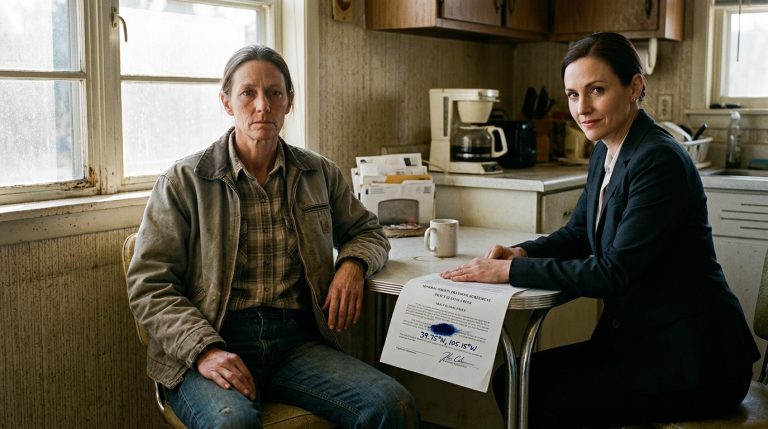
The silence in the cabin was thick, the kind that pressed against the eardrums. It wasn’t the natural quiet of the high woods, but a heavy, artificial stillness born from the realization that someone had been looking at my land and seeing a blank slate for their own ambition. I sat at the kitchen table, the binder open before me. The scent of the pages—stale paper, a faint trace of damp, and the sharp, chemical tang of high-quality ink—filled the air.
I didn’t reach for a coffee or a cigarette. I reached for a highlighter.
I needed to transform the abstract threat of the HOA’s letter into a concrete, tactical advantage. I started with the logbooks. Years of notes, scrawled in black ink, tracked the progression of the road’s construction. June 14th: Foundation set. Three loads of base rock. Culvert orientation matched to the natural drainage shelf. My own handwriting looked like a stranger’s, steady and focused, recording facts that were now the only weapons I had.
As I thumbed through the progress photos, a memory flickered—the physical vibration of the skid steer’s engine humming through my chest, the way the metal teeth of the bucket tore through the stubborn root systems of the mountain side. It was a memory of raw, tangible effort. The contrast between that violent, productive roar and the soft, neutral font of the courtesy notice I’d received made my jaw ache. They wanted to turn my labor into a concept, a “shared community asset,” because concepts were easier to dismantle than a roadbed of packed stone.
I laid the photos out across the table, creating a timeline. I needed to map my history against their intrusion. I wasn’t just organizing paperwork; I was building a barricade of logic. Every receipt for every ton of gravel was a pin in the map of my property. I checked the dates again. The construction logs predated the Aspen Veil expansion by half a decade. If they were claiming historic reliance, they were lying about the timeline. They were betting I wouldn’t have kept the records, or worse, that I wouldn’t have the patience to prove it.
They were wrong about the patience.
My mind started to run through the chess moves. To stop them, I needed more than just these papers. I needed a clear, undeniable demonstration of the boundary. I stood up, the chair scraping sharply against the wood floor, and walked to the window. Outside, the road curved down the slope, a dark ribbon of gravel against the green, and then disappeared into the treeline. It looked permanent from here, but I knew how easily boundaries could be blurred if left unmonitored.
I returned to the binder, extracting the original surveyor’s map. I placed it over the copy of the HOA’s “emergency route” map. I aligned the corner pins, my movements precise. There, under the harsh light of the kitchen lamp, the deception became clear. The HOA map had shifted the boundary lines of my turnout just enough to include the access point under the umbrella of their jurisdiction. It was a calculation, a subtle distortion designed to pass a casual glance.
I took a deep breath, the air cool and biting. The anger was still there, but it had cooled into something much harder, a tempered steel of intent. I wouldn’t shout at them. I wouldn’t argue the point in a meeting until I had the terrain on my side. I grabbed a notepad and began to write, not a letter, but an audit list.
GPS coordinate verification of every drainage culvert.
Cross-reference of excavation invoices with county permits (or lack thereof).
Secure the original machine logs.
Every step was a move to secure the ground. I felt the familiar weight of the mountain outside, the unyielding stone and earth that had been my partner in building this path. They wanted to steal it with language, to turn my property into a footnote in their community agenda. But paper was just paper. The mountain was something else entirely. I closed the binder with a firm snap, the sound echoing in the small room. The audit had begun, and I had no intention of losing the count.
CHAPTER 3: The Boardroom Theatre
The Aspen Veil community center smelled of expensive floor wax and recycled air. I stepped inside, the grit of the mountain road still clinging to the treads of my boots, a stark, tactical reminder of the ground I was there to defend. I wasn’t a member of the HOA—never had been, never would be—but the public-facing nature of these meetings meant the door was unlocked, and the air was thin enough for anyone to walk in and watch the sausage get made.
At the front of the room, behind a polished mahogany table that looked like it had been salvaged from a corporate boardroom, sat the governing body. Celeste Harmon was at the center. She wore a cream blazer that looked entirely too clean for the high altitude, her hands folded neatly on the table surface. She didn’t look like a thief; she looked like a librarian managing a collection of unruly books. Her stillness was the first thing I noticed. It wasn’t the natural repose of a calm person; it was a rehearsed, weaponized order.
I took a seat in the back row, blending into the shadows. My folder was tucked under my arm, heavy and grounding.
“We have several items on the agenda tonight,” Celeste said, her voice dropping into that smooth, practiced cadence that smoothed over disagreements like gravel under a heavy roller. “Chief among them is the wildfire preparedness initiative. We’ve been reviewing our access corridors to ensure, in the event of an emergency, our evacuation response is optimized.”
She didn’t look at me, though she knew I was there. She didn’t have to. The performance wasn’t for me; it was for the residents scattered in the folding chairs, the people who bought the dream of mountain living without knowing the cost of the ground beneath their feet.
I watched her hands. When she spoke about “optimization” and “shared responsibility,” her fingers didn’t move. She was performing stewardship, using the language of safety to insulate the board from accountability. It was a masterclass in administrative gaslighting. She was relabeling my private property as a public safety asset, and she was doing it with the calm confidence of someone who had already decided that the outcome was inevitable.
Ten minutes later, the mask slipped, just for a fraction of a second. An older resident in the front row stood up, asking a pointed question about the enforcement of trash-bin placement. The man was worried about his property value, about the aesthetics of the lane.
Celeste smiled, but it didn’t reach her eyes. “Standards are what protect the value of our community, Mr. Henderson. Without rigid enforcement, we are just a collection of cabins in the woods. We are something better than that.”
The coldness in that statement was visceral. She wasn’t talking about trash bins. She was talking about control. If she could enforce the placement of a garbage can, she could certainly dictate the use of a road. It was the same mechanism—the imposition of an aesthetic and administrative will over the physical reality of the land.
I opened my folder just enough to see the edge of the survey. I had recorded the meeting, the device hidden in my pocket, the audio clean and steady. Every word she spoke was being archived. She wanted order? I was going to provide it. I was going to document every scrap of her performance until the structure of her argument collapsed under the weight of the actual, physical truth.
A woman sitting next to me turned, noticing my notebook. She leaned in, whispering, “You’re not from the neighborhood, are you?”
“I own the land above the north turnout,” I replied, my voice low and dry.
She looked at me, a flicker of something—fear, perhaps, or pity—crossing her face. “They don’t like people who hold on too tightly. They say this place belongs to everyone.”
“It belongs to whoever holds the deed and does the work,” I said, not looking at her. My eyes were locked on Celeste.
Celeste was now talking about “temporary hazard controls.” She gestured toward a map projected on the wall—the same one I had seen in the letter. She spoke of “limited operational discretion.” It was bureaucratic jargon meant to obscure the fact that they wanted me to sign away my authority so they could occupy the road, slowly, until my ownership became a vestigial, unenforceable fact.
I sat there, the weight of the binder against my side acting as a counter-balance to the airiness of the room. I wasn’t going to interrupt. I wasn’t going to shout. I was going to let her build her house of cards until the structure was so high that it couldn’t survive the first gust of real evidence. The room was warm, the lights were too bright, and the air smelled of perfume and artifice, but underneath it all, I could still feel the phantom vibration of the skid steer, the solid, unyielding reality of the road I had built. I kept my notes, marking the time, the speaker, and the specific, poison phrases that would eventually be used to dismantle everything she was currently pretending to protect.
CHAPTER 4: The Gatekeepers
The drive back up the mountain was not a return to sanctuary; it was a return to the front line. I left the community center behind, the echo of Celeste’s voice still hanging in the back of my mind like thin smoke. She dealt in language, in the soft, polished lies of “optimization” and “resilience,” but as I pulled my truck toward the lower gate of my property, I was reminded that she also dealt in muscle. She was an architect of order, and the first piece of her design was the obstruction of my access.
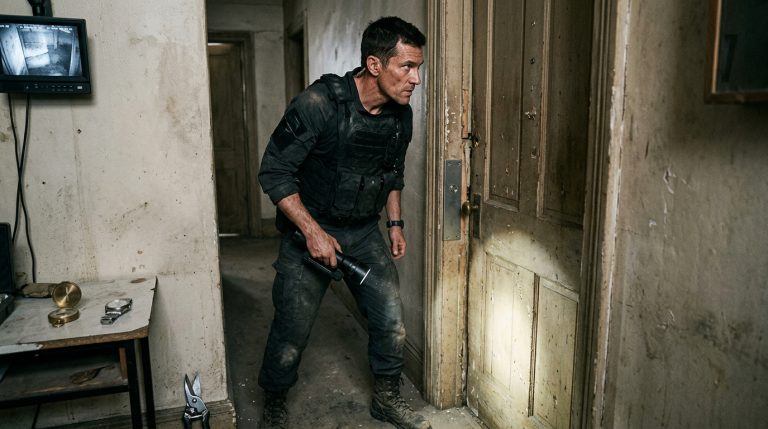
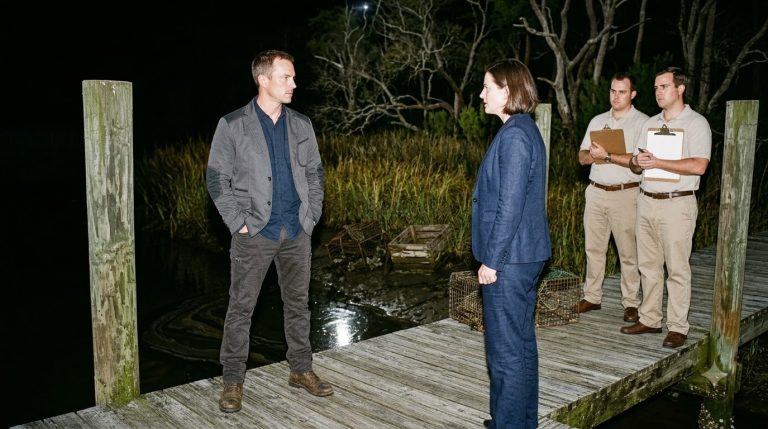
I slowed the truck. My headlights swept across the lower gate and settled on the scene: two men in high-visibility jackets, standing with the practiced, heavy stillness of contract security. They weren’t leaning on the fence or looking at their phones. They were waiting. A laminated sign was zip-tied to the crossbar of my gate, fluttering slightly in the night breeze. It looked official from ten feet away, carrying the bold, aggressive weight of a legal notice, but the longer I looked, the more the illusion started to fray.
There was no seal. No county insignia. No signature from the sheriff’s office. It was a piece of theatre, a prop meant to stop someone who didn’t know the difference between a real order and a printed bluff.
I killed the engine. The silence that followed was heavy, broken only by the ticking of the cooling manifold. I didn’t reach for a weapon, but my hand rested briefly on the gear shift—a familiar, cold surface that reminded me of the machinery I had used to carve this road into the mountain. I opened the door and stepped out. The mountain air was sharp, smelling of pine needles and damp, iron-rich earth.
The two men didn’t move as I approached, but their posture shifted. The older one, a man with a graying beard and eyes that had seen enough shift-work to be bored by it, took a half-step forward. He looked at me, then at the sign, his expression completely neutral.
“Private property,” I said. My voice was steady, pitched low. I didn’t ask a question. I stated a fact.
“We’re under board instruction, sir,” the older guard said. He kept his hands visible, loose at his sides. He wasn’t a fighter; he was a sentry, paid to stand in the way until the fiction of the sign felt like reality. “Temporary safety authority, pending boundary clarification.”
“By whose authority?” I stepped closer, stopping just short of the reach of his arms. I kept my phone in my pocket, the record button already engaged. “Show me the county order.”
He glanced at the laminated paper on my gate. It was a nervous, practiced movement. “We were just told to secure the route. Ms. Harmon’s committee. They said the boundary is in dispute.”
“There is no dispute,” I said. The weight of the folder in my truck seemed to pulse in my mind. I had the deeds, the receipts, the coordinates. I had the reality of the mountain while he had a piece of plastic zip-tied to a fence. “And there is no county authority here. There is only a trespassing claim you are currently helping them build.”
The younger guard stayed silent, his eyes flickering toward the dark woods behind me. They were uncomfortable—not with me, but with the lack of ground beneath their own instructions. They were being used as human placeholders, blocking the road until the HOA could convince the county that the gate was a public liability.
“Look,” the older guard said, his tone shifting toward a weary, transactional fatigue. “We don’t make the policy. We’re here until the route gets finalized. If you want to talk to someone, you talk to the committee.”
“I’ve talked to the committee,” I said. “And I’m talking to you. You’re standing on my property, enforcing a policy that doesn’t exist, under a banner that is a forgery. You want to be part of a lawsuit? Because that’s what happens next.”
I didn’t yell. Anger was heat, and heat burned out quickly. I needed the cold, hard pressure of procedure. I watched his face—the way his jaw tightened, the way his eyes tracked my calm demeanor. He was starting to see that I wasn’t an unruly neighbor. I was an audit.
I turned back to my truck, my movements deliberate. I didn’t ask them to move. I didn’t offer them a bribe. I simply started the engine, the roar of the diesel echoing against the canyon walls, and began to back the truck up, creating space. I wasn’t leaving. I was preparing. I took one last look at them—two men, dwarfed by the massive scale of the mountain, clinging to their authority like a lifeline—and felt a grim, dark satisfaction. They were already beginning to realize that the ground they stood on was rapidly shifting, and that by the time this was over, they would be the ones left holding the sign when the real authority arrived.
CHAPTER 5: The Drones Eye
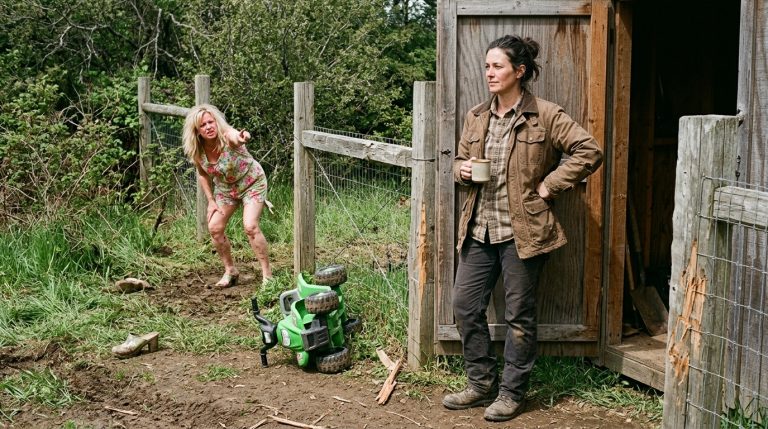
The sound was what hit me first—the sharp, discordant clatter of machinery working where no machine had a right to be. I didn’t get out of the truck immediately. I sat, my hands still gripping the wheel, watching the scene unfold four hundred yards upslope. A crew of three men was swarming over my turnout, the very spot where I had spent weeks hauling base rock and leveling the drainage shelf to ensure the road survived the spring melt.
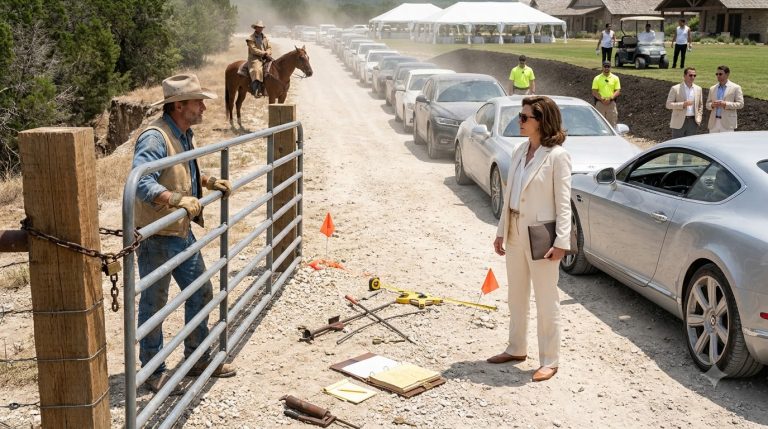
One worker held a saw, the sparks showering the dry grass in a bright, illicit display. Another was resetting survey stakes, his movements hurried, clinical. And there, standing safely on a patch of undisturbed dirt, was Celeste. She wasn’t holding a tool. She was holding a clipboard, her boots perfectly clean, pointing toward the slope with the casual detachment of an architect finalizing a minor adjustment.
The rage was there, a sharp spike of heat in my chest, but I suppressed it. Anger was a waste of momentum. I needed eyes on the ground, and I needed them to be objective.
I reached behind the seat and pulled out the flight case. The drone was a small, carbon-fiber piece of engineering, quiet and steady. I didn’t launch it from the truck—that would give them a warning. I stepped out, moving with the practiced silence of someone who knew every inch of this terrain. I tucked myself behind a cluster of ancient spruce, the needles damp and smelling of deep, undisturbed shade.
The controller felt familiar, its joysticks sensitive to the slightest pressure. I launched, the drone rising like a hawk into the thinning air. On the screen, the view shifted from the immediate forest to a wide, unforgiving angle of the entire hillside. I hovered, adjusting the gimbal until I had the entire excavation site framed in high-definition detail.
From this height, the deception was naked. I could see the trench line cutting deep into the shoulder of my road, a raw, angry red scar against the natural grade. I could see the steel pedestal they were guiding into a fresh form, a permanent anchor for a gate that wasn’t theirs to install. I moved the camera lower, zooming until I could see the foreman’s face, the sweat on his brow, and the way he looked toward Celeste for every instruction.
I recorded it all. I captured the drainage angle, the new post placement, and, most importantly, the exact, undeniable point where they had crossed my parcel boundary to relocate the choke point deeper into my land. It was a digital map of their theft.
“Who’s the client on this?” I muttered to myself, knowing full well the answer would be written in the rhythm of their work.
I didn’t stay hidden. Once the footage was secure, I landed the drone and packed it away with a methodical, cold efficiency. Then, I began the walk. I didn’t take the road; I took the east line, moving through the timber where I couldn’t be seen until I was within earshot.
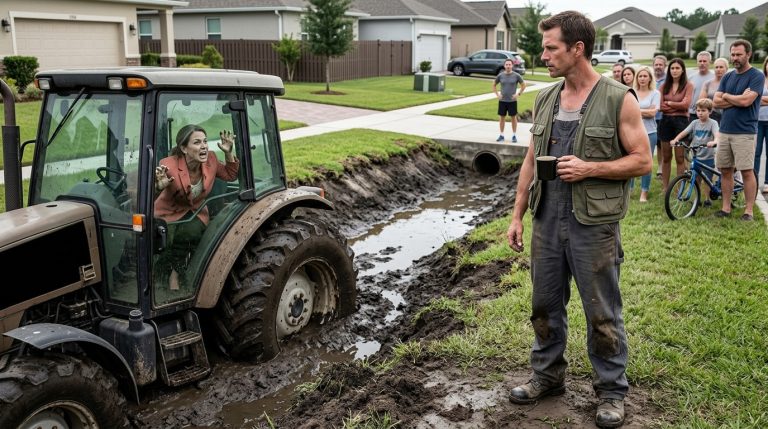
When I emerged onto the turnout, the foreman froze, his hand still on the lever of the hydraulic hammer. The sound of the machine died, leaving a ringing silence that felt heavier than the noise. Celeste didn’t flinch. She turned, her expression settling into a mask of polite, simulated surprise.
“You’re trespassing, sir,” she said, her voice clear and carrying over the wind. “This is an active work site. Aspen Veil Road Committee has authorized these improvements for safety.”
I didn’t acknowledge her. I looked at the foreman. His skin was pale, his eyes darting from me to the woman in the clean boots. “You have a county permit for this excavation?” I asked. My voice was calm, a sharp contrast to the mechanical violence that had been tearing up the slope seconds ago. “A utility permit? Grading authority?”
He looked at Celeste. It was a tiny, involuntary movement, a blink of hesitation that betrayed the entire hierarchy of their operation.
“We have committee authorization,” the foreman stammered, his hand letting go of the hammer as if it were suddenly too heavy to hold.
“Committee authorization isn’t law,” I said, pulling my phone out and framing them both in the shot. “But this is going to be evidence. You’re trenching on private land. You’re damaging private property. And every minute you continue, you’re just adding to the liability.”
Celeste stepped forward, her posture rigid. “You are harassing my crew. We are performing necessary maintenance on a shared corridor.”
I looked at her, not with anger, but with a flat, unwavering focus. “This isn’t a shared corridor, Celeste. And you aren’t doing maintenance. You’re doing damage.” I turned to the foreman. “Turn the machine off. Now. Before you make a decision that isn’t covered by their insurance.”
The foreman hesitated, his chest rising and falling in shallow, jagged bursts. He looked at Celeste again, expecting a command, a directive, something to hold the structure of their reality together. But I held the frame, the phone recording the truth of the broken earth and the silence of the trees. The mask of order was cracking, and for the first time, I saw the fear beneath the polish of her blazer. She was the one who had initiated the move, but it was the foreman who was standing in the dirt, and he was realizing, in real-time, that he had been left to hold the bag.
CHAPTER 6: The Paper CounterPunch
The foreman’s hand hovered, trembling almost imperceptibly over the ignition switch. He was caught between the tangible threat of my phone’s lens and the looming, cold authority Celeste projected from the sidelines. Celeste’s eyes flicked to me, then back to the man, her face a calculated study in aristocratic indifference. She didn’t shout. She didn’t have to. She was a conductor, and she expected the orchestra to continue playing even as the floorboards began to rot.
“You’re making a mistake,” she said, her voice dropping into a register of cool, polished condescension. “This is a registered community improvement. We have records.”
“You have fiction,” I replied, not breaking eye contact with the foreman. I kept the phone steady. “And fiction is about to get very expensive for everyone involved. If you move one more shovel of dirt, if you reset one more stake, that’s not just a trespass. It’s a willful act of property destruction. I have the drone footage. I have the geo-tags. I have your face, and I have the date and time.”
The foreman looked at his boots, then at the half-torn trench. He realized, finally, that he wasn’t just a worker following orders; he was a liability being groomed for a fall. He climbed down from the machine, his movements stiff and stripped of all the bravado he’d carried when he thought he was backed by the full weight of the HOA.
“We’re done,” he muttered, his voice barely audible over the wind rushing through the pines. He reached for his radio, his fingers clumsy, and clicked the transmit button. “Job’s stopped. Owner’s here. It’s a legal issue.”
Celeste’s posture didn’t change, but a muscle in her jaw gave away the tension. She reached for her phone, her thumb moving with the aggressive speed of someone drafting a defense. “You’ll regret this obstruction,” she said, though the words lacked their previous bite. It was a reflex, an attempt to reassert the narrative, but the narrative had just been cut off at the knees.
I didn’t argue. I didn’t gloat. I simply turned and walked back toward my truck, my boots crunching rhythmically on the gravel I had laid years ago. Every step was a tactical withdrawal, not a retreat. I had them pinned to the site of their own fraud, and the clock was now on my side.
Back in the cabin, the silence was different. It wasn’t the heavy, suffocating quiet of the night before; it was the sharp, humming silence of a gunned engine before the release of the clutch. I cleared the kitchen table, pushing aside the cold remains of a coffee cup to make space for the laptop. I opened the browser, the county’s public portal loading with agonizing slowness.
I wasn’t looking for a fight; I was looking for the flaw. I accessed the site, my fingers moving with the precision of a safecracker. I cross-referenced the site address with the excavation permit list. Empty. No grading permits. No drainage diversions. Nothing. The HOA hadn’t just bypassed the rules; they had assumed the rules didn’t apply to them because they believed they could rewrite the definition of “community necessity” to encompass anything they desired.
I began to draft the formal notice. I didn’t send it to the HOA—they had already shown they wouldn’t listen. I sent it to the county planner, the sheriff’s office, and a local land-use attorney who had a reputation for enjoying the smell of burning bureaucracy. I attached the screenshots, the drone stills, and the transcripts of the board meeting. I made sure every file was timestamped, a permanent, immutable record of the reality as it stood at this exact moment.
The process was rhythmic. It was the administrative equivalent of pouring concrete, setting the foundation for the coming storm. I wasn’t just defending a road; I was defining a boundary. When I hit ‘send,’ the screen blinked, a brief, silent confirmation that the packets of data were on their way. I sat back, the blue light of the monitor reflecting in the dark glass of the window, and listened to the mountain outside. The forest was calm, indifferent to the wars fought over its surface. But the paper—the cold, unyielding, documented truth—was already moving through the wires, destined for the desks of people who didn’t care about Celeste’s blazer or her performance of order. They only cared about the rules. And the rules were about to crash into the Aspen Veil Road Committee like a freight train.
CHAPTER 7: The County Hearing
The air in the county hearing room was stagnant, trapped by the weight of two dozen people waiting for a resolution that felt as inevitable as a rockslide. The room was a sterile grid of fluorescent lights, gray carpet, and the low, rhythmic hum of a ventilation system that couldn’t quite keep up with the tension. Celeste Harmon sat at the dais, flanked by her board members and a lawyer whose suit was sharper than his arguments. She was a picture of practiced composure, her hands folded on the table as if waiting for a tea service rather than a formal interrogation of her actions.
I took my seat at the back, the binder resting heavily on my knees. I didn’t need to look at it; I knew every page, every date, every invoice that proved the history of the ground they were trying to claim.
The county chair rapped his gavel, the sound flat and final. “We are here to address the petition regarding the access corridor at Aspen Veil. Let’s proceed.”
Celeste stood. She spoke with a voice that was practiced, modulated to sound reasonable, even civic-minded. She didn’t talk about land or dirt or engineering. She talked about “neighborhood resilience” and “emergency management.” She painted a picture of a community held hostage by the stubbornness of a single, non-member owner who failed to appreciate the greater good. She looked toward the dais, her expression one of pained, weary stewardship. She was performing the role of the victim, and it was almost convincing. Almost.
I waited. My lawyer caught my eye from the front row and offered a single, imperceptible nod.
“The floor is open for the property owner,” the chair said.
I stood up. I didn’t have a suit. I didn’t have a rehearsed, melodic cadence. I walked to the lectern, the floorboards groaning slightly beneath my boots. I didn’t look at the board members. I looked at the screen behind them.
“My attorney has the exhibits,” I said, my voice cutting through the stuffiness of the room. I reached into the binder and pulled out the first file. “We aren’t here to discuss community feelings. We are here to discuss facts.”
The lights dimmed. The drone footage filled the screen—high-definition, unflinching, and absolute. The trench, the false stakes, the discarded debris of their unauthorized grading—it all looked small and ugly against the scale of the mountainside. The room went silent. Celeste’s composure flickered, just for a second, her gaze darting to the screen as if she could turn it off with her will alone.
“No permits,” I said, gesturing to the portal screenshots. “No grading authority. No lawful reason to be on the parcel boundary.”
I brought up the old construction logs. The dates were clear, the ink—digitized and magnified—stark against the white background. “I built this road. I paid for the base rock. I managed the drainage. These aren’t opinions. They are the history of the terrain.”
Then, I brought up the overlay. My lawyer pulled the GIS base layer, matching it against the exhibit Celeste had submitted in her petition. The discrepancy was glaring. They hadn’t just made a mistake; they had shifted the digital markers by a dozen feet, carving out a slice of my land and re-labeling it as ‘common area’.
“This,” I said, pointing to the shifted line on the screen, “is the mechanism of the theft.”
The room was electric with the weight of the revelation. A ripple of whispered comments moved through the back rows. Celeste’s lawyer stood up, his face reddening, but the county chair waved him back down with a sharp, impatient gesture. I pulled the final document from the binder—the scope sheet the contractor had forwarded to us after he realized he was being turned into a fall guy.
“Present as pre-existing route during county walk,” I read, my voice steady. The words echoed, cold and instructional. “Professional, cold, and entirely fraudulent.”
Celeste didn’t look at me. She didn’t look at the screen. She looked down at the table, her hands, which had been so perfectly folded, now gripping the edge of the wood with a white-knuckled rigidity. She was no longer an architect of order; she was an architect of a collapse. The sheriff, sitting to the side, leaned forward, his gaze fixed on the scope sheet with the professional, hard-edged interest of someone who knew exactly what a case of documented fraud looked like.
“Any claim built on altered site conditions,” the sheriff said, his voice deep and cutting through the room, “is not something this office recognizes. And if these documents are what they appear to be, this isn’t a land dispute. It’s a criminal investigation.”
The air left the room. Celeste looked up, and for the first time, I saw it—not the mask of the stewardship, not the performance of order, but the raw, shaking reality of a woman who had realized that her version of the world had finally, irrevocably, run out of road.
CHAPTER 8: The Quiet Restoration
The drive home from the hearing was a blur of gray highway and thinning pines, but the exhaustion didn’t set in until I reached the base of the mountain. It wasn’t the kind of tiredness that sleep could touch. It was a structural fatigue, the feeling of a frame that had been held under immense pressure for months and was only now being allowed to relax.
I pulled up to the lower access point. The transition was absolute. No guards. No laminated signs fluttering in the wind like mocking birds. No trenching equipment bleeding oil into the turnout. Just the clean, hard edge of the gravel road I had built with my own hands, stretching upward into the dark canopy of the trees.
I parked the truck and got out. My boots hit the road with a solid, satisfying crunch. The morning air was thin and bitingly cold, carrying the sharp scent of cedar and high-altitude damp. I walked to the spot where they had attempted to relocate the gate—the very center of their administrative theater. It was quiet here, a profound, heavy silence that felt like the mountain itself had been waiting for the noise to leave.
I took the gate’s handle. The steel was cold, familiar, a solid weight that answered to my touch. It swung wide without a hitch, moving through its arc with the smooth precision I had calibrated years ago. They hadn’t just lost the fight; they had failed to even understand the nature of the thing they were trying to steal. They viewed the land as a collection of negotiable assets, a set of lines on a digital map, while I knew the reality was in the drainage culverts, the packed base rock, and the sweat that had soaked into the soil during the first, hardest season of the cut.
I reached for the post assembly—the one they had tried to mask with their false drainage controls—and began the work of final restoration. It wasn’t a battle anymore. It was maintenance. I tightened a bolt, the wrench singing against the metal, a sharp, metallic sound that seemed to signal the absolute end of the tension. I cleared away the last of the debris from their trenching—a handful of misplaced gravel and a few shards of orange marking tape—and tossed them into the back of my truck. The site was clean. The evidence of their arrogance had been erased, not by a lawyer’s decree, but by the simple, physical act of returning the earth to its proper shape.
That evening, I invited the people who mattered to the cabin. The attorney, the surveyor, and the old county roads inspector who had seen through the fraud from the first glance at the GIS overlay. We sat on the porch, the takeout barbecue containers lined up on the rail, the paper trays holding the weight of our shared, silent victory. We drank a bottle of bourbon, the liquid amber catching the fading light, and we didn’t make speeches. We didn’t have to.
I leaned against the railing, my eyes drifting down the grade I’d cut. The shadows were long, purple-black streaks across the turnout. I thought of Celeste, of the way her face had shattered when the truth was projected onto the screen behind her. I thought of the board, the endless, circular logic of their meetings, and the sheer, exhausting emptiness of their desire for control. They had wanted to turn my property into a footnote for their own sense of order, but they had forgotten that truth—real, documentable, physical truth—is not something you can shade into a different color on a map.
The inspector clinked his glass against mine. “You built it right, from the start,” he said. He didn’t say it like a compliment; he said it like a scientific observation.
“I built it to last,” I replied.
The night air grew colder, the stars beginning to puncture the dark overhead like pinpricks of white light. I realized then that I wasn’t feeling the surge of triumph I had expected. It was something deeper, quieter, and far more permanent. It was the feeling of a thing returned to its proper name. The road was mine. The boundary was fixed. And as I looked out at the silent, looming presence of the mountain, I knew that the labor had been the point all along.
I went inside and opened the binder one last time. I didn’t need to add anything. The case was closed, the file complete, the history intact. I set the book on the shelf, the weight of it anchoring the room. Outside, the wind moved through the trees, a rhythmic, steady pulse, the sound of the mountain taking back the silence. I sat in the dark for a long time, the cold seeping in through the walls, and for the first time in months, I didn’t feel the need to check the door. The boundary was set. The work was done. And the road, as it had always been, was ready for the next season of rain.