The Mineral Rights War: A Fight for the Inherited Soil of Rigidest Valley
CHAPTER 1: THE FORGED SIGNATURE
The silence in the kitchen was thick, tasting faintly of stale coffee and the dry, unsettled dust of the ranch. Lena Caldwell stood near the doorway, her posture precise, her presence an intrusion that felt as physical as a sudden drop in pressure. She didn’t belong in this kitchen. The linoleum was worn, the cabinets chipped—it was a space built for endurance, not for the polished efficiency she radiated.
She had dropped the envelope with a thud that echoed against the backsplash. I didn’t reach for it immediately. Instead, I kept my eyes on her, waiting for the shift in her expression that would betray her motive. It never came. Her smile was a thin, tight line—a calculated blade meant to cut through any attempt at protest.
“This land isn’t yours,” she said. Her voice was steady, practiced. It was the tone of someone who had practiced the line in front of a mirror until it felt like a universal truth. “The mineral rights were transferred to the HOA back in 2019.”
I pushed the envelope toward me with the tips of my fingers. The paper was crisp, expensive, and out of place in this room. I opened it. The documents were clean, formatted with a clinical coldness. At the bottom of the last page, the ink looked fresh.
I looked at the name: Uncle Roy.
My heart hammered against my ribs, a rhythmic, frantic sound in the quiet kitchen. Roy had been gone since September. The date on the document was March of the following year. I looked up at Lena, the logic of the situation grinding against the reality of my grief.
“My uncle had been dead for six months by the time this was signed,” I said. My voice was steady, a contrast to the storm rising in my chest. I wasn’t just angry; I was calculating. Every move she made was a piece on a board I hadn’t realized I was playing on until now.
Lena didn’t blink. She didn’t offer a hollow excuse or a sympathetic lie. She simply leaned forward, her eyes scanning the room as if she were already measuring the square footage for someone else.
“We’re giving you a choice,” she said. “Sign over the mineral rights, or we take it all. The legal fees alone will drain you before you even make it to a hearing.”
I looked down at the signature again. It was a perfect forgery, the loops and slants identical to his hand, but the intent behind it was rotten. A thought surfaced, sharp and cold: If she was willing to forge this, what else was buried in the county clerk’s archives that she hoped I’d never look for?
“You think this is just a transaction,” I said, finally meeting her gaze.
She turned to leave, her hand on the door frame, but she paused, looking back over her shoulder with a gaze that held no warmth. “I think you’re holding onto a ghost, and the living are moving on without you.”
She walked out, the screen door slamming behind her, leaving the house trembling. I looked down at the document, and then, for the first time, I noticed the smudge of ink on the margin of the second page—a set of coordinates that didn’t match the property lines of the ranch, but pointed directly toward the western creek bed.
CHAPTER 2: THE WESTERN BOUNDARY
The silence in the kitchen remained, but it had shifted. It was no longer the empty quiet of a lonely house; it was a pressurized chamber. I stared at the coordinates until the numbers burned into my vision. The western creek bed was a stretch of land my uncle had always avoided, a patch of rocky, unforgiving ground where the iron content in the soil made the grass struggle to grow. Why would Lena Caldwell, a woman who measured the world in profit margins, care about a patch of dirt that couldn’t even sustain a decent herd?
I grabbed my jacket and a heavy-duty flashlight, the weight of the metal familiar and grounding in my palm. The door hinge groaned as I stepped out into the twilight. The air was cooling, carrying the scent of dry earth and impending rain.
I didn’t have time to process the forgery further. As I rounded the corner of the barn, the sound hit me first: a low, guttural vibration that seemed to crawl up through the soles of my boots. It wasn’t the rhythmic chugging of a tractor or the hum of a pickup. It was heavy, industrial, and utterly alien to the valley.
I crested the ridge, my heart hammering against my ribs, and stopped dead.
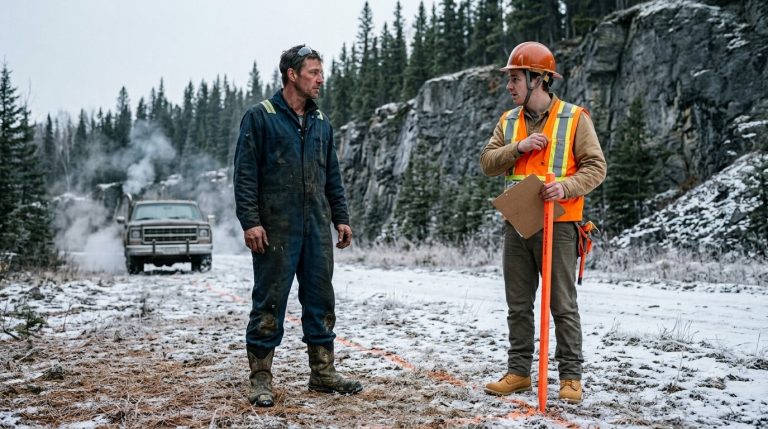
The western boundary, usually a quiet expanse of scrub brush and jagged limestone, was transformed. A perimeter of chain-link fence—raw, silver-gray metal that caught the fading light—had been punched into the ground with violent efficiency. The signs clipped to the mesh, RIDGEREST VALLEY HOA AUTHORIZED ZONE, flickered in the wind. Beyond the wire, the earth had been ripped open.
Large, yellow industrial excavators sat like sleeping beasts, their hydraulic arms folded into the dirt. A drilling rig, its mast silhouetted against the bruised purple of the evening sky, rose like a skeletal finger.
The violation was absolute. It wasn’t just a legal threat anymore; it was an act of physical annexation.
I moved forward, keeping low behind a line of dense, gnarled mesquite. My mind, trained by years of ranch maintenance and observing the subtle shifts in the landscape, began to catalog the intrusion. There were no permits posted on the fence. There were no survey markers, no flags. This was a smash-and-grab operation, the kind of work done in the dark to avoid eyes that might know better.
Then, the ground beneath me trembled. A heavy truck, its bed loaded with steel piping, rumbled along the makeshift access road they had carved into the side of the creek bed. I ducked into the shadows of a deep ravine, the smell of diesel and hot oil thick in the air.
I checked my watch: 7:14 PM. The crew was moving at a pace that suggested they expected an eviction, or worse, they were racing against a deadline I didn’t yet understand.
As the truck passed, the driver slowed near the gate, leaning out to exchange words with a man standing near the edge of the fence. Even from fifty yards away, I recognized the silhouette. It was Ray Bledsoe. He was holding a tablet, tapping it rhythmically against his thigh, his eyes scanning the ridgeline—my ridgeline.
I felt a cold prickle of realization at the base of my neck. They weren’t just drilling for oil; they were scouting the perimeter to ensure the boundaries were fully “secured.” If they moved the fence another fifty feet, they would bypass the creek and enter the core of the ranch’s water rights.
The frustration that had been burning since Lena left the kitchen turned into something sharp and cold. I wasn’t just defending a property title; I was defending the physical geography of my life. I adjusted my position, shifting my weight to keep my footing on the loose, shale-heavy slope. One misstep, one shift of rock, would give me away.
I watched them for another hour, observing the way they operated—not like a company, but like a tactical unit. They kept to the shadows, their movements synchronized. They didn’t work the equipment; they guarded it. The machines remained silent, waiting for an order.
As the moon began to rise, casting long, fractured shadows across the site, a realization hit me with the force of a blow. They weren’t waiting for the morning to start drilling. They were waiting for the cover of complete darkness to move the boundary markers.
My pocket vibrated. A text from an unknown number: The perimeter is the first lie. Check the survey records for the 2019 transition.
I looked back at the drilling rig. The fence wasn’t there to keep people out; it was there to hide the fact that the drilling had already begun in the one place no one would look: the dry bed of the western creek, where the limestone acted as a natural sound muffler.
The “development” was a cover. They were extracting, and they were doing it on my land, using my family’s history as a screen.
I turned back toward the house, my legs aching, the grit of the ranch floor under my boots feeling like the weight of a duty I hadn’t asked for but couldn’t walk away from. I had to reach Gene Hollister. If anyone knew what was really buried in that creek bed, it was the man who had lived on the other side of that boundary for forty years.
I started back, every muscle in my body coiled, the rust of the old ranch machinery in the barnyard now looking less like decay and more like a fortress gate I had to hold. I was no longer an observer of the HOA’s encroachment; I was the primary obstacle in their path, and for the first time, I felt the cold, hard satisfaction of a predator finding the scent of its prey.
CHAPTER 3: THE RECLUSES THRESHOLD
The walk back from the boundary line was a study in controlled tension. Every shadow cast by the mesquite looked like an intruder; every snap of a twig beneath my boot sounded like a signal flare. By the time I reached the main gate, my pulse had slowed into a steady, rhythmic thrum—the calm before the inevitable collision. I didn’t go into the house. The documents on the kitchen table were a dead end for now; I needed the living history of this valley.
I swung the truck into gear and pointed the headlights toward the far eastern edge of the property, where the fence line disintegrated into a tangle of rusted barbed wire and dead cedar. Gene Hollister’s place was less of a home and more of a watchtower. It sat on a rise overlooking the valley, a structure of corrugated iron and weathered cedar that had been slowly reclaiming the earth for decades.
I pulled up to the drive, killing the lights. I didn’t reach for the door immediately. I sat in the darkness, letting my eyes adjust, listening to the cooling metal of the truck ticking in the quiet air. Gene was a ghost in this town, a man who saw everything but spoke to no one. If he was protecting a secret about the western creek, it wouldn’t be because he wanted to—it would be because he was afraid of the men who had put that fence up.
I stepped out, my boots crunching on the dry, calcified limestone. Before I even reached the porch, the heavy thwack of a bolt-action rifle sliding home echoed in the night.
“Roy Wilson’s nephew,” a voice rasped from the gloom. It wasn’t a question. “You’re late.”
I stopped, hands raised, palms open. “I’m not here for trouble, Gene. I’m here because your fence line is the only thing standing between my land and a drilling rig that isn’t supposed to be there.”
“Drilling rigs,” Gene spat the words, the sound of a man spitting out grit. A shadow shifted on the porch, and the silhouette of a shotgun barrel lowered just enough to show me he wasn’t looking to kill—yet. “You think you’re the first to notice the earth moving under your feet? Your uncle Roy knew. He died keeping his mouth shut so you wouldn’t have to deal with the vultures.”
I stepped onto the first wooden plank of the porch. It groaned, a high-pitched protest in the stillness. “Caldwell is forging documents, Gene. He’s seizing land. He has people on my western creek right now, moving markers under the cover of night.”
“Caldwell,” Gene muttered, his voice softening into something like grief. He stepped into the sliver of moonlight filtering through the porch roof. He was a man made of sinew and scars, wearing a coat that looked like it had been patched with wire. He didn’t look like a savior; he looked like a man who had already lost everything and was waiting for the final tally. “You go looking for truth in a valley owned by a man who prints his own laws, and you’ll find nothing but a shallow grave.”
“I have the permits,” I said, leaning in. I could smell the faint, sharp scent of pipe tobacco and stale oil clinging to his clothes. “I have the forged signatures. I just need to know why they’re targeting the creek. What’s under there, Gene? It isn’t just oil.”
Gene went still. He looked down at the valley floor, his eyes tracking the faint, distant lights of the drilling rig. “It’s not what’s under the ground that matters, son. It’s what’s buried in the ledgers. You want to save your ranch? You don’t look at the dirt. You look at the bank that holds the HOA’s debt. Caldwell isn’t building a kingdom; he’s trying to pay for his funeral before the state finds out he’s been gambling with community funds.”
The revelation landed with the weight of a physical blow. The forgery, the intimidation, the rush to drill—it wasn’t just greed. It was desperation. He wasn’t expanding an empire; he was frantically trying to fill a hole in his balance sheet before the audit hit.
“Why tell me?” I asked, my voice barely audible.
“Because I’m tired of watching good men break their backs for a lie,” Gene said. He turned, disappearing back into the dark interior of the cabin, but he stopped at the door. “Talk to the County Auditor. Not the clerks—the Auditor. Look for the discrepancy between the land development grants and the actual disbursement of funds. And for God’s sake, stay off the western boundary. They have eyes on the perimeter now. If they see you again, they won’t use lawyers.”
He didn’t wait for a reply. The heavy thud of his door closing was final.
I stood on the porch for a long time, the cold wind picking up, rattling the corrugated tin of the roof like a warning. I had the motivation, I had the culprit’s secret weakness, and I had the location of the next move. But as I walked back to my truck, I saw a set of headlights cut through the darkness on the ridge opposite Gene’s property. They weren’t moving; they were watching.
They knew I had visited the recluse. The game had shifted from a legal standoff to a hunt. I climbed into the truck, the steering wheel cold and slick under my palms. I wasn’t going back to the ranch. If the Auditor was the key, I needed to be in the city by sunrise. I threw the truck into reverse, the tires spitting gravel, and felt the familiar, dangerous surge of a decision that could never be taken back. I was going to find that ledger, and I was going to pull the rug out from under Warren Caldwell’s entire life.
CHAPTER 4: THE AUDITORS LEDGER
The county clerk’s office was a tomb of paper, smelling of ozone, dust, and the slow, inexorable rot of administrative decay. I pushed through the heavy double doors, the chill of the air conditioning hitting my skin like a physical barrier. My clothes still carried the scent of Gene’s cabin and the dry, metallic dust of the western creek, and I felt entirely too exposed in this world of polished tile and flickering fluorescent lights.
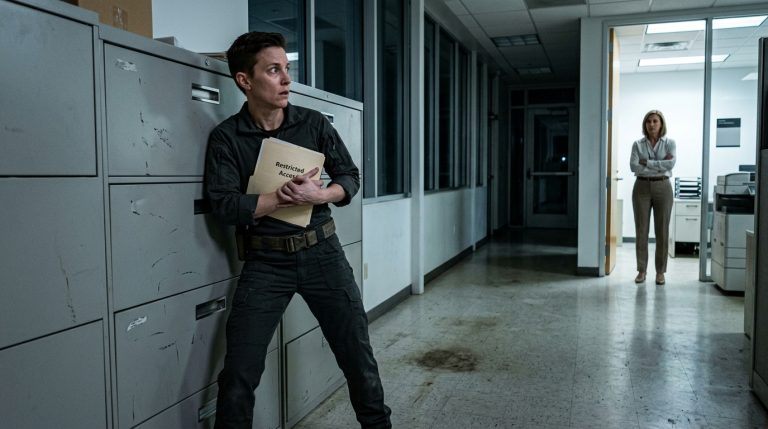
I didn’t head for the front desk. I knew the clerk, a woman named Miller whose loyalty was as flexible as the HOA’s budget. I kept my head down, moving toward the deep stacks of the archives—the place where the county kept the records that no one was supposed to ask for anymore.
I navigated the rows of metal shelves, the silence ringing in my ears. I wasn’t here for building permits. Gene had been specific: look for the discrepancy between development grants and disbursements. It was a needle in a haystack, but I had the date of the “transfer”—February 10th, 2019—a date that was now etched into my mind like a brand.
I found the box marked Ridgerest Infrastructure 2019-2020. It was heavier than it had any right to be. I pulled it down and set it on a scarred wooden table at the end of the aisle. My hands were steady, but the paper felt slippery under my touch.
I flipped through the files. The first few were mundane: invoices for paving, sewage upgrades that had never happened, and requests for zoning variances. Then, I hit the quarterly financial summaries.
The numbers jumped out. There were massive outflows of capital labeled “Emergency Maintenance Reserves.” These payments were being funneled into a shell company called Ridgeview Holdings—an entity that didn’t appear in the standard registry. I cross-referenced the dates of these payments with the dates of the forged documents.
They aligned. Every time the HOA “seized” a property, a corresponding payout was made to Ridgeview Holdings.
My breath hitched. It wasn’t development. It was liquidation. Caldwell wasn’t building the valley up; he was strip-mining the HOA’s capital reserves and funneling the money into his own private accounts to stave off a total financial collapse.
I reached for my phone to snap photos of the pages, but my gaze snagged on a single, out-of-place detail. It was a signature line on a grant disbursement form dated March 2019. It was signed by Warren Caldwell, but the ink wasn’t standard. It was a faint, watery blue—the kind of ink used by a printer, not a pen.
I lifted the paper closer to my face, squinting in the harsh light. The signature was a scan, overlaid onto the document. It was a digital copy, pasted onto a public record.
He hadn’t even bothered to forge it properly. He was moving so fast, so recklessly, that he was leaving a digital paper trail for anyone with the patience to look.
“You’re not supposed to be in that box, Mr. Wilson.”
The voice came from the end of the aisle. I didn’t look up immediately. I just slid the file back into the box, my movements slow and deliberate.
I turned. Miller stood there, her hands clasped tightly in front of her. She wasn’t holding a phone or a weapon, but the way she blocked the exit told me everything I needed to know. She wasn’t just a clerk; she was the gatekeeper for everything Caldwell wanted to keep in the dark.
“The records are public, Miller,” I said, my voice quiet, cutting through the hum of the archives. “Or have you forgotten the law while you were busy shredding it?”
“The law in this valley is whatever the board decides it is,” she replied, taking a step forward. Her eyes flickered toward the security camera in the corner—a device that had been dark since I walked in. “You have no idea what you’re messing with. Caldwell isn’t just protecting a project. He’s protecting a legacy that this county relies on. You take him down, you take the town’s credit, its infrastructure, its very survival down with him.”
“If survival is based on theft and forgery, then maybe it deserves to fall,” I countered. I picked up the box. It was heavy, but the weight felt right in my arms.
“You think you’re the hero,” she said, her voice dropping to a harsh whisper. “You’re just another variable we didn’t account for. And variables are easily erased.”
I didn’t answer. I didn’t have to. I stepped past her, my shoulders squared, the box pressed against my chest. As I walked toward the front doors, I could feel her gaze—cold and calculating—burning into my back.
I stepped out into the parking lot, the night air hitting me like a wave of reality. The city lights glowed on the horizon, but I didn’t see the promise of safety. I saw the scope of the problem. I had the evidence of his fraud, but now, I knew that the entire administration—from the clerk to the council—was tied into his survival.
I climbed into the truck and locked the doors, the silence of the cabin now filled with the sound of my own heartbeat. I had the proof that he was insolvent, a man running on nothing but stolen air. But Miller’s warning echoed in the quiet: Variables are easily erased.
I looked at the box on the passenger seat. The truth was here, but the cost of carrying it just went up. I started the engine, the engine roaring to life in the darkness, and pulled out into the empty street. I wasn’t going back to the ranch. There was a contact at the state level—the Attorney General’s office in Austin—and I knew exactly where I had to be by morning.
CHAPTER 5: THE FORENSIC GAMBIT
The drive to Austin was a slow-motion descent into the reality of what I had started. The box on the passenger seat—the evidence of Caldwell’s house of cards—seemed to hum with its own lethal energy. Every time a pair of headlights lingered too long in my rearview mirror, the hair on the back of my neck stood up, and I found myself checking the distance between my truck and the cars ahead, my fingers white-knuckled around the steering wheel.
I wasn’t just driving anymore; I was running. The realization settled in with a sick, hollow dread. Gene Hollister’s warning hadn’t been a prediction; it had been an observation. By the time I reached the outskirts of the city, the sun was beginning to bleed over the horizon, a bruised orange smear that did nothing to warm the interior of the truck.
I pulled into a nondescript office park on the edge of town, the location provided by Sandra’s contact. It was a place where things were kept quiet, exactly where a forensic examiner should operate. My hands felt stiff as I grabbed the box. The weight of it felt different now—not just files, but the future of the ranch, of the valley, and of every person in that town who was currently looking the other way.
I climbed the steps to the second floor. The door to suite 204 was unlocked. Inside, a woman sat behind a desk cluttered with high-powered magnifying lamps and digital scanners. This was Sarah Jenkins, the expert Sandra had vetted. She didn’t look like a savior; she looked like a mechanic for the truth.
“You’re the one with the land dispute,” she said, not looking up from her screen.
“I’m the one with the forgery,” I corrected, setting the box down on the clean, sterile workspace.
I opened it, and as I laid out the documents, the familiar scent of old paper filled the room—that dry, metallic tang that had haunted my nights for weeks. Sarah went silent, her hands moving with the practiced efficiency of a surgeon. She used a digital microscope, the screen showing the magnified structure of the ink on the forged mineral rights document.
“This ink,” she muttered, pointing to a pixelated ridge on the monitor. “It’s not from a pen, and it’s not from a standard toner cartridge. It’s an inkjet simulation, probably done with a high-end commercial printer. And look here—the pressure variance is consistent across every single stroke. A human hand has natural tremors, micro-fluctuations. This… this was a robotic overlay.”
She looked up at me, her face pale. “This wasn’t just a forgery, Mr. Wilson. This was a mass-produced, automated document fabrication. Someone has a template for this. They could do this to anyone in that valley.”
I thought of Uncle Roy, his calloused hands, the way he used to sit on the porch and trace the boundaries of the property with a stubby pencil. He had been so meticulous about his land. The idea that someone could turn his life’s work into a digital file, a template that could be printed and falsified on command, hit me with a surge of cold, nauseating rage.
I looked down at the documents, and suddenly, a memory flared—vivid and sharp. It was Uncle Roy, months before he died, standing by the fence line of the creek, his eyes narrowed as he watched a surveyor crew from the valley. He had muttered something about the “theft of shadows”—how they were measuring things that weren’t there, waiting for the land to be worth enough to steal. At the time, I thought it was just the rambling of an aging man. Now, it was a prophecy.
“Can you testify to this?” I asked, my voice tight.
“I can,” she said, “but you’re going to need more than just the signatures. You need the link to the printer, the source of the data. If this is automated, there’s a server somewhere. A database where they store these files.”
“I know where the paper trail ends,” I said. “The auditor’s office.”
But as I turned to pack the box, a sudden, sharp rap at the door shattered the quiet. Sarah froze. She looked at me, her eyes wide. We weren’t expecting anyone.
I reached for the door, my hand hovering over the lock, but before I could turn it, the frame shuddered under the force of a shoulder slamming against it. Someone was outside, and they weren’t interested in a conversation.
I backed away, scanning the room for an exit. There was no back door. The only way out was through the window, but we were on the second floor. The sound of a key—a master key, scraped roughly against the lock—made the metal scream.
“Get behind the desk,” I whispered, grabbing a heavy paperweight from the counter.
The door began to creak open, the lock mechanism failing under the pressure of the key. I wasn’t just an observer anymore. The war had moved out of the valley and into the heart of the city, and they had found me faster than I had ever thought possible. I was trapped in a room with a woman who held my only leverage, and the people on the other side of that door were coming to make sure that leverage never reached a courtroom.
CHAPTER 6: THE MIDNIGHT RAID
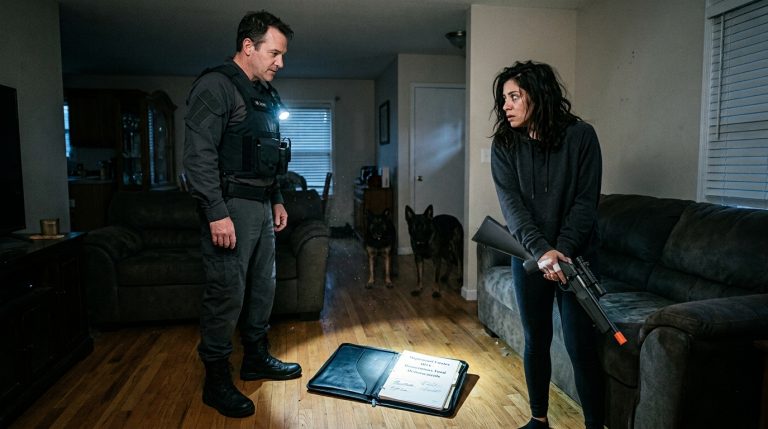
I didn’t wait for the door to finish giving way. I threw my entire weight against the wood, the impact jarring my collarbone. On the other side, there was a surprised grunt and the scrape of a boot on the linoleum. The door cracked inward, revealing a sliver of the hallway—and the silhouette of a man in a dark tactical jacket.
I didn’t try to close the door. I shoved it wider, catching the intruder off balance, and used the momentum to shove him back into the narrow corridor. He scrambled for footing, his hands flying toward his waistband.
“Sarah, go! Out the window—now!” I roared, the command ripping from my throat.
I didn’t look back to see if she obeyed. I knew if I hesitated, we were both finished. I lunged at the man, but he was fast, a shadow in the dim hallway light. He sidestepped my swing, his fist connecting with my ribs in a sharp, blinding punch that stole the air from my lungs. I crumpled, the floorboards cold and unyielding beneath my knees, but I didn’t stay down. I lashed out, grabbing his ankle, and twisted with everything I had left. He went down with a heavy thud, his radio skittering across the floor.
“Ridgerest control, we have a breach in the records suite,” he hissed into his collar, his voice laced with practiced calm.
I didn’t let him finish the transmission. I scrambled up, the pain in my side flaring like a white-hot wire, and delivered a kick to his wrist, sending his hand away from his gear. I felt the grit of the hallway dust under my knuckles as I pinned him, but I knew I couldn’t hold him. There were more coming. The heavy rhythm of boots began to echo from the stairwell—a sound like a clock ticking down to my destruction.
I looked toward the window. Sarah was already halfway out, her feet searching for the narrow fire escape ladder. I grabbed the box of evidence from the floor—the weight of it was the only thing that felt real—and scrambled to follow her. I hit the fire escape just as the office door was kicked wide open.
“He’s heading for the east ladder! Block the alley!”
The voice was cold, professional, and entirely devoid of hesitation. It was the sound of a machine that had been running for years, built to silence anything that disrupted its operation.
We descended the ladder in a frantic, clattering rush, the metal groaning under our combined weight. Below, the alley was a claustrophobic canyon of brick and shadow. I hit the pavement and didn’t stop, my lungs burning, the taste of copper sharp in my mouth. We sprinted toward the corner, but the beam of a spotlight cut through the darkness, illuminating the trash cans and discarded pallets in harsh, blinding white.
A black SUV screeched into the mouth of the alley, blocking our path.
“Stop! Now!”
I pulled Sarah into the shadow of a dumpster. My mind raced, stripping away the panic, leaving only the cold logic of the hunt. They weren’t shooting—not yet. They wanted the box. They wanted the evidence destroyed, and they wanted us to disappear.
I looked at the box, then at the layout of the alley. There was a narrow gap between the buildings, barely wide enough for a person to squeeze through—a shortcut to the main road where I’d left my truck.
“Listen to me,” I whispered to Sarah, my voice shaking with the effort to remain steady. “When I say go, you run for that gap. Do not look back. If you make it to the main road, the truck is the silver pickup, two blocks down. Drive. Don’t stop for anything.”
“What about you?” she hissed, her face pale in the reflected light.
“I’m the distraction,” I said.
I didn’t wait for her to argue. I grabbed a rusted pipe leaning against the wall, the rough texture of the oxidized iron biting into my palm, and hurled it toward the opposite end of the alley. The clang of metal against a dumpster rang out like a gunshot in the confined space.
The SUV tires screeched as the driver swung toward the noise.
“Go!”
Sarah bolted. She was a blur of motion, vanishing into the narrow dark gap. I waited one second, two, and then I stepped out, holding the box high as if I were about to run in the opposite direction.
“There! Stop him!”
I turned and sprinted toward the main street, the heavy box thudding against my side. The SUV surged forward, the engine’s whine rising to a fever pitch. I didn’t have a plan; I had a trajectory. I reached the corner and dove, not into the shadows, but into the thick, overgrown landscaping surrounding the office complex, where the mud was deep and the bushes were dense.
I heard the SUV slam to a halt, doors opening, boots hitting the pavement. They were closing in. I flattened myself against the wet, cold earth, the scent of damp soil and rotting leaves filling my nose. My heart was a drum, vibrating through the ground, but I forced my breathing to slow.
They passed within inches of where I lay, their flashlights dancing over the grass. I saw the flash of tactical gear, the glint of a sidearm. They were looking for a runner, not a ghost. I held the box tightly, the cardboard soft from the moisture of the mud. The truth was still in my hands, but the war had reached its breaking point. I was alone, out of options, and the only thing left to do was reach the Auditor’s office before they could trace the trail back to the source. I waited until their voices faded toward the far end of the property, then crawled, inch by agonizing inch, toward the road.
CHAPTER 7: THE COURTHOUSE SIEGE
The morning air in the city was sharp and unforgiving, a stark contrast to the humid, dust-choked reality of the valley. I stood before the tall, bronze-clad doors of the county courthouse, the weight of the cardboard box in my arms acting as a physical anchor. Behind me, the city woke up—the roar of traffic, the distant wail of sirens—but here, the silence was absolute.
I didn’t enter as a victim seeking justice. I entered as a man who had spent three days digging through the filth of a town’s secrets, and I carried the blueprints of their collapse in my hands.
The security checkpoint was a gauntlet of cold stares and clipped, professional commands. I kept my head down, my gaze fixed on the floor—the polished marble looking like a frozen lake that could crack under the wrong step. When the guard reached for the box, I didn’t hand it over easily. I held it with a grip that left white marks on the cardboard.
“Personal records,” I said, my voice sounding hollow in the echo of the lobby.
He didn’t argue. He just waved me through, his eyes flicking toward the entrance behind me.
I made my way to the third floor, where the presiding judge’s chambers were located. The hallway was narrow, lined with portraits of men who had long since turned to dust, their stern faces watching as I approached the heavy oak door. I had no appointment. I had no lawyer. I had only the truth, documented and undeniable.
Just as I reached for the handle, the elevator doors at the end of the hall chimed.
I didn’t turn around. I didn’t have to. I recognized the rhythmic, heavy click of expensive heels on stone. Lena Caldwell.
“You’re making a mistake that no amount of money can fix,” she said, her voice dropping into a low, resonant register that commanded the space around us. She was dressed in charcoal gray, her hair pulled back into a severe knot, her face a mask of iron-willed composure. “Do you think you’re the first person to walk through those doors with a box of ‘evidence’? Do you think the system you’re appealing to isn’t already part of the foundation we built?”
I stopped, my hand still resting on the cold metal handle. I turned slowly, my eyes locked on hers. She wasn’t just confident; she was vibrating with the strain of holding her world together.
“I’m not looking for your permission, Lena,” I said, my voice steady. “I’m looking for an Auditor who doesn’t answer to a community board.”
“The Auditor answers to the council,” she stepped closer, the scent of expensive, sterile perfume clashing with the dusty smell of the files. “And the council answers to the people who hold the debt. Do you have any idea how much money we’re talking about? How many homes in that valley depend on the credit lines the HOA secures? If you open that box, you aren’t just taking down my father. You’re taking down the town. You’ll be the man who burned the valley to the ground just to keep his own soil.”
She was trying to flip the narrative, to turn my own moral compass against me. It was a classic move—the predator playing the martyr. I felt the familiar, sharp bite of cold resolve in my chest.
“My uncle didn’t leave me this land so you could leverage it against the people you were supposed to protect,” I said, leaning in. “He left it to me because he knew you were rot. You didn’t build this valley; you harvested it.”
She didn’t retreat. She reached out, her fingers hovering near the edge of the box, as if she were tempted to rip it from my hands. For a second, the mask slipped—a flash of pure, unadulterated fear, the panicked look of someone who realizes the game is lost.
“Think about it,” she hissed, her voice trembling. “One signature. One donation to the right fund. We can make the drilling stop. We can return the rights. You win, and the valley stays intact.”
It was a bribe, plain and simple. A tactical surrender.
I looked at her, and for a moment, I saw the reflection of every lie she’d told. I saw the forge, the night raids, the intimidation of men like Gene Hollister. I saw the wreckage of a family’s legacy. I pulled the box back, away from her reach.
“The time for transactions is over,” I said.
I turned and threw the door open.
Inside, the room was cool, illuminated by the soft, gray light of an overcast morning. The Auditor sat at a desk covered in green-lined ledgers, his pen paused in mid-air. He looked up, his expression neutral, waiting for an explanation.
“My name is Wilson,” I said, setting the box onto the polished surface of his desk, the sound a definitive thud that echoed through the small chamber. “And I think you’re going to want to see what’s inside.”
Lena stood in the doorway, her shoulders slumped, her presence suddenly diminished. She had nowhere left to go, no more words to spin. I sat down in the chair facing the Auditor, my lungs aching with every breath, my body heavy with the exhaustion of a three-day war. The room was quiet, the only sound the rustle of paper as the Auditor began to turn the first page. The siege was over. The truth was finally, irrevocably, in the light.
CHAPTER 8: THE CONSERVATION COVENANT
The Auditor, a man whose skin seemed the color of old parchment, didn’t look up for a long time. He turned the pages of the ledger with a soft, dry rasping sound, his eyes darting across the columns of fake maintenance reserves and hollow shell companies. Outside the office, the world of the courthouse seemed to have gone mute. I stood by the door, my chest still heaving from the sprint, my knuckles raw and aching from the encounter in the hallway.
Lena was still there, leaning against the doorframe, her face drained of its professional veneer. She wasn’t fighting anymore. She was watching her father’s empire dissolve into a series of financial miscalculations and paper forgeries.
“The disbursement trail is clear,” the Auditor finally said, his voice quiet. He slid the ledger toward Warren Caldwell, who had arrived late, his face a mask of sweating, frantic indignation. “You didn’t just borrow against the land, Mr. Caldwell. You were liquidating the HOA’s operational budget to cover your own private leverage in a drilling venture that never even broke ground. You were insolvent before the first fence was even installed.”
Warren’s hands shook as he looked at the numbers. He tried to speak, but the words died in his throat—a stutter of excuses that wouldn’t hold up in the harsh, sterile light of the room. He wasn’t a mastermind; he was a desperate man who had gambled with a community’s trust to patch the holes in his own sinking ship.
“It was meant to be temporary,” Warren whispered, his voice cracking. “I was going to pay it back. Once the oil hit…”
“The oil didn’t hit because there was never any investment in the technology,” the Auditor replied, his gaze cold. “You were selling the promise of wealth to buy time against your creditors. That isn’t management, Mr. Caldwell. That’s fraud.”
The arrest followed within the hour. It wasn’t the chaotic, cinematic spectacle I had feared. It was quiet, bureaucratic, and final. Officers escorted Warren and his associates out through the side entrance, their hands cuffed behind them, their faces shielded from the cameras. As they passed me, Warren didn’t look at me. He looked at the floor, his entire posture collapsed, the weight of the truth finally forcing him to see the ruins he had created.
I walked out of the courthouse an hour later. The city air felt different—cleaner, stripped of the tension that had gripped me for days.
The months that followed were a slow, steady tide of restitution. The HOA was dissolved by a state-appointed board. The fraudulent liens on my land were voided, and the drilling equipment, having never been sanctioned, was seized as state property.
I returned to the ranch alone, the silence of the valley now a comfort rather than a threat. The first thing I did was walk the western boundary. The chain-link fence was gone, dismantled and carted away by the county, leaving nothing but the scarred, rhythmic holes in the dirt where the posts had been. I found a piece of twisted wire snagged on a mesquite branch—the last artifact of the “authorized zone”—and I pulled it free, feeling the sharp, rusted metal bite into my skin one last time before I cast it into the brush.
I spent the rest of the afternoon in the barn, the smell of dust and dry earth greeting me like an old friend. I found my uncle’s old, weathered compass on the workbench, its glass face cracked and its needle spinning erratically. I sat down and began the work of cleaning it, polishing the casing with a soft rag, repairing the tension in the hinge. It was a small, quiet act—a way to anchor myself to the land again, to acknowledge the weight of what I had inherited and the responsibility of keeping it whole.
Sandra Vance helped me file the conservation easement the following week. Sixty acres would stay untouched, the creek bed left to the scrub brush and the hawks, never to be carved up or drilled. The rest of the land I leased to a local cooperative. It wasn’t about the money. It was about creating a buffer, a way to ensure that the land remained a living thing rather than a commodity to be strip-mined.
The valley didn’t change overnight. The fear was too deep-seated for that. But people started talking again. Small businesses opened; the legal aid office Sandra managed became a hub for residents who had been intimidated for years, providing them the tools to stand up for their rights.
One evening, as the sun began to dip behind the ridge, I sat on the porch. The air was cool, smelling of rain on hot stone. I looked out over the property, the shadows lengthening across the fields. The fence was gone, the fear was receding, and for the first time in years, the valley felt like a place where things could grow. I had fought the machine, but I hadn’t become it. I had used the law to dismantle a lie, and in doing so, I had regained the only thing that actually mattered: the right to hold my own ground in peace.