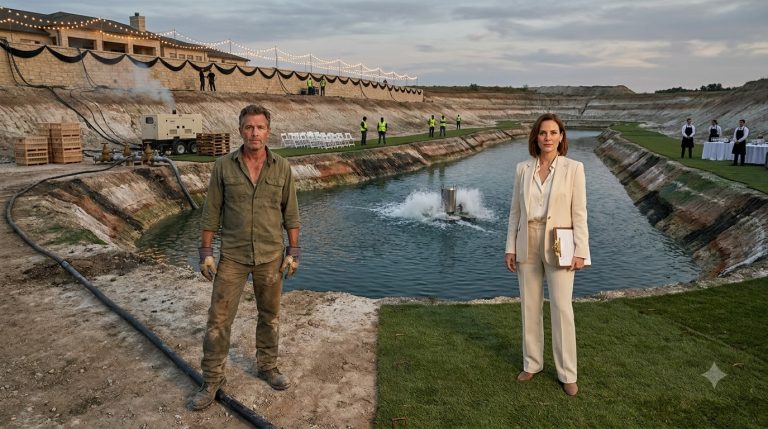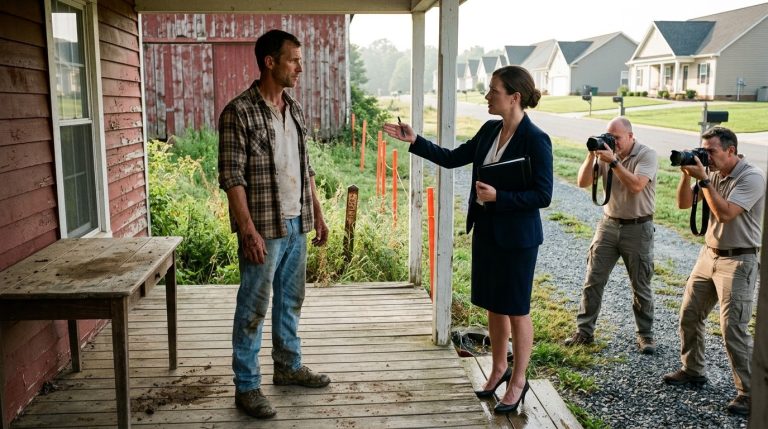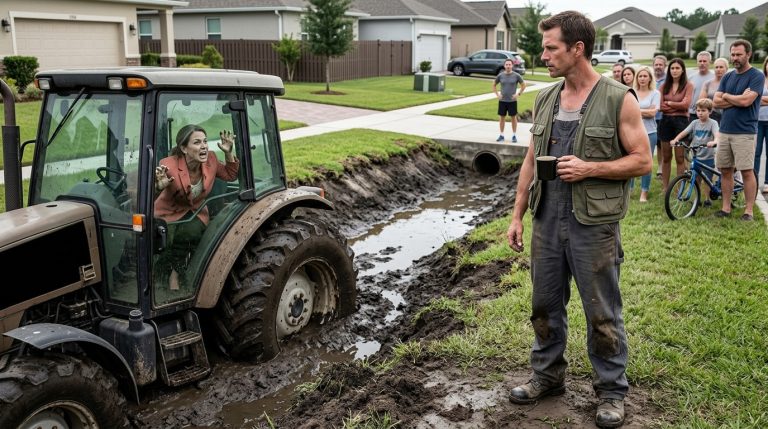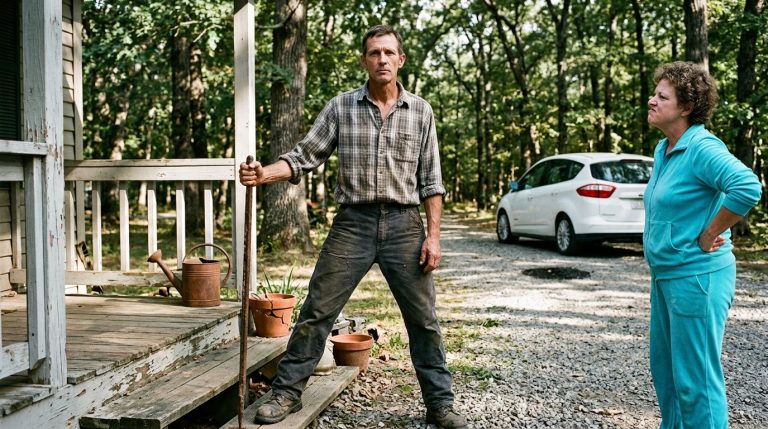
The Hydraulic Perimeter: A Calculated Stand Against the Empire of Hollow Promises and Stolen Land
CHAPTER 1: The First Convoy
The dust had barely settled from the morning dew when the horizon began to ripple. It wasn’t heat haze, and it wasn’t the shifting of the prairie grass. It was a rhythmic, mechanical thrum that vibrated through the soles of my boots. I stood on the porch of the farmhouse, the coffee in my mug still hot enough to sting, watching the impossible happen.
Eighteen vehicles. A rolling, chrome-plated snake of German engineering and excess, carving a path straight through the emerald green of my north pasture.
My pregnant heifers didn’t stand a chance of staying calm. They bolted, a panicked blur of hide and muscle, scattering toward the creek bed like buckshot hitting water. I didn’t yell. I didn’t reach for a rifle. I just tightened my grip on the coffee mug, the ceramic groaning under the pressure of my thumb.
They were live-streaming. I could see the high-end cameras mounted to the hoods, the gleam of lenses catching the morning sun, capturing my livelihood like it was nothing more than a scenic backdrop for a digital tantrum. One of the lead cars, a silver Mercedes G-Wagon with vanity plates screaming HOAP, slowed as it passed my security camera. The driver-side window slid down. A hand reached out, waving at the lens with the playful, mocking grace of someone who expected the world to bow.
They thought they were showing me the future of the neighborhood. They didn’t realize they were documenting the beginning of their own end.
I set the mug down on the weathered railing. It made a sharp, clean clack—a sound that carried no emotion, only intent. My father had taught me that when the ground gets violated, you don’t fight the earth; you fight the people trying to own it.
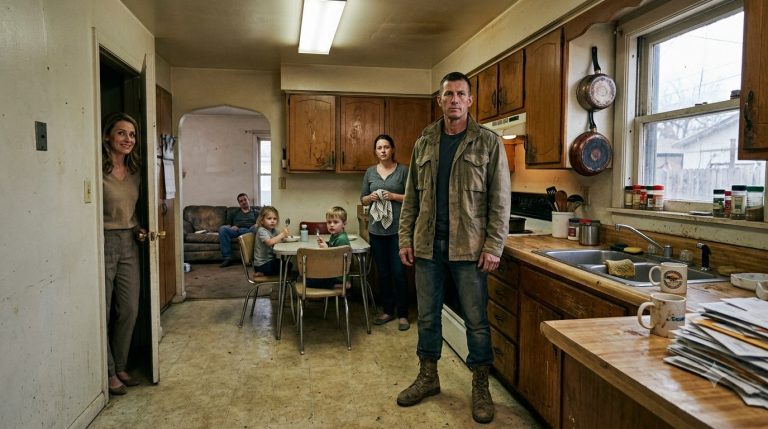
I walked into the kitchen, the floorboards creaking the familiar, weary tune of the 1890s, and stepped over to the wall-mounted console. My fingers moved with the muscle memory of twenty years of bomb disposal. I tapped into the sub-grid I’d installed the day I bought the place. I didn’t just watch the live feed; I mirrored it, recording the high-definition plate numbers, the faces behind the tinted glass, and the specific, arrogant geometry of their tire ruts.
As I watched them carve their path, I noticed something that stopped my breath. A single, perfectly straight line left by the lead vehicle, cutting through the mud of the bank. It wasn’t just a turn; it was a stake. They weren’t just driving; they were marking.
A shadow fell over the doorway. Emma, my daughter, stood there, her eyes fixed on the window. She didn’t look scared, just tired of the noise.
“Dad?” she asked, her voice barely a whisper. “Who are they?”
“They’re lost, Em,” I said, my voice steady, stripped of everything but the truth. “But they’re about to find out exactly where they are.”
I watched the screen again. The Mercedes pulled to a stop near the old oak tree, and the driver’s door swung open. A man in pressed khakis emerged, smoothing his shirt with a practiced, club-friendly flick of the wrist. He looked around as if he were already signing the deeds to my life. He hadn’t seen the cameras yet. He hadn’t seen the depth of the soil he was standing on.
He hadn’t seen the steel I had buried beneath it.
CHAPTER 2: The False Easement
The screen on my monitor pulsed with a quiet, persistent blue light, reflecting in the glass of the window where Bryce Kellerton still stood, his back to me. He was gesturing at the fence line—or where he pretended the fence line ought to be—with the casual arrogance of a man who owned the horizon. I didn’t wait for him to finish his pantomime. I stepped out onto the porch, the screen door clicking shut behind me with a finality that silenced the morning crickets.
“You’re standing on private property, Bryce,” I said. My voice was a low hum, steady as a plumb line.
He turned, the smile plastered across his face like fresh, cheap paint. He didn’t look like a man trespassing; he looked like a man conducting an inspection. He held a leather-bound portfolio under his arm, the kind that held nothing but empty promises and high-priced letterhead.
“Jed, good morning,” he said, his tone dripping with a practiced, country-club camaraderie. “I was just pointing out the natural flow of the local traffic. It’s a shame to see such beautiful land essentially cut off from the rest of the neighborhood. Willowbrook isn’t just a collection of houses; it’s a community. And communities need access.”
I walked down the steps, the gravel crunching under my boots—a hard, abrasive sound. I stopped three feet from him. He was taller, but he carried his weight in his posture, leaning in, invading the space like he was already measuring the square footage of my porch.
“Willowbrook isn’t an HOA, Bryce,” I replied. “It’s a subdivision with a mailing address and a set of bylaws that don’t reach my front gate. You know that. I know that. So, why are you really here?”
His smile didn’t waver, but his eyes—cold, restless, and constantly scanning—flickered toward the farmhouse. “There are… zoning considerations, Jed. Environmental studies that suggest this corridor is vital for the county’s long-term infrastructure. We’re prepared to talk about a prescriptive easement. It’s a win-win. We get the access, and you get to be a partner in the development of the valley.”
He handed me a document. The paper was heavy, cream-colored, and smelled faintly of expensive ink. I didn’t look at it. I watched his hands. They were soft, uncalloused, and currently, they were twitching, just a fraction of an inch, against the spine of his portfolio. He was vibrating with a specific, high-frequency anxiety that had nothing to do with zoning laws.
“Martha Hendris owned this land for thirty years,” I said, my gaze shifting from his hands to his throat. “She didn’t give you an easement. She didn’t even give you the time of day, and I’ve seen her records. You’re eight years short on the state requirement for hostile use, and you’re a full mile out of your legal jurisdiction.”
The air between us seemed to sharpen, turning brittle. Bryce finally dropped the facade of the friendly neighbor. He didn’t blink, but his jaw tightened, the skin pulling thin over his cheekbones. “Laws are fluid, Jed. They follow growth. And right now, this area is growing fast. It would be a real pity if you found yourself tied up in litigation for the next decade. Costs a fortune, you know. Legal fees, inspections, consultants… it can really drain a man’s resources.”
“Is that a threat?” I asked.
“It’s a projection,” he said smoothly. “I’m looking out for the interests of the valley.”
He turned and began walking back toward his G-Wagon, his gait confident, though I noticed him stumble slightly on the uneven ground near the cattle barn. He was already composing his next move in his head, already calculating how much pressure he’d need to apply to make the ‘old rancher’ fold. He didn’t look back. He didn’t need to. He assumed that once he’d laid the papers on the table, the outcome was inevitable.
I watched him go, the heavy chrome of the SUV catching the glare of the sun. He climbed inside, the door shutting with a dense, muted thud that sounded like a coffin lid. As he pulled away, leaving behind deeper ruts in my pasture, I felt the cold, hard logic of the situation settle into my bones.
He wasn’t here to build a road. He was here to secure a path through my life because he needed it for something else. Something he was hiding behind those environmental studies.
I looked down at the portfolio he’d left on the porch railing. I didn’t open it. Not yet. I just looked at the way it sat there, a foreign object in my home. The wind picked up, rustling the oaks, and for a moment, the silence of the ranch felt like a countdown.
Emma was standing in the doorway again. She looked at the portfolio, then at me. I saw the question in her eyes—not fear, but a sudden, sharp clarity. She’d heard enough.
“He’s not going to stop, is he?” she asked.
“No,” I said, turning back to the house. “He’s not. But he’s playing a game he doesn’t realize we’ve already mapped.”
I walked into the kitchen, the room feeling smaller, more intimate, a bunker of sorts. I moved to the counter and picked up the phone. I didn’t call the sheriff. I didn’t call a lawyer. I called Jake.
“Yeah?” Jake’s voice was crisp, professional, the voice of a man who lived in the weeds of financial crime.
“He just showed up, Jake,” I said, keeping my voice low. “He’s pushing the easement angle. Hard. Whatever is behind this, it’s not just land value. He’s in a hurry.”
“Good,” Jake said, a faint, metallic edge to his tone. “If he’s in a hurry, he’ll make a mistake. Keep him talking. Give him a reason to think he’s winning. And Jed?”
“Yeah?”
“Don’t give him an inch.”
I hung up, looking at the empty kitchen table. The silence of the house seemed to press in, a contrast to the roaring engines outside. The battlefield had been defined. Now, I just had to wait for him to trip over his own ego.
CHAPTER 3: The Shadowed Perimeter
The sun didn’t just set over the Texas prairie; it bruised the sky, bleeding deep purples and jagged oranges against the horizon. I didn’t go out to the porch to watch the twilight. Instead, I stayed in the dark of the living room, my eyes fixed on the grid of monitors. The house was quiet, save for the rhythmic tick of the grandfather clock in the hallway, but my senses were keyed to a different frequency. Every shift in the shadows on the screens was a potential breach.
I had spent the last hour adjusting the sensitivity on the motion sensors. It was tedious work, the kind of fine-tuning that required the focus of a bomb disposal technician. My hands were steady, but my mind was playing back the last twenty-four hours. Bryce’s stumble on the uneven ground, the way he’d gripped that portfolio—it was all pieces of a larger mechanism, gears that hadn’t yet locked into place.
I pulled up the feed from the rear fence line. The infrared camera rendered the world in shades of high-contrast grey, turning the oak trees into ghostly, gnarled silhouettes. I leaned closer. There.
A movement. A flicker of motion near the southern boundary, where the brush grew thickest. I toggled the zoom, the pixels sharpening into a grainy, flickering image. It was a vehicle, low-profile, creeping along the fence line like a predator circling a kill. I didn’t recognize the make, but the movement was unmistakable. It wasn’t the clumsy, aggressive intrusion of the SUVs from the morning. This was surgical.
I felt a cold prickle at the back of my neck. I grabbed the handset for the perimeter lights and hesitated. If I tripped them, I’d show my hand. If I didn’t, I was leaving the gate open to a ghost. I chose the middle path. I engaged the silent alarm—a low-frequency vibration that would register only on my handheld device, turning the entire ranch into a tripwire.
I walked to the kitchen, moving in the dark to avoid silhouettes against the windows. I checked the bolt on the back door. My hand brushed against the cool, steel latch, and I remembered Sutton Blackwood’s eyes. She hadn’t been taking pictures of the scenery; she had been cataloging the infrastructure, looking for the weak points in the grid.
Emma was sleeping, her breath slow and steady from upstairs, and I meant to keep it that way. I stepped into my workshop, a detached shed that smelled of dry earth and welding flux. I didn’t turn on the overhead lights. I used a small penlight to navigate to the workbench. My current project—a structural steel housing for the hydraulic system—sat half-finished under a canvas tarp.
I peeled the cover back. The steel was cold, waiting. I had the blueprints for the ballards locked in a fireproof safe, but the geometry was etched into my mind. Four feet deep. Reinforced concrete. The math was simple, the physics immutable: force against resistance.
I picked up a caliper and measured the thickness of the housing. Something wasn’t right. I’d been planning for a standard heavy-vehicle impact, but the footage of that second vehicle—the stealthy, low-profile one—suggested that Bryce wasn’t just relying on muscle. He was looking for a way under. He was looking for the bypass.
I set the caliper down and picked up a high-resolution printout of the satellite survey of the property. I spread it across the bench. My finger traced the line of the creek, a natural drain that snaked under my northern fence. If you couldn’t go through the fence, you went through the earth.
“Smart,” I whispered to the empty room.
I didn’t panic. Panic was for people who didn’t have a plan. Instead, I started mapping the drainage. I took a piece of chalk and began sketching the geometry of the creek bed on the concrete floor of the workshop. I needed to know the exact arc of the bank, the pressure points where the ground turned soft during the rainy season. If Bryce was planning to tunnel or divert, he’d choose the path of least resistance.
The air in the shop grew heavy, the scent of dust and oil thick in my lungs. My focus narrowed until the rest of the world ceased to exist. There was only the land, the math, and the encroaching shadow.
Suddenly, my phone vibrated. A pulse, rhythmic and sharp. A breach.
The notification came from the southern sensor, the one hidden inside the hollowed-out stump by the old barn. I didn’t rush. I moved with the slow, deliberate pace of a man who knew exactly what the terrain looked like in the dark. I grabbed a thermal scanner and stepped out into the night air.
The temperature had dropped, the prairie grass stiff with frost. I moved along the treeline, staying low, using the natural depressions in the soil to mask my approach. I reached the barn and flattened myself against the corrugated metal siding. I held the thermal scanner up, watching the screen.
There, in the center of the frame, was a heat signature. It was small, tight, and focused. It wasn’t an animal. It was a person, crouched down, their hands moving with frantic precision. They were digging, or perhaps planting—it was hard to tell from this distance. They were working on the ground right where the fence met the creek.
They weren’t here to vandalize. They were here to mark.
I stayed still, letting my heart rate settle into a steady, controlled rhythm. I wanted to see who it was. I wanted to know if this was Sutton, or if Bryce had hired someone with more… professional experience. I nudged the scanner to a higher resolution.
The figure shifted, turning their head toward the house. The glow from the screen caught the edge of a jacket—something synthetic, high-visibility, but muted. They reached into a pack, pulling out a device. A ground-penetrating sonar unit? My jaw tightened.
They weren’t just guessing. They were surveying.
I could have ended it there. I could have stepped out, shone the light, and made them run. But that would only flush them out. I needed them to think they’d succeeded. I needed them to believe they’d found the weak point in the armor.
I backed away, silent as a drifting leaf, leaving them to their work. As I retreated toward the house, the realization hit me with the force of a physical blow: the escalation wasn’t going to wait for a Tuesday morning or a dramatic entrance. It was happening now, in the silence of the night, while the rest of the world slept.
I reached the porch and looked back. The heat signature was still there, a bright, pulsing beacon in the darkness. I didn’t go inside immediately. I stood on the wood, the creaking board under my feet sounding like a warning, and felt the weight of the land beneath me. It wasn’t just dirt and grass. It was a fortress, and for the first time in my life, I felt the walls beginning to tilt.
I would let them mark their spot. I would let them think they had the map. But tomorrow, when the sun rose, I would be waiting for them at the only place they didn’t expect: the reality they were trying to build.
CHAPTER 4: The Catalyst
The morning mist clung to the prairie like a damp, suffocating shroud. I was back in the kitchen, the coffee pot whistling a high, thin note that cut through the silence of the house. On the table lay the “meeting minutes” Dorothy had slipped into my hand at the diner—a document so bland, so bureaucratically perfect, that it practically screamed of a cover-up.
Dorothy had pulled up in her ancient, gravel-chewing Buick, her eyes bright with a sharp, bird-like intelligence. She’d leaned across the seat and whispered, “They’re voting to take you down, Jed. They aren’t just building a road; they’re burying a million dollars of bad accounting under your topsoil.”
I poured the coffee, the steam curling into the stale air. I didn’t drink it. I watched the surface of the liquid, dark and still. My mind drifted—a dangerous luxury—back to a morning in the desert, twenty years ago, when the heat was a physical weight and the stakes were measured in seconds and blast radii. The discipline required to disarm a device was the same as the discipline required to survive this: you didn’t look at the whole bomb; you looked at the wires, one by one.
The phone rang. It was Dorothy again.
“They’re moving the timeline up,” she said, her voice dropping to that familiar, urgent register. “Bryce is holding an emergency board meeting at three today. He’s going to officially vote to authorize ’emergency environmental remediation’ on your ranch. It’s the pretext, Jed. They’ll bring the heavy machinery under the guise of an environmental audit.”
“Let them come,” I said, my voice as flat and hard as a paving stone.
“They’ll have the county permits, Jed. Bryce has the commissioner in his pocket.”
“They can have all the paper they want,” I replied, a small, humorless smile touching my lips. “But paper doesn’t stop steel.”
I hung up and set the phone down. The physical reality of the situation was crystallizing. Bryce wasn’t just bullying; he was escalating to a corporate-state hybrid tactic. He was using the machinery of the county to bypass the laws of property. It was efficient, it was cold, and it was entirely predictable.
I walked out to the garage, where the air smelled of ozone and oil. My gear was laid out on the workbench: the schematics for the hydraulic ballards, the legal filings I’d spent all night prepping with Jake, and the list of contacts for the local news outlets. I didn’t need a militia. I needed an audience.
I picked up a wrench, turning a bolt on the hydraulic actuator until it groaned under the tension. The work was precise, a physical manifestation of the control I was desperately trying to maintain. But behind the precision, a new layer of the mystery was unfolding. Dorothy’s information regarding the $300,000 bond for a road that never existed—that was the key. Bryce didn’t just want my land; he was covering a financial crater. If I could expose that, the road, the HOA, and the entire “environmental” facade would collapse under the weight of its own fraud.
I heard a car pull into the drive. I moved to the window, peering through the gap in the blinds. It wasn’t an SUV. It was a nondescript sedan, idling at the edge of the property. I watched as a man stepped out—not Bryce, not Sutton—but someone I recognized from the feed store. A local contractor, the kind of man who’d do anything for a contract. He stood there, holding a clipboard, looking at my fence line with a look of detached assessment.
He was the vanguard. The scout for the ‘remediation’ crew.
I didn’t confront him. I didn’t step outside to engage in a pissing contest. I simply watched him. I opened my notepad and recorded the time, the vehicle’s license plate, and the specific way he stood—his hands on his hips, his head tilted as if he were already measuring the depth of my soil for a foundation.
He stayed for ten minutes, his movements mechanical, almost rhythmic. He checked the fence, he took photos with his phone, and then he climbed back into his car and drove away, leaving behind a plume of dust that lingered in the stagnant air.
The pressure in my chest tightened. This wasn’t just a threat anymore; it was an active operation. The ‘decoy’—the road—was being dismantled in my mind, replaced by the grim reality of the embezzlement. Bryce was going to burn my ranch to the ground just to hide the fact that he’d been stealing from the people who trusted him.
I turned back to the workbench. I had three hours before the vote. Three hours to prepare for the inevitable arrival of the machinery. I picked up the radio and clicked the frequency I’d established with Jake.
“He’s sending the contractors,” I said, my voice low and controlled.
“I’m ready,” Jake replied, his voice coming through with the sharp, crystalline clarity of a man who’d been waiting for this exact moment. “The federal agents are monitoring the county records. The moment that vote is certified, the fraud becomes actionable. We just need to make sure they’re on the land when the order comes down.”
“They’ll be here,” I promised.
I walked over to the corner of the garage and pulled the tarp off the control panel. The red, industrial-grade button looked like a bloodshot eye. I had calibrated it for a three-second deployment. Not fast enough to kill, but fast enough to stop a bulldozer in its tracks.
The house felt like a pressure cooker. I went back inside, the floorboards groaning under my weight. I checked on Emma; she was sitting at the kitchen table, her school books open, but she wasn’t reading. She was watching the road, her eyes steady, her expression far more resilient than I’d ever been at her age.
“Is it happening today?” she asked.
“It’s starting,” I said, leaning against the counter.
“Good,” she replied, and for the first time in weeks, she smiled. It wasn’t a happy smile; it was a hungry one. The kind of smile you get when you realize you’ve been fighting a war you didn’t know you were in, and you’ve finally found the line of scrimmage.
I looked at the clock. 1:45 PM. The world outside was quiet, but the air felt charged, humming with the static of a storm that had already arrived. The game was no longer about property rights; it was about the architecture of justice. And for the first time, I wasn’t just waiting for the threat. I was building the answer.
CHAPTER 5: The Bait
The feed store was a temple of dry rot and ambition. I leaned against a pallet of alfalfa cubes, my movements loose but calibrated. The goal was simple: noise. I needed to broadcast my supposed desperation to a theater of gossips.
“Legals are killing me, Earl,” I said, loud enough for the men hovering near the seed corn to catch the frequency. I stared at the floor, letting my shoulders slump just enough to suggest a man reaching his breaking point. “Two hundred grand in litigation, and the county just filed another motion. I’m thinking about liquidating the north pasture just to keep the roof over my head.”
Earl, a man whose skin looked like cured leather, gave a sympathetic grunt. “That Bryce fella is a shark, Jed. Shouldn’t have let him get a foothold.”
“Maybe,” I muttered. “But a man’s only got so much fight before the bills drown him.”
I felt the shop’s bell ring—a thin, brassy sound that hung in the air. Sutton Blackwood stepped into the store, her presence a jarring note of high-end perfume and tailored ambition amidst the smell of fertilizer. She didn’t look at me immediately. She walked to the counter, her eyes sweeping the store with that professional, acquisition-specialist gaze. She was checking the room, gauging the audience.
I turned, pretending to be surprised. “Sutton. You a long way from the country club.”
“I heard you were having some trouble, Jed,” she said, stepping into my space. She didn’t whisper. She wanted the room to hear. “The board is concerned about your situation. We’d hate to see you lose the ranch to creditors. It’s bad for the neighborhood’s valuation.”
“Valuation,” I repeated, my voice tight. “Is that what you call it?”
“We’re prepared to offer a fair market exit,” she continued, sliding a thick envelope onto the counter. “It’s not what you paid, but it’s enough to clear your debts and walk away with your dignity intact.”
The room had gone silent. The seed-corn crowd was frozen, watching the transaction with the intensity of vultures at a carcass. This was it—the public display of weakness. I reached out and took the envelope. It was lighter than I expected.
Suddenly, a massive metal shelf behind the counter groaned. A rack of bagged supplement pellets—at least four hundred pounds—tilted, the metal brackets shearing off the wall. The crash was deafening, a cascade of dust and heavy paper that sent the regulars scrambling. A stray bag clipped Sutton, forcing her to stumble back into my arms.
“Jesus!” she shrieked, her composed facade shattering.
I steadied her, keeping my grip firm on her arm. “Easy,” I said, looking her dead in the eye. “Seems like the foundation is failing all over the place.”
She pulled away, brushing dust from her designer blazer, her face flushed with a mixture of fear and irritation. The accident was a pure, chaotic mechanical failure—a reminder that in this ranching life, even the infrastructure was tired of the status quo.
“I’ll have my people reach out,” she said, her voice shaking slightly as she regained her professional mask. She didn’t stay to chat. She turned and vanished out the door, leaving the shop in a state of stunned confusion.
I waited until she was in her Range Rover before I moved. I stepped outside. The parking lot was empty save for my truck and her vehicle. I saw her inside, hands shaking as she pulled out her phone. She started talking—fast, erratic, her gestures wide.
I didn’t need to hear her words. I had the small, flat microphone I’d pressed into the side of the envelope before I’d even walked into the store. I adjusted my earpiece, the audio feeding directly into the burner phone in my pocket.
“He’s folding,” Sutton’s voice crackled, clear as a bell. “He’s at the feed store talking about liquidation. It’s working. Bryce, he’s terrified. We don’t need the environmental audit if he’s already checking out. We can just force the sale by Tuesday.”
“And the others?” Bryce’s voice on the other end was a hollow, echoing drone.
“They’re already in escrow. If we get his pasture, the main road bypass is cleared. The bond money will be laundered through the acquisition account by Friday.”
I felt a rush of adrenaline so sharp it made my vision blur. There it was. The link between the bond, the acquisition, and the laundering. They weren’t just protecting a development; they were balancing a ledger of criminal debt.
I walked to my truck, my movements measured. I didn’t want to smile. I didn’t want to celebrate. I just felt a grim, cold satisfaction. They were so busy watching the man who looked like he was losing that they’d forgotten to check if he was actually in the game.
I started the engine, the roar of the diesel echoing against the flat, unforgiving landscape. I had the confession. I had the timeline. But the “butterfly” accident in the store had left a bad taste in my mouth. It was a reminder of how quickly the world could fall apart, and I needed to ensure that when it did, I was the one holding the hammer.
I drove out of the lot, checking my mirror. A black SUV—not Sutton’s—was sitting at the intersection, a block away. It stayed there, engine running, watching me pull onto the highway.
They were getting desperate. And desperation, as I knew from the core, was the ultimate variable. It made men predictable, but it also made them dangerous.
I didn’t head home. I headed toward the courthouse in the next county over. It was time to give the federal agents exactly what they needed to turn this civil dispute into a prison sentence. The trap was set, but the terrain was shifting. I checked my speedometer. 65 miles per hour. A steady, forward motion.
The weight of the land felt different now—less like an anchor, more like a launchpad. Bryce wanted a road? I was going to give him a tunnel, and it led straight to a federal cell.
CHAPTER 6: The Sabotage
The drive from the courthouse was a blur of grey pavement and the relentless, rhythmic thud of the tires. I had dropped the evidence with Jake—the recording, the records, the map of the diversion—but the silence in the truck felt heavier than it had before. Every mile back to the ranch felt like a betrayal of time itself.
When I crested the hill overlooking my north pasture, the sight stopped the breath in my throat. It was 12:23 AM. The moonlight was a cold, silver blade, cutting across the field and illuminating the dark forms of men moving near my cattle barn. They weren’t hiding. They weren’t stealthy. They were working with the frantic, jagged energy of men who knew their window of opportunity was closing.
I killed the engine a quarter-mile out. The silence that followed was absolute, save for the faint, metallic clinking of tools against steel. I stepped out of the truck, the night air sharp enough to burn the lungs. I didn’t reach for a weapon. I reached for the perimeter control unit on my belt.
Through the thermal optics, I watched them. Bryce was there. He stood by the barn, his silhouette unmistakable, holding a phone to his ear. I could see the light from the screen painting his face in ghostly blue. He was the conductor of this final, desperate act of destruction.
“Phase one complete,” his voice drifted to me through the receiver I’d rigged into the barn’s internal audio system, a ghost of a transmission. “Phase two launches at 7:30.”
My blood felt like liquid ice. They weren’t just sabotaging the fence; they were preparing to dismantle the watering systems, to poison the feed—a scorched-earth policy to make the land worthless, to justify the ‘remediation’ they’d sell to the county by morning. They were going to strip the value out of the property while I was still standing on it.
I moved forward, my boots finding the soft spots in the grass. My focus narrowed until there was nothing but the distance between me and the barn. I saw a man pouring a dark, viscous liquid into the feed trough—oil. The smell hit me even from fifty yards—the sharp, chemical bite of heavy lubricant. My cattle would drink that, and it would be the end of them.
The rage was there, a white-hot coal in my chest, but I suppressed it. Rage was a variable I couldn’t afford. I needed them committed.
I reached the edge of the tool shed, the metal walls cool and indifferent against my palms. I watched as they cut the main lines to the water pumps, the hoses coiling like dead snakes in the mud. Bryce walked toward the barn, his voice rising, a sharp, arrogant cadence that cut through the night. He was already rehearsing his victory, his mind probably already spent the money he’d siphoned from the development bonds.
Suddenly, my phone buzzed in my pocket—a text from Jake. The board meeting was a farce. They’re accelerating the acquisition for 6:00 AM. They know we have something. Be careful, Jed.
A realization struck me like a physical blow. They weren’t just sabotaging the ranch; they were setting a trap for me. They knew I was the one who had the leverage. They wanted me to intervene. They wanted me to be the ‘hostile’ element that justified the sudden, forceful takeover.
I looked at the barn, then at the irrigation controls. I saw another figure moving toward the electrical junction box—the man with the bolt cutters. He was about to cut the power to the house. If he did that, the security system would default to a local loop, and I’d lose my eyes on the property.
I didn’t wait. I moved, not toward the barn, but toward the junction box. I needed that power.
I lunged, my hand catching the man’s shoulder, twisting him around with the leverage of a man who’d spent twenty years moving weight. He gasped, his eyes wide in the dark, but before he could scream, I had him pinned against the transformer housing.
“Don’t,” I said, my voice barely a whisper, but carrying the weight of a judge’s hammer.
He didn’t fight back. He went limp, his face slack with fear. He was just a contractor, a man looking for a paycheck, way out of his depth. I pushed him away, toward the shadows. “Leave. Now. If I see you on this land again, you won’t be walking off.”
He didn’t need to be told twice. He scrambled into the darkness, his feet thudding against the dirt.
I turned back to the barn. Bryce was still there, his back to me, the phone to his ear. He was laughing—a thin, brittle sound that seemed to mock the very earth he stood upon. He thought he was untouchable. He thought the system he’d gamed would protect him from the consequences of his own greed.
I retreated into the darkness, my heart pounding a rhythm of cold, hard intent. I had the confession. I had the proof of the sabotage. And I had the hydraulic steel I’d been working on all week.
As I made my way back to the house, the light of dawn began to bleed into the sky, a pale, sickly yellow that promised no comfort. The battle lines were no longer drawn in ink or law; they were drawn in the soil of the pasture, in the damage to the troughs, and in the sheer, unadulterated hubris of the man standing by my barn.
I reached the house and locked the door, the sound of the deadbolt clicking home a final punctuation mark in the night. Emma was awake, sitting in the kitchen, her eyes fixed on the door. She didn’t say a word. She just looked at me, seeing the dirt on my jacket, the steel in my gaze.
“Is it time?” she asked.
“It’s time,” I said, moving to the control panel.
The sun was coming up. The cavalry was on its way—federal agents, deputies, news crews—but the field was mine for one last hour. And I was going to use it to turn their ‘phase two’ into a final, irreversible mistake.
CHAPTER 7: The Deployment
The air in the kitchen was thick with the scent of coffee and the sharp, ozone tang of the electrical panel. I stood before the console, my fingers hovering over the glass. 7:29 AM. The digital clock blinked in neon red, counting down the seconds of the life I’d built here. Outside, the pasture was a canvas of mist and shadows, but the sound was unmistakable: the low-frequency rumble of a dozen high-displacement engines waking up at the property line.
They were coming.
I looked at the monitor. The lead vehicle—the silver G-Wagon—was idling at the fence line, its headlights cutting through the fog like twin daggers. Behind it, a phalanx of SUVs and utility trucks sat in a disciplined, aggressive line. Bryce Kellerton wasn’t just bringing men; he was bringing a broadcast. I could see the camera crews, the drones buzzing like angry hornets, the entire apparatus of his manufactured empire ready to capture my ‘eviction’ for the world to see.
My hand moved to the primary toggle. My heartbeat was a steady, rhythmic thud against my ribs. There was no room for hesitation, no space for the ghosts of the desert to haunt this moment. It was purely physics.
7:29:45.
Emma stood in the doorway. She wasn’t watching me; she was watching the pasture, her posture rigid, her hands tucked deep into the pockets of her hoodie. She wasn’t afraid. She was waiting.
“They’re crossing the marker, Dad,” she said. Her voice was thin, but it didn’t tremble.
I didn’t answer. I watched the screen. The G-Wagon moved forward, tires biting into the mud, crossing the threshold of the easement they claimed was theirs. They were accelerating, a slow, predatory roll that gained momentum as they entered the pasture. They wanted the spectacle. They wanted the drama of the ‘hostile holdout’ being crushed by progress.
7:29:55.
My finger applied pressure to the switch. The LED warning lights at the perimeter, buried deep in the soil of the pasture, flared to life—a series of brilliant, strobing amber flashes that cut through the morning gloom. I saw the G-Wagon’s brake lights flare red in response. Bryce had seen them. He hesitated, but only for a fraction of a heartbeat. He assumed it was just more theater. He assumed I was a man who would talk, a man who would argue, a man who would eventually move.
He didn’t know what it meant to reach the end of the line.
7:30:00.
I flipped the switch.
The sound was instantaneous—a deep, tectonic groan of structural steel meeting resistance. The ballards didn’t just rise; they punched through the earth, four feet of reinforced concrete and hardened steel slamming upward in a perfect, three-second arc. The impact was violent, a seismic tremor that I felt through the floorboards of the house.
The silver G-Wagon, doing thirty-five miles per hour, hit the steel pillar with the force of a falling anvil. It didn’t bounce. It buckled. The front end of the SUV folded like wet cardboard, the chassis twisting as the kinetic energy was instantly arrested. The vehicle groaned, lifted into the air, and flipped, a slow-motion cartwheel of chrome and shattering glass.
Behind him, the chain reaction was immediate. The Range Rover behind the G-Wagon didn’t have time to stop; it slammed into the wreckage, its nose diving into the mud, the frame snapping like a dry twig. A pickup truck, swerving to avoid the pile-up, hit a soft patch of ground near the creek, lost its footing, and plowed nose-first into the cattle pond, water spraying into the air in a muddy, chaotic fountain.
The silence that followed was absolute, a sudden void where the noise of the engines had been. Then, the screaming started.
I didn’t move. I kept my hand on the console, my eyes locked on the monitors. Bryce was alive—I could see his hand clawing at the broken glass of the Mercedes’s window, his movements jagged, terrified. The empire had collided with reality, and the friction was lethal.
“Dad?” Emma asked.
“It’s over,” I said.
I walked out onto the porch, the air now filled with the acrid, metallic smell of ruptured radiators and the distant, approaching wail of sirens. The federal agents, the deputies, the news crews—they were already cresting the hill, their flashing lights forming a chaotic, multicolored garland around the scene of the collapse.
Bryce stumbled out of the wreckage, covered in glass and engine coolant, his khakis torn and soaked in mud. He looked toward the house, his eyes wild, searching for someone to blame, someone to shout at, someone to reclaim his authority from. He saw me standing on the porch. He opened his mouth, his face twisting into a mask of pure, unadulterated fury.
He didn’t get the chance to speak. The first cruiser skidded to a halt in the pasture, the doors flying open. Margaret Smith, the forensic accountant I’d been working with, was already out of the lead sedan, a file folder clutched in her hand like a weapon. She walked straight past me, heading for the crumpled Mercedes.
I didn’t follow her. I stayed on the porch, watching the scene unfold. It was a demolition derby of greed, a landscape littered with the wreckage of a lie. I looked at the steel ballard, standing firm and unmoving in the mud, a perfect, silent sentinel. It had held.
The weight of the last few months seemed to lift from my shoulders, replaced by a strange, quiet clarity. The war wasn’t won with guns or shouting. It was won by knowing the terrain, by respecting the laws of physics, and by waiting for the moment when the arrogance of the bully finally outran his ability to survive it.
I turned back to the house. The interior was still quiet, the coffee pot still whistling a soft, low note. I picked up my mug, the ceramic warm against my skin, and looked at the kitchen table. The documents, the files, the maps—they were all just paper now. The truth had been written in steel, and for the first time in twenty years, the silence of the ranch wasn’t a mask. It was home.
CHAPTER 8: The Aftermath
The morning sun finally cleared the oak trees, painting the battlefield in a harsh, unforgiving light. The pasture was a wreck of twisted metal and churned mud, but the air felt scrubbed clean. Bryce Kellerton sat on the bumper of a deputy’s cruiser, his head in his hands, his expensive clothes stained by the very earth he’d tried to steal. He looked smaller than he had twenty-four hours ago, his “country club confidence” stripped away like the paint on his wrecked Mercedes.
I stood on the porch, my hands deep in my jacket pockets, watching as Margaret Smith laid out the documents for the lead federal agent. She was precise, methodical, her voice carrying across the quiet space like a lecture. She pointed to the bond records, then to the fake environmental studies, and finally to the ledger showing the siphoned millions. It was all there—the architecture of a fraud built on the assumption that no one would bother to look beneath the surface.
Bryce didn’t fight back. He didn’t even look up when they read him the charges. He was a man who had staked his entire existence on the belief that authority was a performance, and now that the curtain was down, there was nothing left behind it but fear.
The agents led him toward a transport van. He stumbled once, his foot catching on a piece of debris, but he didn’t protest. He just climbed inside, the heavy steel door shutting with a sound of permanent finality. Sutton Blackwood, held in the back of another vehicle, caught my eye through the window as they pulled away. She didn’t look angry; she looked tired—the kind of exhaustion that comes from realizing the game you were playing was rigged from the start.
I stepped off the porch and walked out into the pasture. The ground was scarred, deep ruts marring the grass, but the cattle had already returned to the creek, their heads down, grazing as if the chaos of the last few hours had never occurred.
I reached the site of the primary impact, where the steel ballard still stood, a dark, immovable pillar in the mud. I placed my hand against the cold metal. It was a sturdy, honest thing. I’d spent months designing it, months pouring the concrete and calibrating the lift, and it had done exactly what it was meant to do. It hadn’t been about revenge; it had been about boundaries. It had been about showing that a man’s home, his land, and his peace were not for sale to the highest bidder of lies.
“Jed?”
I turned. Emma was walking toward me, her step light and easy. She stopped a few feet away, looking at the wreckage of the vehicles.
“They’re gone,” she said. It wasn’t a question.
“They are,” I replied.
“What now?”
“Now,” I said, looking out toward the horizon where the fence line remained intact, “we get to work.”
We spent the rest of the day in a quiet, steady rhythm. We started by dragging the smaller bits of metal and glass from the pasture. It was physical, grounding work. My muscles ached, but it was a good, honest ache. Every piece of debris we removed was a victory. Every hour we worked was an hour reclaiming the land.
By late afternoon, I found a tool that had been bent during the sabotage—a heavy-duty gate latch that had been wrenched from the barn by the men I’d seen earlier. I took it back to the workshop. It took an hour of hammering, heating, and careful alignment in the vice, but I finally got it straight. I reattached it to the gate, the metal clicking into place with a satisfying, familiar snap. It was a small thing, but it was fixed. The ranch was whole again.
We sat on the porch as the sun began to dip, the sky turning a soft, bruised purple. The air was cool, the wind through the oaks carrying the scent of damp grass and incoming rain. General Patton, my dog, rested his head on my boot, his breathing deep and steady.
Peace felt different this time. It wasn’t the silence of someone who had successfully ignored the world; it was the quiet of someone who had faced it, held his ground, and survived. I thought about the families who hadn’t made it, the ones who had sold because they felt alone. I realized then that the only way to stop a bully wasn’t just to be strong; it was to document, to prepare, and to refuse to believe that their power was anything more than a bluff.
I looked at Emma. She was reading a book on agricultural law, her brow furrowed in concentration. She wasn’t just my daughter anymore; she was a witness to the fact that you didn’t have to be loud to win. You just had to be right, and you had to be willing to do the math.
I closed my eyes and listened. The cattle were lowing by the creek. The wind was sighing in the trees. The ranch was silent, but it was a full, rich silence—the sound of a life earned, a perimeter secured, and a debt finally paid.
Sometimes, justice isn’t a strike of lightning. Sometimes, it’s just a post rising from the ground, right where it belongs. I reached over and rested my hand on the porch railing, feeling the wood vibrate with the strength of the house, and I finally understood that while the empire had fallen, the land would remain.