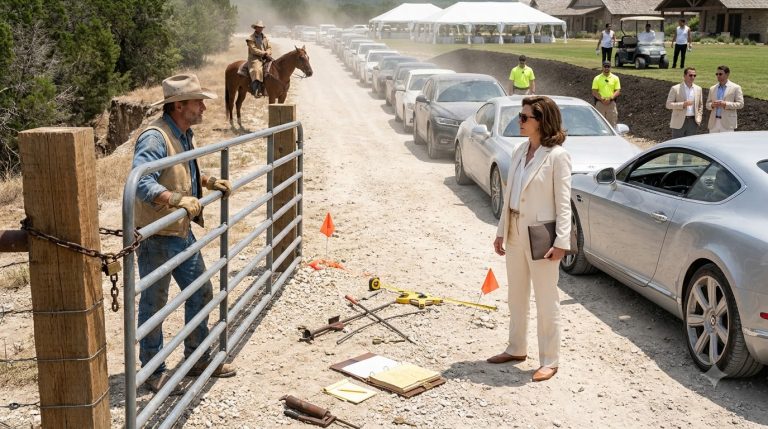
Unyielding Dust And Rusted Levers: How One Soldier Reclaimed His Rusted Homestead From Bureaucratic Fraud
CHAPTER 1: THE KITCHEN INTRUSION
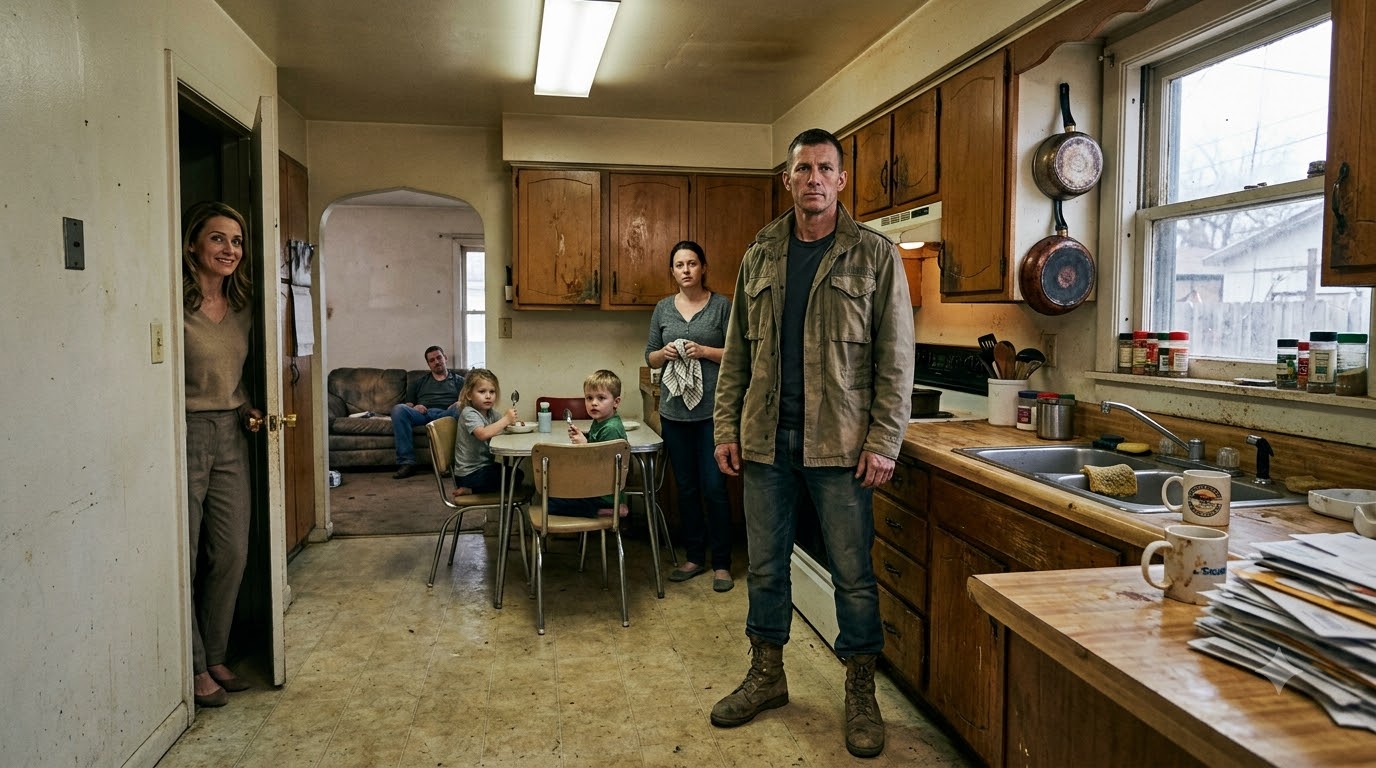
The desert dust was still packed deep into the treads of my combat boots when I pushed the back door open.
The kitchen air was heavy with the smell of cheap butter and scorched whites.
A woman I had never laid eyes on stood by the stove, flipping eggs in my dead grandmother’s heavy iron skillet.
To my left, a man had his muddy sneakers propped up on the arm of my living room couch like he owned the deed.
Two kids sat at the dining table, cereal spoons frozen halfway to their open mouths, staring at me as if a ghost had just walked through the screen door.
“Who are you people?” I asked, my voice flat, every muscle in my neck locking tight against the sheer absurdity of the scene.
The woman at the stove didn’t flinch.
She turned around, wiped her hands on a dish towel, and looked me dead in the eye with an expression of supreme, unearned annoyance.
“Excuse me, sir, but you’re trespassing,” she said, her tone dripping with the confidence of someone reciting a script she had practiced in the mirror.
She reached for a clipboard on the counter and flashed a lease bearing my exact street address.
Her husband gave a lazy shrug from the couch, offering no apology, just a blank stare.
Before I could answer, the sharp, rapid-fire clack of high heels echoed across the hardwood in the hallway, accompanied by an overwhelming wave of cheap vanilla perfume.
Margaret.
Of course it was Margaret, stepping through the front entryway with her white Lexus SUV sitting proudly in my driveway.
“Jake, you’re back early,” Margaret said, her voice dripping with artificial sweetness as she adjusted her designer purse.
She didn’t look surprised; she looked inconvenienced, like a manager interrupted during a lunch break.
“You know, abandonment requires proper HOA procedures,” she added, waving a hand dismissively at the kitchen.
Abandonment.
That was her word for eighteen months spent dodging incoming fire in a foreign desert while keeping my mortgage payments on automatic draft.
I looked at her, really looked at her, feeling the cold, hard weight of reality settle into my chest.
She thought she had managed every variable, leaning on the assumption that a deployed soldier would come home tired and compliant.
She didn’t realize the kind of patience eighteen months of silence teaches a man.
CHAPTER 2: THE PAPER TRAIL
I didn’t waste time shouting after her.
Instead, I dropped the wrench onto the scarred wooden workbench in the garage and reached for my truck keys.
The county records office sat downtown in a brick building built to outlive any bureaucrat who ever worked inside it.
I walked past rows of humming fluorescent lights straight to the public archive counter, where the air always smelled of old paper and dust.
The clerk on duty didn’t look up when I slapped my identification down on the scarred laminate counter.
“I need every recorded lien, easement, and lease transfer for my property over the last eighteen months,” I said, my voice steady, keeping the exhaustion of the road completely locked down.
The clerk squinted through thick glasses, pulling open a heavy metal drawer that groaned on its tracks.
She slid a thick stack of manila folders across the counter without a word, letting me sift through the physical bureaucracy that Margaret had used as a shield.
I flipped through page after page of standardized forms, my thumb running along the margins of each document.
Most of it was standard municipal paperwork, neatly stamped and filed.
Then my finger caught on a folded sheet near the back of the file, wedged between two unrelated property tax receipts.
It was an HOA amendment regarding emergency property management rights during extended military deployment.
The stamp at the bottom bore the official seal of the neighborhood association, but something about the impression looked wrong under the harsh overhead lights.
I held the page closer to my face, ignoring the ache in my lower back from the long drive home.
The signature line belonged to a former board member who had passed away three years prior, yet the date inked onto the stamp was barely four months old.
More than that, a faint, unmistakable smell of fresh industrial ink rose off the paper, completely at odds with the yellowed, brittle edges of the official archive sheet.
Margaret had filed a forged amendment, using a dead man’s name to legitimize her rental scam while I was half a world away.
I folded the paper carefully, slid it into the inside pocket of my field jacket, and walked out into the glaring afternoon sun.
The paper trail didn’t lie, but it required a lawyer who knew how to turn a forged stamp into a federal cage.
I pointed my truck toward the veterans legal aid office across town, knowing the next move belonged to Sarah Rodriguez.
CHAPTER 3: THE COLD PUSHBACK
Margaret was not about to fold just because county archives held a paper trail.
By sunrise, her retaliation had shifted from my kitchen to the pavement outside.
Maria, the nurse living in my house, stood by her sedan down the driveway, staring down at a bright orange sticker plastered across her driver-side window.
“She says my car violates community aesthetic rules because of a small oil stain on the asphalt,” Maria said, her voice tight with exhaustion as she clutched her shift bag.
Across the street, Carlos was out early trying to wipe down his truck before Margaret’s clipboard could find another technicality to weaponize.
The neighborhood was turning into a quiet, tense standoff zone fueled by petty authoritarian memos.
Margaret’s strategy was simple: isolate the witnesses, weaponize local bureaucracy, and bury everyone in administrative noise before the truth caught up to her.
I stepped up beside Maria’s car and scraped the bright sticky violation off the glass with a thumbnail, feeling the glue resist every inch.
“Leave it alone, Jake,” Maria whispered, glancing toward Margaret’s Mediterranean-style stucco house across the cul-de-sac. “She sends emails to the whole board every hour. She’s telling everyone you’re unstable.”
Unstable was her polite word for a soldier who refused to play along with her quiet theft.
I didn’t argue or raise my voice; I just dropped the crumpled orange paper into my pocket and walked straight toward Margaret’s front porch.
The white Lexus sat in her driveway like a monument to unearned confidence, smelling faintly of synthetic air freshener even from ten feet away.
Before my knuckles could touch the wood, the front door swung open an inch, and Margaret peered through the crack with eyes hardened by panic.
“You’re harassing my tenants with fake violations, Margaret,” I said, keeping my tone flat and low against the morning hum of the street.
Margaret forced a tight, thin smile that didn’t reach her eyes.
“I’m just enforcing the bylaws, Jake—someone has to keep order while you’re busy disrupting the neighborhood peace.”
She tried to close the door in my face, but I blocked the frame with my boot, letting her feel the absolute, unyielding weight of a boundary she couldn’t write away.
CHAPTER 4: THE PORCH CONFESSION
“You think a few printed memos scare me off?” Margaret hissed, her voice trembling slightly beneath its manufactured veneer of authority.
“I’m not scared of memos, Margaret,” I said, applying just enough pressure with my boot to keep the door from clicking into its latch. “I’m looking at someone who cashed twelve months of rental checks on a property she didn’t own.”
Her breathing hitched, a tiny bead of sweat breaking out right at the edge of her heavily powdered hairline.
She pulled a folded cashier’s check out from her designer handbag and thrust it toward my chest like a shield.
“Five thousand dollars,” she whispered fiercely, looking around the empty cul-de-sac to make sure no one else was watching. “Take it, drop the records inquiry, and let’s resolve this quietly before things get messy for everyone.”
Five thousand dollars.
Less than half of what she had stolen while I was eating sand overseas, offered up on a stained slip of bank paper as if a bribe could wipe away a federal statute.
I didn’t reach for the check.
Instead, I looked straight down at her shaking fingers, letting the silence stretch until her composure completely frayed.
“You stole eleven thousand dollars from a deployed soldier, forged a dead man’s signature on an HOA document, and you think five grand fixes the math?” I asked, my voice flat.
“It’s all I have liquid right now!” she snapped, dropping her professional mask entirely as panic finally broke through her denial. “If the board or the county sees those files, my real estate license is gone for good, everything I built here is finished!”
She said it out loud, right there on the porch in the open air, her own voice condemning her without a shred of legal protection left.
I didn’t need a digital camera or a backup file; her own desperation had done the work for me.
I stepped back, pulling my boot free from the doorframe and letting her stumble forward onto her own welcome mat.
“Keep your blood money,” I said, turning my back on her as I walked down her driveway. “You’re going to need it for the federal fees.”
CHAPTER 5: THE GARAGE INFILTRATION
The digital clock on the workbench glowed 2:14 in the dark as I eased out of bed without waking the house.
A faint rustle of nylon and the soft scuff of a sneaker against concrete drifted from under the garage door.
I didn’t turn on the overhead lights; I kept my hand low, wrapping my fingers around the cold handle of a heavy iron pipe lying beside the tool chest.
The side door creaked open an inch, letting in a sliver of pale moonlight that caught the hem of a pair of expensive yoga pants.
Margaret crouched low near the base of my motorcycle lift, her hands frantically shoving a small plastic bag deep behind the hydraulic housing.
“Looking for something specific, Margaret?” I asked, my voice cutting through the dark garage like a cold blade.
She froze mid-motion, her breath catching sharply as she whipped around with wide, terrified eyes.
“You’re paranoid—I was just checking on the property bounds,” she stammered, her fingers twitching against the concrete floor as she tried to back away from the lift.
I stepped forward into the pale strip of moonlight, keeping the iron pipe loose at my side while pointing straight down at the white plastic pouch she had just jammed behind the frame.
She had tried to plant a stash of crushed prescription pills right where anyone searching the shop would find them, hoping to build a fake police report out of thin air.
“That’s a nice trick,” I said, my tone flat and immovable. “Too bad the county sheriff is already holding your signed lease and the forged notary stamp.”
Margaret scrambled to her feet, her face flushing a mottled, furious red as she realized her final desperate frame job had completely evaporated.
“You can’t prove a thing—everyone knows you’re just an unstable veteran making things up!” she screamed, abandoning all pretense of neighborhood politeness as she lunged toward the exit.
I didn’t block her path; I simply reached out and tapped the wall-mounted landline receiver, dialing three digits while her heavy heels clattered down the driveway into the street.
The squad car lights swept across the cul-de-sac two minutes later, throwing red and blue flashes against the garage windows as the officer stepped out with his heavy boots crunching on the pavement.
Margaret stood by her white Lexus, arms crossed, screaming at the deputies about harassment while the officer unclipped his cuffs with a slow, heavy metallic click.
CHAPTER 6: THE FEDERAL COLLAPSE
The courtroom benches smelled of floor wax and heavy oak.
Margaret sat at the defense table in a gray jumpsuit, her posture rigid, her hands locked tightly in her lap as the federal prosecutor laid out the ledger books, forged lease contracts, and the physical evidence of the stolen notary stamp.
She didn’t look like a neighborhood queen anymore; she looked like someone caught in the grinding gears of a machine she had thought she could manipulate.
When the judge handed down the fifteen-year sentence for wire fraud, racketeering, and mail theft, Margaret didn’t cry or apologize.
She turned her head, shooting one last glare of pure, unyielding venom toward the gallery where Sarah Rodriguez and Mrs. Fiona sat side-by-side.
Her defense attorney had tried one last desperate counter-move a week prior—offering a secret plea deal packed with false counter-claims—but the evidence from county archives had crushed it flat under its own dead weight.
No digital backups, no cameras, just raw paper trails and common sense holding the line.
Outside the courthouse doors, the afternoon sun hit the pavement hard, warming the concrete after months of bitter cold.
The restitution checks recovered from her seized assets went straight to helping Maria’s family settle securely into a place of their own, and the neighborhood association was scrubbed clean of executive fraud.
An hour later, I was back on my own front porch.
The air smelled faintly of cut grass and warm engine oil drifting from the open garage door where a young Marine family down the street was helping me unload tools.
I set my heavy coffee mug down on the wooden railing, wrapped my fingers around a cold wrench, and just listened to the steady, rhythmic hum of an engine coming back to life.
There was no rush left to chase, no fake notices taped to the glass, and no invisible weight pressing down on the floorboards.
Just the quiet, solid reality of a home built with my own two hands, standing tall in the sunlight.