A Sovereign War in the Montana Wilderness: Where the Land Demands a Heavy Price for Peace
CHAPTER 1: The Weight of Paper and Soil
I let the letter lie where it fell, an ugly white scar against the dark pine of my kitchen island. Outside, the wind whipped through the valley, carrying the sharp, metallic tang of an approaching front. I was done with phone calls and lawyers for the day. My head throbbed, a dull ache that mirrored the constant, low-frequency hum vibrating through the soles of my boots. It wasn’t the wind. It was coming from beneath the cabin, deep in the earth.
I walked to the mudroom, pulling my heavy coat from the hook. The zipper was cold, biting into my fingers, but I didn’t rush. Out here, speed invited accidents. I needed precision. I stepped out onto the porch, the air immediately stripping the heat from my lungs. The snow around the cabin was untouched, a vast, blinding white sheet, but near the western property line, the shadows were already deepening, growing long and jagged like broken teeth.
I crouched, pressing a palm to the porch railing. The wood was weathered, splintered in places, smelling of aged cedar and damp earth. I felt the vibration again, subtle but rhythmic, like a distant, labored heart.
My trail cameras were set. I’d spent the last three days mapping every approach, every deer path they might use to bypass the gates. Patricia and her cohort were methodical; they didn’t just break the rules, they re-engineered them. They treated the forest like a corporate boardroom, believing that if they threw enough ink and paper at me, I’d eventually surrender the soil. They were wrong. But the hum—that was new. That was structural.
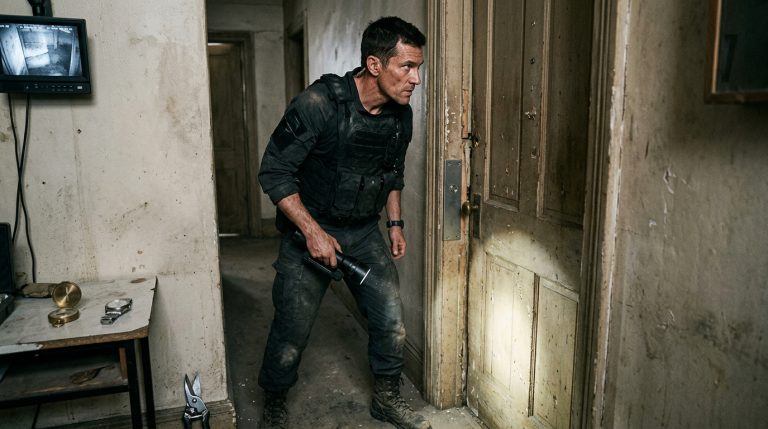
I walked toward the shed, my boots crunching on the crusty snow. My gaze drifted to the edge of the tree line. Something was off. A sapling, barely six feet tall, was leaning at an unnatural angle, its trunk scarred by something sharp. I approached it, my hand instinctively dropping to the heavy flashlight at my hip.
The bark hadn’t been bitten by elk or rubbed by bear. It had been sliced. Clean, mechanical, deliberate. Someone had been walking the perimeter with a blade, marking my territory as if they were measuring me for a grave.
I traced the cut with my thumb, the texture rough and jagged. If they were marking the trees, they were mapping a route. They weren’t just protesting anymore; they were preparing for an intrusion that went beyond words. I looked back at the cabin, the light in the window casting a weak, golden rectangle onto the snow. For the first time, the 300 acres didn’t feel like a sanctuary. It felt like a trap I’d walked into willingly, and the walls were finally starting to close in.
I adjusted my grip on the flashlight, hearing a snap of dry timber from the direction of the ridge. I stopped breathing, my entire focus narrowing to a single point in the dark, wondering if I was the one doing the hunting, or if I’d become the game.
CHAPTER 2: Reconnaissance under the Rime
The snap of wood hadn’t been a deer. I knew the difference between the brittle crack of a frozen branch under the weight of an animal and the dull, heavy thud of a boot hitting solid, packed snow. I stood motionless in the shadow of the tool shed, my breathing hitched in my chest, white plumes of vapor rising into the freezing night air. My hand remained gripped on the heavy flashlight, but I didn’t click it on. To reveal my position was to surrender the only advantage I had—the dark.
The silence that followed was suffocating. I waited, counting the heartbeats pulsing against my throat. One, two, three. Nothing. Just the wind, shifting its pitch as it caught the eaves of the cabin, sounding like a low, mournful whistle.
I moved, not toward the source of the sound, but toward the corner of the shed, keeping my back against the weathered, iron-stained cedar. My boots were silent on the crust, the cold biting through the leather. When I rounded the corner, the flashlight beam of my cabin’s porch light—motion-activated—flickered to life. The sudden wash of yellow light cut across the yard, revealing nothing but the empty expanse of snow, swirling with the first true flakes of a coming blizzard.
The intruder, if there had been one, was gone. Or they were better than me.
I checked the perimeter. My trail cameras were still blinking their rhythmic, soft red pulses in the dark. I moved to the nearest one, a unit mounted on a sturdy lodgepole pine, and accessed the SD card slot with numb fingers. The metal casing of the camera was cold enough to stick to my skin. I pulled the card, pocketed it, and started the trek back toward the cabin.
But as I stepped into the open, the air pressure dropped with a sudden, violent intensity. The sky, which had been a clear, crystalline black, turned a bruised, heavy grey. The wind died, replaced by a vacuum, and then the first flakes started to fall—not drifting, but driving horizontally, stinging my cheeks like fine glass.
I reached the snowmobile sitting at the edge of the clearing, the one I’d been tuning earlier. I needed to get back to the warmth of the workshop to check the camera footage. I hopped onto the seat, turned the key, and squeezed the starter.
The machine coughed.
It was a sound of mechanical protest—a metallic grind that didn’t belong in the engine’s rhythmic purr. I tried again. The starter spun, whined, and then died, leaving me in the sudden, absolute silence of the mountain night.
I climbed off, my frustration rising like a tide. I yanked the side panel open, the rusted latch biting into my thumb. Even in the gloom, I could see it. The fuel line hadn’t been pulled; it had been sliced cleanly with a sharp, precise blade, and the gas was already beginning to freeze into a slushy, iridescent puddle in the snow.
My pulse hammered against my ears. This wasn’t just harassment. This was an attempt to strand me.
I looked back at the western ridge. The mechanical hum I’d felt through the floorboards of the cabin earlier was gone now, replaced by the rising roar of the wind. I didn’t wait to fix the line. I turned and walked, my pace steady and deliberate, toward the cabin’s front door. Every step was a calculation of potential points of entry, every shadow a potential threat.
The cold was no longer just an environmental factor; it was an adversary. I reached the porch, my boots heavy with the caking ice, and stepped inside, locking the door with a double-bolt. The cabin was warm, the wood stove still radiating heat, but the air felt heavy, charged with the same static that preceded a strike.
I moved to the computer, my fingers moving with practiced, rhythmic efficiency. I slid the SD card into the reader and pulled up the footage. The screen flickered, the light casting long, distorted shadows of my own face against the logs of the wall.
The footage showed the tree line, the steady, rhythmic movement of the wind in the branches, and then, at 9:14 PM, a flicker of movement. It wasn’t a person. It was a dog, a sleek, dark shape moving low to the ground. It didn’t look like a stray; it moved with a purpose, circling the area where I had just been standing. And then, following the dog, a pair of boots appeared at the very edge of the frame—heavy, tactical soles, leaving deep, patterned imprints in the snow.
I paused the video, the image graining as I zoomed in on the tread pattern. It wasn’t a hunting boot. It was a high-end, civilian climbing boot, the kind sold in the boutiques of Whitefish, the kind Patricia Morrison wore.
My jaw tightened. She wasn’t just sending people to harass me. She was tracking the land like a thief. I looked at the floorboards, the hum returning, faint but insistent. The mystery of the “community trails” was merely the surface, the decoy. There was something beneath the earth, something they were desperate enough to cut lines and stalk my property for.
I reached for the phone, then stopped. My lawyer would just tell me to file more reports. I didn’t need reports. I needed to know what was under my feet. I walked to the corner of the room, pulled up the rug, and stared at the floorboards. I knelt, pressing my ear to the wood, feeling the vibration. It wasn’t a hum. It was a frequency—constant, mechanical, and deep.
They were digging.
CHAPTER 3: The Tremor in the Foundation
The sound was no longer a vibration; it was a rhythmic assault. Beneath the floorboards, the earth seemed to growl. I stayed on my knees, the rough cedar pressing into my skin, listening to the deep, percussive thud that vibrated up through my skeletal structure. It wasn’t the sound of an animal burrowing, nor was it the shift of natural shale or bedrock. It was mechanical. Hydraulic.
I stood, my joints popping in the quiet room. The cabin felt different now—not a refuge, but a fragile shell anchored to a piece of ground that was being hollowed out.
I grabbed my heavy utility jacket and stepped back into the mudroom. The temperature had plummeted further, the air inside the cabin thickening with the frost creeping in around the window frames. I didn’t bother with the lights. I clicked on my tactical flashlight, its beam a stark, cold white that carved through the swirling dust motes.
I went out the back door, heading toward the western ridge where the hum had been most persistent. The storm was in full force now. The wind hammered against the side of the cabin, but I pushed forward, my boots finding purchase on the ice-slicked ground. I wasn’t just checking the perimeter anymore. I was hunting for the source of that frequency.
I climbed the slope, my lungs burning with the intake of sub-zero air. Every step required a deliberate transfer of weight. As I crested the rise that overlooked the lower basin of the property—the section Bill had always left untracked—I stopped.
The beam of my light caught something metallic, partially buried in the drift of fresh, wind-blown snow.
I approached it cautiously. It wasn’t natural. It was a surveying stake, but not the kind used by local foresters. This was high-grade aluminum, capped with a prism-like reflector. It was hammered deep into the permafrost, and attached to its side was a small, black box with a blinking green LED.
I knelt, brushing the ice away. The metal was unnaturally cold, radiating a localized chill that made my skin crawl. It wasn’t just a marker; it was a sensor. I reached out to touch the casing, but my hand hovered inches away. I could feel the electricity, a faint, prickly tingle against my fingertips.
What are you measuring?
I looked out into the darkness toward the basin. The trees there were thick, their limbs heavy with ice. But through the gaps in the timber, I could see the faint, unnatural glow of halogen floodlights reflecting off the underside of the storm clouds. They were working. Even in the middle of a blizzard, they were out here, carving into the mountain.
I pulled a pair of heavy-duty pliers from my belt. The metal of the tool felt solid and reassuring in my grip. With a sharp, sudden torque, I sheared the cable connecting the sensor to the ground. The blinking green light flickered and died. For a heartbeat, the silence of the forest was absolute. Then, the rhythmic grinding from the basin increased in intensity, a higher-pitched whine that signaled a machine straining against a sudden, unexpected resistance.
I stood up, backing away into the shelter of the trees. They would know the sensor was gone the moment the data feed dropped.
A flashlight beam cut through the snow on the other side of the ridge, sweeping wide and fast, searching. I dropped into the deep powder, pressing my body against the trunk of a massive spruce. The bark was rough, smelling of sap and rot, a grounding scent that kept me from panic.
The light swung over my position, the beam cutting through the driving snow like a scalpel. It moved past, lingered for a fraction of a second on the now-darkened sensor, and then held steady. Someone was walking toward it.
I recognized the stride—the measured, arrogant pace of someone who didn’t fear the mountain, because they owned it. Patricia.
“Check the line,” her voice carried over the wind, sharp and commanding. It was distorted by the gale, but the cold authority was unmistakable. “If the uplink is down, he’s found the perimeter. Sweep the ridge. I want him identified and neutralized before the next shift starts.”
Neutralized. The word hung in the air, stripped of its corporate casing. It wasn’t about property law anymore. It was about erasure.
I didn’t wait to see who she had with her. I turned and moved, not back toward the cabin, but deeper into the woods, toward the creek. If I went home, I would be trapped. I had to become the ghost of this property, someone they couldn’t find, even as I tore their operation apart from the inside.
I stepped into the icy water of the creek, the liquid fire of the cold searing my nerves, and began to move upstream. I kept my head down, my eyes fixed on the shifting ice, my mind already calculating the path of least resistance back to the valley road—a route they would never expect me to take. I was no longer the owner protecting a deed; I was the hunter reclaiming the soil.
CHAPTER 4: The Edge of the Basin
The water was a razor against my shins. It churned over the smooth, ice-slicked stones of the creek bed, a relentless, numbing force that tugged at my boots with every step. My legs had gone dead minutes ago, a hollow, tingling sensation that made it difficult to gauge the depth of the pools. I kept my head down, watching the way the flashlight beam danced across the dark, swirling current, looking for anything that indicated a path back to the valley road.
I was moving against the current, a deliberate choice. If I followed the flow, I’d be heading toward the open flats where the HOA members could easily track my silhouette against the snow. By moving upstream, toward the higher, broken terrain of the foothills, I gained elevation and, potentially, cover.
The wind had intensified, howling through the narrow canyon formed by the creek’s banks. Every so often, it would catch the tops of the lodgepole pines, shaking them with such force that a cascade of frozen needles and ice would shower down on me like shrapnel. My breath came in ragged, shallow bursts. I could feel the heat radiating away from my core, the insidious, creeping lethargy that precedes the final stage of cold.
Keep moving. Calculate the next point of cover.
I focused on the physical. The weight of my pack, the bite of the strap against my shoulder, the way my left boot felt heavier than the right. I forced myself to stop every fifty yards, ducking into the deep shadow of an undercut bank to listen.
The first time I stopped, the woods were empty. The second time, I heard it: the distinct, rhythmic beat of a rotatory engine. A drone.
I pressed myself deep into the silt and frozen clay of the bank. Above me, the black sky was pierced by the faint, pulsing red light of a commercial-grade surveillance drone. It was hovering over the basin, its camera sweep perfectly methodical. They weren’t just searching for me; they were scanning the entire riparian zone, looking for heat signatures, for movement in the water.
My skin prickled. The drone was moving toward the creek.
I realized then the depth of their operation. This wasn’t a local neighborhood dispute. The technology, the tactical coordination, the cold, ruthless efficiency of the “neutralization” order—this was industrial, perhaps even state-level in its sophistication. The HOA was a front. A perfect, suburban camouflage for something much larger, something that required this specific patch of mountain wilderness.
As the drone banked, its camera light washing over the frozen surface of the creek, I saw my chance. A massive, fallen cedar had created a natural dam, forcing the water to pool into a deep, dark eddy beneath an overhanging rock shelf. I didn’t think; I moved. I scrambled into the ice-black water, submerging myself until only my nose and eyes were above the waterline.
The cold was an explosion, a violent, tearing sensation that threatened to stop my heart. I gritted my teeth, forcing my muscles to remain still, to not shiver, to not create the telltale ripple that would give me away.
The drone passed overhead. I could hear the high-pitched whine of its motors, a sound that felt like it was drilling into my skull. It lingered for a moment, the light sweeping back and forth over the cedar log, then banked away, heading back toward the western ridge.
I waited until the sound had completely faded before pulling myself out of the creek. My clothes were instant suits of armor, the fabric stiff with ice. I couldn’t feel my fingers. I couldn’t feel my toes.
I clawed my way up the bank, my movements clumsy and mechanical. I reached the tree line and collapsed into a small grove of stunted aspen. My vision blurred. Shadows seemed to detach themselves from the trees, shifting and dancing in my periphery. Is that a guard? Or just the light?
I rubbed my eyes, but the movement was slow, like trying to push through wet sand. My mind began to race, thoughts fracturing into disjointed shards. I remembered the deed, the day I bought the land from the estate, the way the agent’s hands had trembled when he handed me the papers. I had dismissed it as nerves, as the strain of selling a large, remote property.
What if he wasn’t nervous? What if he was terrified?
I shook the thought away, forcing myself to stand. I had to reach the valley road. I had to find a way to contact someone outside the influence of this town. I looked back toward the basin, the glow of the halogen lights now a distant, angry orange against the sky. I wasn’t going home. I was going to turn this around. I took the first step, my boots crunching heavily on the frozen crust, and pushed toward the high ridge, every ounce of my remaining strength poured into the act of simple, rhythmic movement. I was the sovereign of this land, and it was time I started acting like it.
CHAPTER 5: The Weight of Hidden Earth
The wind had not relented; it clawed at my clothes, searching for the gaps in my gear, seeking the warmth I was rapidly losing. My muscles burned with a dull, lactic fire, and every breath felt like inhaling ground glass. I pushed through a dense thicket of lodgepole pines, their branches stiff with ice, the friction of my passing sending a chorus of brittle snaps into the gale.
I stopped in the shelter of a limestone outcropping, the stone ancient and pitted, smelling faintly of sulfur and cold damp. My hands, still clumsy from the creek water, fumbled with my pack, pulling out a thermal flask. I didn’t drink. I just held the warm metal against my chest, closing my eyes for a heartbeat.
That was when the phantom hit me. It wasn’t a sound, but a memory—the image of Dennis, my attorney, sitting in his cluttered office back in the city during the final sign-off. I remembered the way he had tapped his pen against the desk, the rhythmic, nervous click-clack that had seemed so professional at the time. Now, in the silence of the mountain, the memory surfaced with a terrifying clarity. He hadn’t been reviewing the title documents; he had been glancing at the clock, his eyes darting toward the door as if he were waiting for someone to burst in.
He didn’t just want the commission.
The realization was a punch to the gut. Dennis hadn’t just handled the sale; he had facilitated it, fast-tracking a transfer that should have taken months. And the estate of Bill, the old logger—it had been a ghost entity. No heirs, no death certificate on record in the public portal—just a digital signature and a promise of a clean title.
I looked at the ground, my boots resting on the frozen, unyielding earth. I was holding a claim to a graveyard of secrets.
The tremor returned. It was louder now, a low-frequency rumble that suggested something massive was moving deep below the granite shelf of the ridge. I pulled myself up the final few feet of the incline, reaching the plateau that overlooked the basin. I didn’t use my light. I dropped to my stomach, crawling through the scrub brush until I reached the edge of the limestone ledge.
Below me, the basin had been transformed.
The forest floor had been stripped back, revealing a sprawling, muddy wound in the earth. Powerful floodlights mounted on tall, mobile towers bathed the site in a stark, artificial white. I saw machinery—not standard excavators, but heavy, specialized rigs, the kind used for deep-core subterranean drilling.
A group of figures moved in the mud, wearing high-visibility gear that shimmered under the lights. They were working with the discipline of a military unit. Patricia stood near the central rig, her red snowmobile parked at the periphery, looking up at a flat-screen monitor mounted to the side of a transport truck.
I watched them, my heart hammering a rhythm that matched the grinding of the drills. They weren’t looking for minerals. They were digging down, aiming for the bedrock itself. The site looked like a sterile, industrial heart transplanted into the wild, raw body of the mountain.
My gaze drifted to the edge of the pit, where a pile of extracted earth and debris had been discarded. I saw something that made me freeze. Protruding from the pile was a piece of timber—not a modern beam, but a rusted, iron-braced fence post. It was a fragment of the original boundary line, a piece of the property that should have been miles from where they were digging.
They were burying the past as they dug into the future.
The wind shifted, carrying the sound of voices toward me. Patricia was laughing—a sharp, mirthless sound that cut through the roar of the drills. One of the technicians pointed toward the ridge, toward the exact patch of woods where I was hiding.
I didn’t wait for them to spot me. I withdrew, my body low, my movements fluid despite the biting cold. I had to get back to the cabin. I had to go through the foundation, under the floorboards where the vibration was strongest.
The descent was brutal. I slid down the slope, letting the momentum carry me, my pack thumping against my spine. I didn’t care about the noise anymore. I needed to move, to get ahead of the shift they were planning for the next day. As I hit the bottom of the ridge, I felt a sharp, metallic bite in my leg—I had tripped over a cable, another sensor line buried just beneath the surface of the snow.
The line pulled taut. Somewhere in the distance, a alarm chirped—a soft, persistent electronic warble that signaled a breach.
I didn’t run. I stood my ground for a second, looking back at the ridge. They were coming. I turned toward the cabin, a dark, lonely silhouette against the white storm, and sprinted. I had to reach it before they cut off the access road. I had to find what Dennis had buried in my living room, and I had to find it before they tore the house down around me.
CHAPTER 6: Weaponized Silence
The electronic chirping was not a distant warning; it was a rhythmic, persistent command that seemed to amplify in the thin, frozen air. I didn’t look back. I relied on the terrain, my boots finding the familiar depressions in the snow that led toward the rear entrance of the cabin. My lungs were burning, each inhalation a sharp, icy sting, but the adrenaline had bypassed the fatigue. I was a machine now, calibrated for survival.
I hit the mudroom door with my shoulder, the impact jarring my entire frame, and tumbled inside. I didn’t pause to lock it. I scrambled across the floorboards to the center of the living room, tearing the rug away with a single, violent motion.
The wood underneath was old, scarred by years of use, and stained with the dark, iron-rich dust of the mountains. I pulled a pry-bar from my kit, jammed it into the seam of the floorboard, and leaned into the leverage. The wood shrieked—a high, splintering protest that echoed in the quiet room—before snapping upward.
I didn’t care about the damage. I ripped the planks away, tossing them aside, and shone my light into the crawlspace.
There was no dirt there.
Beneath the cabin, the earth had been systematically removed. In its place was a reinforced, steel-lined chamber that shouldn’t have existed. It was small, a box barely four feet deep, but it was pristine, lit by the same cold, green light I had seen on the sensor in the woods. Spread across the floor of the chamber were documents—not digital files, but thick, vellum-bound ledgers and maps of the entire region dating back to the late 19th century.
I reached down, my hand brushing against the rough, cold metal of the lining. The vibration here was intense, a mechanical hum that resonated in my very bones. I grabbed a handful of the documents, the paper brittle and smelling of stagnant time, and tucked them into my waterproof interior pocket.
That was when the porch light flickered and died.
Silence descended on the cabin, heavy and absolute. I stopped, my breath hitching. They weren’t coming from the road. They were already at the door.
I clicked my light off and pressed myself into the shadows behind the wood stove. I waited. The silence wasn’t empty; it was filled with the subtle, tactical sounds of professionals—the soft scuff of a boot, the faint, metallic snick of a holster being adjusted, the controlled, steady breathing of people who expected no resistance.
The back door opened. No bang, no forced entry. Just the quiet, professional creak of hinges.
Patricia stepped into the mudroom, her silhouette framed by the pale, drifting light of the blizzard. She didn’t have her ski jacket on anymore. She wore a dark, form-fitting tactical layer, and in her hand, she held a suppressed sidearm. She moved into the kitchen, her eyes scanning the room with the clinical detachment of a predator.
“I know you’re here, Marcus,” she said, her voice soft, devoid of the smug, corporate sharp-edge she’d worn in our earlier encounters. Now, there was only the cold, hollow weight of purpose. “You’ve been a fascinating variable, but you’re an unnecessary one. The land doesn’t belong to you. It never did. You were just the temporary placeholder for a title that had to be cleared.”
I stayed behind the stove, my hand resting on the heavy, cast-iron handle of the poker. I wasn’t going to talk. Talking was for people who still believed they could negotiate. I was the sovereign of this house, and she was an invader.
She moved toward the center of the room, her boots stopping just inches from the torn-up floorboards. She looked down at the dark, hollow cavity, and for the first time, her composure cracked. A flash of genuine, jagged anger crossed her face.
“You really couldn’t just walk away, could you?” she whispered, more to herself than to me. She didn’t look for me. She went straight for the hole, her eyes fixed on the remaining ledgers. She was exposed, her focus entirely on the secret I had unearthed.
I moved. I didn’t run; I shifted, the iron poker in my hand acting as an extension of my resolve. I didn’t aim to harm—I aimed to neutralize the space between us. I slammed the iron against the heavy timber of the table, the ringing clang vibrating through the room like a bell.
Patricia spun, her weapon coming up, but I was already moving, my weight low, using the momentum of the stove’s corner to pivot. I crashed into her, not with rage, but with the calculated, brutal efficiency of a man protecting his home. We went down together, the floorboards groaning under the impact.
The gun skittered across the floor, sliding into the dark corner beneath the cabinets. We scrambled, a frantic, desperate tangle of limbs and breath, the air in the cabin growing thin. She was faster than I expected, her movements practiced, but I had the terrain. I knew the weight of these floorboards, the way the cabin shuddered under the strain of the wind.
I caught her wrist, pinning it to the floor. She stared up at me, her blue eyes devoid of fear, replaced by a chilling, calculating assessment.
“You think this is about land, Marcus?” she hissed, her voice a sharp, cutting whisper. “You haven’t even seen the depth of what’s underneath.”
I leaned in, my gaze locking with hers. “I don’t care what’s under the dirt,” I said, my voice steady, iron-hard. “I only care that you’re off it.”
I stood, dragging her up with me, and shoved her toward the door. I didn’t let her reach for the gun. I walked her back, step by step, forcing her toward the threshold of the mudroom. This was my ground. Every inch of it was accounted for, and I would hold it until the mountain itself collapsed.
CHAPTER 7: The Paper Trail
I shoved Patricia out onto the porch, the freezing wind instantly stripping the remaining heat from the room. She stumbled, her boots finding purchase on the icy, uneven wood, but she recovered with the balance of an athlete. She didn’t turn to face me immediately. She stood on the edge of the porch, looking out into the swirling white void of the blizzard, her shoulders tight.
“You think you’ve won something, Marcus,” she said, her voice barely carrying over the howl of the gale. She turned, her expression unreadable in the dim light of the cabin interior. “But you’ve only just started the clock. Those papers in your pocket? They’re not just history. They’re a liability you don’t even understand yet.”
I didn’t argue. I didn’t care about the philosophical weight of her warnings. I watched her, my eyes tracing her every movement, my hand still gripping the iron poker. I kept the door between us, the barrier a necessity. “Get off my property,” I said, my voice steady, stripped of everything but the command. “And if I see you or your crew on these trails again, I won’t be calling the sheriff. I’ll be handling it as a breach of sovereign defense.”
She laughed—a dry, brittle sound that seemed to shatter against the frozen pines. “Sovereign defense,” she mocked, shaking her head. “You’re playing at being a king in a kingdom that’s already been sold out from under you.”
She stepped back, moving into the darkness of the yard, and within seconds, the familiar, low-frequency growl of her snowmobile ignited. The engine roared, a mechanical scream that tore through the mountain’s silence, and she sped away into the storm.
I stood on the porch for a long time, listening to the engine fade until the only sound remaining was the relentless, rhythmic scouring of the wind against the cabin walls. My body began to shake—the delayed reaction to the adrenaline, the cold, and the sudden, jarring shift in my reality. I turned and retreated inside, slamming the door and sliding the bolt home.
The living room was a wreck. The floorboards lay in a chaotic pile, exposing the cold, dark void beneath. I walked over to the center of the room, my boots crunching on the splintered wood, and sat on the edge of the jagged opening. I pulled the documents from my pocket.
They were dense, handwritten logs, the ink faded to a dull, sepia brown. I laid them out, my fingers tracing the lines of property maps that looked nothing like the ones I had been given at the closing. These documents showed a series of transfers, a web of names that led back to a single, shell company registered in an offshore jurisdiction.
But it was the last page that caught my eye. It wasn’t a deed; it was an affidavit, signed by an attorney named Elias Thorne—the same man whose signature appeared on the documents Dennis had “verified” for me months ago. The affidavit explicitly stated that this land was not “undeveloped,” but was, in fact, the site of a decommissioned geological testing facility dating back to the late seventies.
Decommissioned. The word felt heavy, ironic.
I looked at the maps again. The coordinates marked as the “decommissioned site” were exactly where the drilling rig was located right now. They weren’t just mining. They were re-opening a facility that had been officially erased from the county’s public record.
I checked my phone. No signal. I went to the wall, pulling aside the heavy, dust-caked curtains to check the small, auxiliary radio I’d kept for emergencies—the one the previous owner had left behind.
It was dead.
I opened the casing, my hands moving with a practiced, technical precision born of years in the software industry. I wasn’t surprised to find the wiring clipped. Not by time, but by a tool. A pair of wire cutters, used with the same clean, surgical accuracy as the ones that had disabled my snowmobile.
I sat back on my heels, the realization settling into my gut like lead. They had been in my cabin before. They hadn’t just arrived when the trouble started; they had been monitoring me, managing my isolation, ensuring that I stayed within the boundaries they had constructed for me.
I pulled the ledgers toward me and started reading, page by agonizing page. I needed to know what was worth this level of secrecy. The answer started to emerge in the margins—notes about seismic stability, isotopic signatures, and a project name, Project Acheron, that kept appearing, crossed out in red ink.
I felt a sudden, sharp vibration through the floor—not the drilling this time, but the sound of heavy equipment approaching. Not a snowmobile, but a truck. A large, tracked vehicle. They weren’t just coming to harass me; they were coming to finish the cleanup, and I was the only witness left standing in their way.
I looked at the hole in the floor. I didn’t need to be here when they arrived. I needed to move, to take the evidence, and to disappear into the only place they couldn’t control: the heart of the mountain itself.
CHAPTER 8: The Siege of Silence
The ground shuddered. It was a rhythmic, heavy thud—the distinct, mechanical crawl of steel tracks grinding over frozen granite. They were at the base of the access trail, no more than three hundred yards from the cabin, and moving with the slow, inevitable pace of a predator that knows its prey has nowhere to run.
I didn’t waste a second on the floorboards or the mess I’d made. I shoved the ledger—the thin, brittle evidence of the Acheron project—into my pack and cinched the straps until they bit into my shoulders. My cabin was no longer a home; it was a target painted in the dark.
I moved to the fuse box in the mudroom, clicking my light on for the briefest of flickers. I had expected a standard array of breakers. Instead, I found a tangled nest of non-standard copper wiring snaking around a small, black-anodized unit clamped to the main line. It wasn’t just power regulation; it was a wide-spectrum jammer, active and pulsing. They had been effectively cutting me off from the world from the inside out, turning my own walls into a Faraday cage.
I didn’t have time to dismantle it. I grabbed the heavy-duty wire cutters from my kit, severed the main leads in a single, sharp motion, and threw the door open.
The cold hit me like a physical blow, a wall of sub-zero air and driving, horizontal sleet. I stepped out onto the porch, my boots crunching on the frozen wood. The cabin lights, which had been flickering to life as the generator strained, died entirely, plunging the property into a suffocating, monochromatic darkness.
The tracked vehicle groaned as it hit the incline—a sound of straining metal and roaring hydraulics. It was massive, a silhouette that blocked out the sky, its headlights sweeping the clearing with searchlight intensity. They weren’t looking for movement; they were clearing the area with precision.
I vaulted the porch railing, landing hard in the deep drift, and dived into the shadow of the woodpile. I could hear voices now—hard, clipped commands being barked over a radio. They were confident. They assumed I was still inside, waiting, hoping for a miracle that wasn’t coming.
I moved through the trees, staying low, my eyes fixed on the gap between the cabin and the dense timber of the eastern slope. Every step was a gamble. The snow was soft, and the crusty top layer broke under my weight, creating sounds that seemed like gunshots in the unnatural silence of the blizzard.
I reached the tree line and paused, looking back. A spotlight swiveled, the beam catching the side of my cabin, illuminating the jagged, open hole in the floorboards. The vehicle stopped. A man in tactical gear—the same sharp-edged, professional equipment Patricia wore—stepped down from the deck of the machine. He didn’t move toward the door. He moved toward the crawlspace, his rifle leveled at the opening.
He knew. He knew exactly where the documents had been hidden.
My blood ran cold. The heist wasn’t just about the land; it was about the recovery of a legacy that was never meant to be read. I felt the weight of the ledger in my pack—it felt heavier now, like a piece of the mountain itself—and I knew then that I couldn’t just run. If I disappeared into the woods, they would burn the cabin to the ground, erasing the last physical link to the fraudulent sale, and I would be nothing more than a missing person statistic in a county that answered to them.
I pulled the flare gun from my gear—a desperate, improvised tool I’d kept in the shed—and looked toward the fuel storage tank at the far end of the property. It was the only tactical advantage I had. A distraction.
I fired.
The orange streak arched through the dark, cutting a line of fire into the sleet before slamming into the frost-rimmed valve of the fuel tank. The resulting boom was less an explosion and more a violent, concussive wave of heat that knocked me off my feet. The tank erupted in a gout of brilliant, roiling flame, casting the entire clearing into a sharp, terrifying contrast of shadow and light.
The soldiers scrambled, their focus shifting instantly to the fire. They roared, their tactical discipline breaking for a heartbeat as the inferno began to lick at the dry timber of the shed.
I didn’t wait. I turned and sprinted, not away from the fire, but toward the vehicle they had left idling at the edge of the clearing. If I couldn’t defeat them, I would steal their mobility. I moved through the smoke, the heat prickling my skin, and lunged for the driver’s cab. My hand caught the cold, rusted handle of the door, and I pulled, my entire existence focused on the singular, desperate act of seizing control.
CHAPTER 9: The Siege of Strategy
The driver’s cab smelled of diesel, stale coffee, and the sharp, metallic tang of ozone—a pressurized, mechanical scent that felt entirely alien compared to the freezing air outside. I slammed the door shut and engaged the locking mechanism just as a flurry of bullets sparked against the reinforced plating of the chassis.
The vehicle was heavy, a massive beast of iron and hydraulics designed for deep-earth penetration. I didn’t wait for a manual—I’d spent years in Seattle working on complex systems, and the interface was intuitive. I toggled the master override, the screen in front of me flickering to life with a grid of sensors and diagnostic data. My heart was still hammering against my ribs, but my hands were steady. I shifted the transmission, felt the heavy, visceral thunk of the gears engaging, and pushed the throttle forward.
The machine lurched, the treads biting into the frozen ground with a roar of strained steel. I spun the wheel, sending the vehicle barreling through the perimeter of the clearing, away from the burning fuel tank and the confused, shouting silhouettes of the men who were still scrambling in the dark.
I kept the headlights off. I didn’t need them; I navigated by the glow of the fire behind me, a dying sun that lit the jagged tree line in long, distorted shadows.
As I crested the ridge and dropped into the basin, the screen on the dashboard pinged. A diagnostic readout flashed: Seismic Integrity Warning – Low. It wasn’t a warning about the vehicle. It was a live feed of the sensors buried throughout my 300 acres. They were tracking movement, pressure, and thermal output in real-time.
I looked at the data, my pulse accelerating. The tremors beneath the cabin weren’t just drilling—they were part of a massive, synchronized effort to stabilize a cavernous, subterranean void they had opened up. A void that, according to the records in my pack, shouldn’t have been there.
A sudden flash of memory cut through the intensity of the moment: a headline in the local paper from six months ago—a report of a “sudden cardiac event” that had claimed the life of the estate agent who’d sold me the land. At the time, it had seemed like a tragic coincidence. Now, staring at the grid of sensors, it felt like an erasure. He hadn’t been a seller; he had been the first liability they had identified.
The vehicle hit a patch of loose shale, the tracks slipping, and I fought the wheel, my muscles screaming in protest. The cabin of the machine vibrated, the hum from the earth rising through the steering column until it rattled my teeth. They were pushing back. A secondary, heavier rig somewhere in the basin began to pulse, a high-frequency jamming signal that made the navigation screen go dead.
I was blind.
I pulled the vehicle into the heavy brush of a cedar grove, the branches whipping against the windshield like skeletal fingers. I killed the engine, the sudden absence of noise amplifying the sound of the wind, and reached for my pack. I needed to see those documents again. I needed to find the flaw in their design.
I laid the maps out on the dashboard. I wasn’t just looking at geography anymore; I was looking at a pattern—a series of drainage points and geological vents that formed a perfect, geometric shape centered exactly where the cabin sat.
They weren’t just drilling the basin. They were venting something.
A soft, rhythmic tapping sounded against the roof of the cab. I froze, my hand hovering over the gear shift. It wasn’t the wind. It was deliberate. Someone was standing on the roof of the vehicle.
I leaned back, my breath held, as the tapping stopped. The hatch above me, the one meant for emergency extraction, shifted—a slow, agonizing inch of light cutting through the ceiling.
They hadn’t been chasing me. They had been herding me. I had driven the vehicle exactly where they wanted it, onto a unstable, hollowed-out section of the basin floor that was now beginning to buckle under the weight.
The dashboard lights blinked red. Sub-surface void detected.
I grabbed the pack and, without a second’s hesitation, kicked the side door open and dived into the snow, the vehicle tilting violently as the earth beneath it began to liquefy. I rolled into the darkness, the world behind me opening up into a terrifying, gaping maw of broken rock and shadow.
CHAPTER 10: The Foundation of Lies
The world didn’t just end; it dissolved. One moment I was pushing off the heavy steel of the tracked vehicle, and the next, gravity inverted. I tumbled through a slurry of freezing mud, shale, and twisted metal, my pack slamming into my spine. The air filled with the sharp, acidic scent of fractured soil and deep-earth minerals—a smell that had been trapped under the crust for decades.
I hit the bottom with a jarring, bone-deep impact, the wind driven from my lungs in a singular, desperate gasp. For a long, terrifying moment, there was nothing but the sound of settling earth—a dry, sliding rustle that sounded like thousands of insects retreating into the dark.
I clawed at the mud, my fingernails tearing against the unyielding, compressed clay. I was trapped in a pocket of darkness, the weight of the mountain pressing down on me. I fumbled for my light, my movements slow and agonizing, until my hand found the casing of my tactical flashlight. I clicked it on.
The beam sliced through a thick, suffocating cloud of dust. I was in a chamber—not a naturally occurring cavern, but a man-made concrete shell, cracked and weeping with ancient, groundwater-stained mineral deposits.
I hauled myself up, my movements jerky and pained. My leg was twisted, a dull throb radiating from my knee, but I ignored it. I was standing in the very heart of the basin, directly beneath the site of the drilling rigs. The walls around me were covered in heavy, reinforced steel plates, bolted into the bedrock. They weren’t just drilling; they were accessing a pre-existing facility—a relic of the late seventies, just as the ledger in my pack suggested.
I limped forward, the flashlight beam sweeping over the walls. There were markings etched into the concrete—names, dates, and a series of technical diagrams that made my head spin. I recognized the geometry; it was a layout of my own property, drawn with a level of precision that reached all the way to the footprint of my cabin.
I found the central conduit—a massive, humming shaft that descended deeper into the dark. It wasn’t mining equipment. It was a localized power-grid hub, a terminal for something that was pulsing with a faint, rhythmic intensity.
I realized then why Patricia was so desperate. She didn’t want the land. She wanted the access code to the facility’s core, which hadn’t been fully deactivated when the site was “erased.” And that code wasn’t digital. It was physical.
I reached into the pocket of my pack and pulled out the ledger I’d scavenged from beneath my cabin. I looked at the maps, the property layouts, and then at the walls of the chamber. Everything was interconnected. My cabin wasn’t built on a foundation of soil; it was built on a capstone.
I am the access key.
A sound echoed down from the top of the pit—the heavy, rhythmic stomp of boots on metal grating. They were coming down. I didn’t have time to process the weight of what I had discovered; I only had time to act. I looked for an exit, for any path that led away from the central shaft, and spotted a narrow, rusted maintenance tunnel running parallel to the conduit.
I climbed into the tunnel, the space tight and claustrophobic, smelling of stagnant oil and ancient, biting cold. As I crawled, I could hear the machinery in the basin above begin to whine again, the drilling rig adjusting its depth, targeting the chamber I was currently standing in.
They weren’t just going to mine the site; they were going to collapse it. They were going to bury the Acheron facility, and everyone inside it, in a controlled seismic event that would look like a natural landslide.
My heart hammered against my ribs. I had the documents, I had the truth, but I was currently five stories below the surface with a collapsing ceiling above me. I stopped, forcing my mind to clear. I had to reach the surface, but not the way I had come. I followed the tunnel, my light catching the glint of a secondary control panel embedded in the wall—a manual override for the basin’s stabilization system.
I knew the layout now. I knew the geometry of the lie. I looked at the panel, the heavy, corroded lever looking like the only weapon I had left. I wasn’t going to let them bury the truth. I was going to turn the mountain against them.
CHAPTER 11: The Feedback Loop
The lever was rusted, fused to its housing by decades of damp and neglect. I braced my feet against the slick concrete of the maintenance tunnel and pulled. My muscles screamed, the exertion drawing a groan from my chest that seemed to swallow the hum of the facility. With a violent, grinding snap of metal, the lever gave way.
A siren—low, mournful, and oscillating—began to blare throughout the chamber. Above me, the rhythmic, heavy drilling of the rig transitioned into a chaotic, high-pitched mechanical shriek. The entire facility began to tremble, not with the controlled pulse of the machinery, but with the raw, unstable movement of the earth itself. The stabilization system was forcing a pressure differential that the basin couldn’t support.
I didn’t wait for the collapse. I turned and sprinted toward the far end of the tunnel, my bad knee throbbing with every stride. The concrete around me was spider-webbing, small chips of rock raining down like hail.
I reached the hatch at the end of the maintenance corridor—the emergency bypass I’d identified on the wall diagrams. It was jammed with years of mineral buildup, but I didn’t hesitate. I used the butt of my flashlight to hammer at the latch, my movements driven by the cold, clear logic of survival. The hatch popped open, revealing a vertical ladder leading into the freezing night air of the forest.
I scrambled up, the cold hitting me with such force I thought my skin would shatter. I climbed out into the snow, the basin behind me illuminated by the strobing red lights of the disaster alarms.
Patricia and her team were already at the rim of the pit, their faces etched with a primal, naked terror. The ground was buckling—a massive, undulating wave of earth moving through the forest floor. They weren’t fighting me anymore; they were running from the mountain they had tried to dismantle.
I watched as the heavy drilling rig, their centerpiece of greed, tilted, its supports buckling as the void beneath it finally gave way. It slid, slow and graceful, into the growing maw of the earth, disappearing into the dark, churning debris of the basin. The sound was deafening—a roar of snapping timber and grinding stone that drowned out everything else.
I didn’t flee. I stayed at the ridge, my pack still tight against my shoulders, the ledger safely inside. I watched as the lights of the facility went out, one by one, until the basin was nothing but a black, jagged scar in the white landscape.
Patricia stood near the edge of the collapse, her hand reaching toward the darkness, her eyes wide, realizing in that singular moment that the land had never been theirs to claim. It was an ancient, autonomous thing, and they were just parasites who had finally been shaken off.
She looked up, her gaze locking with mine across the chasm of the ruined pit. There was no defiance left in her, only the hollow realization of total, crushing failure.
I walked toward the edge of the pit, my stride steady, the cold no longer biting. I had reached the end of the trail. The truth I held in my pack wasn’t just evidence of a crime; it was the final, devastating proof that the sale had been a orchestrated, multi-generational fraud, a house of cards built on a foundation of lies. And I was the one who had finally pulled the plug.
I turned away from the edge, leaving her to the silence and the ruin of her ambition. I began the long walk back to the cabin, the path now illuminated by the distant, grey light of the approaching dawn. The battle was over. The land was quiet, settled, and for the first time since I’d signed those fraudulent papers, it felt like mine. I didn’t need the law to tell me I was home; I felt it in the way the frost settled on the trees, a cold, clean seal on a promise finally kept.
CHAPTER 12: The Quiet Land
The cabin was a ghost of its former self, a hollowed-out skeleton in the middle of a frozen, silent wilderness. I stepped across the threshold, my boots crunching on the shattered floorboards, and dropped my pack onto the kitchen island. The silence here was different now—no longer the heavy, static-filled tension of a trap, but a genuine, expansive stillness that spoke of an ancient, indifferent peace.
I moved to the center of the living room and knelt by the opening in the floor. The ledgers I had pulled from the chamber were fanned out on the remaining planks. By the grey, filtered light of the morning, the truth was no longer a mystery to be solved, but a history to be recorded.
The fraudulent sale had been a masterstroke of bureaucratic erasure. Elias Thorne, the attorney I had trusted, hadn’t just been a facilitator; he had been the executor of a long-dead corporation’s final, desperate gamble to leverage the land’s geological significance before the state could fully secure it. Patricia and her team weren’t residents; they were the cleanup crew, tasked with reclaiming the “assets” that had been buried beneath my property line. The title I held was a fiction, a placeholder document designed to give them a legal shield while they stripped the basin of its secrets.
I picked up a pen and a blank sheet of paper, the movement slow and deliberate. I started writing. Not a manifesto, not a desperate plea, but a deposition. I documented every encounter, every coordinate, every piece of evidence I had gathered. When I was finished, I sealed the ledger and the deposition in a heavy-duty, waterproof casing.
The sound of a vehicle approached—a slow, steady crunching of tires on the icy access road. I didn’t reach for the iron poker. I walked to the front door and opened it.
Deputy Kowalsski stood on the porch, her breath a plume of white in the cold air. She looked past me, taking in the splintered floorboards and the remnants of the burned fuel tank visible in the distance. Her expression was unreadable, a mixture of professional exhaustion and a quiet, dawning realization.
“I saw the flare, Marcus,” she said, her voice low. “And then I saw the smoke from the basin.”
I stepped aside, gesturing toward the kitchen island. “There’s a deposition on the table, Deputy. And the ledger that explains why the basin just disappeared.”
She walked inside, her gaze tracing the path of the destruction. She didn’t ask questions. She simply picked up the waterproof casing, her fingers lingering on the surface of the plastic. She knew what this was. She knew that the quiet, remote land I had purchased had been a war zone for longer than I had been alive.
“They’re gone, aren’t they?” I asked.
She looked at me, a flicker of something like sympathy crossing her face. “The road out is blocked by the landslide, Marcus. They’re trapped on the other side of the ridge. I have a crew coming in, but by the time they get here, the site will be nothing but a crater.” She paused, her voice hardening. “It’s going to be a long process, but this… this changes everything.”
She left an hour later, the tail lights of her patrol car disappearing into the morning mist. I stood on the porch, watching the light reclaim the valley.
I spent the next two days repairing the floorboards. It was a slow, meditative process—measuring, cutting, hammering—the sound of the work echoing through the cabin like a heartbeat. I used the old, salvaged lumber, the wood marked by years of Bill’s labor. It didn’t look perfect; it was scarred and weathered, a testament to the fact that nothing is ever truly erased, only covered over.
When the final board was set, I stood in the middle of the room, the wood solid and firm beneath my feet. The house felt steady.
I walked out to the edge of the property, toward the western ridge. The basin was a scar, a vast, grey depression in the white, but already the wind was beginning to smooth it over, the snow covering the jagged edges of the collapse. Nature was reclaiming the site, burying the failure of those who thought they could own the mountain.
I reached into my pocket, pulled out the old, hand-painted boundary sign I’d found toppled in the snow weeks ago, and hammered it back into the earth. The metal was rusted, the paint flaking, but it stood upright, a testament to a claim that was finally, truly, mine.
I turned back toward the cabin, the air crisp and clean, smelling of pine needles and the damp, iron-scented earth. The war was over. The land was quiet. And for the first time, I could finally hear the wind without fearing what it was trying to tell me.