The Perimeter of Will: A Cold Defense Against the Paperwork of Tyranny in Mosquite Ridge
CHAPTER 1: The Weight of the Hinge
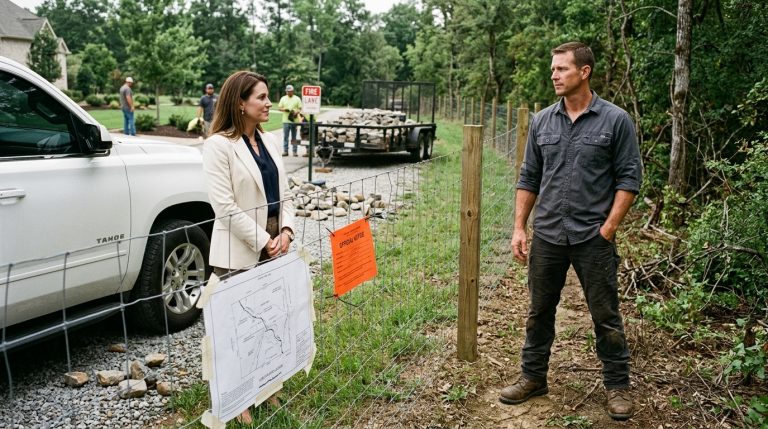
The morning was dry, the kind of heat that turned the air in Mosquite Ridge into a fine, grit-filled haze. My garage door, which usually sat open, was closed tight, but the orange notice—the one that had appeared three days ago—was still there. It had been slapped on with a violent disregard for symmetry, crooked and taunting, its adhesive already beginning to bubble in the relentless sun. It wasn’t just paper; it was a stake in the ground.
I stood in the entryway, the silence of the house thick enough to feel. My phone rested on the small wooden table by the door, the screen dark, but my heart was keeping a count. Somewhere, three blocks away, a white SUV with community safety magnets was likely idling, waiting for a sign.
The knock came then. Not a polite inquiry, but a heavy, deliberate strike that vibrated through the frame.
I didn’t answer immediately. I took a breath, feeling the texture of the air—metallic, sharp, smelling of scorched sage and the pervasive dust of a neighborhood trying to be something it wasn’t. They wanted me to move. They wanted me to step aside, open the door, and fold.
I checked the camera feed. Three men. They were young enough to still believe that a vest with the word “Security” stamped on it gave them the right to command a room. They didn’t look like law enforcement; they looked like rent-a-muscle, their boots planted wide, their gazes searching for weakness.
My hand hovered over the deadbolt. I wasn’t angry. Anger was a luxury I’d discarded the moment I saw the planning documents in the county database. I was merely cold. I was measuring the distance between my reality and their pretense.
I turned the lock and pulled the door open, but I didn’t step back. I filled the space. The lead man, his shoulders bulging against the black fabric of his vest, blinked. He had expected a cowering resident; he got a stone wall.
“Spare key,” he said. It wasn’t a question. It was a rhythmic, rehearsed delivery, the kind of sentence that had likely worked on every other house on the block. “HOA emergency ordinance. Hand it over.”
He reached for a clipboard, his eyes flicking toward the camera mounted high in the corner of my porch. He knew it was there, but he ignored it, a tactical choice designed to signal that he didn’t care about evidence. He only cared about the objective.
“You’re standing on my property,” I said, my voice steady, stripped of any inflection. “And you have no authority to be here.”
The man smiled, but the expression didn’t reach his eyes. It was a thin, predatory line. “Non-compliance escalates,” he replied, repeating the line verbatim from the letter I had filed in my records. “You’re making this harder than it needs to be.”
Behind him, the second man shifted, his hand moving an inch closer to his belt. It was a micro-gesture, a silent threat, but as I looked past them, toward the cul-de-sac, the movement died. A sleek black sedan had rolled to a quiet, definitive stop at the curb. The engine cut off, and the silence that followed was heavier than the heat.
The man in front of me didn’t notice the car, but he sensed a change in the air. He leaned in, his shadow stretching across the threshold, and for a fleeting second, I saw his reflection in the glass of the door—a man playing at power, unaware that he was standing on the edge of a precipice. Then, a voice cut through the stillness, cold and calm, drifting from the driveway: “Gentlemen, before this goes any further, I need to see your badges.”
CHAPTER 2: The Paper Trail of Ghosts
The three men on my porch didn’t move. They remained frozen in their awkward, aggressive stances, their hands still hovering near the belts that held their hollow authority. Behind them, the black sedan was a dark, unmoving anchor in the street. I held the door partially open, the weight of the frame pressing against my shoulder, and watched as the reality of the situation slowly bled the color from their faces.
Sheriff Daniel Mercer didn’t rush. He stood in the driveway, his posture so relaxed it bordered on predatory. He wasn’t just a man in a position of power; he was a man who knew how to wait for the exact moment the tension became unbearable. He held his wallet open, a shield of identification that looked as heavy as the badge inside it.
“Sheriff,” the lead man stammered, his voice cracking. He looked toward Veronica, his eyes searching for the promise of a pay stub or a legal shield that was no longer there. But Veronica had shifted. She was no longer filming. Her phone hung at her side, her thumb twitching against the glass screen. She was calculating the distance between her position on the sidewalk and the quiet safety of her own home.
“I asked for badge numbers,” Mercer repeated, his voice barely rising above the hum of a distant irrigation system. “And an explanation for why three civilians in tactical gear are attempting to force entry into a private residence under the guise of an ordinance that does not exist in this county.”
A memory flared in my mind—a construction site five years ago, the smell of ozone and wet cement, and the feeling of walking away from a job where the blueprints had been intentionally falsified. I had sworn then that I would never be the one to sign off on a lie, never be the one to stand in the path of a disaster waiting to happen. The grit of the porch under my boots felt like that old site. It was the same friction, the same slow, grinding realization that the world was built on layers of quiet compromises.
“We were told,” the second man started, his eyes darting to me, then back to the Sheriff. He took a step back, and his boot scuffed the concrete, a harsh, grating sound that felt like sandpaper on raw skin. “She said it was a safety protocol. Mandatory. Everyone on the block had already…”
“Everyone else has been coerced,” I cut in, my voice sounding flat and alien in my own ears. “They didn’t have the paperwork. I did.”
I stepped fully out onto the porch, leaving the door unlocked. I didn’t need to lock it anymore; the power dynamic had shifted the moment the word ‘Sheriff’ hit the pavement. I pulled my phone from my pocket. It was still recording, the file size ticking upward, a digital ledger of every lie told in the last ten minutes. I tapped the screen to stop, feeling the satisfying weight of the data—the proof that I wasn’t the outlier; I was the witness.
Veronica finally spoke, her voice thin, stripped of its practiced, professional veneer. “Dan, this is a misunderstanding. Mosquite Ridge is a pilot program. We’re trying to standardize the grid. If we can’t secure the access points, the entire grant is at risk.”
Mercer didn’t even look at her. He kept his focus locked on the three men. “A pilot program does not grant the right to trespass, nor does it allow you to employ mercenaries to intimidate residents. You’ve bypassed every oversight committee in the county.”
He stepped closer, his shadow engulfing the porch. The three men retreated, their tactical vests suddenly looking less like a uniform and more like a costume. The lead man took off his hat, his hair matted with sweat, and let it hang at his side. He looked tired—not the tired of a criminal, but the tired of a man who had trusted the wrong person to hold the leash.
“Deputies are two minutes out,” Mercer said. “You will remain exactly where you are. If anyone reaches for a weapon, or if anyone makes a move toward the street, that becomes a much different conversation.”
I leaned against the porch railing, feeling the cold, rusted metal beneath my palms. My pulse was finally slowing, the adrenaline giving way to a calculated, clinical focus. I watched the neighbors peeking through their blinds. One by one, doors began to crack open. They were watching the theater of their own liberation, still too afraid to step out into the light, but unable to look away.
I knew this wasn’t the end. The grant, the seven-figure infrastructure project, the way the HOA had woven my home into their budget like a line item—this was just the surface. The layers beneath, the ones that connected Veronica to the grant oversight boards and the internal planning departments, were still buried. I had the letters, the screenshots, and the recorded evidence of their trespass, but the real rot—the “why” behind the specific targeting of my property—was still a locked room.
Mercer turned toward me, his expression softening just enough to be seen. He didn’t offer a smile. He simply nodded, a silent acknowledgment of the work that had brought us to this moment. “You have the files?” he asked.
“Everything,” I said, sliding the phone into my pocket. “And the county engineer is expecting the logs tonight.”
“Good.” He looked past me, toward the HOA office building down the block. “Then let’s make sure that when we tear this down, we don’t leave a single brick standing.”
As the distant, rising wail of sirens began to bleed into the desert air, I looked at the orange notice still taped to my garage. The wind caught a corner of it, tearing it slightly, and for the first time, it didn’t look like a threat. It looked like a receipt.
CHAPTER 3: The Geometry of a Lie
The county engineer’s office was a room built for utility, not comfort. The walls were a shade of beige that seemed to absorb light, and the air was thick with the scent of recycled paper and burnt coffee. Across the desk sat Marcus, the engineer I’d met at the diner. He looked even more tired than he had forty-eight hours ago. His tablet was pushed to the center of the desk, its screen glowing with a complex, multi-layered map of Mosquite Ridge.
“You realize what you’ve handed me?” Marcus asked, his voice barely audible over the hum of a server stack in the corner. He wasn’t looking at me; he was looking at the red rectangle highlighted on the digital map—the ‘Central Access Hub’ that encompassed my property. “This isn’t just an HOA dispute. If this grant filing is what I think it is, someone at the state level signed off on a massive expansion of private property intrusion, all under the banner of ‘Emergency Resilience.'”
I didn’t answer immediately. My fingers were still stiff from gripping the porch railing earlier. My mind kept returning to the look on Veronica’s face when she realized the Sheriff wasn’t there for a conversation. It was the look of a person who had spent months constructing a reality only to find it made of cheap, flammable materials.
“Why my lot?” I asked, pointing to the screen. “There are other houses. Older ones, ones closer to the main thoroughfare. Why insist on mine?”
Marcus tapped the tablet, and the view zoomed out. Dozens of blue dots appeared across the residential grid, but my lot—marked in deep, urgent red—was the only one connected to the main municipal backbone. “It’s not just a house,” he said, his tone shifting into the detached, rhythmic cadence of a man describing a structural failure. “Look at the subterranean wiring, the municipal utility access points. Your lot sits on the primary junction for the entire north quadrant. They don’t want your house, not really. They want a legal easement that lasts in perpetuity. If they can force a smart-lock agreement, they effectively own the physical infrastructure access for the entire district. It’s a backdoor to municipal control, financed by a federal grant meant for ‘community safety.'”
The room felt smaller. The realization wasn’t a shock; it was a cold, hard piece of data clicking into place. I felt a surge of paranoia—not the irrational kind, but the calculated, sharp-edged awareness that my home had been a target for months, monitored by the white SUV, documented by the woman in the neon vest, all for the sake of a digital key.
“I need a paper trail,” I said, leaning forward. “If they’re using the grant to justify this, where’s the authorization for the security contract? That wasn’t in the original proposal.”
Marcus sighed, a long, weary sound, and reached for a stack of physical files on his desk. He slid a folder toward me. “That’s the thing. There isn’t one. The security services were billed as ‘Maintenance and Infrastructure Support.’ They laundered the cost through a subsidiary firm. I dug into the corporate registration this morning. The subsidiary is registered to a P.O. Box in a neighboring county, and the initial capital contribution came from an account linked to the HOA’s reserve fund—which, according to these records, shouldn’t have enough liquid capital to cover a landscaper, let alone three contracted security personnel.”
I opened the folder. The pages were crisp, filled with the dry, sterile language of budget lines and corporate jargon. It was a masterpiece of obfuscation. I looked at the names of the signatories on the subsidiary’s filing. It wasn’t Veronica’s name. It was a man named Arthur Vance—a name I didn’t recognize, but whose signature appeared on every single document regarding the ‘Resilience Pilot.’
“Who is Vance?” I asked.
Marcus shrugged. “He’s a ghost. A consultant. He shows up on state-level infrastructure projects every three or four years, does a quick, aggressive rollout, and then disappears before the audit phase begins. If Veronica is the face, Vance is the architect. She was doing the dirty work, but she was following a blueprint she likely didn’t even understand.”
I felt the phantom weight of the situation—the way I had been singled out, not because I was a problem, but because I was the only one who had actually bothered to check the bylaws. I had been a test case. If I had folded, if I had handed over that key, the precedent would have been set. Every other house would have followed suit, the easement would have been solidified, and the “infrastructure project” would have been operational before anyone even realized the gate had been opened.
“What now?” I asked.
Marcus finally looked up at me, his eyes tired but focused. “Now, we don’t just complain to the state oversight committee. We show them the ledger. We show them that this isn’t about HOA rules; it’s about fraudulent billing on a federal project. But be careful. If Vance is behind this, he doesn’t just want the access point. He wants the documentation cleaned. You’re holding the only copy of the primary source files, and I guarantee you, they aren’t going to try to negotiate again.”
I stood up, the chair scraping loudly against the industrial carpet. I walked to the window. Outside, the sun was beginning to dip, casting the county parking lot in the same long, harsh shadows that had stretched across my porch. My phone buzzed in my pocket. A notification from my home security app: Motion detected: Front Porch.
I pulled the phone out. The feed was grainy, flickering in the low evening light. A black sedan, not the same one as before, was idling at the edge of my driveway. Two men were standing near my mailbox, their postures stiff, their heads tilted in conversation. They weren’t wearing tactical vests this time. They were wearing suits.
“Something wrong?” Marcus asked, standing up.
“They’re at my house,” I said, my voice steadying into a familiar, cold resolve. “And they aren’t here for a spare key.”
I didn’t wait for Marcus to respond. I headed for the door, my mind already running through the sequence of files I had backed up to the cloud. I had the ledger, the map, and the proof of the fraud. All I needed was to get back to the house before they found whatever it was they were looking for.
CHAPTER 4: The Breach of Silence
I didn’t wait for Marcus to ask what was happening. I shoved the folder into my bag and moved toward the office exit, my boots hitting the linoleum with a speed that felt like a sprint. The suit-clad men on my doorbell camera hadn’t just been looking for a conversation; they had been waiting for me to leave. Now, they were testing the structural integrity of my home.
“They’re inside,” I said, my voice tight. “Or they’re about to be.”
Marcus was already reaching for his phone, dialing the Sheriff’s direct line, but I was focused on the navigation app, watching the time-to-destination tick down in agonizing, real-time seconds. I didn’t drive recklessly; I drove with a cold, calculated precision, mapping the fastest route through the winding, dusty streets of Mosquite Ridge. Every turn felt like a gamble against time. The neighborhood looked different from the driver’s seat—too quiet, the houses looming like spectators in a game where the rules had been rewritten to favor the intruder.
When I pulled onto my street, the black sedan was still there, but the men were gone. My front door stood ajar, a sliver of darkness where there should have been the solid, familiar wood of a closed entrance. My pulse wasn’t racing; it was rhythmic, a low-frequency hum of survival. I parked behind their sedan, leaving the engine running, and stepped out into the dry, desert heat.
The porch was empty. I didn’t call out. I kept my movements small, tight, and efficient. I drew my keys, not to unlock the door, but to keep them ready as a tool, and stepped inside.
The foyer was undisturbed, but the air felt wrong. It smelled of ozone and high-end cleaning solution—the scent of a professional. I moved through the living room, my gaze tracking the subtle shifts in the environment: a chair pushed an inch from its place, the cover of my electrical panel slightly askew. They hadn’t been here to rob me. They had been here to facilitate access.
I reached the hallway and heard the soft, insistent clicking of a mechanical device. My home office door was partially open. I pushed it wider and stopped.
A neighbor—a man I’d seen walking his dog every morning for months—was kneeling by my wall-mounted router, a diagnostic tool in his hand. He wasn’t a professional agent; he was just a regular guy, his face pale, his hands trembling as he bypassed the security protocol. He looked up, his eyes widening when he saw me. He tried to speak, but the words died in his throat.
“Get out,” I said. It wasn’t a shout. It was a command that carried the weight of everything I had discovered in the last forty-eight hours.
“They said… they said it was just for the safety audit,” he stammered, scrambling to his feet, the tool clattering to the floor. “They told me the HOA would fine everyone if the network wasn’t reset. They said you were the one blocking the emergency grid.”
“You’re not doing a safety audit,” I said, stepping into the room. “You’re installing a back-door bypass. You’re giving them a key to my digital life.”
He didn’t argue. He bolted, brushing past me with a frantic, desperate energy that left him stumbling into the hallway. I didn’t chase him. I didn’t care about the neighbor. I cared about the hardware. I looked at the router—a sleek, blinking piece of equipment that should have been humming with my own encrypted traffic. Now, it was pulsing with a secondary, unauthorized signal.
I ripped the cables from the wall, the plastic connectors snapping with a sharp, final sound. The silence that rushed back into the room was absolute. I looked at the device in my hand. It was an interceptor—a small, sophisticated piece of gear designed to mirror my home network and reroute all traffic to an external, private server. Everything I had worked to protect—the grant documents, the emails, the county engineer’s correspondence—was currently being mirrored in real-time.
My phone buzzed. A message from an unknown number: Compliance isn’t a request. It’s an inevitability. We know what you have, and we know who you’ve been talking to. Leave the files on the table and walk away. You have five minutes before the utility disconnects.
I didn’t leave. I walked to my desk, pulled the hard drive from my PC, and checked the backup synchronization. It was still running, but the connection was weak. I pulled a portable drive from my drawer, plugged it in, and started a full-disk clone.
Outside, the streetlights flickered—a systematic power-down that moved block by block, heading straight for my house. They were going to kill the power, the network, and the security system, turning my fortress into a dark, isolated box.
I heard the sound of a vehicle door closing outside, then heavy footsteps on the porch. Not the neighbor’s hesitant shuffle. These were the footsteps of men who didn’t care about being seen.
I looked at the transfer bar on my screen. 64%.
I wasn’t going to make it to the end of the backup before the power failed. I had to choose: finish the copy and be trapped, or grab what I had and get to the car. I grabbed the portable drive, shoved it into my jacket, and headed toward the back door.
The power clicked off, the house plunging into a suffocating, unnatural darkness. The security cameras died, their small red status lights winking out one by one. I stood in the kitchen for a second, my eyes adjusting to the gloom. I could hear the front door being kicked in—a structural, bone-shaking impact that vibrated through the floorboards.
I slipped out the back, the night air cool against my skin. The desert was vast, dark, and indifferent. I moved through the shadows of my backyard, my hand on the handle of the gate, when a light swept across the fence line. A spotlight, handheld and blindingly bright, cut through the dark.
“There,” a voice said—a voice that sounded too calm, too professional to be local.
I didn’t look back. I climbed the fence, the rusted wire biting into my palms, and dropped into the alley. I was being hunted in my own neighborhood, and the only thing I had left was the small, cold drive in my pocket.
CHAPTER 5: The Static of the Hunt
I dropped from the wall, the impact jarring my teeth, and sprinted into the darkened sprawl of the neighboring construction site. The light had passed over me, not quite pinning me down, but close enough that I could feel the heat of the beam against my shoulder. I didn’t stop. I navigated the labyrinth of half-finished framing and stacks of drywall, my breath coming in short, controlled bursts. I had to get to the main road, to the diner where I’d left my truck, but the portable drive in my pocket was growing uncomfortably warm.
I pulled it out as I ran, glancing at the small LED indicator. It was pulsing a faint, rhythmic amber—a signal I hadn’t seen when I’d yanked it from the PC. It was transmitting. They hadn’t just breached my home; they’d compromised the drive itself. Every step I took was a GPS coordinate being logged onto a map they were likely watching in real-time.
I slowed, my boots crunching on loose gravel. If I headed to the truck, I was walking into an ambush. I needed a blind spot. I crouched behind a stack of plywood, the silence of the site broken only by the distant, muffled sound of car doors slamming. They were spreading out, a coordinated sweep that was too disciplined for hired muscle. These were the men in suits, the architects of the Vance blueprint.
I looked at the drive, then at the sprawling network of exposed utility trenches that crisscrossed the site. I couldn’t keep it, and I couldn’t destroy it without losing the evidence I’d spent days accumulating. I needed a third option.
I took the drive and wrapped it tightly in a piece of discarded foil from a lunch pack, trying to dampen the signal, then I wedged it deep into the open conduit of a main power line access port. It wasn’t permanent, but it was enough to buy me time. I moved away, crouching low, heading toward the perimeter fence that bordered the local park.
As I reached the park’s edge, a black sedan crawled past the streetlights, its headlights sweeping the area with systematic indifference. I went to ground under a thicket of scrub brush, the smell of damp earth and rotting leaves grounding me. I checked my phone—the screen was black, the cellular connection completely dead. They hadn’t just cut my house power; they’d initiated a localized signal jammer.
I was blind, but I knew the terrain. Mosquite Ridge was a grid, a series of geometric failures designed to trap anyone who strayed from the designated path. I had to get to Mercer. I hadn’t reached him yet, and the longer I stayed in the dark, the more the balance tilted in their favor.
I crawled through the grass, moving toward the rear entrance of the community pool complex. It was a restricted area, locked by keycard, but the maintenance gate had a known weakness—a rusted hinge that hadn’t been greased since the development opened. I reached it, my hands shaking with adrenaline. I braced my shoulder against the gate and shoved. It gave with a long, agonizing screech of metal on metal that sounded like a gunshot in the still night air.
I squeezed through, closing it behind me just as a set of floodlights hit the alley I’d vacated seconds before. They were close. Too close.
I moved through the pool area, the water a stagnant, lightless rectangle in the center of the patio. I paused at the edge, listening. Footsteps. Heavy, rhythmic. They weren’t hunting me with panic; they were hunting me with the confidence of men who knew the perimeter was sealed.
I needed to make a move. I looked at the maintenance shed—the place where the community control panel was housed. If I could trigger a manual override, I could force a system-wide reset. It wouldn’t stop them, but it would drop the jamming field, giving me exactly enough time to ping the Sheriff’s department with my location.
I crept toward the shed, the metal siding cold and damp. The door was padlocked, but I knew the trick—the hinges were mounted from the outside. I pulled a multi-tool from my pocket, the one I used for the simple maintenance tasks they’d claimed I was ‘hoarding,’ and set to work on the screws. It was slow, agonizing work in the dark, my movements restricted by the need for silence.
The screw turned, and the hinge plate popped free. I pulled the door open and stepped into the small, cramped room. It was filled with servers, switches, and the hum of the neighborhood’s “Resilience” brain. I found the master override toggle, but as I reached for it, the door behind me creaked.
I spun around. A man stood in the doorway, his silhouette framed by the harsh light of the floodlamps outside. He wasn’t one of the suit-clad intruders. It was the neighbor from earlier—the one I’d kicked out of my office. He looked broken, his clothes disheveled, his eyes darting toward the men standing just behind him in the shadows.
“I didn’t have a choice,” he whispered, his voice trembling. “They have my family, man. They said if I didn’t help them track you, they’d burn everything.”
I looked at him, then at the men in the shadows—two more figures, silent and waiting. I had been playing for high stakes, but they were playing for the only thing that mattered.
“They aren’t going to let you go,” I said, my voice steady, despite the way my heart was hammering against my ribs. “Even if you do this, they have no reason to keep their word.”
The neighbor didn’t answer. He just stepped aside, leaving the doorway clear for the men behind him. The hunt was over, and the realization hit me with the weight of cold steel: I hadn’t been leading them into a trap. I had been leading them exactly where they wanted me to be—to the center of the very infrastructure they were trying to protect.
I grabbed a heavy fire extinguisher from the wall, the only weapon in the room, and braced myself. There was no more time for documentation. There was only the immediate, brutal geometry of survival.
CHAPTER 6: The Weight of the Truth
The man in the doorway hesitated. It was the crucial half-second of doubt—the moment where the professional calculation of risk outweighed the momentum of the breach. They hadn’t expected the target to stay, to fight, and to wait in the dark with the only heavy object in the room.
I didn’t give them time to adjust. I swung the extinguisher with every ounce of kinetic energy I’d been saving since the first orange notice appeared on my garage. It caught the lead man in the shoulder, the impact shuddering through my arms like a hammer strike on an anvil. He stumbled back, colliding with the two men behind him, and the tight, professional formation of their assault shattered.
“Police!” I yelled, though I wasn’t. It didn’t matter. The word acted as a psychological grenade in the confined space. In the chaos of the collision, I saw my opening. I surged forward, pushing past them and into the hallway.
They scrambled to recover, but the small room was a tomb of their own making. I reached the maintenance gate and didn’t stop for the hinges—I smashed through the secondary security door, my momentum carrying me out into the pool patio. The floodlights were blinding, a harsh, artificial sun that made it impossible to see, but I knew the layout. I dived behind the concrete wall of the filtration system.
“He’s got the drive!” one of them shouted from the shed.
I didn’t answer. I pulled the emergency phone box on the exterior of the pump room—a relic from the neighborhood’s original construction plans—and smashed the glass. I didn’t need to call 911; I needed the line to remain open to the county engineer’s office, which was already recording.
Sirens wailed in the distance, closer this time, but real, high-pitched, and escalating. The men in suits didn’t wait. They knew the math. They’d lost the initiative, they’d lost the surprise, and now, they were losing the time window. They turned and sprinted toward the perimeter fence, leaving the neighbor slumped on the ground in the middle of the patio.
I didn’t follow them. I walked over to the neighbor, my hands still shaking from the adrenaline. He looked up at me, his face pale and tear-streaked.
“They’ll come back,” he whispered.
“No,” I said, looking toward the gate where the Sheriff’s lights were already cresting the horizon. “They won’t. They’re ghosts. And ghosts don’t like it when the sun comes up.”
The aftermath was a slow, methodical dismantling of a lie. The Sheriff’s deputies swarmed the site, securing the maintenance shed, the logs, and the illicit server setup that had been rerouting the neighborhood’s traffic. It wasn’t a firefight; it was an audit.
Two hours later, I was back on my porch. The air was cool now, the oppressive heat of the day having finally broken. The orange notice, shredded and peeling, still hung on the garage door, but it felt like a relic from a different lifetime.
Sheriff Mercer sat on the top step, his presence as calm as it had been on the day of the standoff. He’d brought the final reports—the ones that tied Vance, the shell corporation, and the federal grant fraud together into a single, unbreakable case file.
“You realize why they picked you, don’t you?” he asked, looking out toward the street. “It wasn’t because you were an easy target. It was because you were the only one who didn’t look away. They needed someone who would fight, someone who would document, because the only way the fraud works is if the target leaves a trail they can eventually bury.”
“I was the paper trail,” I said. It was a realization that didn’t bring me joy, just a heavy, settling clarity.
“You were the witness,” Mercer corrected.
The HOA office was shuttered. Veronica Hail was already in custody, and the federal oversight committee had frozen every asset tied to the ‘Resilience Pilot.’ The neighborhood was slowly coming back to life—not the manufactured, high-compliance life they’d been promised, but something messier, more real.
I stood up and walked to the workbench that had started this entire sequence of events. I picked up the toolbox I’d been forced to hide, the metal cool and solid in my hands. I placed it back where it belonged, right in the center of the garage floor.
I took the remaining pieces of the orange notice and peeled them away, the glue resisting before finally surrendering. I didn’t feel a surge of triumph, just the quiet satisfaction of a job finished. I’d maintained the boundary. I’d defended the perimeter.
Across the street, a neighbor—the one who had waved tentatively after the arrests—was out on his lawn, finally pruning the bushes he’d been told were out of compliance. He saw me, hesitated, and then gave a small, genuine nod.
I nodded back and went inside. I locked the door, not because I was afraid, but because it was mine to lock. The house was quiet, the air smelled of nothing but dust and the coming night, and for the first time, I could hear the rhythm of the neighborhood breathing—not as a controlled experiment, but as a place where people lived. The ledger was closed.