The Cold Calibration: A Tow Operator’s Fight Against Bureaucratic Corruption in a Frozen Community
CHAPTER 1: THE FIRST FRICTION
The wind didn’t just blow; it felt like it was trying to peel the paint off the door panels. I sat in the cab, the heater clicking rhythmically, the only warmth in a world that had gone gray and lethal. Mile 9 was screaming over the radio—a rollover, multiple occupants, the kind of call that demands immediate, mechanical focus.
Then came the impact.
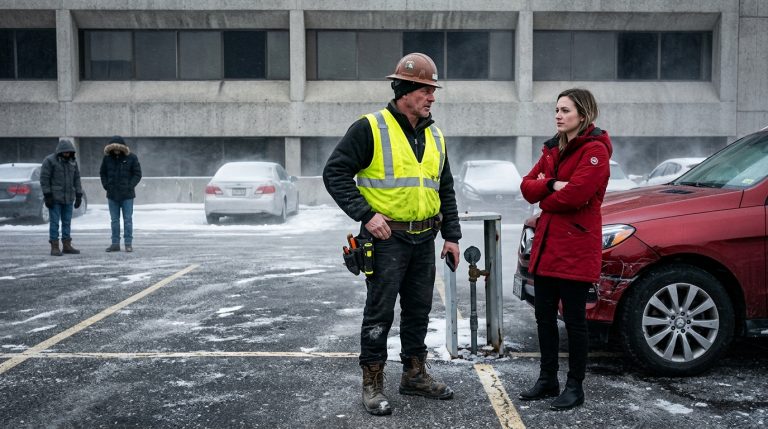
Not a wreck, but a hand—Marin’s hand—slapping the steel of my ramp. She wasn’t just standing there; she was defying the physics of the storm. Her coat was pristine, a dark stain against the white blur, and her expression was less like a neighbor and more like a creditor arriving to collect a debt.
“My SUV,” she said, her voice thin but perfectly pitched to cut through the diesel rumble. “Clear the ice from my drive. Now.”
I stared at her through the glass. The radio static crackled, the dispatcher’s voice tinny with panic—dispatching EMS to mile 9—but Marin didn’t blink. She held up a laminated badge, the edges sharp and perfectly square, pressing it against my windshield.
“HOA emergency priority,” she stated. “You’re in my jurisdiction, driver. You do what I say, or you won’t be doing it for long.”
I looked down at the dash. The winch control was right there, a cold, oily lever under my thumb. My pulse didn’t jump. That was the first lesson I’d learned in this business: anger is a liability; logic is a tool. I watched the snow build up on the edge of her collar, a tiny accumulation of ice on a woman who thought she could command the weather.
“There are people trapped on the switchback,” I said, my voice flat, professional. “I’m on county rotation. I don’t take orders from the HOA.”
She didn’t flinch. She just moved closer, the perfume she wore clashing with the sharp, metallic smell of the storm. It was a calculated distance, intimate enough to be a threat, far enough to be safe. “You’re not on county rotation if you lose your contract. And I’m the one who decides who keeps it.”
She tapped the glass again, the sound rhythmic, persistent. My radio cut back in—a child’s cry barely audible over the wind—and the hair on my arms stood up. This wasn’t just a policy dispute; it was a wall. I had a truck that could move mountains of metal, a winch that could pull a car from the belly of a ravine, but here, in the middle of a blizzard, I was facing something that couldn’t be winched out of the way.
I reached for the gear shift. The truck groaned, metal protesting against the cold. Marin didn’t step back. She stood there, watching, the laminated badge still pressed to the glass, an opaque window into a bureaucracy that wanted to own the storm.
“If you move that truck,” she warned, “you’re choosing the wrong side.”
I pulled the gear into drive. My gaze fixed on the road ahead, where the ice waited, and for a split second, I saw her reflection in the rearview—she wasn’t looking at the rescue, she was watching her watch. Something was missing, a detail in her routine that felt off. I glanced down at her badge again as I eased off the brake. The date of issuance was blurred, barely visible beneath the lamination, but the ink looked far too fresh for a standing policy.
CHAPTER 2: THE LOGIC OF THE LINE
The truck lurched forward, the tires biting into the packed snow with a sound like grinding teeth. I kept my eyes locked on the amber glow of the road markers, ignoring the rearview mirror. If I looked back, I’d see Marin, the badge, the absurdity of an HOA president trying to legislate physics. I couldn’t afford that. In the cab, the smell of diesel and stale coffee was sharp, grounding.
My pulse settled into a steady, rhythmic thrum. Action. Consequence. Resolution. That was the only math that held up out here.
The switchback on mile 9 was a scar on the side of the mountain, a sharp U-turn where the guardrail had been stripped away by a previous season’s storms. My headlights cut through the whiteout, illuminating the swirling vortex of ice crystals. The radio crackled again, a jagged burst of static that morphed into the frantic, high-pitched voice of the dispatcher. “Unit 4, report status. Multiple occupants trapped. Vehicle off-road, instability high.”
I didn’t answer. Talking was a waste of oxygen and concentration. I needed that energy to navigate the tilt of the road.
As I crested the rise, the world dropped away. The SUV was there, a dark, crumpled shape huddled against the base of a pine, halfway down the embankment. It looked like a discarded toy, half-buried in the drift. My hands tightened on the wheel, the cold of the steering column leaching into my palms, even through my leather gloves.
I hit the brakes, the ABS system shuttering violently. The truck came to a halt on the shoulder, the nose pointed toward the abyss. I didn’t wait for the engine to cool. I dropped out of the cab, the wind hitting me like a physical blow, a wall of air that tasted of iron and arctic silence.
The silence was the worst part.
I remembered the child’s cry from the radio. It wasn’t just a sound; it was a ghost, an echo that played in the back of my mind, a phantom of the vulnerability I was trying to suppress. Focus. I walked around the rig, my boots crunching on the frozen surface, feeling the weight of the winch cable in my hand. It was solid. It was real. Unlike the laminated badge or the empty threats of the HOA, the steel cable didn’t care about rules or compliance. It only cared about tension.
I moved down the embankment, the slope steep and treacherous. Every step was a gamble. I reached the vehicle, the roof crushed, windows shattered into a million opaque diamonds. The silence deepened here, broken only by the low, steady thump-thump of my own heart.
I reached the driver’s side, scraping snow from the glass with a gloved hand. A man sat slumped against the steering wheel, his breath coming in ragged, shallow clouds. He was alive.
“Stay with me,” I said, my voice barely audible in the gale.
He didn’t move, but a hand weakly tapped the door. I shifted my focus to the latch. The metal was frozen, seized by the ice. I took a deep breath, the cold air burning my throat, and braced my boot against the frame.
This was the “No Time-Skip” rule in action. There was no easy pull, no magic lever. There was only the physical work of prying steel away from steel. I worked the pry bar into the seam, feeling the resistance, the stubborn, unyielding nature of the wreck. Therefore, the door wouldn’t open. But, if I applied the pressure at the hinge point instead of the lock, the leverage would shift.
I adjusted, my muscles screaming as I threw my weight behind the bar. A sharp crack echoed through the trees—not the metal snapping, but the ice shattering. The door groaned, buckling inward.
As the seal broke, a rush of cold air flooded the cabin, carrying the scent of broken plastic and stale air. The man’s eyes fluttered open, unfocused, searching the white void.
“Child,” he wheezed, his voice so thin it barely existed. “Back seat.”
I didn’t need to ask for more. I turned, my boots hunting for a stable foothold on the treacherous, shifting slope. The back window was a jagged frame, the glass gone. I leaned into the dark, cold interior, the beam of my headlamp sweeping across the upholstery. A small, motionless shape huddled in the booster seat, eyes wide, paralyzed by the sheer scale of the world gone wrong.
I didn’t offer a platitude. I didn’t tell them it would be okay—that was a lie, and in this weather, lies were dangerous. I reached in, my hands moving with the steady, practiced rhythm of a machine. I unbuckled the harness, the sound of the plastic click jarringly loud. I pulled the child close, shielding them from the driving sleet with my own body, and started the climb back to the road.
Each step was an exercise in pure survival, a negotiation with gravity. When I finally reached the truck, I tucked them into the cab, cranking the heat up until the vents rattled. The man was coming out now, his movements jerky, uncoordinated. I guided him to the rig, my focus narrow and relentless.
I didn’t think about Marin. I didn’t think about the $12,000 fine. In this precise moment, those things didn’t exist. There was only the heat of the engine, the weight of the steel, and the simple, brutal task of keeping the living alive until the professionals could take over.
As I secured the winch cable to the frame of their car, I glanced up at the road. A pair of headlights crested the rise—not a cruiser, but a local sedan, slowing down as it passed. It didn’t stop. It just cruised by, the driver’s face illuminated for a second by the flash of my beacon. It was one of the HOA board members.
He looked at me, then at the wreck, his expression unreadable, before accelerating into the dark. He wasn’t stopping to help. He was observing. Reporting.
The realization sat heavy in my gut, cold as the ice on my gear. This wasn’t just a rescue anymore. It was a witness account.
I turned back to the winch, the machine whining as it took up the slack. I’d save these people, I’d clear this wreck, and I’d pay the price for it later. But for now, the only thing that mattered was the steady, mechanical pull of the cable, bringing the metal back from the edge.
CHAPTER 3: THE WEIGHT OF THE RECORD
I didn’t rush. Rushing was how you made mistakes, and in this weather, a mistake was just another name for a fatality. I hooked the chain of the wrecked SUV to the recovery bed, my movements methodical. Every click of the metal, every hitch of the cable, was a deliberate act of order against the chaos of the mountainside. The wind whipped my jacket, a relentless, icy friction, but my attention remained on the steel.
The HOA member’s car was long gone, his taillights swallowed by the whiteout minutes ago. Yet, his presence lingered. It was a pressure at the base of my skull, the unsettling realization that my routine, life-saving work was being reframed as a subversive act. I checked the winch tension one last time, my gloved fingers testing the cable’s bite. It was locked.
I hauled myself up the embankment, boots slipping on the frozen mud. When I reached the truck, I didn’t get straight in. I stood for a moment, letting the cold air clear the adrenaline-fog from my lungs. The child inside the cab was quiet now, asleep in the passenger seat, wrapped in a blanket I’d scavenged from my own emergency kit. The father was slumped against the dashboard, his breathing shallow but steady. They were safe for the next few miles. That was the only victory that mattered tonight.
I climbed into the driver’s seat and pulled the door shut, cutting off the howl of the storm. The sudden quiet was heavy, filled only with the low hum of the truck’s heater and the occasional, sharp tink-tink of cooling metal. I grabbed a small, battered notebook from the center console. This was my logbook—the physical foundation of my defense.
I wrote down the time of arrival, the weather conditions, the nature of the rescue, and the exact coordinates of the rollover. I added a note about the sedan that had passed by, detailing the make and the time, though I didn’t write down the driver’s name. I didn’t need to. I knew who it was. The record was clinical, devoid of the anger I felt simmering in my chest.
Therefore, I record the truth.
But, the truth is no longer a neutral observation.
I looked at the dashcam. The small lens stared back, a glass eye recording the whiteout in front of us. I needed to ensure this footage was offloaded properly. If the HOA was going to frame my work as negligence, then my defense had to be built on an ironclad chain of data.
I started the truck, the engine turning over with a familiar, mechanical authority. The drive down from the switchback was slow, tires struggling for purchase on the slick, polished ice. I drove like I was holding a fragile secret. Every mile back toward the valley floor was a mile closer to the inevitable confrontation. I wasn’t just transporting a family to safety; I was carrying the proof that Marin Holt’s “emergency priority” was a hollow lie.
When I reached the main road, the streetlights of Frostline Terrace flickered in the distance, orange orbs struggling against the driving snow. As I approached the entrance, I saw the gatehouse. It was normally unmanned at this hour, but tonight, a light burned inside. A vehicle was parked sideways, blocking the lane—a tow truck, its logo obscured by a thin, deliberate coating of slush.
It was the competition. The same company I’d seen lurking at the perimeter for weeks.
I slowed down, my foot hovering over the brake. I didn’t pull up to the gate. I stopped twenty yards back, the high beams cutting a long, harsh tunnel through the falling flakes. The other driver stepped out. He was tall, thick-shouldered, wrapped in a neon-orange vest that looked brand new, unscarred by the labor of the road.
He didn’t move toward me. He just leaned against the hood of his rig, arms crossed, watching. He was waiting.
I sat there, my hands relaxed on the wheel. I could see the gatehouse door open, and another figure emerged—a man I recognized from the board meetings. He wasn’t wearing a coat, just a light windbreaker, shivering violently against the cold. He held a clipboard.
My stomach tightened, not with fear, but with a cold, sharpening focus. This was the trap. A road block disguised as community oversight. If I forced my way through, I’d be the aggressor. If I stopped, I’d be delayed.
I looked at the notebook on the seat next to me. The logbook was full of hours, of miles, of rescues that held the weight of actual human life. I reached out and toggled the dashcam, ensuring it was still pulling a signal. Then, I didn’t pull forward. I pulled the truck into neutral and engaged the parking brake. I didn’t move. I simply waited.
If they wanted to initiate this, they would have to come to me. I wasn’t going to make their job easy. I wasn’t going to offer them a pretext. I just sat in the cab, the heater clicking, watching the two men in the distance through the distortion of the storm. They were talking, gesturing at my truck, their voices lost to the wind. The man with the clipboard looked at his watch, his impatience a jagged contrast to the absolute stillness of the night.
They expected me to be angry. They expected me to step out, to yell, to play into the narrative of the “unstable, reckless operator” that Marin had spent weeks cultivating. Instead, I gave them nothing.
The silence inside the cab was my sanctuary. I listened to the steady, calm breathing of the child in the passenger seat. That was the only sound that mattered. Everything else was just noise, a pathetic, bureaucratic attempt to impose control on a world that was currently being erased by a blizzard. I watched the clock on the dash—tick, tick, tick. Time was the one resource they couldn’t control, and I had plenty of it.
CHAPTER 4: THE SILENT COUNTER
The board member at the gate, the one with the clipboard, finally looked away from the other driver and stepped forward, his boots crunching loudly on the frozen gravel. He was trying to project an authority he didn’t possess, a posture of bureaucratic weight that felt fragile against the backdrop of the relentless, swirling blizzard. He gestured for me to roll down my window.
I didn’t move. I kept the window sealed, maintaining the barrier between my cab—my operational space—and the chaos of their interference. He reached the driver-side door and tapped on the glass with a gloved finger, an impatient, rhythmic sound that was quickly swallowed by the wind. I didn’t acknowledge the tapping. I simply stared straight ahead, watching the way the snow accumulated on his shoulders, a creeping white frosting on a man who believed he was orchestrating the night.
After a long minute, he seemed to realize that his presence wasn’t extracting the reaction he wanted. He pulled a laminated card from his pocket and held it against the glass—a mirror image of Marin’s tactics. HOA Authorized Access Only. I recognized the document. It was a mock-up, a piece of cardstock designed to look official enough to intimidate a resident who didn’t know the law.
I took a slow, measured breath. I wasn’t going to argue. I wasn’t going to engage. I reached over, turned the radio volume up just high enough to drown out the muffled shouts of the man outside, and then I picked up my phone. I didn’t call the police; I didn’t need to provoke an escalation that would disrupt the rescue of the family in my passenger seat. Instead, I opened the encrypted file where I’d been keeping my logs and tapped a single button: Upload Pending.
The signal was weak, flickering in the storm, but the data—the GPS coordinates, the dashcam timestamp, and the image of this man blocking the gate—began to trickle toward the cloud server. It was a digital insurance policy.
Outside, the man’s face went from frustrated to livid. He began shouting, his mouth working in silent, frantic shapes behind the glass, but I ignored him, my attention pivoting back to the notebook on my seat. I flipped the page, checking my own hand-written notes against the timestamps I’d logged for the rollover.
I noticed something then, a detail I’d missed in the adrenaline of the rescue. In the official HOA packet Marin had circulated, there was a column for “Operational Expenses” related to storm response. I remembered seeing a figure, a specific number, listed next to a vendor code that matched the tow truck idling in front of me. I turned the page of my notebook and re-examined my own records. The date for a payment listed in the packet preceded the date the contract was even drafted.
It was a math error, a clerical slip in their arrogance. They hadn’t expected anyone to actually cross-reference the paperwork. They treated the community as a closed loop where no one checked the books.
The board member outside pulled out a radio, his movements sharp and agitated. He was calling for reinforcements—likely Marin herself. I shifted the truck into gear. The engine surged, a low, guttural protest of power. The man stepped back, his expression flickering with a momentary, genuine alarm. He hadn’t expected me to move.
I didn’t drive through them. I backed the truck up, the trailer hitch swinging with a heavy, deliberate grace. I pulled into the wide, snow-covered apron of the gate’s overflow lane, putting enough distance between us to neutralize his ability to block me physically. Then, I killed the engine.
The silence returned, deeper and more biting than before.
I reached for the small, black flashlight in the door pocket and clicked it on. I didn’t point it at them; I pointed it at my own passenger seat, illuminating the ledger of my own work. I needed to be sure. I checked the figures again, my breath fogging in the air of the cab. The discrepancy was undeniable. It wasn’t just a mistake; it was the signature of a fraud, a pattern of pre-dated invoices that linked this tow company directly to the HOA’s slush fund.
They weren’t just redirecting traffic; they were laundering the fees they extracted from residents under the guise of “emergency bonds.” The rollover at mile 9 was supposed to be a payday for them. My presence had derailed their timeline.
I looked back at the gate. Marin’s car was approaching, her high beams cutting through the trees like searchlights. She was arriving to claim her victory, to ensure the narrative was set, to finalize the exclusion of the only operator who didn’t play by her rules.
I clicked the flashlight off and leaned back in the driver’s seat. My hand hovered near the radio mic. I didn’t call for help. I waited. The trap was set, but not by them. By documenting their movements, by logging their interference, and by uncovering the financial fracture in their story, I had turned their blockade into a stage.
The snow fell faster now, a white curtain closing in on the scene. I watched Marin’s vehicle pull up alongside the tow truck, the orange vest of the other driver blending into the swirling light. They were moving into position. I checked my mirror, seeing the quiet, safe shapes of the family I’d rescued in the back of my mind. My work was clean. My records were precise.
I gripped the wheel, feeling the texture of the worn leather under my thumbs. Whatever happened next, I was ready. The truth wasn’t something I had to argue; it was something I had simply gathered, piece by piece, until it was impossible to ignore. I reached out and started the engine again, the roar echoing off the gatehouse walls, a sound that finally broke the silence of the night.
CHAPTER 5: THE SIGNAL BREAK
The sudden darkness felt less like a power failure and more like a tactical choice. One second, the orange glow of the Frostline Terrace sign was illuminating the snow-caked pavement; the next, the world was reduced to the narrow, piercing beams of my headlamps. Inside the cab, the light from the dash was a stark, green contrast to the void outside.
Marin had stopped her car just past the gate. She didn’t get out immediately. She sat there, her silhouette motionless behind the windshield, a shadow within a shadow. The man with the clipboard was still hovering near the gate, his frantic energy dampened by the sudden loss of illumination. He looked lost, his head darting toward the darkness of the gatehouse as if waiting for a signal that wasn’t coming.
I kept my hands light on the wheel, my eyes scanning the perimeter. The “Butterfly Detour”—the power loss—was a complication I hadn’t calculated, but the Therefore/But logic of the night remained. Therefore, they had cut the power to disorient me. But, in the dark, they had also lost the ability to observe me clearly. I wasn’t just a target anymore; I was a ghost in the machine they thought they owned.
I reached out and clicked on my work lights—the high-intensity floods mounted on the back of the tow bed. They didn’t just illuminate the road; they washed the gate area in a blinding, clinical white that turned the snowflakes into suspended shards of light. The board member shielded his eyes, stumbling back toward the gatehouse. Marin’s car door opened, and she stepped out, her posture rigid, a cold fury radiating from her even at twenty paces.
“You’re making a mistake,” she called out, her voice amplified by the hollow acoustics of the storm. She didn’t walk toward me. She stayed in the shelter of the gate. “You aren’t authorized to be here. This is private property.”
I didn’t answer. I opened the door just a crack, letting the sound of the wind bleed into the cab to heighten the sense of exposure. I wasn’t going to talk. I was going to force them to be the ones to break the silence. I reached down and picked up my radio, tuning it to the local emergency frequency, leaving it loud enough that they could hear the static, the rhythmic pulses of the storm warnings and the distant, professional chatter of the county dispatchers. It was a reminder: I was tied into a system they couldn’t cut with a fuse box.
“You hear that?” I said, my voice projecting, stripped of any emotion. “That’s the county rotation. I have a vehicle in tow. I have an emergency dispatch order. If you obstruct this path, you aren’t just bothering a tow driver. You’re obstructing a state-regulated recovery operation.”
Marin paused. The wind snatched at her hair, but she didn’t tuck it back. Her eyes were fixed on the front of my truck, cataloging the winch, the chains, the heavy steel bumper. She was looking for a crack, a sign of hesitation. I leaned against the door frame, my posture loose, indifferent.
But, her eyes darted to the tow truck behind her. The driver in the neon vest was trying to move his rig, likely intending to box me in, but the ice beneath his tires was too slick. His wheels spun, throwing up a spray of slush that caught the light like gravel. He was spinning his tires, burning through his own leverage.
“Move the rig,” Marin commanded, her voice sharpening.
The man didn’t stop. He pushed the throttle, the engine revving high and erratic—a sound of panic. The truck didn’t move forward; it began to slide sideways, the heavy bed drifting toward the ditch like a wounded animal. I watched the physics of it—the weight, the momentum, the utter lack of tactical control. He was destroying his own chance to block the gate.
I didn’t look at Marin. I looked at the gatehouse. The board member was fumbling with his phone, his face bathed in the blue glow of a screen. He was looking at his own data, and based on the way his shoulders slumped, he was seeing the same thing I was: the signal in this sector was gone. My upload was complete, and the server had acknowledged the receipt.
The weight of the night was shifting. They had come here to finalize their hold, to bury me in a mountain of fake compliance and administrative fear. But the blizzard was a great equalizer. It didn’t care about their board meetings or their forged letterhead. It cared about traction, about heat, about the hard, physical reality of the road.
Marin started walking toward me, her heels clicking on the ice. She was close enough now that I could see the fine, precise lines of her makeup, the way she held her jaw—the effort it took to keep her mask from sliding off. She stopped ten feet from the front bumper, her hands jammed deep into the pockets of her expensive wool coat.
“You think you’re so clever,” she said, her voice dropping to a low, intimate register. It wasn’t a question. “But you’re just a guy with a truck. You have no idea what happens when you turn against the people who actually live here.”
“I know what happens when someone stops a rescue,” I replied. I didn’t raise my voice. I didn’t need to. The wind was carrying everything I said to the board member, to the driver in the ditch, and to the empty gatehouse. “And I know what happens when the county sees the logs.”
She froze. For a heartbeat, the mask didn’t just slip; it shattered. Her gaze flickered toward the gatehouse, toward the board member, and then back to me. The realization that I had bypassed their local containment, that I had pushed the data out into a larger, uncontrollable system, changed the atmosphere of the entire gate.
The driver in the ditch finally killed his engine. The silence that followed was absolute. He climbed out, his shoulders hunched, and walked toward us, hands held up in a gesture of retreat. The blockade was over. They had failed to secure the perimeter, and in failing, they had signaled their own weakness.
“You’re done,” she said, but the bite was gone. It was just a hollow threat, a ghost of the authority she had wielded so easily twenty-four hours ago.
I didn’t argue. I didn’t gloat. I stepped back into the cab and pulled the door shut, the latch clicking with a finality that sounded like a verdict. I put the truck in gear. The gate was blocked by the spinout, but the apron was wide enough. I eased the truck onto the shoulder, the tires gripping the edge of the pavement, and pulled around them, leaving the board member, the failed tow driver, and Marin Holt standing in the dark, illuminated only by the fading flicker of my own work lights.
As I drove past, I didn’t look back. I had the road now. I had the data. And most importantly, I had the quiet, steady hum of an engine that knew exactly where it was going.
CHAPTER 6: THE GAUNTLET OF TRUTH
I pulled the truck onto the main artery of the county road, but the familiar route felt alien in the driving whiteout. The headlights didn’t cut the darkness; they bounced off it, creating a disorienting, swirling sphere of illuminated ice. Every mile marker I passed was a test of my own internal compass. My notebook lay open on the passenger seat, the ink of the timestamps appearing to bleed into the paper in the dim, pulsing light. I didn’t look at it, but I could feel its weight—a physical testament to the fraud I had unmasked.
The wind shrieked against the windshield, a rhythmic, high-pitched whistling that sounded like the voice of the man I’d pulled from the switchback. I forced that memory down. Focus on the physics. The traction under my tires was thinning, the slush shifting into hard-pack. The truck swayed, the heavy frame protesting the uneven, frozen surface.
I checked the dash-cam screen for the hundredth time. The recording light was a steady, unblinking red. Data integrity. As long as that signal stayed locked, I had a weapon they couldn’t confiscate or discredit. But the road ahead was quiet—suspiciously so. The Highgate County Sheriff’s outpost was another twelve miles north, an eternity in a storm that was actively trying to bury the world.
My phone vibrated in the cup holder—a jagged, stuttering motion that I felt through the entire chassis of the rig. I glanced down. Unknown Caller. I didn’t answer. I knew who it was. The caller ID was a formality; the pressure was the message. The phone kept vibrating, a steady, rhythmic pulse that seemed to match the thrum of the engine. It was an intrusion, a deliberate attempt to break my rhythm, to force me into the reactive state they were counting on.
Therefore, the phone is a distraction.
But, if I answer, I establish a line of communication they can exploit.
I reached out and hit the power button, killing the device entirely. The sudden silence that followed was sharp, almost ringing. The physical act of turning off the phone felt like cutting a wire. I was untethered, isolated, and solely responsible for the delivery of the records.
The road took a sharp, descending curve, and I tapped the brakes. The trailer groaned, the weight shifting with a violent jerk that nearly pulled the truck into the ditch. I compensated, the wheel fighting me, my muscles locking as I manually steered the skid, feeling the friction return only when the treads finally bit into a patch of exposed gravel. My heart was a drum, steady and fast, but my mind was cold, analyzing the arc, the angle, the momentum.
That was when I saw it.
The taillights. A soft, dim red glow through the curtain of snow, hovering on the shoulder near the turn-off for the county maintenance depot. It wasn’t a patrol car. It was the other tow truck—the one from the gate. He was parked horizontally across the lane, a massive, rusted steel wall blocking the only path to the Sheriff’s station.
He hadn’t followed me; he had predicted my route. He had used the county map to cut the corner, and now he was waiting.
I didn’t panic. Panic was a waste of mechanical energy. I slowed the truck, bringing us to a crawl, the tires crunching through the deep, drift-heavy powder. The man in the neon vest stepped out again, but this time, there was no clipboard, no fake authorization card. He stood in the middle of the road, his hands resting on his hips, his body language predatory. He had an advantage of mass, a heavy-duty chassis, and a position that forced me to come to a full stop.
The space between us was less than fifty feet—a kill zone in a blizzard.
I could see the front of his rig, the winch hook dangling, swaying rhythmically in the wind. He was counting on me to stop, to get out, to engage in a confrontation that would eat up the final hours of the storm, leaving me stranded and defenseless. He was counting on the “Rusted Truth” of the road—that whoever had the heaviest iron and the most aggression won the right of way.
I didn’t stop.
I shifted into a lower gear, the engine revving to a higher, more aggressive pitch. I watched his face—the moment of confusion as he realized I wasn’t braking. He expected a negotiation, a dialogue, a clash of wills. He didn’t expect a calculation.
I steered for the very edge of the road, where the snow-buried drainage ditch met the uneven, frozen embankment. It was a narrow, dangerous sliver of space, barely wider than my tires, but it was enough. I wasn’t going to hit him, and I wasn’t going to stop. I was going to pass.
As I accelerated, the truck tilted, the cab shuddering as we rode the lip of the embankment. The other driver dove out of the way, a desperate, scrambling motion that sent him face-first into the drift. I didn’t look back. I drove with my foot pressed into the floorboard, the engine howling as we regained the flat of the road, the truck fishtailing violently before the weight of the trailer pulled us straight.
I was past him. I was on the final stretch.
The road ahead was empty, a white, featureless tunnel leading toward the Sheriff’s station. My hands were shaking now, the adrenaline finally starting to leak through the cracks in my discipline, but I kept my eyes on the horizon. The truth was just a few miles away. And as I saw the flicker of the Sheriff’s station lights piercing the dark, I knew one thing for certain: I hadn’t just survived the night. I had earned the right to finish it.
CHAPTER 7: THE ARCHITECTURE OF COLLAPSE
I didn’t stop the engine until the nose of the rig was square under the floodlights of the Sheriff’s station. The building was a bunker of concrete and humming wires, a stark, functional contrast to the chaotic, white-out world of the Frostline terrace. I sat for a moment, the engine ticking as the heat began to bleed from the manifold. My hands were locked to the steering wheel, the leather cold and damp against my skin.
I reached over and took the notebook. I had the logs, the dashcam drive, and the physical printouts of the financial anomalies. The “Rusted Truth” of the situation was finally within reach: they hadn’t just been bullying residents; they had been running a systematic extraction of funds under the cover of emergency management.
I stepped out, the air hitting me like a physical barrier, freezing and sharp. I didn’t head for the front door. I walked toward the back, where the deputy cruisers were lined up like iron soldiers. One of the side doors opened, and Captain Mercer stepped out, his uniform crisp and dark against the snow. He didn’t look surprised to see me. He looked expectant.
“You made it,” he said, his voice flat, professional.
I didn’t offer a greeting. I walked to the passenger side, opened the door, and pulled the evidence packet from the seat. It was bundled in a heavy-duty plastic bag, dry and intact. I handed it to him. “Everything you asked for,” I said. “The radio logs, the dashcam, and the ledger records. The dates don’t match the HOA filings. They were pre-dating their ’emergency’ invoices to match the storms.”
Mercer took the bag, his movements slow and careful. He didn’t open it; he just weighed it in his hand, a look of grim confirmation crossing his face. “We’ve been tracking the pattern,” he said, his voice dropping. “It wasn’t just your route. They were hitting everyone on the rotation, steering the calls toward that preferred firm and splitting the insurance kickbacks. You’re the first one who stayed inside the lines enough to document it.”
I looked toward the road I’d just traveled, the dark, swirling void where Marin was likely still waiting, still believing she had the power to stop this. “She’s coming,” I said. “She thinks this is still an HOA matter.”
Mercer nodded. “That’s exactly what I’m counting on.”
We moved inside. The station was a hum of activity, radio traffic layering over the quiet clatter of keyboards. I felt out of place in my diesel-stained coveralls, my skin raw from the wind, but as I sat at the table and watched Mercer begin the process—the filing, the logging, the formal initiation of the fraud investigation—I felt the tension that had been coiled in my stomach for forty-eight hours begin to unspool.
I sat there while they worked, watching the clock. I didn’t need to speak. I watched the system take over. The very thing Marin had tried to manipulate—the protocol, the official record, the chain of command—was now systematically dismantling her world.
Every time a deputy walked by with a folder, or an officer sat at a console, it was another nail. The “Layer 2” truth of the entire conflict was finally visible: they had no real power. They had only ever had the power we, the residents, had allowed them to borrow through our own fear. Once the evidence hit the desk, that borrowed authority evaporated.
About an hour later, the front doors opened. The sound of the wind rushing in preceded her. Marin Holt walked into the station lobby, her hair windblown, her coat splattered with road salt. She was surrounded by two of her board members, their faces pale, their eyes darting around the room like cornered animals. Marin looked less like an HOA president and more like a woman who had just realized the floor had vanished beneath her.
She stopped when she saw me.
She didn’t look at the Sheriff or the officers. She looked at me. She started to open her mouth, the sharp, practiced words of a dismissal ready to deploy, but Mercer stepped between us. He didn’t raise his voice. He didn’t have to. He simply held up the plastic bag, the contents clearly visible—the logs, the receipts, the evidence of the fraud.
“Marin Holt,” he said, the words echoing in the quiet lobby. “We have a statement to take regarding the obstruction of emergency services and the misappropriation of community emergency funds. I suggest you sit down.”
She faltered, the practiced, sharp smile she’d worn at the gate replaced by a sudden, jagged vulnerability. She looked at the bag, then back at me, her eyes widening as the reality of the situation finally hit her. There was no argument left. No paperwork. No community priority.
She opened her mouth, started to say something—a defense, an excuse, an order—but she caught Mercer’s look and went silent. She looked small. The board members behind her were already drifting away, distancing themselves, their hands held up in a futile gesture of dissociation.
I stood there, watching the final collapse of her influence. It wasn’t explosive. It wasn’t a shouting match. It was just a quiet, systematic erasure of a lie that had been sustained too long. As she turned and walked toward the interrogation room, she didn’t look back. She didn’t have the dignity to acknowledge the failure. She just disappeared into the back of the station, the heavy, metallic door clicking shut behind her.
Mercer walked back to the desk, his face set in a neutral, exhausted mask. He looked at me, then at the paperwork piling up on the console. “It’s done,” he said. “The county is moving to dissolve the board’s emergency authority entirely. Effective immediately.”
I nodded, feeling a strange, hollow sense of peace. I turned to walk out. My truck was waiting in the lot, covered in ice, a testament to the night’s work. I didn’t feel like a hero. I felt like a man who had finally finished a long, dangerous job, and as I walked out into the cold, the wind had finally stopped howling.
CHAPTER 8: THE WEIGHT OF THE SETTLED SNOW
I pushed out of the Sheriff’s station, the heavy door groaning as it fought against the building pressure of the wind outside. The world had changed in the hours I’d spent inside. The storm had lost its manic, screaming intensity, settling into a deep, rhythmic fall that coated the world in a thick, insulating blanket. The air was colder, crisper, tasting of ice and pine.
I walked toward my truck. It was sitting where I’d left it, a crusted, white monument to the last forty-eight hours. The red chain of the winch was still visible on the side, a bright, defiant streak against the drab, frozen surface of the bed. I didn’t reach for it immediately. I stood by the driver-side door, letting the silence of the night soak into my bones.
The investigation was formal now. The fraud charges against Marin were not just a threat; they were a process. I could visualize the files being opened, the evidence being indexed, the slow, grinding gears of the law doing exactly what they were designed to do. There was no more “emergency priority” in Frostline Terrace. There was only the law, applied without the distortions of local politics or personal ego.
I climbed into the cab. The engine turned over with a familiar, mechanical sigh. It felt different tonight. The vibration of the steering wheel, usually a chaotic, rattling sensation, felt smooth, aligned. I reached over to the passenger seat and picked up the empty plastic bag that had contained the evidence. I folded it into a small, tight square and tucked it into the glove box. It was a souvenir of a system that had held, even when everything else had tried to pull it apart.
I pulled out of the parking lot, the tires crunching through the fresh drift. As I turned back toward the main road, I passed the spot where the other tow truck had been parked, the one that had tried to block me. It was gone now, likely towed or abandoned in the ditch. The road was clear, a wide, open corridor stretching out into the dark.
I drove slowly, my eyes scanning the road, my senses tuned to the environment. I wasn’t looking for threats anymore. I was looking for the work. And then, the radio chirped—a soft, unremarkable sound that cut through the silence of the cab.
“Dispatch to Tow 4, stranded vehicle on County Road 12. Non-emergency. Are you in position?”
I reached out and touched the microphone. It was a simple, transactional question, the kind that defined my life. No power plays, no threats, no complex hierarchies of influence. Just a call, a need, and a professional response.
“Unit 4 clear,” I said, my voice steady, unforced. “I’m on my way.”
As I turned the wheel, I noticed the red tow chain again. I pulled over to the side of the road, the truck coming to a quiet halt under the dim, swaying glow of a single streetlamp. I climbed out and walked to the back of the rig. The chain had come loose from its mounting during the gauntlet, dangling low against the fender. I took it in my hands, the metal cold and heavy, and re-secured it, clicking the link into place with a firm, satisfying thud.
I looked at my hands. They were raw, the skin cracked and stained with diesel, but they were steady. I’d done the work. I’d held the line. And in doing so, I’d found the one thing that mattered more than any HOA title or fake emergency priority: I’d found the rhythm of a world where things worked the way they were supposed to.
I climbed back in, the cab feeling warm and protected. The snow continued to fall, burying the tracks I’d made, a clean slate covering the scars of the last few days. I didn’t mind. I knew the road would be there when the sun came up, and I knew exactly what I was going to do. I’d go out, I’d answer the calls, and I’d treat every stranded driver with the same, quiet, mechanical respect.
The engine roared to life, a steady, rhythmic beat that felt like a heartbeat. I shifted into gear and pulled onto the road, the truck gliding forward, powerful and precise. I didn’t look back at the Frostline entrance as I passed it. I didn’t need to. I had the road, I had the work, and for the first time in a long time, I had a peace that felt as solid and immovable as the mountain itself.