The Concrete Blueprint: How an Ex-Marine Plumber Dismantled a Tyrannical HOA President’s Empire of Lies
CHAPTER 1: THE CEDAR SHOWER NOTICE
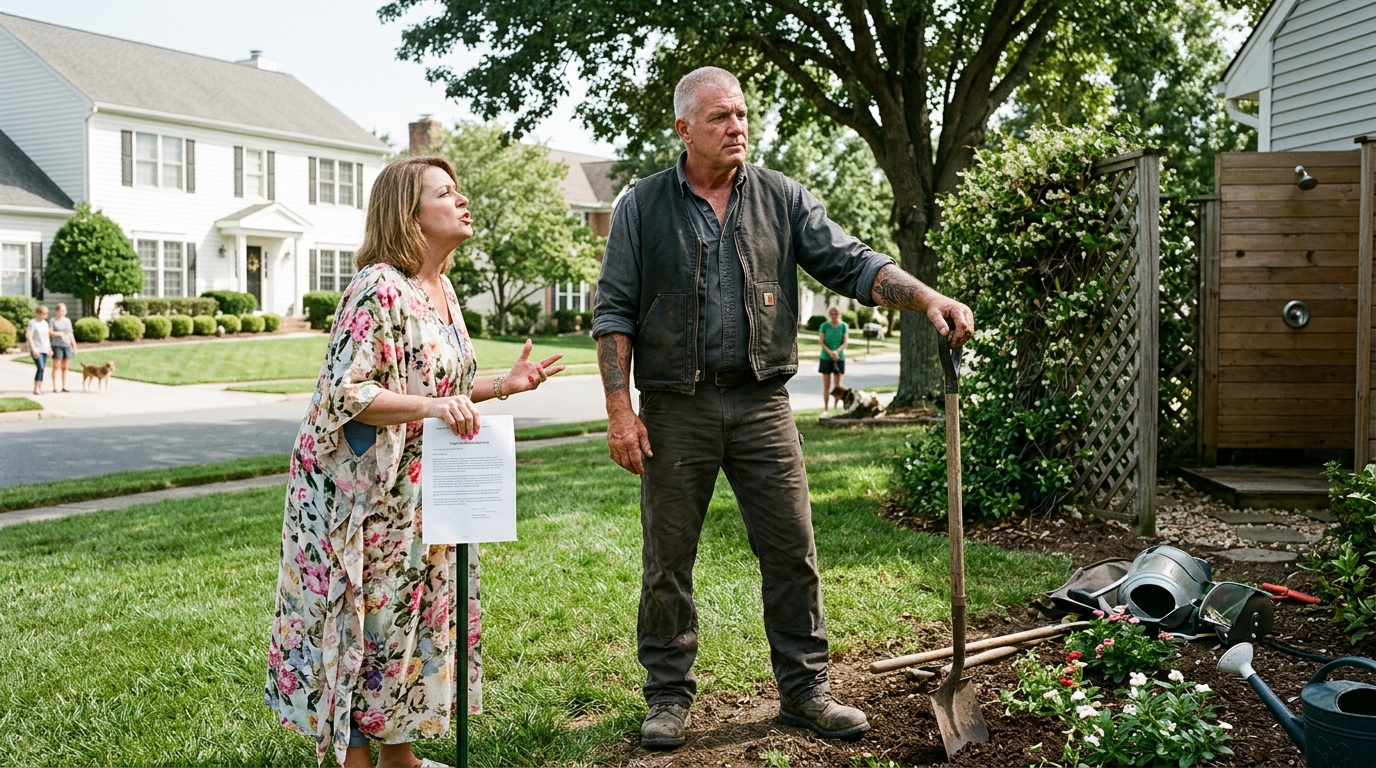
The clipboard came down on my freshly cut lawn with a sharp, plastic snap that cut straight through the morning quiet.
“That’s a $3,000 fine, Mr. Davis, payable within 15 days or it doubles.” Karen’s floral-print caftan billowed in the sharp breeze as she stood over my property line, looking like a hostile parade float.
My hand tightened around the weathered wooden handle of the garden spade.
The cedar and brushed nickel shower I had finished installing last week sat quietly behind a lattice screen of overgrown jasmine, completely hidden from the street.
Thirty years as a master plumber and four years in the Marine Corps taught me one immediate law: you never react in the heat of a surge, you assess.
“Karen,” I said, my voice dropping into a low, level register that carried no warmth at all. “There’s no provision in the bylaws against a free-standing fixture not visible from the right of way.”
She barked a short, ugly laugh and tapped a manicured nail against the violation slip.
“Section 7, Article B, Paragraph 4. All exterior alterations require prior approval from the Architectural Review Committee.”
She spun on her heel and marched away, leaving the flutter of white paper pinned to my thoughts.
I didn’t watch her go; instead, my gaze locked onto the big two-story colonial at the top of the cul-de-sac.
She thought she was dealing with a quiet retiree she could easily push around her little kingdom.
She had no idea I was the man who had plumbed the entire development from the ground up fifteen years ago.
I turned the handle of the hidden shower, letting the cool water wash over my knuckles to ground the rising tension.
The time for quiet gardening was over.
CHAPTER 2: THE EMPTY FILING CABINET
The damp basement air of the county records office smelled of wet lime and decades of neglected paper.
I set my travel mug down on the cold laminate counter with a heavy thud, the cheap plastic lid rattling.
Without the fireproof filing cabinets in my garage—locked away from my reach by the strict parameters of what I could access—I had to rely on the cold, indifferent terminals of the municipal database.
My fingers felt thick and clumsy against the smooth plastic of the public search station.
The screen flickered with a green-tinted glare, casting long, sharp shadows across my knuckles.
I typed in the parcel ID for the big colonial at the top of the Oak Hollow cul-de-scar, my eyes tracking the loading bar crawl across the glass.
The public registry listed the structure exactly as it had been approved fifteen years ago: two thousand eight hundred square feet, four bedrooms, standard setbacks.
There was zero digital footprint for the massive all-season sunroom currently anchored to the rear of Karen’s property.
No electrical permits. No foundation inspections.
I scrolled through the history logs, looking for any sign of a retroactive filing, but found only blank rows and empty digital folders.
The silence in the basement was heavy, broken only by the rhythmic hum of a fluorescent ballast overhead and the faint dripping of a condensation pipe somewhere in the shadows.
It was a total paper ghost.
She had built her entire administrative throne over an unpermitted void, relying entirely on the assumption that no one would ever look backward.
I pulled a small, worn notebook from my back pocket and jotted down the parcel verification numbers with a stubby wooden pencil.
The county clerk at the far end of the long room shifted in her squeaking vinyl chair, the sound cutting through my thoughts.
I closed the browser tab, cleared the terminal cache, and picked up my mug.
The first pillar of her authority was standing on a cracked foundation, and I had the parcel numbers to prove it.
I stepped out of the municipal building and into the sharp afternoon glare, my mind already calculating the next coordinate.
CHAPTER 3: THE FIRST OFFICIAL MISSILE
The sun-bleached concrete of the municipal annex burned through the thin soles of my work boots as I slid the manila folder into the public drop box.
It contained the unpermitted plat maps, the missing setback measurements, and the photographic proof of Karen’s massive glass sunroom.
Without my personal garage archives, I had pieced this single payload together from public memory and county site logs.
Two days later, the retaliation arrived with the blunt force of a sledgehammer.
A crisp white municipal truck idled at the edge of the cul-de-sac, its engine humming a low, steady drone.
I stood behind my kitchen window, watching through the clean glass as the inspector in a high-visibility vest stepped up to the front door of the big colonial.
He didn’t knock softly; he rapped three sharp knuckles against the wood, holding an official clipboard like a shield.
Karen swung the door open, her welcoming grin collapsing into a mottled mask of furious disbelief as he handed her the bright orange violation sticker.
Her mouth moved in sharp, erratic bursts, pointing wildly across the street toward my yard.
The inspector didn’t flinch, didn’t argue, and certainly didn’t care about her floral-print caftan or her self-appointed title of queen.
He simply pulled out his digital camera, snapped two wide-angle shots of the unpermitted sunroom addition, and walked back to his truck.
The first missile had landed squarely on target, cracking the very foundation of her petty kingdom.
A cold, heavy silence settled over her porch as she stood alone on the concrete, staring down at the orange warning notice in her trembling grip.
CHAPTER 4: THE TOWED TRUCK CONFRONTATION
The cold steering wheel chilled my palms as I watched the yellow tow truck’s hydraulic arm swing toward my bumper.
I shoved the driver’s side door open and hit the pavement before the heavy steel chains could latch onto my old Ford’s axle.
“Hold it right there,” I said, my voice cutting sharply through the morning air as I stepped directly between the rig and my truck.
The young tow driver dropped his hands from the winch mechanism, his eyes darting nervously toward the porch at the end of the cul-de-sac.
“Got a dispatch from the association office,” the kid mumbled, wiping grease off his thumb onto his blue canvas trousers. “Said this vehicle is leaking hazardous fluids and parked in violation.”
I crouched down and tapped my knuckles against the pristine, bone-dry asphalt beneath the tailpipe.
“Look at the ground,” I commanded, my tone dropping to a hard, low register. “There isn’t a single drop of oil, and you know it.”
I pulled out a printed violation slip stamped with Karen’s signature and shoved it into his field of vision.
“That’s not code enforcement; that’s an illegal seizure of private property using association funds.”
The kid swallowed hard, looked down at the clean pavement, and cursed under his breath.
“I’m just doing my job, man—I don’t want any legal trouble.”
“Then unhook my truck right now,” I said, stepping closer, “or your next call is going to be grand theft auto.”
He didn’t hesitate a second longer; he yanked the chains free, threw himself into his cab, and rolled coal down the street without looking back.
CHAPTER 5: THE PARK ASSEMBLY
My fingertips brushed the smooth, cool wood of the front porch railing as dusk settled over the front lawns of Oak Hollow.
The memory of late nights spent over old blueprints flickered briefly behind my eyes, reminding me of what had been lost when my garage records were locked away, but the physical reality of the neighborhood’s anger pushed the ghost aside.
Dave Riley stood near the folding tables at the community park, tapping a heavy binder against his thigh to quiet the gathering crowd.
Over a hundred residents spilled across the grass, their faces illuminated by the harsh white glare of portable work lights.
“We’re not here to complain about grass height,” Dave announced, his voice carrying the gravelly authority of a retired sergeant major. “We’re here because our homes are carrying a half-million-dollar insurance liability nobody told us about.”
I stepped up to the microphone, resting my calloused palms on the cold metal stand.
“Fifteen years ago, every single house in this development was fitted with a water heater missing a mandatory expansion tank,” I said, looking out over the sea of anxious faces. “If one of those tanks ruptures under pressure, your insurance will deny the claim because the board knew about the code violation and buried it.”
Murmurs rippled through the crowd like wind through dry brush.
Mrs. Rodriguez leaned forward, her hands tightly clutching a folder of her own rejected architectural requests.
“She used those rules as a weapon against anyone who questioned her,” she called out, her voice sharp with years of built-up frustration. “While her own house was sitting on an unpermitted sunroom.”
Dave hoisted a thick stack of petitions onto the table.
“We have over seventy signatures right here demanding a special meeting,” he said, holding up the clipboard. “And the board’s own members are ready to crack.”
Karen’s reign of terror wasn’t just crumbling; it was being weighed, measured, and found entirely bankrupt by the very neighbors she had tried to silence.
CHAPTER 6: THE FINAL GAVEL FALL
The heavy wooden gavel hit the scarred folding table with a sharp, dry crack that silenced the murmuring room instantly.
Karen sat rigidly at the head of the panel in her severe black pantsuit, her jaw locked into a mask of furious denial as Gary read the motion for her removal.
“The board has always acted within its legal bounds,” she snapped, her voice trembling with outraged entitlement as she tried to shout over the rising tide of voices. “This is an illegal coup led by a disgruntled plumber who refuses to pay his fines!”
I walked up to the center podium, placing a single, unadorned manila folder on the laminate surface without a word.
“You want to talk about rules, Karen?” I asked, my voice carrying a quiet, heavy iron that forced the room into absolute stillness.
I clicked the remote, projecting the unpermitted sunroom plans and the neighborhood-wide water heater liability logs onto the screen behind her.
“You fined people for blades of grass while sitting on half a million dollars of uninsurable code violations.”
Her face drained of color as the building inspector and fire marshal pushed through the packed double doors at the back of the hall, holding a fresh stop-work order and daily fine notices.
“Mrs. Miller,” the inspector announced loudly, “you are officially served with retroactive daily penalties for your unpermitted structure.”
The crowd erupted in a roar of absolute vindication, drowning out her desperate, frantic attempts to deflect and blame-shift.
She stood up abruptly, knocked her chair backward onto the linoleum, and stormed out of the clubhouse without looking at a single neighbor.
Weeks later, the house was sold at a steep loss, the fines were voided by the new board under Dave Riley’s leadership, and Semper Fi Plumbing was officially hired to fix every single faulty water heater in Oak Hollow.
I stood in my backyard under the open sky, letting the cool water of my cedar shower wash away the last remnants of the fight.
My phone buzzed in my pocket, and I heard my granddaughter’s bright voice asking if we could finally build that tree house.
“Absolutely, sweetheart,” I said, a quiet smile settling across my face. “Just as soon as we draw up the plans and follow the rules.”
The water pressure was steady, the air was clear, and my property was finally, truly my own.