The Price of Dead Roots: A Sergeant’s Guide to Suburban Retribution
CHAPTER 1: DEAD WOOD AND DISTILLED RAGE
The morning dew soaked straight through the denim of my work jeans, but I didn’t feel the cold.
I felt the acrid, metallic burn of industrial defoliant at the back of my throat. It hung thick in the humid air, choking out the sweet smell of morning earth and replacing it with something chemical and dead.
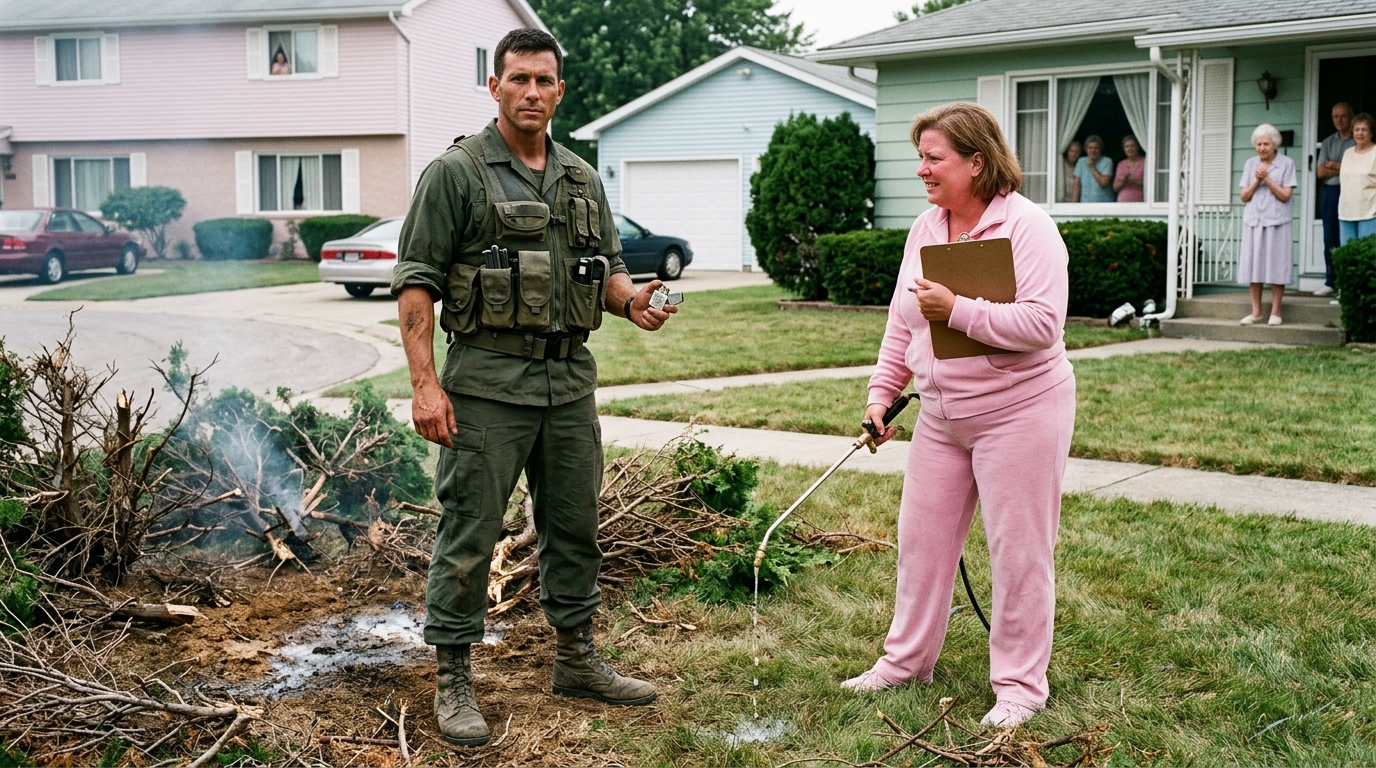
Before me lay eighty feet of arborvitae—or what was left of it. The dense, vibrant wall of green that Sarah and I had planted the week I left active duty was gone. In its place stood a jagged skeleton of brown, brittle sticks, shriveled and smoking under the rising sun.
“Consider it a community service, Sergeant.”
The voice dripped with self-satisfied venom.
I didn’t turn around right away. I rolled the silver Zippo in my right pocket, feeling the cold brass crest of my old combat engineer unit dig into my thumb. Click-clack. The silent, rhythmic metal movement anchored the sharp surge of heat in my chest, turning it back into ice.
I turned slowly.
Karen Williams stood on the edge of my manicured grass in a pastel pink tracksuit that strained against her shoulders. She held a heavy industrial pressure sprayer by the wand, its brass nozzle still dripping a clear, greasy liquid onto the turf.
“Section seven, subsection C, Mr. Davidson,” she said, tapping a clipboard tucked under her arm. Her double chin quivered with a tight, triumphant smile. “Elimination of potential fire spread vectors. You were warned.”
“I trimmed it to eight feet on Tuesday, Karen,” I said. My voice dropped an octave, settling into that flat, low cadence from my tactical days—the tone that meant the perimeter was compromised. “You came onto my property while the street was asleep.”
“The HOA common area buffer extends five feet past your surveyor pin,” she sneered, stepping closer until I could smell her sweet floral perfume mixed with the sharp stench of weed killer. “I am the president of this board. I don’t need permission to enforce safety codes on non-compliant residents.”
She waddled back toward her golf cart parked at the curb, her heavy sneakers squeaking against the wet asphalt.
“You have thirty days to clear the dead wood,” she called over her shoulder, not bothering to look back. “Or the board will hire a crew and bill your account directly. Have a blessed day.”
I didn’t yell. I didn’t move toward her.
I stood motionless on the lawn, the metal lighter clicking softly in my pocket, watching her cart hum down the street. She thought she was dealing with a quiet widower who paid his monthly dues without a fight. She had no idea she had just declared war on a man trained to tear down structures brick by single brick.
CHAPTER 2: THE PAPER TRAIL OF POISON
The dead arborvitae didn’t just look destroyed; it looked executed.
I walked down the steps, the grass slick under my boots, and knelt at the base of the center trunk. The smell hit me again—sharp, chemical, and totally alien to standard weed killer. It wasn’t the sweet, soapy tang of round-up. This was something heavy, something meant to sterilize the dirt until nothing green could survive for a decade.
I reached out with a gloved hand and snapped a branch. It didn’t bend. It shattered into dry dust between my fingers.
“Mark?”
I looked up. Mrs. Gable stood near her property line, her frail hands wringing the edge of her floral apron. She kept glancing over her shoulder toward Karen’s house, her eyes wide and terrified.
“Morning, Martha,” I said, keeping my voice level.
“I saw her last night,” she whispered, taking two hurried steps closer before stopping cold. “Around two in the morning. She had that little yellow cart idling on the curb with the lights off. I heard a hissing sound… but I was too scared to look out the blinds.”
“You don’t have to be scared, Martha.”
“She threatened to fine me five hundred dollars for my wind chime last month, Mark,” she said, her voice cracking. “She said if I disputed it, she’d have the county inspector check my back porch for unpermitted footings. She… she ruins people.”
“She tries to,” I said, standing up and pulling a box of heavy-duty freezer bags from my jacket pocket. “Do me a favor. Go inside and write down what you saw. Just the time, the color of the cart, and the hissing sound. Keep it on your kitchen counter.”
She nodded frantically and scuttled back toward her door like a shadow.
I pulled a small hand trowel from my belt and drove it into the dirt at the root line. The soil didn’t turn over brown and rich. It came up dark, slick with a transparent oil that didn’t mix with the morning dew.
I sealed the dirt into the first bag, labeled it Sample A – Base, and dropped it into my canvas tool bag. Then I walked fifty feet away to the far edge of my lawn, drove the trowel into the green turf, and pulled up a clean control sample.
Karen thought she was playing neighborhood politics. She thought a five-hundred-dollar fine and an official letter from the board would force me to back down, clean up the mess, and bite my tongue.
She didn’t realize that every combat engineer knows how to document a site of impact. You don’t fight the blast; you trace the residue back to the man who laid the wire.
I carried the tool bag into the house, set it by the kitchen island, and pulled the thick binder of HOA Covenants, Conditions, and Restrictions off the bookshelf. Two hundred pages of fine print, designed specifically so normal people would give up reading after page three.
I poured a cup of black coffee, sat down, and cracked the spine.
I didn’t start at the front. I flipped straight to the back, to Section 12: Enforcement Procedures.
There it was, printed in black ink. Section 12, Subsection A required a full board vote, a certified warning letter, and a fourteen-day grace period before any physical action could be taken against a homeowner’s property. Karen hadn’t sent a certified letter. She hadn’t called a board meeting.
She had acted alone, under the cover of darkness, with an industrial sprayer.
Then my eyes caught a small line tucked into the administrative appendices—Section 18, Subsection G: Hazardous Materials and Environmental Remediation.
I paused, tracking the line with my fingernail. It stated explicitly that if a chemical contaminant was introduced to a lot within the community, the HOA board was legally required to notify its master general liability insurer immediately to oversee containment.
I smiled, a cold, hard line across my face.
Karen wanted to play by the rules. I was going to make her swallow every single word of them.
CHAPTER 3: DIVISION OF THE RANKS
Each envelope was addressed to a different member of the Oak Haven Estates board.
I slid the sheets into their sleeves and smoothed the paper flat. I didn’t frame the letter as a threat. That would give Karen a shield to hide behind. Instead, I cited Section 18, Subsection G, informing the entire board of an active hazardous material contamination event on my lot that required immediate notification to the HOA’s primary insurance carrier.
By mailing it to all five members individually via certified mail, I created a paper trail that stripped away their legal defense of ignorance. If they ignored it, they became personally liable along with her.
I picked up the fifth envelope, marked for George Maxwell—the board’s vice president—and walked out to my truck.
George was standing in his driveway three doors down, vigorously scrubbing the hood of his sedan with a chamois cloth. His jaw was set tight, his shoulders braced like a man constantly waiting for an artillery shell to land.
“Morning, George,” I said, stopping at the edge of his concrete.
He flinched, his hand freezing on the hood. He glanced nervously toward Karen’s house across the cul-de-sac before clearing his throat.
“Mark,” he muttered, adjusting his glasses. “Look, if this is about your landscaping… Karen’s handling the enforcement side. You need to take it up with her.”
“I’m not here to argue about bushes, George,” I said, holding out the white envelope. “I’m handing you a formal notice under Section 18G. There’s a chemical hazard on my property line, and as VP, you have a fiduciary duty to open a claim with our master insurance policy.”
George’s face paled, the chamois towel limp in his fingers.
“Insurance?” he squeaked, taking a half-step back. “Mark, we can’t open a environmental claim. Our premiums will skyrocket. Karen said—”
“—Karen told you it was a routine maintenance issue,” I interrupted softly. “What happens to the board’s personal assets if an unaddressed chemical contamination spreads to the municipal storm drain, George? Does Karen’s little notebook cover your retirement savings when the carrier denies coverage for failure to report?”
He stared at the envelope in my hand, a bead of sweat breaking on his forehead despite the cool morning air. He didn’t take the paper, but he didn’t walk away either. The cracks in Karen’s armor were already showing.
I left the envelope on his hood, turned on my heel, and walked away.
The counter-attack didn’t take forty-eight hours.
By Thursday evening, an email blast hit every inbox in Oak Haven. Karen had drafted it herself: URGENT SPECIAL MEETING: DEFENDING OUR COMMUNITY FROM BASELESS LEGAL THREATS.
She was calling an emergency neighborhood assembly at the clubhouse for Saturday night, proposing a mandatory five-hundred-dollar assessment per household to fund a legal defense against a “hostile, non-compliant resident.”
She was trying to turn sixty families into an angry mob before I could even present my evidence.
My phone buzzed on the counter. It was a local number I didn’t recognize.
“Mark?” A sharp, gravelly voice barked through the speaker. “Bill Sterling. I live on Elm Street. I just read this absurd email from Karen Williams.”
“Evening, Bill,” I said, leaning back against the kitchen counter. “I take it you’re not eager to hand over five hundred dollars?”
“I spent thirty-four years as a corporate litigator, son,” Bill grunted. “I know a panicked cover-up when I see one. She’s trying to isolate you before the rest of the neighborhood realizes she’s spending their money to fight her own personal war. What’s your play?”
“I’ve got soil samples coming back from a certified lab,” I said quietly, rolling the Zippo against my palm. “And I’ve got her on procedural violations. She didn’t hold a board vote.”
“Good,” Bill rasped. “Then don’t fight her in the driveway. Let her scream at the clubhouse. Let her build her own gallows in front of seventy witnesses—and then we’ll spring the trap.”
CHAPTER 4: THE POISONED LEDGER
David stopped beside my truck, his chest heaving, his face slick with sweat. He was the board secretary, a soft-spoken software engineer in his early thirties who spent most meetings looking down at his shoes.
“I shouldn’t be giving you this, Mark,” David whispered, his fingers trembling as he thrust the envelope toward me. “If Karen finds out I pulled these files from the portal before she locked the board accounts, she’ll come after my house.”
“She won’t have time to look at your house, David,” I said, taking the heavy folder. “Did you find the maintenance receipts?”
“It’s worse than receipts,” he said, taking a step back into the shadow of my oak tree. “Look at the line items for Prestige Lawn Care from six months ago. She tagged a three-thousand-dollar invoice under ‘Routine Buffer Maintenance.’ But there’s a second set of documents attached in the appendix… an unfiled site survey.”
He didn’t wait for my response. He turned and walked briskly down the sidewalk, keeping his head down as if the streetlights were watching him.
I walked back inside, flipped on the overhead kitchen light, and dumped the contents of the folder across the counter.
Bank statements, invoice logs, and email chains spanned three years of Karen’s presidency. I rolled the brass Zippo across my knuckles, the smooth click of the lighter casing counting off the beats of my pulse.
Layer one broke open right under my eyes.
Karen hadn’t bought a fifty-dollar jug of weed killer at a hardware store. She had authorized a three-thousand-dollar payout to Prestige Lawn Care for “specialized grounds clearing.” The vendor—a local contractor who held an industrial license—had purchased a restricted, soil-sterilizing defoliant with HOA funds and handed a portion of the batch directly to Karen under the table.
She was using our own neighborhood dues to pay for the poison she dumped on my property.
I shuffled deeper into the file stack, pulling out the folded blueprint David had mentioned.
It wasn’t an HOA document. It was a private developer’s site survey map, marked with high-density townhome footprints that cut right across the rear property lines of my lot, Martha Gable’s lot, and two others on our side of the street.
Tucked beside it was a legal draft outlining automatic foreclosure triggers for unpaid maintenance liens over ten thousand dollars.
My jaw tightened. The cold rage inside me turned from iron to glass.
She wasn’t just trying to win a petty fight over hedge height. She was trying to force an exorbitant, unpayable environmental cleanup lien onto my title, trigger an automatic foreclosure through her legal retainer, and clear my land for a developer’s kickback.
The hedge had simply been in the way of her payday.
I folded the survey map carefully, tucked it into the inner lining of my leather binder along with the lab soil test, and closed the cover.
She thought she was playing a quiet game of suburban real estate chess against an old soldier who didn’t know the rules. She didn’t realize she had just handed me every shred of rope needed to hang her in front of the entire town.
CHAPTER 5: THE AMBUSH AT THE CLUBHOUSE
I pushed the doors open.
The room was packed wall-to-wall with sixty homeowners crammed onto folding chairs, the noise deafening under the low fluorescent lights. Up at the front table, Karen sat behind a wooden gavel, her face flushed dark crimson as she slammed the block against the felt pad.
“Order!” she shrieked, her voice cracking across the microphone. “We are here to vote on a mandatory legal defense assessment! I will not have this meeting hijacked by—”
Bill Sterling stood up from the front row, his tall frame blocking her view of the podium.
“Point of order, Madam President,” Bill’s baritone cut through the room like cold iron. “Under Robert’s Rules of Order, Section Fourteen, any member may request a reading of the specific legal claim before a special assessment is put to a vote.”
“This isn’t a courtroom, Mr. Sterling!” Karen snapped, her hands trembling as she adjusted her glasses. “A disgruntled resident is threatening this community with multi-million dollar ruin over a dead hedge! We need legal representation immediately!”
I walked down the center aisle, my boots heavy against the linoleum floor.
The crowd fell silent, line by line, as people turned in their chairs to watch me approach the front table. I stopped five feet from Karen, laid the leather binder flat on the board table, and looked directly at Susan Clark and George Maxwell.
“I haven’t threatened a lawsuit,” I said quietly. My voice didn’t carry theatrics; it carried the weight of a stone wall. “I filed a formal notification under Section 18G regarding a chemical hazard on my lot. And Karen refused to forward it to our insurance carrier.”
“You have no proof of chemical damage!” Karen stood up so fast her chair screeched backward. “You let your overgrown bushes die to spite this board!”
I unzipped the binder and pulled out the top sheet of the toxicology report from the lab.
“This is a certified environmental screen,” I said, sliding the paper across to Susan Clark. “The soil under my hedge was treated with imazapyr at five hundred times the legal concentration. It’s a restricted soil sterilizer.”
Susan gasped, her fingers brushing the paper as her eyes scanned the header. “Karen… this says it’s a restricted substance.”
“He fabricated it!” Karen yelled, her voice rising to a frantic pitch as she pointed a manicured finger at my chest. “He hired a crooked lab! He’s trying to extort us!”
“I also have the vendor invoice from six months ago,” I continued, pulling the second document from the binder and laying it flat between George and Susan. “Three thousand dollars paid from HOA reserves to Prestige Lawn Care for ‘buffer clearing.’ The same vendor who purchased the batch code identified in this soil report.”
The room erupted into a deafening roar. Homeowners were on their feet, chairs scraping against the floor, shouting over one another as George Maxwell stared down at the invoice with his mouth open.
Karen slammed her palm on the table, her eyes wide, wild, and completely cornered.
“This meeting is adjourned!” she screamed, snatching at her purse. “You’re all being manipulated by a bitter old man! I am the president of this board, and I am shutting this down!”
“You’re not shutting anything down, Karen,” Bill Sterling said, stepping between her and the side exit. “Because twenty-five percent of the homeowners in this room just signed a petition for an immediate vote of no confidence.”
Karen stood frozen behind the table, breathing heavily, her chest heaving as she glared at me with pure, unadulterated hatred. She wasn’t surrendering. She was a cornered rat getting ready to bite.
CHAPTER 6: THE FINAL LIEN COLLAPSE
Two uniformed township officers—called by Bill Sterling fifteen minutes before the meeting started—stepped cleanly into the doorway, blocking her path.
“Out of my way!” Karen shrieked, her purse swinging wildly. “I am the president of this board! This is an illegal assembly! I’m being harassed!”
“Ma’am, sit down,” the lead officer said, his hand resting flat against his utility belt. “We have a complaint filed regarding unauthorized chemical dumping and financial fraud.”
Karen spun around, her face pale, her lips trembling as she looked past the officers toward the fifty homeowners staring back at her in stone-cold silence. Her composure shattered completely.
“It was a safety violation!” she screamed, pointing a shaking finger directly at my face. “He’s a rebellious, arrogant contractor who thinks he’s above the rules! He ruined the neighborhood aesthetic! I did what had to be done to protect our property values!”
“You took three thousand dollars from the reserve account to buy illegal defoliant, Karen,” Susan Clark spoke up from the board table, her voice ringing clearly across the room. “And you hid a developer’s site survey in the financial files.”
The crowd surged forward, shouting for her immediate resignation.
Karen didn’t sign a confession. She didn’t weep or ask for forgiveness. She glared at every person in that room, spewing threats of countersuits and legal retaliation until the officers escorted her out to the patrol car under the glare of the clubhouse porch lights.
Without her dictating the board, the dominoes fell in rapid, ruthless succession.
Bill Sterling took over as interim president by unanimous vote before the night was out. The board immediately voted to file a formal claim with the master insurance policy under Section 18G, handing over the toxicology report, the vendor invoices, and the sworn statements from Mrs. Gable and David Chen.
The insurance carrier didn’t fight it. Faced with clear corporate board liability and a paper trail of embezzlement, they approved full remediation.
A specialized environmental crew arrived forty-eight hours later. They dug out three feet of contaminated topsoil along my property line, disposed of the toxic dirt legally, and replaced it with clean, rich earth.
By the end of the week, a flatbed trailer backed into my driveway carrying twenty ten-foot emerald arborvitae trees—fully paid for by the insurer’s liability fund.
I stood on the lawn as the planting crew set the final tree into the ground.
The acrid chemical stench was gone, replaced by the fresh, piney scent of green foliage and damp soil.
Mrs. Gable walked across her grass, holding a small brass wind chime in her hands. She hung it quietly from her porch hook, and the light breeze caught it, filling the quiet afternoon with a soft, metallic ring.
I pulled the silver Zippo from my pocket, flipped the top open, and ran my thumb across the flint wheel. The small yellow flame flickered in the clear air.
I closed the lid with a sharp, clean snap, dropped the lighter into my pocket, and picked up my garden hose to water the new roots.