Operation Enduring Justice: How a Retired Army Major Took Down a Tyrannical HOA President
CHAPTER 1: THE SCARS IN THE SOIL
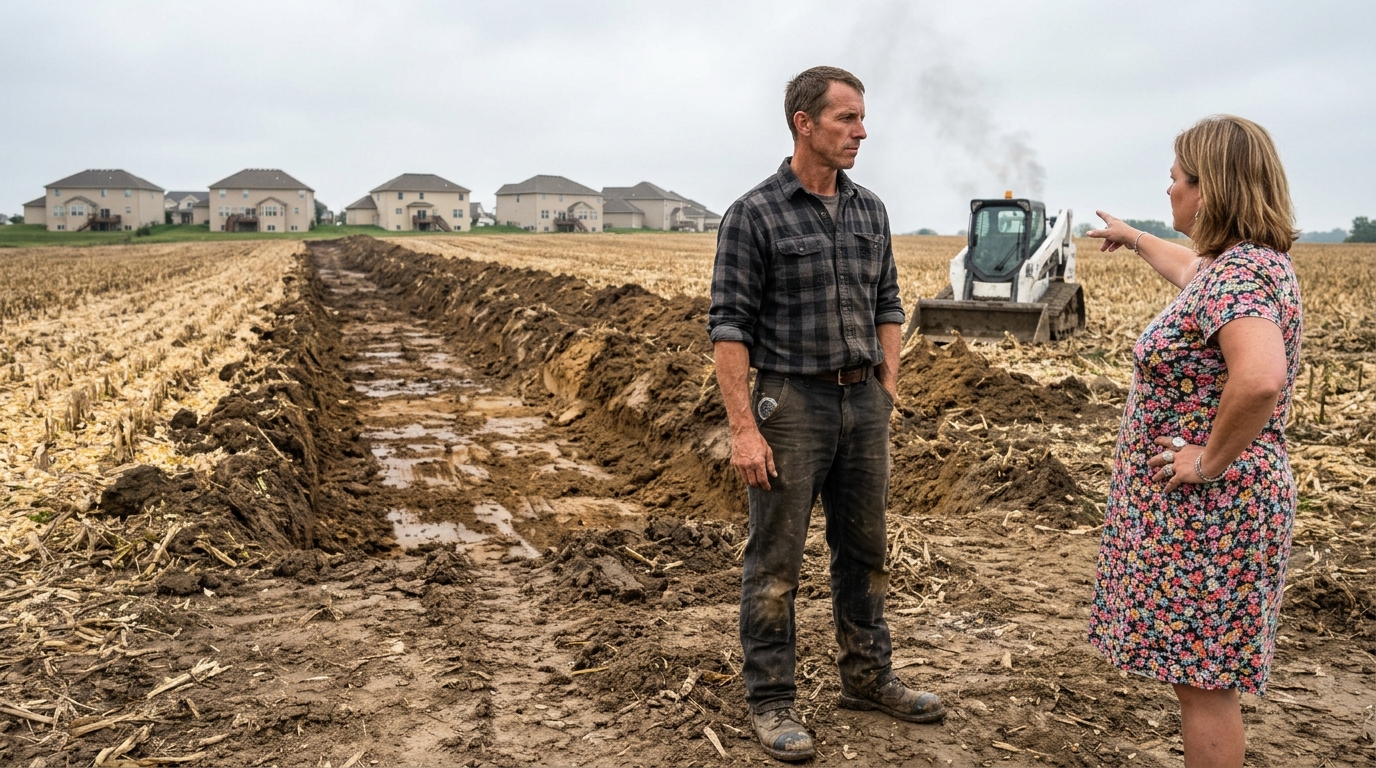
The exhaust fumes from the yellow Bobcat hung heavy in the damp morning air, mixing with the sweet, sickening smell of crushed vegetation.
I stood at the edge of my field, watching the diesel heat ripple above the engine housing.
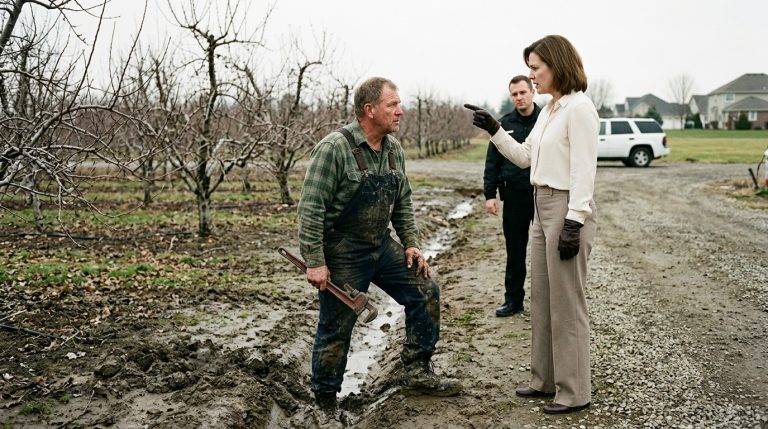
Across the fresh dirt, fifty yards of my bloody butcher corn lay pulverized. Four generations of Callahan sweat had turned this soil, and in less than two hours, a hired machine had carved a wide, muddy trench straight through the heart of the crop.
Karen Miller stood beside the idling compact track loader, her floral print dress a harsh blot of color against the fresh brown wound. She didn’t look flustered. She didn’t even look warm.
“Your corn is an eyesore, Major,” she said, her voice carrying effortlessly over the low thrum of the engine. “We’ve improved it.”
I didn’t answer right away. I thumbed the latch on my brass pocket compass, feeling the worn metal casing click open inside my pocket, then snap shut. Once. Twice.
“You’ve improved it,” I repeated, keeping my voice level, stripped of any rising heat.
“It’s a walking trail for the Whispering Pines community,” she said, waving a hand adorned with oversized rings that caught the morning sun. “The residents needed access to the woods. Your field was in the way, and frankly, this overgrown red corn lowers the aesthetic standard of the surrounding homes.”
“This field is private property,” I said, stepping forward until my boots met the edge of the churned earth. “My boundary line is marked at the county courthouse. It’s been recorded since 1868.”
Karen rested one hand on her hip, her face tightening into an expression of practiced condescension.
“We are a master-planned community, Jack. You should try being a neighbor instead of hoarding land for a little hobby.”
She turned on her heel, her sandals crunching against the gravel as she began walking back toward the beige McMansions crowning the ridge.
“The trail markers are already stacked by the trees,” she called over her shoulder without looking back. “Consider it a value add for your farm.”
I didn’t run after her. I didn’t shout. I stood in the quiet ruin of three acres of heirloom seed stock, the brass compass cool against my palm, and began calculating the exact width of the breach.
She thought she was dealing with a tired farmer. She was about to find out what happens when you cross an Army engineer on his own ground.
CHAPTER 2: PAPER SALVOS PAPER SHIELDS
The notices were printed on dense, high-grade stock with a gold-embossed seal at the top.
Fifty dollars for an “unsightly swath of bare dirt and dead vegetation” visible from the community path. One hundred dollars for my restored red barn, citing an unapproved paint color outside the subdivision’s approved palette of taupes and soft greys. Two hundred dollars for my 1952 John Deere tractor parked near the equipment shed, flagged as an illegal commercial nuisance.
The total came to three hundred and fifty dollars.
I set the sheets down, aligned their corners precisely against the oak grain of the table, and pulled my brass pocket compass from my pocket. I snapped the lid open, watching the needle settle on North, then closed it with a soft click.
She wasn’t trying to collect three hundred dollars. She was building a file.
A heavy knock rattled the back screen door, three slow, cautious thuds.
I walked over and flipped the latch. Arthur Pendleton stood on the porch, holding a Tupperware container of pie and squinting through his bifocals.
“Saw your lights on, Jack,” Arthur said, stepping inside without waiting for an invitation. He was a retired corporate litigator who had spent thirty years unpicking contract fraud for manufacturing firms before settling into Whispering Pines for what he thought would be a quiet retirement. “And I heard the Bobcat yesterday morning. Word travels fast at the mail kiosks.”
“She brought paper this time,” I said, nodding toward the table.
Arthur set the pie down, pulled a pair of reading glasses from his breast pocket, and picked up the notices. He scanned them in silence, his eyebrows climbing higher with every line. When he reached the bottom of the third page, he let out a short, dry whistle.
“She’s fining you for the dirt her hired machine chewed up,” Arthur said, setting the page back down. “That’s a level of nerve I haven’t seen since I deposed chemical executives in the nineties.”
“She thinks if she throws enough ink at the wall, I’ll back off the cornfield,” I said, leaning against the counter. “I can’t call the deputy back out here. This isn’t their department, and I’m not waiting on a squad car to tell me my own property lines.”
“Good, because law enforcement wouldn’t touch an HOA boundary spat anyway,” Arthur said, tapping his knuckle against the center notice. “She’s weaponizing the covenant rules to wear you down. But she made a fundamental tactical error.”
I looked at him. “Which is?”
“She assumes your farm is subject to her bylaws.” Arthur leaned over the table, pointing a thin finger at the date printed on the bottom of the letterhead. “Whispering Pines was incorporated seven years ago. This deed has been in the Callahan name since Andrew Johnson was in the White House. You aren’t in her association, Jack. You never signed a joinder agreement.”
“So these notices are worthless,” I said.
“Legally? They’re garbage,” Arthur replied, his voice dropping into a dry, precise rhythm. “But strategically, they are a gift. She just handed us a documented paper trail of bad-faith harassment. We don’t ignore these. We answer every single line with certified mail.”
I pulled out a legal pad and a pen, sliding them across the table.
“Tell me what to write,” I said.
CHAPTER 3: THE PAPER FORTRESS
The red ink on the return receipts was still wet.
Arthur sat across from me, his reading glasses propped on his forehead, carefully filing the copies into a thick manila folder labeled Callahan v. Whispering Pines.
“We bypass civil court entirely,” Arthur said, smoothing down the tab with his thumb. “If we sue for simple trespass, her board will vote to cover her legal costs using community funds. She won’t pay a single dime out of her own pocket.”
“What’s the alternative?” I asked.
“State statute 7B-21,” Arthur said, turning a sheet toward me. “Agricultural damage claim through the Department of Agriculture. It’s designed to protect active farms from bad-faith destruction. If the state investigator finds the act was deliberate, the statute triggers treble damages.”
I looked at the number written in Arthur’s neat handwriting at the bottom of the worksheet: 75,000.
“Three times seventy-five thousand,” I said.
“Two hundred and twenty-five thousand dollars,” Arthur corrected smoothly. “And under section four of that same statute, an officer who acts outside the scope of their written bylaws loses corporate indemnity. That means Karen Miller pays it personally.”
“She won’t take that sitting down,” I said, thumbing the brass casing of my compass. “She’ll claim the board authorized the path.”
“Which is why we need to prove she acted alone before she can retroactively forge the meeting minutes,” Arthur said.
I stood up, pulling my heavy work boots on and stepping out onto the back porch. The sun was barely breaking the horizon, casting long, sharp shadows through the ruined swath of corn.
I walked the edge of the destruction, my boots sinking into the churned mud, following the tread marks left by the track loader toward the far treeline.
Where the field ended and the timber began, forty yards inside my property line, a flash of bright yellow caught my eye.
I pushed through a tangle of briars and stopped.
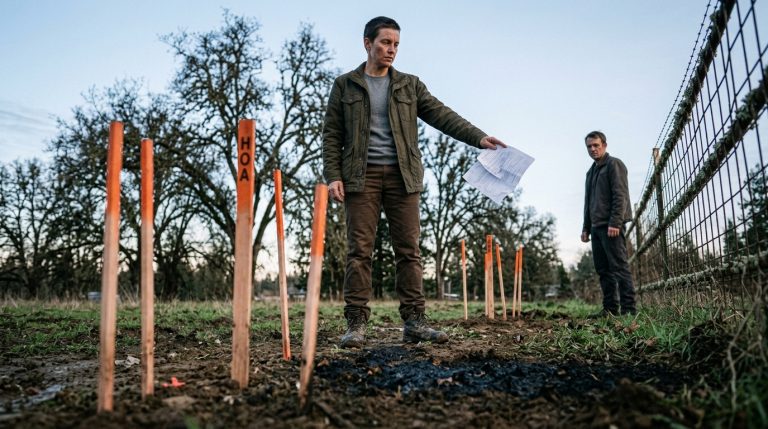
Driven clean into the soft earth was a brand-new aluminum surveyor’s stake. Tied to the top was a strip of fresh yellow surveyor’s tape, stamped with a code that didn’t match the county land office stamps: WP-ARC-04.
This wasn’t a reckless shortcut for a walking trail.
This stake had been driven here weeks before the Bobcat ever touched my corn.
She hadn’t made a stupid mistake about where the community grounds ended. She was marking a new line.
CHAPTER 4: THE FLANK ATTACK
I carried the stake back to the house and set it squarely in the middle of Arthur’s kitchen table.
Arthur adjusted his reading glasses, squinting at the code stamped into the metal cap. “WP-ARC-04. Whispering Pines Architectural Review Committee. She didn’t just cut a path, Jack. She’s laying groundwork to claim this strip by adverse possession.”
“Not while I’m breathing,” I said, popping the brass compass open with a sharp snap before closing it again. “How do we get into her records without waiting six months for a court order?”
“We don’t go through the court,” Arthur said, a dry smile touching his lips. “We go through her own backyard. The board is required by state law to allow any homeowner access to financial ledgers upon written request.”
David Chen was sitting on Sarah Jenkins’ porch when I walked up the driveway an hour later. David was an analyst who worked from home, his garage crammed with high-end 3D printers and server racks. Sarah was setting down two mugs of coffee, her toddlers playing quietly with chalk on the concrete nearby.
“She fined Sarah seventy-five dollars for sidewalk chalk,” David said, holding up a printout as I approached. “And she rejected my solar panel permit three times. So I did what I do for a living—I scraped the HOA’s public portal for every financial record uploaded over the last twenty-four months.”
“Find anything?” I asked, leaning against the porch railing.
“The numbers don’t balance,” David said, tapping a spreadsheet column. “Under ‘Common Area Maintenance,’ there’s a single entry from two weeks ago for nine thousand five hundred dollars paid to Lush Green Landscaping. Itemized as ‘routine mulching.'”
“Nine grand for mulch in the middle of July?” Sarah interjected, shaking her head. “They haven’t laid fresh mulch in our cul-de-sac since March.”
“It wasn’t mulch,” I said, setting my coffee down. “That’s what she paid the contractor to drive the track loader through my field.”
David looked up, his eyes widening behind his wire-rim glasses. “If she used community assessments under a falsified line item to commit illegal acts on private land outside the development—”
“—then she committed corporate fraud,” Arthur said, stepping up the porch stairs behind me with his legal briefcase. “And every homeowner in Whispering Pines is currently subsidizing her personal vendetta.”
Sarah stood up, her face setting into a hard, angry line. “I’m calling the block captains on our street. We’re getting signatures for a discovery motion before she can alter the portal books.”
The flank was open. Karen thought she was fighting one stubborn farmer in a field. She didn’t realize her own neighbors were about to pull the floorboards right out from under her feet.
CHAPTER 5: DEPOSITION DEMOLITION
The room was air-conditioned down to fifty degrees, but a thin bead of sweat was beginning to track down Karen’s temple, ruining her powder.
Her lawyer, a smooth-talking partner from Charlotte named Vance, glanced at the top sheet, his jaw tightening almost imperceptibly. He leaned over, whispering low in her ear.
Karen pulled back, her face flushing a deep, mottled plum as she glared across the table at Arthur and me.
“This is an outrage,” Karen snapped, her voice shrill against the quiet hum of the court reporter’s recording rig. “I was carrying out a routine community improvement project! The landscaper knew exactly what was required!”
Arthur didn’t raise his voice. He sat back in his leather chair, adjusting his bifocals, and picked up a second stack of paper—the sworn affidavit from Henderson, the owner of Lush Green Landscaping.
“Mrs. Miller,” Arthur said smoothly, “Mr. Henderson has already testified under oath. He confirmed that when his GPS alerted him to the property boundary, you explicitly ordered him to bypass the boundary check, push through Major Callahan’s crop, and bill the job under routine common area maintenance.”
“He’s lying to protect his business!” Karen shouted, slamming her hand onto the mahogany table.
“Page three, paragraph two,” Arthur continued, completely ignoring her outburst. “Your own text message to him reads: ‘The farmer is a problem and we are solving it. Bill it under the maintenance account.'”
Vance immediately placed a flat hand over Karen’s arm, cutting her off before she could speak again.
“We are taking a ten-minute recess,” Vance said, his voice flat, drained of all the bluster he had walked into the room with an hour ago.
“Take all the time you need,” Arthur replied, closing his file folder with a soft thump. “The State Department of Agriculture hearing is set for Tuesday. When this transcript hits the hearing officer’s desk, the finding of willful malice will be absolute.”
Karen stared at me, her chest heaving, her eyes burning with pure, unadulterated fury. She wasn’t surrendering. She was looking for a way to burn the whole room down before she lost her crown.
“You think you’ve won, don’t you?” she whispered, leaning over the table, her voice dripping with spite. “You think some old dirt farm matters more than our neighborhood?”
I reached into my pocket, pulled out my brass compass, and set it on the table between us. I snapped the lid open, then closed it with a clear, metallic click.
“Tuesday morning, Karen,” I said quietly. “Bring your checkbook.”
CHAPTER 6: THE FALL OF THE EMPIRE
The air in the clubhouse was heavy with humidity and angry whispers.
Karen sat behind the head board table, her eyes red-rimmed, clutching a legal pad so tightly her knuckles were translucent. Vance sat beside her, his shoulders slouched, his briefcase closed on the floor.
“Point of order,” Sarah Jenkins said, standing in the front row and yielding her three minutes directly to me. David Chen stood right behind her, holding the laptop hooked into the wall projector.
The first image hit the projector screen: a crystal-clear enlargement of Karen’s text message ordering the landscaper to bypass my boundary lines and hide the charge under common area maintenance.
Shouts erupted across the room. Neighbors stood in the aisles, pointing at the board table.
“She used our dues!” a man in the back yelled. “She used assessment money to do this!”
Karen lunged for the microphone on her table, her chair scraping violently against the linoleum. “This is an unapproved presentation! He isn’t even an association member!”
“Under section twelve of your own bylaws,” Arthur said from the second row, his voice carrying clearly over the chaos, “a member may yield their floor time to any designated speaker regarding association expenditures.”
Karen looked at Vance, her hands shaking, her mouth opening and closing as she searched for a loophole that wasn’t there. Vance simply looked down at his lap and shook his head once.
The Department of Agriculture’s ruling had arrived by courier four hours earlier: a two-hundred-and-twenty-five-thousand-dollar personal judgment against Karen Miller for willful crop destruction and land-grabbing.
The association’s insurance provider had already issued a formal denial of coverage, citing deliberate criminal fraud by an officer.
“The petition for recall is certified,” David announced, setting a stack of signed papers on the secretary’s desk. “Eighty percent of the voting interest has signed. You are removed from the board, effective immediately.”
Karen grabbed her handbag, her heels clicking frantically as she pushed through the side exit door without saying another word to the crowd she had ruled for seven years.
The next morning, the fuchsia convertible was gone from her driveway, replaced by a large wood-frame real estate sign staked into her front lawn—a forced sale to satisfy the personal lien placed against her property.
I walked back down to the edge of my field as the sun began to warm the dirt.
The tire gouges were smoothed over, the soil tilled and composted, ready for the late-season planting. Deep red stalks of bloody butcher corn were already sprouting two fields over, their leaves catching the cool morning breeze.
I pulled my brass pocket compass from my pocket, flipped the latch open, and watched the needle settle straight and true toward North before snapping it shut.