The Dusty Driveway Reckoning Where Entitlement Meets Raw Friction and Common Sense Wins Back the Peace
CHAPTER 1: THE HOOD SLAP
The engine of the red convertible was still ticking off heat against the driveway asphalt when the kid’s palm hit the metal with a dull, hollow thud.
I stood ten feet away, wiping a smudge of grease off my thumb with a shop rag, my lower back already aching from three hours of scrubbing oil pans.
Chadwick stood there in a neon windbreaker that cost more than my first lawnmower, a camera gimbal clutched in his right fist like a scepter.
“This car is mine now,” he said, his voice cracking slightly on the final syllable before he forced it down into an imitation of authority.
He didn’t ask. He didn’t even phrase it like a negotiation.
He just looked at the polished chrome bumper as if he had already mentally rearranged the garage to fit his trophies.
Lisa didn’t flinch. She sat behind the low-slung wheel, her sunglasses pushed up onto her forehead, her fingers resting lightly on the black leather-wrapped steering rim.
She didn’t raise her voice or reach for a phone.
“You ever driven anything that hits back harder than your mother’s golf cart?” she asked.
It was flat, dry, and entirely devoid of heat.
The air smelled of scorched gasoline and cut grass, the heavy afternoon stillness of a subdivision designed by people who hated silence.
I tossed the shop rag onto the workbench inside the open garage and let my hand settle on the heavy metal weight of the garage door remote resting by the door frame.
The plastic casing was scarred and scuffed from years of hard use, a solid anchor of everyday friction against the bright, plastic absurdity standing in our path.
Chadwick blinked once, his mouth parting as if he expected a laugh or an argument.
When neither came, his jaw tightened, the skin over his cheekbones flushing a mottled pink.
“My mom’s the president of this association,” he muttered, stepping closer to the driver’s side door, his camera lens dipping down to frame Lisa’s face without permission. “We handle community assets. And that car hasn’t met compliance standards for street noise.”
Lisa turned the ignition key.
The starter ground for half a second before the V8 caught, settling into a deep, uneven rumble that vibrated straight through the concrete and up into the soles of my boots.
She didn’t look at him again.
She just eased the clutch forward, letting the machine’s own heavy momentum push him back a half-step without her ever needing to touch the bumper.
CHAPTER 2: THE MEETING TABLE
The community room smelled of stale coffee, industrial floor wax, and the quiet panic of people who took yard dimensions way too seriously.
Three rows of folding chairs faced a raised dais where the association board sat like minor royalty presiding over a tax revolt.
Chadwick’s mother held a silver pen between her fingers, tapping it against an agenda packet with a rhythmic, calculated click.
Lisa didn’t sit in the front row where the folding seats rocked on uneven tile.
She stayed standing near the back exit, her arms crossed lightly over her jacket, her weight balanced evenly on both boots.
I stood beside her, my thumb hooked into my belt loop, watching the ceiling vent rattle overhead.
The agenda item came up faster than expected, slipped into the middle of landscape budget approvals like a mouse under a rug.
“We need to address community equity regarding specialty asset management,” the president said, her voice dropping into that smooth, practiced cadence designed to sound objective while picking your pocket.
She clicked her pen twice and looked directly at Lisa across the room.
“The board has received multiple inquiries about integrating private collector vehicles into community-sponsored displays and shared neighborhood programs.”
A murmur rippled through the front row where three of Chad’s friends sat nodding with aggressive synchronization.
The president leaned forward, resting her forearms on the laminate table.
“Specifically, the red vintage convertible on lot forty-two has generated significant public interest among younger residents seeking engagement opportunities.”
She phrased it like a charitable donation drive.
She made it sound as though keeping our property in our own garage was an act of civic aggression against the common good.
I felt the muscle along my jaw tighten, the memory of hot oil and scarred metal sitting heavy in the back of my throat.
Lisa didn’t shift her weight.
She didn’t reach for her bag or raise her voice to match the hollow theater echoing off the cinderblock walls.
“When your son learns what a clutch does, he can practice on a simulator,” she said.
The words hit the room with the dry, flat snap of a dry branch underfoot.
A sharp cough went off somewhere near the coffee dispenser, followed by an immediate, desperate silence.
The president’s pen stopped tapping.
Her fingers curled over the edge of the agenda packet, the knuckles whitening under the fluorescent lights.
“That vehicle has been flagged for non-standard municipal output,” the president said, her tone dropping its corporate varnish. “The community requires full accessibility to maintain property values.”
Lisa uncrossed her arms, her fingers brushing the hem of her jacket with deliberate slowness.
“The only thing this car shares is rubber with the road,” she said.
She didn’t look at the board members.
She looked at the corner of the room where a stack of uncollected recycling bins sat overflowing with slick, glossy neighborhood flyers advertising community asset sharing.
CHAPTER 3: THE FAKE CITATION
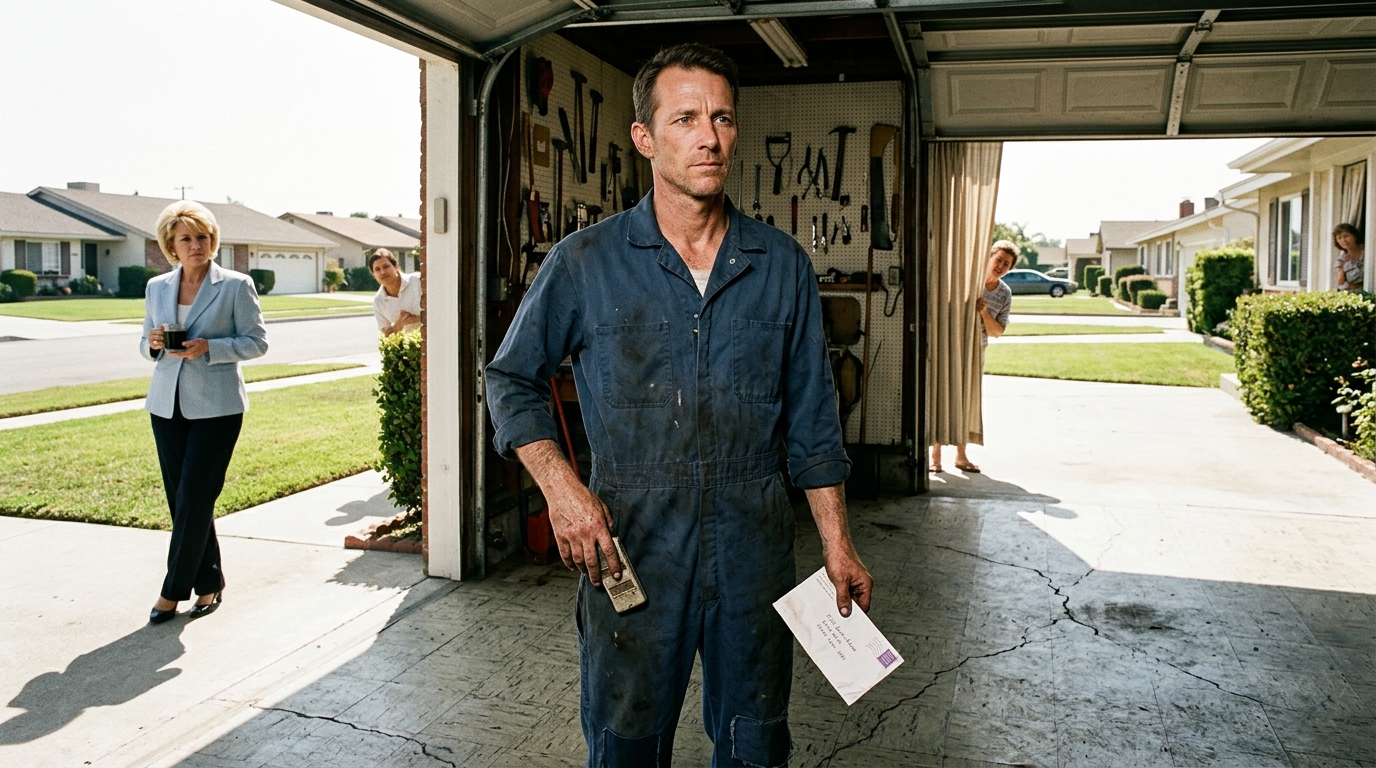
The white envelope lay on the linoleum floor just inside the front door, crisp and heavy with official municipal weight.
I picked it up, my thumb catching on the bottom corner where the texture felt wrong, too smooth and plasticky for genuine state stationery.
Lisa walked past with a mug of black coffee, her eyes dropping to the envelope for half a second before she set her cup down on the counter with a dull clink.
“Open it,” she said, her voice entirely flat.
I slit the top edge with a kitchen knife and pulled out the single sheet of thick bond paper.
It cited code violations for unapproved vehicle modifications, excessive noise signatures, and failure to surrender asset control to the neighborhood district board.
The penalty listed at the bottom was immediate impoundment pending administrative review.
What caught my eye wasn’t the threatening language or the steep fines.
It was the stamp in the lower right corner.
The purple ink was slightly smeared on the left edge, and the border lines of the municipal seal didn’t quite line up with the text box.
It was printed on an inkjet printer from a home office, not stamped by the county clerk’s office three miles away.
“They’re using letterhead they made themselves,” I said, sliding the paper across the counter toward her.
Lisa didn’t pick it up.
She just looked at the crooked stamp, her lips pressing into a thin line as the reality of what the board was doing settled into the quiet kitchen.
“They aren’t even trying to hide the paperwork anymore,” she muttered, her fingers tightening around her coffee mug. “They just want us to panic and hand over the keys out of sheer exhaustion.”
I walked over to the workbench in the garage and picked up the heavy garage door remote, letting its scarred plastic casing rest against my palm.
“Panic isn’t in the budget,” I said, listening to the morning traffic rumble past the subdivision wall.
CHAPTER 4: THE BOARDROOM CONFRONTATION
The laminate tabletop in the district office felt cold under my forearms as Lisa slid the packet of documentation across the scarred wood.
The HOA president sat opposite us, her silver pen poised above a fresh ledger sheet, her expression locked into a mask of bureaucratic patience.
“The district has absolute authority over exterior storage standards,” the president said, refusing to look down at the papers.
“You don’t have authority to fabricate municipal seals on a home printer,” Lisa replied, her voice dropping into a register so quiet it forced the room to lean in.
The president’s silver pen stopped moving, the tip hovering a millimeter above the page.
“We operate under standard compliance bylaws,” she muttered, her eyes narrowing as she finally glanced at the misaligned purple stamp on the citation copy.
“You operate a family clearinghouse to strong-arm residents into surrendering valuable property for your son,” I said, leaning forward to close the distance across the table.
One of the newly elected board members down the row shifted uncomfortably, his chair legs scraping against the linoleum with a sharp, grating squeak.
“I move that we table this review pending independent legal verification,” the new member said, his voice tight with sudden, nervous tension.
The president slammed the silver pen down against the wood, the sharp crack echoing off the bare walls.
“You’ll do nothing of the sort,” she snapped, her composure fracturing under the weight of the exposed timeline.
Lisa didn’t blink.
She reached out, picked up her documentation packet, and tucked it back into her leather folder with deliberate, unhurried precision.
“The track is booked for Saturday,” Lisa said, standing up so smoothly the chair didn’t even wobble. “Tell your boy to bring a helmet that fits.”
CHAPTER 5: THE ASPHALT SHOWDOWN
The community track parking lot was packed with folding chairs, cheap coolers, and neighbors holding Styrofoam cups like they were waiting for a parade.
Chadwick stood by the start line wearing a rented fire suit that bagged at the shoulders and a helmet that looked brand new, his camera gimbal strapped tight to his chest.
He didn’t look at the crowd.
He kept his eyes fixed on the low-slung red convertible idling fifty feet away, its engine emitting a deep, rhythmic thrum that rattled the gravel under our boots.
Lisa stepped out of the driver’s side, her helmet tucked under her left arm, her face completely expressionless in the glaring midday sun.
She didn’t stretch or put on a show for the cameras.
She just walked up to the starting line where Chadwick stood rocking back on his heels, trying to look casual while his jaw worked overtime.
“You lose, you scrub,” she said, her voice carrying clear and flat across the silent asphalt.
Chadwick flushed red under his visor, his hands tightening around his steering wheel gloves until the knuckles went white.
“I’ve logged hours on simulators,” he snapped, his voice cracking slightly on the final word. “That machine isn’t rated for district standards.”
The flag dropped with a sharp snap of yellow nylon against the wind.
Chadwick hammered his accelerator, kicking up a spray of loose gravel as his rental sports car shot forward on the straightaway like a scolded cat.
Lisa didn’t rush.
She let the red convertible roll smoothly off the line, catching the tachometer right at the sweet spot before feeding power into the rear wheels.
The first tight hairpin turn came up fast, a wall of faded rubber and painted concrete marking the apex.
Chadwick turned too early, braking hard and sliding wide across the asphalt with a squeal of scorched rubber that made half the crowd wince.
Lisa took the inside line cleanly, her tires biting into the dry surface with barely a sound, her steering correction so minimal it looked effortless.
By the second lap, she was three car lengths ahead, carving through the curves with the cold, methodical rhythm of someone doing routine maintenance.
By the final straight, it wasn’t a race anymore.
It was a public demonstration of what happened when someone mistook arrogance for actual ability.
The crowd erupted into a ragged cheer as Lisa crossed the finish line and cut the engine, leaving the lot dead silent except for the metallic ticking of cooling headers.
Chadwick crossed ten seconds later, slamming his brakes so hard his front bumper clipped a plastic cone and sent it skidding across the pavement.
He climbed out of the rental car, his face flushed deep crimson, his breath coming in ragged, angry gasps as the neighborhood onlookers stared in absolute silence.
CHAPTER 6: THE DUSTY SETTLEMENT
The morning air smelled of wet pavement and fresh soap suds as Chadwick dragged a heavy yellow sponge across the windshield of a dusty neighborhood minivan.
He wore a bright safety vest bearing giant reflective letters across the chest, his shoulders slumped under the weight of four straight weekends of public penance.
Across the street, his mother’s name had already been scrubbed off the district board roster, replaced by an interim neighbor who believed in property lines rather than private empires.
Lisa stood by our open garage, wiping down the chrome bumper of the red convertible with a clean microfiber cloth.
The engine was cold, ticking softly as the morning sun caught the deep crimson finish without a single speck of dust or ink on the glass.
Chadwick tossed his bucket onto the pavement with a dull splash, water sloshing over the concrete rim as he wiped his forearm across his forehead.
He looked over at the red car, his expression empty of the swagger and cameras that used to follow his every step.
“What torque rating does this block actually run at?” he asked, his voice rough and stripped of its usual posturing.
Lisa didn’t look up right away.
She finished wiping the side mirror before tossing him a clean sponge across the strip of gravel.
“Enough to know when you’re out of your depth,” she said, her tone level and unhurried.
He caught the sponge out of the air, his fingers closing around the damp yellow foam with a quiet, chastened grip.
I stood by the workbench, letting the scarred metal garage remote rest comfortably against my palm while the subdivision around us hummed with a quiet, ordinary peace.