The Price of a Daughter: How a Stolen Identity Collapsed Under the Weight of 18 Years of Silence
CHAPTER 1: THE COLD KITCHEN
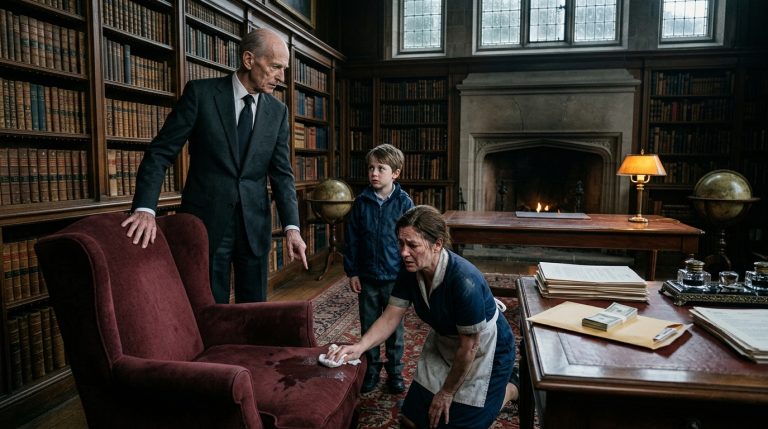
The linoleum bit straight through my socks, cold enough to ache in my arches. I didn’t turn on the overhead light because Donna hated paying for electricity before six, so I worked by the dim, bluish glow of the microwave clock.
On the counter lay the two-page handwritten list pinned down by a chipped ceramic lemon. Sweep the patio. Arrange thirty-two folding chairs. Press the linen tablecloth. Slice the lemons for the water pitcher exactly five millimeters thick.
My skin still throbbed slightly from the previous night’s exhaustion, but I kept my hands steady as I hauled out the heavy Pottery Barn platters. Rosy’s Off Route One didn’t open until ten, but my shift there scrubbing greasy sheet pans felt like a vacation compared to the quiet, suffocating humidity of the Talbet kitchen.
Upstairs, Megan’s bedroom door remained shut tight, sealing in the scent of expensive laundry detergent and safety. Downstairs in the storage closet next to the water heater, my twin mattress sat directly on the concrete floor, smelling permanently of damp cardboard and old copper pipes.
I sliced the third lemon, the blade clicking against the wooden board with a dry, rhythmic beat. Gerald liked everything lined up like soldiers on parade, every surface scrubbed until it reflected his own self-importance.
“Make sure the silver doesn’t spot today,” Donna’s voice dropped down the staircase, flat and devoid of any warmth. “We have actual guests coming, Allison. Not just your usual crowd.”
I didn’t answer. I just reached for the next lemon, wiped the juice from my fingers with a damp rag, and kept moving.
CHAPTER 2: THE BRUTAL SLAP
The flagstone beneath my shoes felt uneven, but I didn’t stop to steady myself. Behind me, the muffled bass notes of the backyard party dissolved into the heavy, damp silence of Patterson Avenue.
Gerald’s open palm had left a dull, throbbing weight across my left cheek, but the physical sting was nothing compared to the sudden, icy clarity settling in my chest.
I clutched the straps of my faded Jansport backpack, feeling the hard edge of the hidden $340 cash packet pressed against the lining. No one chased me down the driveway, and no one called my name through the suburban dark.
Donna stayed behind the window curtains, and Megan kept her camera rolling until the very end, treating my life like a bad clip to be edited out.
The streetlights overhead buzzed softly, casting long, fractured shadows across the pavement as I put distance between myself and the house I had scrubbed for eighteen years.
A black Cadillac Escalade rolled to a halt ten feet ahead, its tinted windows absorbing the amber street glow without a sound.
The rear door clicked open, and the chill of the October night suddenly felt secondary to the heavy presence waiting inside.
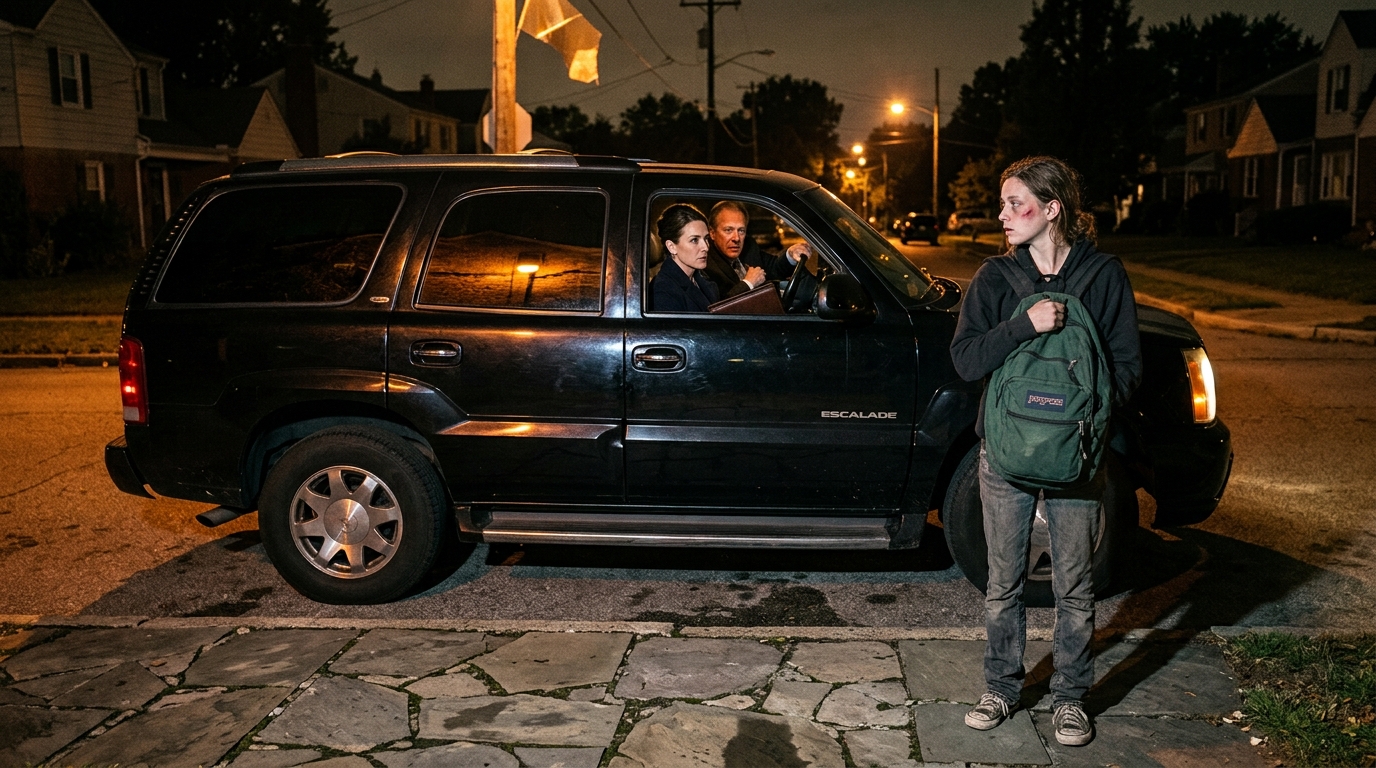
CHAPTER 3: THE BLACK ESCALADE
The cabin smelled faintly of cedarwood and cold leather, entirely removed from the scent of bleach and old dust that clung to my skin.
I kept my fingers locked tightly around the worn nylon straps of my backpack, watching Richard’s hand tremble as he reached into his inner coat pocket.
“I know how this looks,” Richard’s voice dropped, straining against the quiet hum of the heater. “After eighteen years of silence, a stranger pulls up to the curb and expects you to believe a story like this.”
Margaret turned slightly from the front passenger seat, her expression tight and professional as she rested her leather portfolio against her knees.
“We aren’t asking for blind faith,” Margaret said, her eyes meeting mine through the rearview mirror. “We have monitored your situation through public records for months, waiting for a safe opening.”
I touched my left cheek, where the skin still felt hot and tender under my fingertips.
“Gerald said my parents didn’t want me,” I said, the words slipping out before I could check them. “He told me I was a charity case nobody else would take.”
Richard flinched, the motion sharp and involuntary, as if he had taken the blow himself.
“Your mother loved you more than anything in this world,” Richard whispered, pulling a creased, faded photograph from his pocket and holding it out toward me. “She never gave you up. Someone else made that choice for us.”
CHAPTER 4: THE HILTON CONFERENCE
Margaret slid a fresh stack of photocopies across the wood grain, her expression flat and unyielding.
“The handwriting exemplar doesn’t just differ,” Margaret said, tapping a red-circled signature block with her pen. “The pen pressure proves the hand that signed away custody was deliberately disguising its movement.”
I stared down at the documents, tracing the jagged loops of a name that wasn’t mine.
For eighteen years, I had believed my existence was an act of charity, a burden carried out of Christian duty by a man who kept me in a storage room.
The financial ledgers clipped to the back of the file told a completely different story—month after month of government deposits routed straight into Gerald’s private account.
Richard sat quietly in the armchair by the window, his jaw tight as he watched me process the math.
“He didn’t just take a child,” I said, my voice dropping into a harsh, steady register. “He invoiced the state for every single day I spent scrubbing his floors.”
CHAPTER 3: THE DNA VERIFICATION
A technician in seafoam scrubs called my name without looking up from her desk, her pen tapping a rhythmic, hollow beat against Form 104-B.
Richard stayed seated three chairs down, his eyes fixed on the linoleum floor as though calculating the exact distance between who I used to be and who I was forced to become.
“Right through those double doors, Miss Witford,” the technician said, her voice clipped and devoid of human curiosity.
I pushed through the swinging aluminum door into a room that smelled faintly of rubbing alcohol and old paper.
The chair was bolted to the floor, metal arms cold against my forearms as I sat down and opened my mouth for the swab.
The synthetic bristles scraped against my inner cheek, a dry, abrasive friction that made my jaw ache.
“Five business days for results,” the technician muttered, dropping the vial into a biohazard sleeve with a sharp plastic snap.
I walked back out to the waiting area where Richard stood up immediately, his hands twitching inside his coat pockets before he caught himself.
“Done?” he asked softly, his gaze searching my face for any sign of regret.
“Done,” I said, sliding my hands into my pockets to hide the way my fingers were shaking.
CHAPTER 4: THE THREEINCH FILE
Margaret Hail slid the first stack of documents forward, her motions as measured and mechanical as a clock hand.
“Look at the pen pressure here,” Margaret said, pointing a trimmed fingernail at the bottom of a 2005 form.
The signature read Richard A. Witford, but the loops in the surname strained against the margin in a way my father’s hand never did.
Beside it, Margaret laid out the certified report from Dr. Elaine Marsh, a forensic document examiner who had cross-referenced twenty years of tax returns and contracts.
“The conclusion is absolute,” Margaret continued, her voice devoid of theatrical drama. “The consent was forged by someone else.”
I shifted my gaze to the third document, a bank statement bearing a direct wire transfer of five thousand dollars.
The date was six days before the adoption was finalized, moving straight from Gerald Talbot’s personal checking account into the pocket of a social worker named Leonard Grub.
“Five thousand dollars,” I whispered, the number tasting like dry ash. “That was what my name cost.”
Richard sat motionless in the armchair by the window, his jaw locked so tight the muscle pulsed beneath his skin.
“They traded your entire life for a monthly check,” Richard said, his voice flat and heavy with a suppressed storm.
Margaret closed her portfolio with a dull thud that signaled the end of debate and the beginning of a reckoning.
“The evidence is complete,” Margaret said, gathering her pens. “Tomorrow, we walk into Judge Dwire’s courtroom.”
CHAPTER 5: THE COURTROOM RECKONING
Gerald stood by the mahogany bench at the front of the gallery, his grey suit immaculate and his burgundy tie knotted with military precision.
Beside him, Donna gripped his arm like a drowning swimmer, her eyes darting nervously toward the banker’s box Derek Simmons was setting down on our table.
Judge Patricia Dwire adjusted her reading glasses, looking down from the elevated bench with a gaze that cut straight through Gerald’s manufactured aura of authority.
Margaret Hail rose without notes, her voice slicing through the heavy silence of the room.
“Your honor, we present irrefutable proof that the adoption of Hillary Witford was built on fraud, forged consent, and systemic financial exploitation,” Margaret announced.
Gerald’s lawyer stood up, his face flushing a dull pink as he tried to wave away the stack of forensic reports.
“Objection, your honor, this is a settled matter from two decades ago,” Gerald’s lawyer stammered, his fingers trembling against the folder.
“A decree built on forgery is never settled, counselor,” Judge Dwire replied sharply, motioning for Margaret to continue.
The Title 4E dispersement summary flickered onto the courtroom projector, casting a cold blue light over Gerald’s rigid shoulders.
Column by column, month by month, the state payments totaled $174,960, exposing every cent collected while I slept in a windowless storage closet.
When Ruth Kesler took the stand in her navy cardigan, she didn’t flinch under Gerald’s furious glare.
“I watched him strike that girl across the face in front of thirty people,” Ruth said, her voice steady and clear against the courtroom walls.
Gerald slammed his palm down on the wooden table, unable to maintain his composure any longer.
“She’s ungrateful trash, and I gave her everything!” Gerald roared, his voice cracking with unbridled rage as his mask shattered completely.
“Sit down, Mr. Talbot, or you will spend the rest of this hearing in contempt,” Judge Dwire warned, her tone dropping to an icy chill.
Donna stood up from the gallery bench, her mascara tracking black streaks down her pale cheeks as she pulled her arm free from Gerald’s grip.
“I wrote the check, your honor,” Donna sobbed, her voice trembling as she faced the bench. “Five thousand dollars to Leonard Grub. Gerald told me to do it, and I couldn’t protect her anymore.”
Judge Dwire reviewed the final documents for twelve agonizing minutes before delivering the verdict.
“The adoption is declared void ab initio, and the respondents are ordered to make full restitution,” Judge Dwire ruled, bringing the gavel down with a sharp, definitive crack.
CHAPTER 6: THE NEW MORNING
Gerald stood at the bottom of the landing, his suit jacket hanging unbuttoned and his fingers twitching against empty air.
“After everything I did for you, this is how you repay me,” Gerald shouted, his voice cracking against the morning traffic.
I paused on the lower step, looking down at the man who had traded my childhood for a monthly government check.
“My name is Hillary,” I said, my voice steady and clear against the cold wind. “And you didn’t do anything for me; you did everything to me, and now it’s over.”
I slid across the leather seat, pulling the heavy door shut, and watched him grow smaller in the tinted glass as we drove away.
Six months later, the morning light poured through the tall windows of my studio apartment off Grey Street, filling the room with a clean, golden warmth.
There was no checklist on the counter, no storage closet with a damp wool blanket, and no footsteps waiting to drop in the dark.
Richard and I sat on the porch of the Fan District bungalow every Sunday, sharing coffee and quiet silences that no longer needed explaining.
The restitution orders and criminal trials were someone else’s burden now, moving through a court system that finally saw the ledger for what it was.
I pulled back the crisp white curtains, watching the morning traffic move along the street without a single shadow holding me back.
My name is Hillary Witford, and for the first time in my life, I know exactly who I am.