The Weight of a Jacket: How a Single Act of Kindness Repaired a Billionaire’s Shattered Soul
CHAPTER 1: THE COLD ROOM
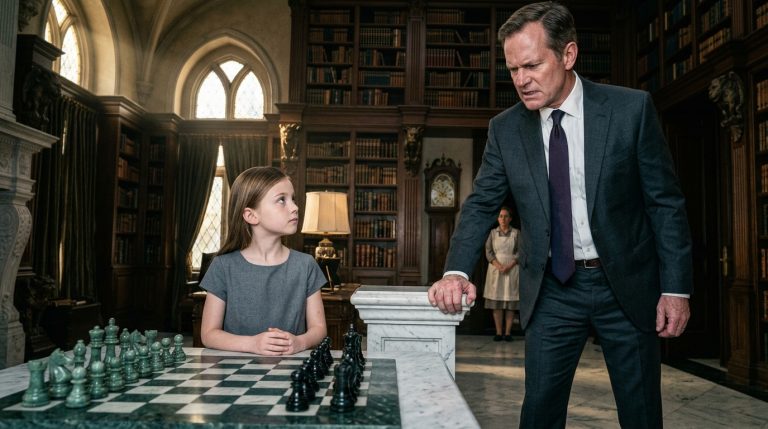
Arthur Sterling was not asleep, though the stillness of the library might have suggested otherwise. His eyes were closed, his posture deliberately slumped into the deep, unforgiving burgundy velvet of his favorite armchair. It was a pose of vulnerability, carefully curated to act as a mirror for any visitor—if they were greedy, they would see an easy target.
The fire in the hearth was a dying thing, its orange glow retreating into embers that offered more smoke than warmth. Outside, the rain battered the high, leaded windows of the Sterling mansion, the sound a rhythmic, percussive reminder of the isolation he had built around himself.
He was seventy-five. He was the owner of shipping lines, technology firms, and hotels, yet here he was, playing a game of psychological entrapment. On the mahogany table beside his right hand sat an open envelope. It bulged with five thousand dollars in crisp, hundred-dollar bills, the edges fanned out with just enough carelessness to look like a forgotten, senile mistake.
It was a test. It was always a test.
Arthur’s heart beat with a steady, rhythmic cadence that he worked hard to keep from quickening. He felt the familiar, bitter weight of his own cynicism. His children were shadows that only drifted through his life when the scent of an inheritance piqued their interest. His partners were vultures in tailored suits. He had decided, years ago, that the world was composed of those who took and those who were taken from.
He heard the heavy oak door creak.
The sound was followed by a soft, hesitant rhythm—a woman’s footsteps, quick and light, trailing behind them the almost imperceptible patter of a child.
Arthur’s muscles coiled beneath his tailored wool coat, though he kept his breathing shallow and heavy. The air in the room felt suddenly charged, the scent of damp wool and ozone drifting in from the hallway.
“Stay here, Leo,” a woman’s voice whispered. It was frayed at the edges, trembling with an anxiety that vibrated through the floorboards. “Sit in the corner on the rug. Do not move. Do not touch anything.”
Arthur tracked the movement with his ears, his internal map of the room sharpening. He felt the shift in weight as a small boy settled onto the rug in the corner. Then came the hurried departure of the maid, her footsteps retreating until the door clicked shut, sealing them in the drafty, fire-lit silence.
Arthur lay in wait, his jaw locked to maintain the facade. The boy was alone. Five minutes passed. The clock on the mantle ticked with a mechanical, indifferent rhythm. Tick. Tock.
The boy didn’t move.
Arthur felt a sliver of annoyance. He wanted the boy to reach for the money. He wanted the confirmation that his theory of human greed was correct, that even a child would prioritize currency over character. He adjusted his hand, letting his fingers brush the edge of the envelope.
Then, a sound that broke the rhythm of his expectations.
A quiet, tentative rustle of fabric. The boy was standing. Arthur tensed, the phantom sensation of a small hand reaching for the cash already playing out in his mind. But the footsteps were not moving toward the table. They were moving toward the chair.
They stopped right beside his left side. Arthur felt the boy’s presence—a small, fragile heat source. Before he could decide how to react, a tiny, cold hand touched his arm. It was a light, feathery press. Then, the boy withdrew, and Arthur heard a heavy, confused sigh from the child.
“Mr. Arthur?” the boy whispered.
Arthur didn’t respond. He emitted a soft, rumbling snore, calculated to sound as deep as a grave.
The boy shifted, and then the sound of a zipper echoed, stark and loud in the quiet room. Arthur felt a new layer of weight settle over his knees. It was a thin, damp windbreaker, the fabric cold from the storm.
“You’re cold,” the boy murmured, his voice a feather-light vibration against the stillness. “Mommy says sick people shouldn’t get cold.”
Arthur’s mind stuttered. The logic of his world—the one where everyone was a thief—hit a sudden, immovable object. The boy hadn’t touched the money. He hadn’t even looked at it. He was touching the coat, smoothing the cheap, wet fabric over the billionaire’s legs, his face filled with a simple, devastatingly earnest concern.
The boy turned back to the table, and Arthur felt his own grip on the reality he had constructed begin to fracture.
CHAPTER 2: THE FEATHERS TOUCH
The silence in the library was no longer empty; it was pressurized, vibrating with the rhythm of the rain outside and the rapid, uneven beat of Arthur’s heart. He remained in the chair, his posture rigid, the muscles in his neck aching from the strain of his own performance.
The weight of the boy’s windbreaker across his legs was surprisingly heavy—a thin, threadbare thing that smelled faintly of cheap laundry detergent and the sharp, clean ozone of the storm. It was a texture he had ignored for most of his life: the rough, honest weave of poverty that didn’t hide its own fragility.
Arthur’s eyes remained shut, but his consciousness was screaming. He was caught in a trap of his own making. If he opened his eyes now, the boy—Leo—would see the billionaire, the cold, powerful man who commanded shipping lanes and real estate empires. If he stayed silent, he was merely an old man who was cold, a simple recipient of grace.
A flicker of a memory pierced the stillness, sharp and unbidden. He saw his own children, years ago, standing in this very room. They had been older than Leo, dressed in cashmere and disdain, calculating the value of the rare wines he kept in the cellar. They had never looked at him and seen a man who might be shivering. They had only ever looked at him and seen a vault.
The sudden, intrusive ghost of that disappointment made his throat tighten. Why was this boy—this son of a maid, this stranger from the periphery of his life—treating him with a gentleness he had never managed to purchase from his own kin?
Leo shifted on the rug near his feet. The boy wasn’t stealing. He was still watching him, his small breath coming in tiny, rhythmic clouds of heat.
Arthur knew he had to act. The script of his life demanded a reaction. The trap was set, the envelope of money sat on the table like a beacon of corruption, and yet the intended thief was busy tucking a blanket around a man who had nothing but money to offer.
Arthur let out a low, practiced groan—a performance that felt more like a betrayal of the truth than any lie he had told his board of directors. He allowed his head to loll to the side, his eyelashes fluttering as if he were fighting a heavy slumber.
“Cold…” he muttered, his voice sounding raspy and thin, even to his own ears.
He didn’t dare move his hands. He kept them resting on the arms of the chair, feeling the velvet beneath his fingertips. It was opulent, expensive, and suddenly felt suffocating. He realized then that the decoy—the water stain he had planned to blame on the boy to justify his rage—was still a potentiality. He could still make the boy move, still make him reach for the money, still force the world to be the ugly place he needed it to be to feel justified in his isolation.
But the boy didn’t move toward the table.
Leo reached out again. This time, his fingers brushed the edge of the jacket, adjusting it so that it covered Arthur’s cold knees more securely.
“It’s okay, Mr. Arthur,” the boy whispered, the voice so profoundly gentle it made Arthur’s eyes sting. “The fire is almost out, but you’ll be warm soon.”
The boy didn’t ask for anything. He didn’t check the mahogany table for coins or rare trinkets. He was purely, transparently focused on the physical well-being of a man he believed was merely a sick, aging stranger.
Arthur felt the internal walls of his resolve beginning to soften, not with ease, but with the painful, grinding sound of a landslide. He had spent his entire life building defenses, treating every human interaction as a transaction to be optimized. This child was dismantling that architecture with a single, threadbare piece of clothing.
Arthur risked a fraction of an inch of movement. He pressed his hand down into the velvet, feeling the fibers give way, and forced his breathing to slow until it matched the deep, rhythmic pulse of someone truly drifting out of a dream.
He had to move toward the next phase of his experiment, but for a split second, he found himself wishing he could simply stay here, in this quiet, drafty room, being cared for by a boy who didn’t want his money. It was a dangerous, seductive thought.
He decided to push. He would open his eyes, not as a man catching a thief, but as a man who was now deeply, terrifyingly confused by his own experiment. He would force the confrontation, even if it meant risking the fragile peace that the boy had laid across his lap.
Arthur’s eyelids twitched. He began to draw a ragged, shallow breath, preparing to wake to the reality he had invited into his house—a reality that, for the first time in his life, did not fit the pattern.
CHAPTER 3: THE CONFRONTATION OF FEAR
Arthur forced his lungs to expand, a slow, rattling intake of breath that signaled his return to the waking world. He let his eyelids peel back, not with the sharp, predatory snap he had intended, but with a sluggish, heavy movement. The library light, filtered through the storm-darkened windows, felt abrasive against his pupils.
He focused his gaze on the space before his chair.
Leo was still there, standing with a tentative, almost fragile stillness, his hands hovering mid-air near Arthur’s knees, still warm from the touch of his own jacket. But the focus of the room had shifted. The door, which had been firmly latched, was now pushed slightly ajar.
Sarah stood in the threshold.
She was breathless, her chest heaving as if she had run the entire length of the mansion’s north wing. Her face was a canvas of pure, unadulterated terror. She wasn’t just afraid for her job; she was looking at Arthur as if he were a predator who had finally bared his teeth. She had clearly caught the tail end of the scene—the jacket draped over his knees, the stillness, the proximity of her son to the man who held their livelihood in his withered palm.
Arthur looked at her, and the performance he had cultivated—the grumpy, testy, demanding billionaire—felt suddenly like a lead weight. He saw the way she recoiled, clutching the doorframe, her knuckles white. She looked like a deer paralyzed by the oncoming glare of headlights.
He shifted his legs. The boy’s jacket slid off, a soft, damp bundle of fabric hitting the dark floorboards.
“What…” Arthur croaked, his voice raw, the words barely forming. “What is all this noise?”
He tried to lean into the anger, but it felt hollow. He looked at Leo, who had jumped back at the sound of his mother’s frantic entrance. The boy’s eyes were wide, darting between the man in the chair and his mother in the doorway.
Sarah moved then, a frantic, desperate motion. She surged forward, pushing past the boundary of the rug, her hands extended not in malice, but in a pathetic, pleading shield.
“Mr. Sterling, please!” she gasped, her voice breaking, soaring into a high, jagged register that made the hair on Arthur’s arms stand up. “He didn’t mean anything by it! He’s just a child—he didn’t know! I told him not to move, I told him to be silent, but he—please, sir, don’t! We’ll go. We’ll leave right now, I promise!”
She reached out to grab Leo, her hands trembling so violently she nearly knocked over the lamp that cast a pool of amber light on the mahogany table. The envelope of money—the trap—sat there, undisturbed, right in the center of the pool of light. To Sarah, it must have looked like a test she had already failed. She didn’t look at the money; she looked at Arthur, searching his face for the cruelty she had come to expect from the master of the house.
Arthur felt the weight of his own silence. He looked at the water-stained velvet where the damp coat had rested. It was a dark, prominent blotch on the rich fabric, a physical discrepancy that his original plan had intended to use as the catalyst for his rage.
“The chair,” Arthur muttered, pointing a shaking finger at the velvet. “Look at this.”
Sarah glanced down, and a sob ripped through her, a sound of absolute defeat. She dropped to her knees, not to pray, but to scrub at the fabric with her apron, her movements erratic and frantic. “I’ll fix it! I’ll pay for it, I’ll find a way, just don’t… please, Mr. Sterling, don’t take him away. Don’t send us out into the rain.”
Leo watched his mother, his lower lip beginning to quiver. He wasn’t crying, but he was bracing himself, his small frame hunched as if expecting a blow.
Arthur looked at them—the mother and child huddled on the floor, the vast, expensive emptiness of the library surrounding them—and he realized that he had achieved exactly what he had set out to do. He had created a situation where the poor were forced to grovel. He had absolute, total, and terrifying control over their reality.
And it tasted like ash.
He didn’t want this. The realization hit him with the force of a physical impact, a sudden, sharp clarity that made his own performative anger feel like a grotesque, antique costume. He looked at his own hand—the one that had reached for the envelope so many times in his mind—and saw that it was trembling. Not with age, but with the shock of having finally realized the depth of the prison he had built.
He could stop this. He could end the test, laugh, and tell them it was a game. But the weight of his own reputation, the stubborn, calcified layers of the persona he had been for twenty years, held his tongue. He was a man who didn’t change. He was a man who caught the rats.
“Water stains velvet,” Arthur said, his voice regaining some of the gravelly, harsh cadence of his usual persona, though he felt a sickening divide between his mind and his words. “It needs to be professionally restored.”
He watched Sarah’s reaction. He looked for the anger, the flash of defiance, the moment where she might stand up and tell him that a chair wasn’t worth the soul of her son. He watched, waiting for the crack, waiting for the human response to his inhuman pressure.
She didn’t look up. She kept scrubbing, her eyes squeezed shut, her tears dripping onto the expensive, imported upholstery. She was completely, utterly broken.
“I’ll work for free,” she whispered into the fabric of the chair. “Just let us stay.”
Arthur stared at the top of her head. He had caught them. He had destroyed them. And as the rain hammered against the glass, he felt the terrifying silence of the library stretch out, demanding a resolution that he had never bothered to prepare for.
CHAPTER 4: THE PRICE OF A TOY
Sarah remained on her knees, her breath coming in ragged, hitched gasps as she continued to polish the velvet. The spot where Leo’s damp jacket had rested was fading, yet the moisture seemed to have soaked deeper into the fabric, darkening it like a bruise. Arthur leaned back in the chair, his hands gripping the armrests so tightly that his knuckles turned a bloodless, waxy white.
He was waiting for the boy to move. He was waiting for the child to grab the money, to run, or to beg. But Leo didn’t move. He stood near the rug, his small frame rigid, his eyes fixed on the envelope of cash as if it were a foreign, dangerous object.
“I said,” Arthur began, his voice gravelly, straining to maintain the facade, “that damage costs five hundred dollars. That is the price of the restoration.”
He saw Sarah flinch. She stopped scrubbing, her shoulders sagging until her forehead nearly touched the velvet. “I don’t have it, Mr. Sterling. Please. I haven’t even received my first month’s wage.”
Arthur looked at the envelope. It was right there. He could point to it. He could force her to take it, to use the money he had put out as bait to pay for the “damage” he had fabricated. He could make the transaction official, turning their survival into a debt that could never be repaid.
But as he opened his mouth to deliver the final strike, he looked at Leo. The boy wasn’t looking at his mother’s distress, nor was he looking at the money. He was looking at Arthur, with a profound, terrifyingly clear gaze that seemed to see right through the expensive wool of his suit and the calculated crust of his malice.
Leo reached into his pocket.
The motion was slow, deliberate. He withdrew his hand, and as he opened his fingers, Arthur saw the object sitting in the center of his palm. It was a small, battered toy car, its red paint chipped away to reveal the dull gray metal beneath. One of its wheels was missing, leaving the chassis skewed at an awkward, lopsided angle.
“I don’t have five hundred dollars,” Leo said, his voice quiet, lacking the tremor of fear that coated his mother’s words. He held the toy out toward Arthur. “But I have this. This is Fast Eddie. He’s the fastest car in the world. My daddy gave it to me before he went to heaven.”
The air in the room seemed to thin. Arthur felt a constriction in his chest, a sensation like a vice tightening around his heart. He stared at the toy. It was worthless. To any appraiser, any antique dealer, or any of his own children, it was junk—a piece of garbage to be swept away.
But the way Leo held it, with his small, dirt-streaked fingers cupping it as if it were a diamond, made the object feel impossibly heavy. It was a piece of the boy’s life, a totem of memory and grief, being offered up to fix a chair that wasn’t even broken.
“Leo, no,” Sarah whispered, her voice cracking as she finally looked up, her eyes wide with shock. “You don’t have to…”
“It’s okay, Mommy,” the boy said, his gaze never leaving Arthur’s. “Mr. Arthur is mad. I don’t want him to be mad at you.”
Arthur felt the Unreliable Perception take hold. For a moment, the library blurred. The mahogany table, the velvet chair, the thick envelope of money—they all seemed to shrink, losing their substance, while the broken toy car expanded, becoming the only real thing in the room. He felt a sudden, dizzying sense of vertigo. Was he the one in control? Or was he a man standing in the wreckage of his own life, being outmaneuvered by a seven-year-old?
He reached out, his hand shaking, and took the toy. The metal was cold against his skin, a stark contrast to the warmth the boy had provided only moments earlier. He felt the weight of it—the missing wheel, the chipped paint, the absolute, sacrificial weight of the gift.
“You would give me this?” Arthur asked, the grumble in his voice faltering, replaced by a strange, hollow resonance. “For a wet chair? A toy?”
“Yes, sir,” Leo replied. “Is it enough? Is it enough to make you stop being mad?”
Arthur stared at the toy, his thumb tracing the jagged edge where the fourth wheel should have been. The silence that followed was absolute. He could see his own reflection in the boy’s wide, expectant eyes—an old, bitter, lonely man holding a piece of scrap metal as if it were the crown jewels.
He realized then that the test hadn’t caught a thief. It had caught a ghost. And he, Arthur Sterling, was the one who had been haunting the living, waiting for a justification to hate them, only to be confronted by a charity so profound it rendered his entire existence moot.
He didn’t look at Sarah. He couldn’t. He looked at the window, where the rain was turning into a steady, gray curtain, and he realized he didn’t know how to finish this scene. The script he had written in his head for twenty years was gone, replaced by a lopsided, broken car.
“Yes,” Arthur whispered, the word barely escaping his throat. “Yes, Leo. It is enough. It is… more than enough.”
He slumped back into the velvet, his hand closing around the toy. The weight of it was suddenly unbearable.
CHAPTER 5: THE CRACKING WALL
The silence in the library was no longer just an absence of sound; it was an active force, pressing in against the heavy oak paneling. Arthur sat frozen in the burgundy chair, the battered toy car clutched in his hand like a burning coal. His heart, which had been performing a steady, rhythmic simulation of a man sleeping, was now genuinely struggling to maintain its pace.
Sarah hadn’t moved. She remained on her knees, her hands still pressed against the velvet of the chair, her head bowed. The moisture from the coat had left a dark, jagged mark, a shadow that seemed to grow in the dim light.
“Sarah,” Arthur said, the word coming out as a rough, unpolished sound. It was the first time he had used her name without a transactional edge, and it sounded foreign in the cavernous room.
She flinched, a sharp, involuntary twitch of her shoulders. She still didn’t look up. She was trapped in the posture of a servant waiting for the lash, and the sight of it—the sheer, ingrained habit of her submission—turned Arthur’s stomach.
“Get up,” he said, firmer this time, though the command lacked the whip-crack authority of his usual tone.
She stood slowly, her legs shaking. She kept her eyes fixed on the floor, avoiding his gaze. She pulled Leo closer to her side, her hand gripping the boy’s shoulder with enough force to turn her knuckles white. She looked small, frayed at the edges, her uniform damp and rumpled from the floor.
Arthur looked at the envelope of cash still resting on the table. Five thousand dollars. It was a pittance, a rounding error in his quarterly accounts, yet it had been the centerpiece of his cruelty. It was the instrument with which he had intended to slice the last of her dignity away.
“I wasn’t asleep,” Arthur said. The confession felt like ripping off a scab. He looked at the window, where the rain was a relentless, grey blurred assault. “I set the trap. I put the money there. I waited to see if you would take it.”
Sarah’s breath caught, a sharp, hitching sound that echoed in the quiet. She looked up then, her eyes raw and wet, reflecting the dying embers in the hearth. The terror was gone, replaced by a devastating, hollow confusion.
“Why?” she whispered.
Arthur looked at the toy in his hand. He spun the three remaining wheels with his thumb, the faint grinding sound of rusted metal mocking him. “Because I am a bitter, lonely man,” he said, the words feeling as though they were being dragged out of his chest, one by one. “I have spent years building a world where no one can be trusted. I believed that if I gave anyone the chance to take from me, they would. I wanted to prove that everyone was a thief.”
He paused, the confession hanging in the humid air. He felt the phantom pressure of the walls he had built around himself, the cold, impenetrable stone of his own making, beginning to shift, to tilt, to give way.
“But you didn’t take it,” he continued, looking at Leo. “And he… he offered me the only thing he had left, to fix a chair that wasn’t even broken. I have spent my life acquiring, and yet, sitting here, I have never felt more bankrupt.”
Leo watched him, his face solemn, lacking the guile or the calculation Arthur had desperately tried to project onto him.
“Sir?” Sarah’s voice was a whisper, her hands trembling as she smoothed her apron. She didn’t understand the magnitude of what he was saying, but she understood that the predator had stopped stalking.
Arthur stood up, leaning heavily on his cane, the movement painful and labored. He walked toward the fireplace, the heat of the dying embers failing to touch the deep, biting cold that seemed to have taken root in his joints. He had come here to finish the test, to deliver the final verdict, but he realized that the person on trial had been himself all along.
He looked at his own reflection in the darkened glass of a display cabinet—a gaunt, grey man with eyes that were suddenly, painfully open. The wall of his cynicism, the thick, heavy masonry of his isolation, hadn’t just been cracked. It had been dismantled, brick by agonizing brick, by a seven-year-old’s concern for his temperature.
“The chair is fine,” Arthur said, the sentence a bridge he was burning as he crossed it. “It’s just water. It will dry.”
He turned to face them, his expression stripped of the mask he had worn for two decades. The vulnerability he saw in Sarah—the way she braced for a blow that was no longer coming—was a mirror of his own. They were both survivors of a war he had been fighting against his own kind.
“I’ve spent years waiting to be robbed,” Arthur said, his voice quiet, steady. “I never realized that by guarding everything, I was simply ensuring I had nothing left to lose. And that is the worst kind of poverty.”
He didn’t know what to do next. The script was gone. The test was over. There was only the rain, the cooling room, and the two people he had tried to destroy.
CHAPTER 6: THE TENYEAR BRIDGE
The transition was not a sudden explosion of relief; it was a slow, agonizing decompression of ten years of isolation. Arthur stood by the fireplace, the heat failing to reach the chill deep within his marrow, while Sarah stood near the center of the room, her hands still trembling. She looked at him as if he had just revealed he was made of glass and had shattered right before her eyes.
“You weren’t testing us,” Sarah said, the realization dawning with a terrifying slowness. “You were trying to break us.”
Arthur looked down at the three-wheeled toy car in his palm. The metal was pitted, the edges sharp and worn. “I was trying to validate the life I had chosen,” he replied, his voice a low, raspy scrape. “If you had taken the money, I could have walked away feeling righteous in my bitterness. Your integrity… your son’s kindness… it didn’t just fail my test, Sarah. It made the test irrelevant.”
He walked, with a deliberate, painful effort, toward the mahogany table. He placed the toy car down, right next to the envelope of cash. He looked at the money, then at the envelope, and felt a strange, cold detachment from it. It was no longer a weapon; it was simply paper.
“I need to fix this,” Arthur said, looking at the water stain on the burgundy velvet of his chair. It remained a dark, ugly smudge—a physical anchor to the cruelty he had contemplated.
“Mr. Sterling,” Sarah began, but Arthur held up a hand.
“Ten years,” he murmured, his gaze drifting to the window, where the storm had begun to settle into a steady, rhythmic rain. “That is what I have left, perhaps. Maybe less. And I will not spend another day of it in this library, guarding a vault of resentment.”
He looked at Leo. The boy was watching him with a calm, steady intensity that felt older than his seven years. Arthur felt a surge of something long-dormant—not pity, but a profound, aching responsibility. He had spent his life accumulating assets that did nothing but divide him from his fellow man. He looked at the boy and saw not a maid’s son, but a mirror—a reflection of the human connection he had discarded decades ago.
“I have a business proposition,” Arthur said, the old, commanding timbre returning to his voice, though it was shorn of its malice. “I am an old man, and I have lost the ability to navigate a world that doesn’t operate on contracts and leverage. I need someone to help me learn the language of it again. Not as a servant, but as… a student.”
Sarah looked at him, her eyes wide, struggling to process the shift in the atmospheric pressure of the room. “I don’t understand, sir.”
“I want Leo to come here,” Arthur said. He picked up the toy car again, feeling the missing wheel’s imbalance. “I want him to come here after school. I want him to do his homework in this room, so I can see what a mind looks like when it is growing, rather than one that is merely calculating. I will pay for his schooling. All of it. And in return, I want him to help me fix this place. Not the chairs. The life.”
The silence returned, but it was different now. It was no longer a pressure; it was a void waiting to be filled. Sarah looked at her son, then back at the billionaire, her face a mask of disbelief. She had been prepared to be cast out into the rain; she was not prepared to be invited into the heart of the fortress.
“You’re not doing this out of pity?” she asked, her voice quiet, searching for the hidden hook.
“I am doing this out of selfishness,” Arthur replied, his eyes finally meeting hers. He didn’t flinch. “I am terrified of dying as the man I was an hour ago. If this is a bargain, Sarah, I am the one coming out ahead.”
Arthur walked back to his chair and sank into it, the velvet groaning under his weight. He looked at the toy car, then placed it deliberately on the side table, next to the lamp. He felt a sudden, sharp exhaustion, the kind that follows a long, violent struggle. The war was over. He had lost, and yet, for the first time in his life, he felt the heavy, quiet peace of someone who had finally laid down his arms.
He watched the mother and son standing in the center of his library, two survivors of the storm, and realized that he hadn’t just saved them. They had reached across the divide he had meticulously constructed and, in a moment of simple, devastating grace, had pulled him back into the world of the living. He closed his eyes, and for the first time in twenty years, he didn’t feel the need to keep watch.
CHAPTER 7: THE FINAL WILL
The library had become a stage, and the actors were not the people Arthur had chosen, but the ones he had spent a lifetime trying to outrun. His two sons, polished in charcoal suits that cost more than a year of Leo’s education, and his daughter, wrapped in furs that seemed to shiver in the stagnant air, stood in the center of the room. They were not here to mourn; they were here to dismantle the last ten years of Arthur’s life.
Arthur sat in his burgundy chair, his strength waning, his lungs drawing shallow breaths that felt increasingly like a debt he could no longer afford to pay. Beside him stood Mr. Henderson, a lawyer whose face was as immobile as a stone monument, holding a thick, cream-colored document bound in leather.
“This is an absurdity,” the older son, Julian, snapped. He paced the length of the rug where Leo had once sat, his expensive leather soles clicking aggressively against the wood. “Father was clearly not in his right mind. You expect us to accept that a stranger—a child of the staff—is to inherit the entirety of the estate? This is litigation waiting to happen.”
Arthur watched them. They were his blood, yet looking at them was like staring at a poorly written manuscript—they were all ego, all entitlement, and utterly devoid of the messy, painful grace he had finally come to understand.
“He was of sound mind,” Mr. Henderson replied, his voice dry and devoid of inflection. “Every provision of this testament was reviewed, notarized, and witnessed during a period of sustained lucidity. Mr. Sterling was quite explicit in his requirements.”
“Requirements?” the daughter laughed, a sharp, brittle sound that seemed to shatter the stillness of the room. “He’s been playing games with that boy for a decade! Giving him the keys to the kingdom while we were kept at arm’s length. Do you have any idea how much of this property is tied up in international holdings? You can’t just hand it to a teenager!”
Arthur leaned forward, his hands trembling against the velvet of the chair. He felt the cold iron of the toy car—now with its gold-plated wheel, a small, ridiculous, beautiful thing—resting in his vest pocket.
“I am not handing you anything,” Arthur said. His voice was quiet, but it carried the weight of a long-denied authority.
The three of them froze. They turned to look at him, their expressions a mix of residual fear and mounting, desperate rage.
“You had your inheritance at birth,” Arthur continued, his eyes tracing the contours of their faces, searching for a spark of something human, something beyond the ledger of their own self-interest. “You had your trust funds, your property, your freedom from the consequences of your own choices. I gave you everything I thought you wanted, and in return, you gave me the only thing you had: your absence, until the moment the scent of my demise drew you back.”
“That’s unfair!” Julian barked, stepping closer. “We are your family!”
“Family is a practice, not a blood type,” Arthur whispered. He looked toward the door, where Leo—now seventeen, tall and steady, his face marked by the quiet confidence of a man who had grown up watching a billionaire learn how to be human—stood silently, watching the unraveling of the Sterling dynasty.
Arthur felt the truth of it then, the absolute, final reality of Layer 2: he hadn’t left his fortune to Leo because he was fond of him. He had left it to him because Leo was the only one who had ever truly seen the hole where Arthur’s soul should have been and hadn’t been afraid to climb inside to help him fill it.
The lawyers and the children began to shout, the sound rising into a discordant roar of threats and legal jargon, but Arthur let his gaze drift away from them. They were fading, becoming background noise to the only thing that mattered. He saw his own life in the reflection of the glass: the long, cold decades of guarding his wealth, and the short, incandescent years of letting it go.
He reached into his pocket and withdrew the toy car. He held it out, not to his children, but to the room, to the legacy, to the only thing that held the weight of his truth.
“The debt is paid,” Arthur whispered, his voice barely audible over the shouting.
He didn’t need to win. He didn’t need to convince them. He had already achieved the only victory that mattered: he was leaving the world not as a collector of gold, but as a man who had finally understood the cost of a jacket, the value of a broken wheel, and the crushing, beautiful weight of being known.
The room blurred, the shouting softening into a dull, distant thrum, and as the final shadows of his old life stretched out to claim the room, Arthur Sterling simply leaned back, closed his eyes, and let the truth settle into the silence.
CHAPTER 8: THE GOLDWHEELED LEGACY
The library had fallen into a state of sudden, ringing stillness, as if the oxygen had been vacuumed out of the room by the departure of the heirs. They had stormed out, their threats trailing behind them like bitter smoke, leaving the massive double doors standing open to the hallway. Outside, the rain had stopped, and the late afternoon sun was beginning to bleed through the clouds, casting long, gilded fingers of light across the dust-moted air of the room.
Leo stood near the window, the golden wheel of the toy car catching the light, throwing a tiny, brilliant spark against the dark mahogany paneling. He felt the immense, suffocating weight of the house pressing in—the sheer square footage, the history, the silence—but beneath it, he felt something else: the faint, residual warmth of the man who had sat in that burgundy chair for ten years.
Sarah walked over to him, her footsteps soft on the hardwood. She didn’t look at the empty chairs or the scattered legal papers on the desk. She looked at her son. Her face, which had carried the hardened lines of survival for so many years, was soft, the tension finally drained from her features.
“He was a good man, Leo,” she whispered, her voice echoing in the vast space.
“He was,” Leo replied. He looked down at the toy, tracing the gold-plated wheel with his thumb. “He just needed a jacket.”
The simplicity of the statement hung in the air, wrapping around the history of the house and binding it into something new. Leo walked toward the burgundy armchair, the centerpiece of the room, the place where the test had begun and where the life had eventually departed. The dark, water-stained spot on the fabric—the phantom evidence of a boy’s kindness—was still there, but in the fading sun, it looked less like a blemish and more like a mark of origin.
He set the toy car down on the side table, right next to the lamp, in the exact spot Arthur had placed it a decade ago.
“Safe now,” Leo murmured, the words falling from his lips with the same weightless gravity they had held when he was seven.
The house was his, but the possession of it felt nothing like the conquest the heirs had envisioned. It was an inheritance of labor. He looked at the books, the antique globes, and the heavy, velvet curtains that had blocked out the world for so long. He knew what he had to do. He would not sell the house. He would not hoard the silence. He would open the windows.
He moved through the room, his motions deliberate, grounded in the pragmatic grace Arthur had taught him. He walked to the double doors and pushed them wider, letting the cool, fresh air of the garden flow into the library. He could see his mother in the distance, working in the rose garden—not as a maid, but as the architect of the grounds she had spent years tending in secret.
He sat down in the burgundy armchair. It was worn, the springs giving a familiar, welcoming creak under his weight. He didn’t feel like a master of the universe, and he didn’t feel like a boy pretending to be a man. He felt like a student sitting in the presence of a master who had finally, through a long and messy process of repair, been made whole.
The Five Pillars of the conclusion settled into place with a quiet finality. The antagonist-heirs had been defeated not by legal maneuvering, but by their own corrosive emptiness—their downfall was the absence of the very thing they thought they were protecting. Poetic justice, quiet and absolute, had taken root in the soil of the estate. The room cooled as the sun dipped lower, the pacing of the narrative slowing to the rhythm of his own heartbeat.
He picked up a book from the side table—a worn, leather-bound volume Arthur had left behind—and began to read. The world outside, once a place of predators and traps, felt smaller, softer, and reachable. He was no longer the boy shivering in the corner, nor was he the billionaire who had forgotten how to look at the sky. He was simply Leo, the boy who had once traded a toy to fix a chair, and who had spent a lifetime learning that the greatest inheritance one can leave is the courage to remain human.
He closed the book as the twilight deepened, the library glowing with the soft, amber light of a fading day. He reached out and touched the toy car once more, its gold wheel catching the last, lingering glint of the sun. The silence was no longer heavy. It was a blank, clean page, waiting for the first word of a story that, finally, belonged to him.