The Iron Ledger: How Mathematical Reality Collapsed an Empire’s Illusion of Invincibility
CHAPTER 1: The Razors Calculation
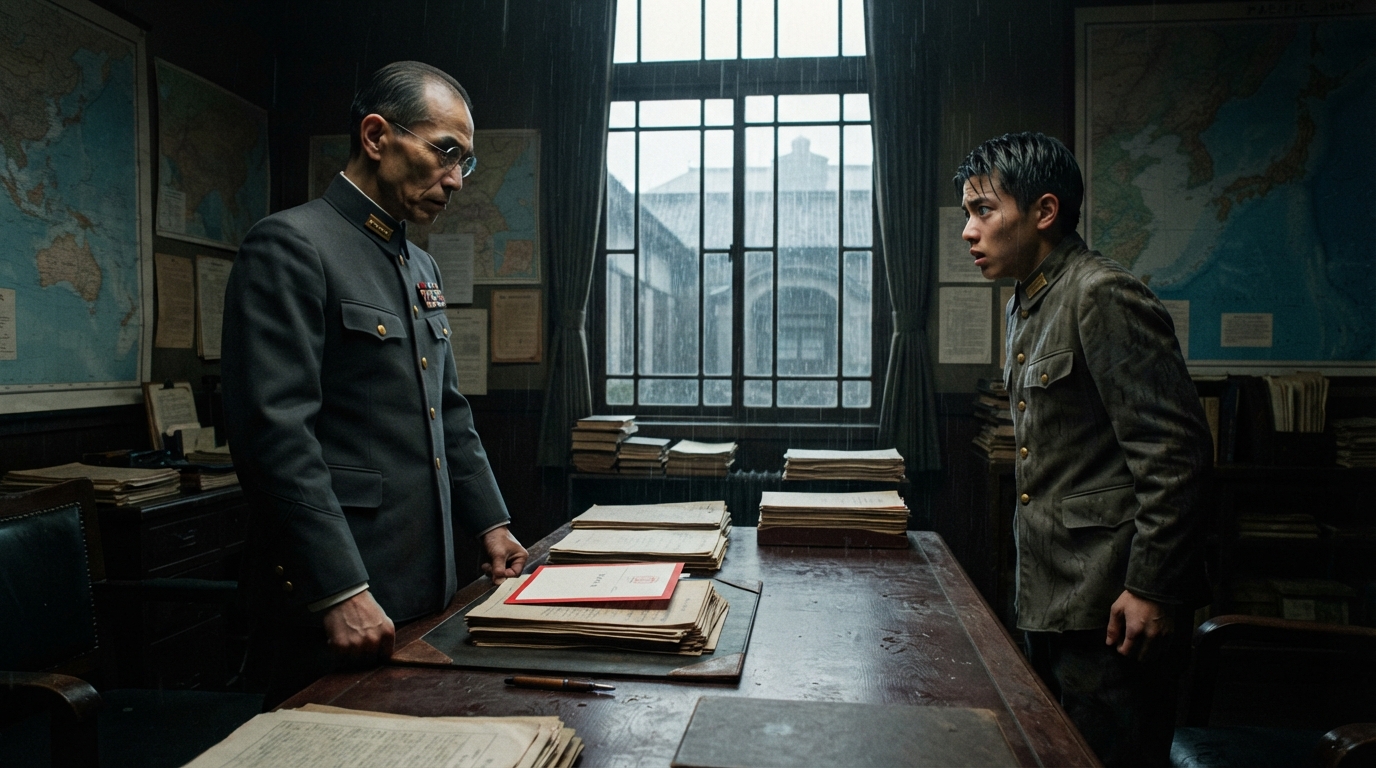
The ink on the dispatch was barely dry, smelling faintly of machine oil and paper pulp from the cable office down the hall. Hideki Tojo did not look up as the door clicked shut, leaving him alone with the map spread across the heavy timber desk. The blue expanse of the Pacific stretched out under neat little paper markers representing conquered islands, oil fields, and rubber plantations secured in weeks rather than years. Outside the tall windows, the gray humidity of a Tokyo autumn pressed down against the glass, heavy and unmoving.
His thumb traced the edge of the wooden fountain pen, feeling the worn lacquer beneath his skin. The reports from the European theater were entirely satisfactory; France had folded in weeks, and Britain remained battered and isolated behind its grey channel. Tojo adjusted his spectacles, his eyes scanning the columns of army allocations and troop counts with the practiced coldness of a staff officer who trusted numbers above all things. Except when those numbers belonged to the nation across the sea.
The American Congress had published their debates for anyone with a printing press to read, full of domestic squabbling, economic depression statistics, and an army ranked behind minor European states. They used horses for artillery and wooden rifles for training because their politicians refused to spend coin on real steel. Tojo picked up the pen, tapping its weighted brass tip once against the blotter. A people obsessed with entertainment, baseball stadiums, and comfort could not possibly summon the spiritual fortitude required for total war.
“They have forgotten the meaning of sacrifice,” Tojo murmured to the empty room, his voice flat and dry.
The strategic plan was simple, elegant, and entirely dependent on swift, decisive momentum before the enemy could find its footing. A crushing blow at Pearl Harbor followed by rapid resource seizure would leave the Americans too demoralized to cross five thousand miles of ocean. The intelligence summaries stacked neatly to his left confirmed that their shipyards were constrained by peacetime limits, lacking the skilled labor and industrial focus to mount a serious challenge before nineteen-forty-six.
A sharp rap at the door interrupted his calculations, and an aide stepped inside, clutching a fresh sheaf of decrypted cables from the Washington legation. The junior officer looked pale, his shoulders rigid under a wool tunic that seemed slightly too large for his frame. Tojo did not invite him to sit, keeping his gaze fixed on the map where the southern resource zone glowed like a secured prize. The friction of governing a sprawling empire was heavy, but the logic remained clear.
CHAPTER 2: Whispers of Steel
The junior officer remained standing by the heavy mahogany desk, his hand twitching slightly against the seam of his trousers. Tojo did not release the pen, keeping its weighted tip pressed against the unread dispatches from the Washington legation. The air in the private office felt stagnant, thick with the smell of wet wool and cheap tobacco drifting up from the lower corridors. Outside, the steady drone of a passing truck cut through the quiet, a brief mechanical friction before the rain began to patter against the leaded glass panes.
“Read the summary of the naval expansion act again,” Tojo commanded, his voice dropping an octave into a low, flat rasp.
“The estimates from the naval attachés in the capital indicate a procurement request of unprecedented scale,” the aide recited, his breath catching slightly before he forced the words out. “Four billion yen authorized for a seventy percent increase in combat tonnage. Over two hundred fifty new hulls, Prime Minister. They are calling it a two-ocean fleet.”
Tojo’s eyes narrowed behind his wire-rimmed spectacles as he stared down at the margins of the report. The figures were preposterous on their face, drafted by a fragmented democracy paralyzed by economic depression and isolationist debate. His own intelligence summaries had accounted for industrial bottlenecks, limited shipways, and a population supposedly softened by decades of consumer comfort. A nation obsessed with baseball and Hollywood could not possibly transform its civilian economy into a war machine without collapsing under the weight of its own inefficiency.
“Procurement requests are political theater for domestic consumption,” Tojo said, tapping the pen twice against the blotter to punctuate the absolute logic of his position. “They draft grand numbers to soothe their public after a defeat. They lack the spiritual discipline to see such labor through.”
The aide swallowed hard, his Adam’s apple bobbing sharply beneath the stiff collar of his tunic. He reached into his leather satchel and withdrew a single, thin sheet of onionskin paper, placing it precisely on the edge of the desk away from the maps. The paper was translucent, covered in dense rows of statistical breakdowns intercepted from commercial shipping registries along the eastern seaboard.
“Our observers noted that private steel mills in Pittsburgh have shifted entirely to armor plating schedules,” the aide whispered, his gaze fixed firmly on the blotter. “And the shipyards in Virginia are clearing new land for expansion before the legislative ink was even dry.”
Tojo reached out and picked up the onionskin sheet, feeling the strange, thin texture of foreign paper between his fingers. The numbers did not match the comfortable projections compiled by the Imperial General Staff; they indicated a rate of industrial acceleration that defied every known law of maritime construction. If the enemy were genuinely mobilizing at that speed, the foundational premise of the entire southern resource strategy would face a mathematical crisis long before nineteen-forty-six.
He let the paper drop back onto the mahogany wood, refusing to grant the discrepancy any official weight. A brief flicker of doubt crossed his mind, quickly suppressed by the cold, familiar armor of absolute discipline. The empire’s momentum in the south was unstoppable, and minor administrative anomalies from across the ocean could not alter the immutable law of superior fighting spirit.
CHAPTER 3: The Broken Perimeter
The sound of boots on the stone corridor was hurried, lacking the measured cadence of an orderly staff. The door swung open before a knock could land, revealing a duty officer holding a red-bordered dispatch envelope that trembled slightly in the damp air. Tojo did not look up from the map instantly, letting the heavy silence stretch until the junior officer forced himself to stand at rigid, breathless attention.
“Report,” Tojo said, his voice flat and unyielding.
“An unverified signal from the central naval station, Prime Minister,” the officer stammered, his eyes darting toward the window where rain beat a frantic rhythm against the glass. “Our forward anchor at Truk has been engaged by carrier aviation. Multiple capital hulls struck simultaneously.”
Tojo’s hand froze over the wooden pen. Truk was the impregnable fortress of the central Pacific, a stronghold guarded by coral reefs and anchored by land-based air wings designed to shred any approaching surface fleet. The absolute defense perimeter was supposed to hold firm against any conceivable assault, serving as an impenetrable wall between the empire and the eastern horizon.
“That is impossible,” Tojo stated, his knuckles whitening as he gripped the edge of the mahogany desk. “The enemy fleet was tracked near the Solomons just two days ago; they cannot project sustained weight across that expanse.”
“The communications are breaking down block by block,” the officer replied, setting the red envelope directly onto the unread industrial registries. “The shore batteries report wave after wave of aircraft descending from the clouds without warning. They are not using traditional scouting patterns.”
Tojo pulled the red envelope open with a deliberate, slow motion, his eyes scanning the fractured lines of kana text reporting burning fuel depots and sinking supply craft. The absolute defense perimeter had not simply been tested; it had been bypassed and shattered within a single afternoon by a force that supposedly possessed only a fraction of the necessary carrier tonnage. The foundational premise of their entire defensive strategy was unraveling right before his eyes.
He stood up abruptly, the heavy wooden chair scraping loudly against the floorboards, and walked toward the tall window overlooking the gray courtyard. The rain blurred the outlines of the stone walls, reflecting a cold, uncomfortable reality that no amount of bureaucratic denial could patch over.
CHAPTER 4: The Great Turkey Shoot
Tojo turned back toward the mahogany desk, his breath leaving a small, fading circle of fog on the pane. The room had grown darker as the afternoon rain deepened into a steady downpour, drumming against the roof of the Imperial General Staff building. A senior naval liaison stood waiting by the door, holding a thick folder bound with heavy black ribbon—the designation for catastrophic combat losses.
“The engagement in the Philippine Sea has concluded, Prime Minister,” the liaison stated, his voice flat, stripped of all standard military ceremonial tone.
“Give me the carrier numbers,” Tojo replied, settling heavily back into his leather chair without touching the fountain pen.
“Admiral Ozawa launched four distinct waves, totaling four hundred thirty naval aircraft,” the liaison said, opening the folder to reveal handwritten columns of pilot rosters, nearly every line crossed through with red grease pencil. “Over three hundred fifty aircraft failed to return. The enemy’s air defense screen intercepted them before they came within visual range of the surface hulls.”
Tojo stared at the red lines bleeding across the paper. The pilots lost were not raw recruits drafted from technical schools; they were the absolute core of the imperial naval aviation program, men who had flown over China, Pearl Harbor, and the Solomons. Replacing three hundred flight crews took years of rigorous training, fuel allocations that no longer existed, and specialized aircraft factories currently struggling under material shortages.
“How many enemy flat-tops were confirmed destroyed?” Tojo asked, his fingers tightening against his knees beneath the desk.
“None, Prime Minister,” the liaison answered, keeping his eyes fixed on the floorboards. “Our surviving aircrews reported dense, proximity-fused anti-aircraft artillery and radar-guided interceptor formations. They describe the sky over the task group as an absolute slaughter.”
The liaison pulled a secondary sheet from the back of the folder, his hand trembling slightly as the paper rustled in the quiet room. “Intelligence intercept units picked up uncoded radio chatter from the American pilots during the engagement. They are referring to the battle as a turkey shoot.”
Tojo felt a cold, sharp friction settle in the pit of his stomach as the blunt reality of the words sank in. This was not a tactical setback that could be balanced by spiritual resolve or strategic posture; it was the total erasure of naval aviation as an operational force. The enemy had not merely defended their positions; they had fielded an integrated wall of radar, metal, and industrial mass that rendered traditional flight tactics completely obsolete.
He closed the folder with a sharp snap, the black ribbon trailing off the edge of the mahogany table like a dead fuse.
CHAPTER 5: The Fall of Saipan
The telegram was typed on rough, unbleached stock that felt coarse under Tojo’s fingertips. He did not sit down, keeping his boots planted firmly against the worn floorboards while the junior officer stood rigidly by the door, refusing to meet his gaze. The absolute defense perimeter had not just cracked; it had dissolved completely under the weight of five hundred enemy hulls and three hundred thousand landing troops.
“The garrison has ceased organized transmission,” the officer reported, his voice tight with suppressed panic. “General Nagumo confirms that all positions on the island have been overrun or neutralized by continuous naval bombardment.”
Tojo stared at the rough paper, his mind stalling against the geographic reality of the loss. Saipan was not merely a strategic island outpost; it was incorporated imperial territory administered as part of the home empire for a generation, populated by Japanese families, merchants, and school children. Its capture marked the first time civilian soil had fallen to an invading Western army.
“What is the status of the strategic bomber installations across the region?” Tojo asked, his throat dry and tight.
“Intelligence reports indicate enemy engineering battalions are already clearing runways for long-range heavy aircraft,” the officer answered, swallowing hard. “From those coral fields, enemy bombers will have direct, unimpeded access to the Tokyo urban zone.”
The realization struck not as a tactical defeat, but as an absolute physical collapse of the empire’s security architecture. The defensive buffer was gone, and the industrial might across the ocean had finally closed the distance. Tojo gripped the edge of the mahogany desk so hard his knuckles turned white, realizing that the delusional margin for error had completely evaporated.
CHAPTER 6: The Unforgiving Ledger
The elder statesmen stood in a tight, motionless semicircle near the mahogany desk, their faces drawn and gray under the dim electric lamps. Tojo did not rise to meet them, keeping his boots locked against the floorboards as he stared down at the massive ledger open before him. The columns of figures were no longer projections or estimates from foreign cable offices; they were cold, immutable facts recorded by his own ministry.
“The Throne has reviewed the casualty summaries from the northern outposts,” the senior envoy stated, his voice devoid of anger, carrying only the flat weight of absolute exhaustion. “The cabinet’s utility has reached its end.”
Tojo’s thumb pressed hard against the corner of the ledger page, feeling the dry fiber of the paper resist his skin. He had assumed supreme command of the army general staff to correct administrative failures, believing that sheer willpower and strict discipline could bend reality back toward imperial victory. Instead, he had simply run headfirst into a mathematical wall that could neither be bargained with nor broken by spiritual resolve.
“The strategic plan relied on a swift resolution before their industrial capacity could awaken,” Tojo said, his voice dropping into a low rasp that barely carried across the room. “We calculated their limits based on peacetime output.”
“The calculation was fundamentally flawed,” the envoy replied, stepping forward to lay a final resignation decree directly over the unread intelligence reports. “They have launched nearly thirty carriers this year alone, with hundreds more hulls sliding down ways that did not exist when this conflict began. Arithmetic does not yield to courage, Prime Minister.”
Tojo picked up the weighted wooden fountain pen one last time, holding its brass tip suspended over the signature line. The illusion of invincibility had completely dissolved, leaving behind the stark, unyielding truth of an empire cornered by its own miscalculations. He brought the pen down and signed away his authority, accepting the quiet, crushing collapse of a delusion that had cost a generation everything.