The Kid They Wrote Off at 25,000 Feet: How a 19-Year-Old Farm Pilot Silenced the Sky Over Germany
CHAPTER 1: COLD IRON AND EMPTY AIR
The oil mist from Captain Donahue’s dying Merlin engine splashed across Mccoral’s windscreen in tiny, frozen black specks.
“QPM-Leader aborting,” Donahue’s voice rattled through the headset, flat and distorted by static. “Rough mag. Turning back for the Channel. Mccoral, fall in with B-Flight.”
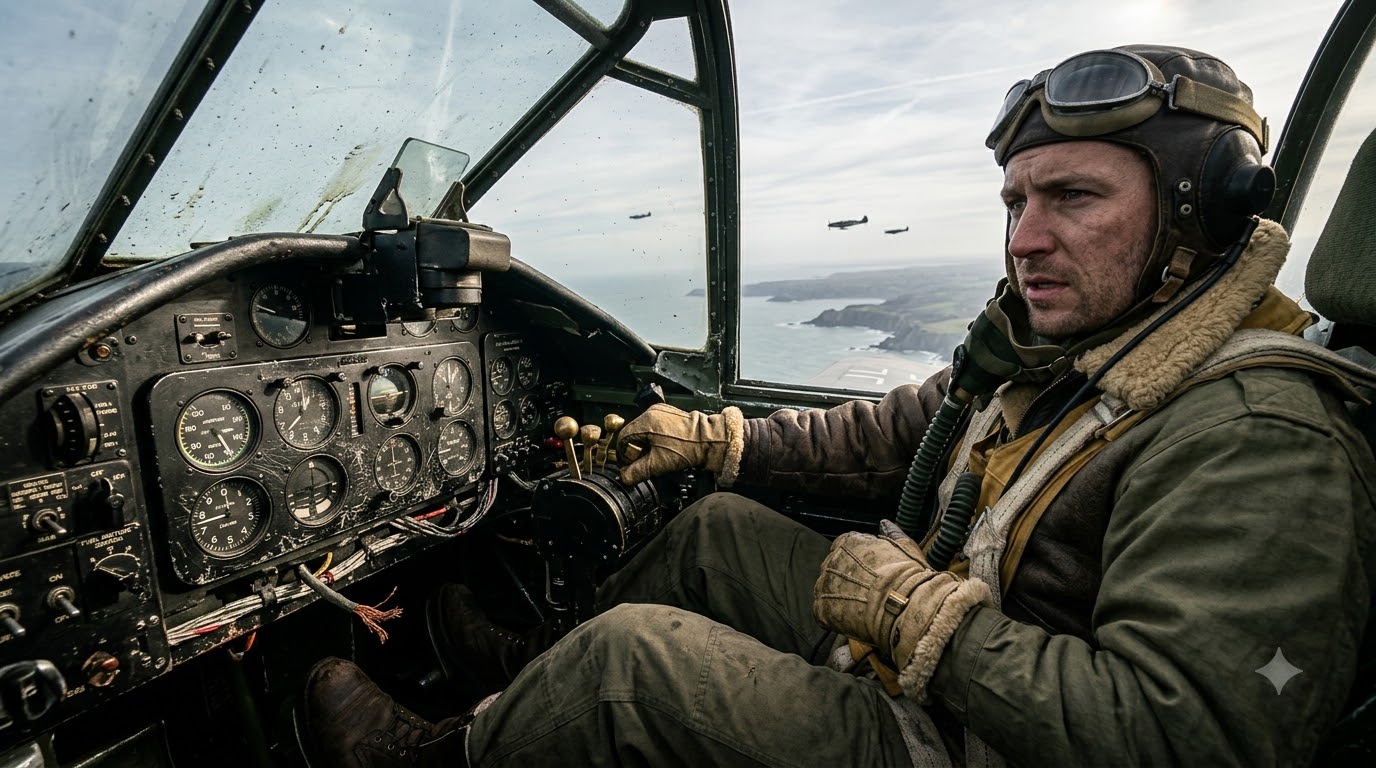
Charles rested his gloved thumb against the brass fuel-mixture stop-latch on the throttle quadrant. Click. He felt the metal notch seat against his palm through the thick sheepskin leather.
He looked left. B-Flight was already three miles ahead, climbing through a bank of cirrus clouds toward the silver stream of B-17s. The distance was too great. The Mustang’s high-altitude speed meant nothing when the sky was this wide and the formation was already tightening its box.
He was nineteen years old. Below his wingtips, the jagged coast of occupied Europe stretched out like rusted iron under a thin sheet of haze.
“B-Flight, QPM-Two,” Charles said, his voice dropping into the quiet, steady cadence his father had taught him over the crop fields of Pennsylvania. “Requesting slot.”
Static answered. Nothing else. The air at 25,000 feet was minus forty degrees, thick enough to freeze the condensation on his oxygen mask, thin enough to make the controls feel light, twitchy, and unforgiving.
He didn’t scream into the mike. He didn’t push the throttle to maximum manifold pressure to chase men who weren’t looking back. He checked his instrument panel: fuel pressure steady, oil temp nominal, main tanks carrying sixty gallons each.
Then he saw the anomaly.
A thousand yards to the north, sliding silently along the upper edge of a contrail, a single aircraft moved in parallel with the bomber stream. It wasn’t an American silhouette. The radial engine cowling was shorter, wider, painted in dark matte gray, with a distinct hand-painted white chevron flanked by double yellow stripes right behind the spinner.
It wasn’t attacking. It was measuring.
The lone fighter banked slightly, its wings glinting in the pale sunlight, before dipping into the top of the cloud layer. It moved with the deliberate, patient speed of a wolf tracking a herd that didn’t know it was being counted.
Charles clicked the brass latch once more. The metal was freezing cold against his glove. Turning back meant landing at Debden before noon, listening to the mechanics scrub grease off the spare parts while the older guys drank coffee and talked about the RAF. It meant being the kid with the soft face who brought his plane back empty.
He pulled the stick toward his right thigh, bank angle thirty degrees, and began to climb alone into the blinding sun.
CHAPTER 2: THE DIVING AMBUSH
Nine Focke-Wulf 190s rolled over in unison, their belly tanks dropping into the cloud deck like iron teardrops. They didn’t scream down in a chaotic cluster. They came down in three tight, staggered Vs, hunting the low-cover B-17s with the cold efficiency of a factory assembly line.
Charles didn’t call for help. The radio channel was already choked with frantic shouting, static, and the distant, dry rattle of defensive Fifty-calibers.
He rested his thumb against the brass throttle latch, feeling the sharp, cold metal notch seat against his palm. Click.
He shoved the Merlin’s throttle past thirty inches of manifold pressure. The Mustang’s nose dropped, and 1,200 horsepower slammed him forward against his shoulder harness. The airspeed needle swept past three hundred miles per hour, then three-fifty, then four hundred. The air screaming over the plexiglass canopy changed pitch, rising from a wind-whistle to a high-frequency screech.
He targeted the trailing German fighter on the left flank. The gray wings expanded rapidly in his gunsight, the black cross on the fuselage sharpening from a smudge to a razor-clean target.
At three hundred yards, Charles squeezed the trigger.
The four .50-caliber machine guns built into the wings hammered with a violence that shook the airframe’s rivets against his boots. The smell of burnt cordite seeped instantly into the cockpit through the heater vents. Tracers arced high—over the target’s canopy.
Too much lead.
He nudged the rudder pedal half an inch to the left, easing the stick back to settle the crosshairs on the German’s tail section. Squeezed again.
The burst walked straight up the FW-190’s aluminum skin. Bright red sparks showered from the wing root, followed immediately by a thick, oily plume of white smoke as the glycol lines ruptured. The German fighter banked violently, nosed over, and spiraled into the soup below.
No time to watch it hit.
The rest of the German formation scattered like flushed quail, but they didn’t panic. The lead aircraft—the one bearing the hand-painted white chevron—snapped into a steep, climbing turn to the right, sweeping its nose around to lock onto the lone Mustang that had dared to break their dive.
Charles pulled back on the stick, hauling the P-51 into a high-G climb to retain his energy. The blood heavy in his legs pooled into his boots, his vision narrowing at the edges into a dark, grainy tunnel.
As he rolled out at 26,000 feet, he glanced down at the small indicator light on his instrument panel—the small red lamp that showed the gun camera was running.
The bulb was dead. Dark.
He reached out with a gloved hand and tapped the glass housing. Nothing. A thin grey wire hanging beneath the lower rim of the dash was sliced clean through, its copper core frayed and cold, severed by a loose bracket behind the panel before he’d even left the tarmac at Debden.
There would be no film. No proof. Every round he fired today was strictly off the record.
Above him, three FW-190s turned together, banking hard to cut off his nose. They weren’t flying like individual pilots anymore. The chevron-marked lead was flashing his wings in short, rhythmic tilts—manual signals to box the intruder in from three sides at once.
Charles gripped the control stick, his teeth gritting against the rubber bit of his oxygen mask as the first German tracer flashed past his canopy.
CHAPTER 3: THERMAL LOCK AND SHATTERED GLASS
The airframe moaned under the G-load, rivets groaning as the wings bit into the thin, frozen atmosphere. He didn’t force a roll. He let his left boot rest heavy on the rudder pedal, slipping the Mustang sideways to spill speed just as a stream of 20mm cannon shells flashed through the space he had occupied half a second prior.
The lead 190—the one with the hand-painted white chevron—overshot by fifty yards, its radial engine glowing hot in the freezing glare.
Charles didn’t shout. He didn’t reach for the dead gun camera toggles on his dash.
Instead, his thumb rested against the brass throttle latch, feeling the cold notch on the metal housing. Click. He eased the throttle back two inches, letting the Merlin engine drop out of its high-RPM whine to save what little fuel remained in his wing tanks.
Through the fogged side panel of his canopy, he watched the chevron leader’s tail.
The German wasn’t just dogfighting. Every time the American bomber escorts shifted their box formation to protect a damaged B-17, the chevron leader dipped his left wing twice. A second later, two trailing 190s would peel off to dive on the exposed gap. They were using the Allied flight manual against them—predicting every standard defensive maneuver before the bomber commanders even keyed their radios.
They weren’t fighting a random patrol. They were executing an operational sweep designed to pick off isolated escort pilots who tried to play by the book.
Charles let his Mustang drift higher, riding the thin thermal air to keep out of their turn radius. He couldn’t record this. He couldn’t show Flight Leader Donahue a crisp strip of 35mm film proving he had broken a coordinated German ambush over Belgium.
He had no gun camera. He had no wingman. All he had was a cold cockpit, six hundred rounds of ammunition, and a sky that didn’t care about his age.
The chevron leader banked right, signaling his remaining wingmen to line up for another pass at the bomber trail.
Charles reached down, adjusted his fuel-mixture lever to lean, and turned his fighter directly into the sun.
CHAPTER 4: THE SCYTHE AT 25000 FEET
The wind noise inside the aluminum cockpit screamed like a saw blade hitting oak as the P-51’s speed hit four-twenty.
Charles didn’t aim for the fuselage. He aimed fifty yards ahead of the white-chevron cowling, calculating the deflection angle purely by the sweep of the horizon against his glare-shield.
He squeezed the trigger.
Four heavy machine guns shook the engine mounts. The heavy lead stream caught the German commander’s right wing root mid-bank. The FW-190’s canopy shattered into translucent dust, the aircraft rolling dead on its back before dropping vertically toward the cloud cover below.
The tight tactical formation dissolved instantly. Without their leader tilting his wings to direct the passes, the remaining five Germans broke off into isolated, defensive turns.
A trailing 190 cut hard across Charles’ nose, trying to drag him into a low-speed turning fight.
Charles didn’t bite. He rested his thumb on the brass throttle latch, clicking the metal stop into place as he pulled straight up into the clear sky, converting his dive speed back into pure altitude. The Merlin engine roared without a stutter.
Another German fighter lunged at his belly from below, firing a wide, desperate burst of 20mm cannon fire that streaked harmlessly into the blue.
Charles reversed over the top of his climb, dropping his left flap five degrees to pivot the Mustang on its tail axis. He lined up on the climbing 190, held thirty degrees of lead, and pressed the switch.
The burst tore through the German’s radial engine. Black smoke erupted from the cowl, followed by a white chute blossoming against the dark farmland five miles beneath them.
The three surviving FW-190s leveled off, turned their tails to the bomber stream, and nose-dived west toward their home base near Lille. They were out of formation, out of coordination, and unwilling to trade metal with an escort pilot who refused to obey their manual traps.
Charles pulled the throttle back to long-range cruise.
His main fuel gauge needle hovered just above fifteen gallons. Deep inside enemy territory, alone, with a dead camera cable behind his dash, he turned his nose toward the English Channel.
CHAPTER 5: THE RED LIGHT LANDING
The Merlin engine coughed twice, sputtered on fumes, and died before Charles even reached the chocks. Silence rushed into the cockpit, heavy and thick, punctuated only by the ping of cooling exhaust pipes.
He unclipped his oxygen mask, letting it dangle against his leather flight suit, and slid the plexiglass canopy back. Cold English drizzle hit his face.
The crew chief—the Ohio sergeant—stepped onto the wing root. His eyes ran over the Mustang’s fuselage, scanning for hole patches, torn aluminum, or oil spray.
“Clean skin,” the sergeant muttered, wiping rainwater off the wing. “Must’ve lost ’em in the clouds over the coast, Lieutenant. Donahue came back an hour ago complaining about his mags.”
Charles didn’t argue. He swung his leg over the cockpit sill, his boots hitting the muddy tarmac with a heavy thud. He reached into his jacket pocket, took out his brass throttle latch, and rested his thumb on the worn metal edge. Click.
“Check the bays, Sergeant,” Charles said softly.
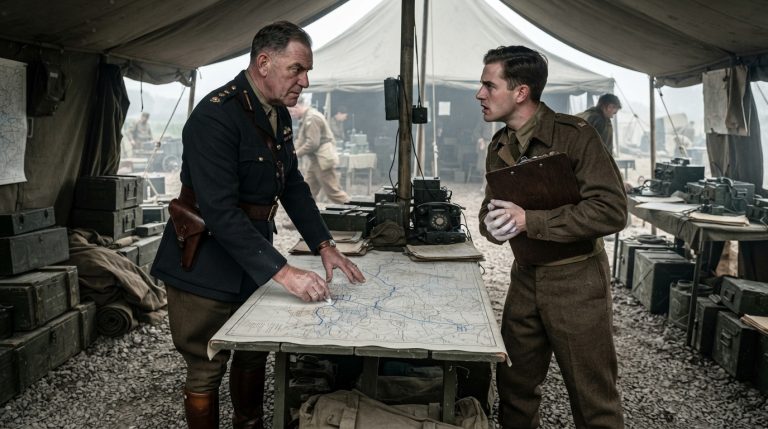
In the squadron debrief office, the intelligence officer sat behind a wooden desk littered with paper coffee cups and stale tobacco ash. Flight Leader Donahue stood near the stove, his arms crossed over his chest, rubbing a knuckle against his chin.
“You were missing from B-Flight’s formation, Mccoral,” Donahue said, his voice carrying the sharp edge of an officer covering his own early abort. “We logged you as separated over France. If you turned tail early, just say so. No sense lying about it.”
“I stayed with the bombers,” Charles said. He didn’t raise his voice. He stood straight, his leather jacket damp from the walk across the tarmac.
“Right,” Donahue sneered, leaning against the desk. “Alone. At twenty-five thousand. And you want us to log engagement time?”
“Nine FW-190s,” Charles said. “They were using our formation manual to pick off the trailing heavies.”
The intelligence officer reached for the film canister tray. “We’ll let the gun camera sort it out. Roll the reel.”
Charles didn’t move. “Camera wire behind the lower dash was severed before takeoff. There’s no film.”
Donahue let out a dry, barking laugh, shaking his head toward the intelligence officer. “Convenient. Kid goes up, gets spooked by the flak, drifts around the Channel for two hours, and comes back with a broken camera story.”
Before the officer could write down the abort tag on the official ledger, the office door swung open.
The Ohio sergeant stood in the doorway, his hands black with gun grease, holding a heavy wooden ammo box filled to the brim with spent brass casings.
CHAPTER 6: THE UNSPOKEN LEDGER
“Eleven hundred rounds expended, Captain,” the sergeant said, not looking at Donahue. “All four wing bays completely swept clean. Guns are scorched up to the receiver blocks.”
The intelligence officer stared at the pile of dull brass casings filling the box. The metal was still faintly warm, smelling of burnt powder and wet grease.
Donahue shifted his boots, his jaw tightening as he reached out with one finger to tap the edge of the wooden box.
“Spending lead in the clouds doesn’t mean hitting targets, Sergeant,” Donahue said, his voice straining to maintain control over the room. “Any rookie can panic and dump his belts into the Channel just to lighten his load.”
Charles reached into his leather pocket, pulled out the brass fuel-mixture stop-latch, and set it down quietly on top of the spent brass casings.
“The leader was wearing a white chevron with yellow double stripes,” Charles said, his voice flat, steady, and devoid of heat. “He was signaling wing tilts to direct intercept sweeps into our escort gaps. He isn’t flying those passes anymore.”
The intelligence officer looked up slowly from the desk, glancing from the severed camera cable report to the pile of brass, then straight into Charles’ eyes. He didn’t ask for a film reel. He didn’t ask for corroborating wingmen.
“Flight Leader Donahue,” the officer said, picking up his pen. “Update the tactical board. QPM accounted for five single-seat engagements over Belgium. Assign Lieutenant Mccoral to lead element tomorrow at zero-six-hundred.”
Donahue opened his mouth to object, his throat working against the collar of his uniform, but no words came out. He looked at the quiet nineteen-year-old kid standing by the door, nodded once with stiff, reluctant compliance, and walked out into the rain without another word.
Forty years later, the morning air over the green hills of Pennsylvania smelled of damp grass and early autumn frost.
Charles sat on the wing step of a yellow Piper Cub parked outside a small grass airstrip. His hands were weathered, lined with the hard work of decades spent in quiet mechanical shops far away from military brass and wartime reporters.
He held a small, cold brass latch between his fingers, resting his thumb against the smooth, worn notch.
A young pilot in a crisp, clean flight suit walked across the grass, stopping a few feet away with uncertain eyes, clutching a fresh set of military orders to his chest.
“They say you flew alone over Europe at nineteen,” the young man said quietly, searching the old man’s face for some secret, some grand heroic phrase. “How did you know you could survive when everyone expected you to fail?”
Charles didn’t talk about medals. He didn’t talk about the night terrors, or the cold, silent sky over Debden, or the faces that never quite left his memory. He just rested his thumb against the brass latch and smiled softly into the morning light.
“You don’t need a audience to prove you know your trade,” Charles said, his voice calm and anchored in earned peace. “Trust your hands, hold your line, and let the quiet work do the talking.”
The young pilot nodded, thanked him respectfully, and walked toward the runway. Charles watched him go, then leaned back against the yellow wing fabric, taking a deep breath of the clear, peaceful country air he had earned fifty miles above a burning world.