The Iron Line at Beak: The Impossible Two-Mile Shot of an Everyday Gunner
CHAPTER 1: HIGH GROUND OVER BEAK
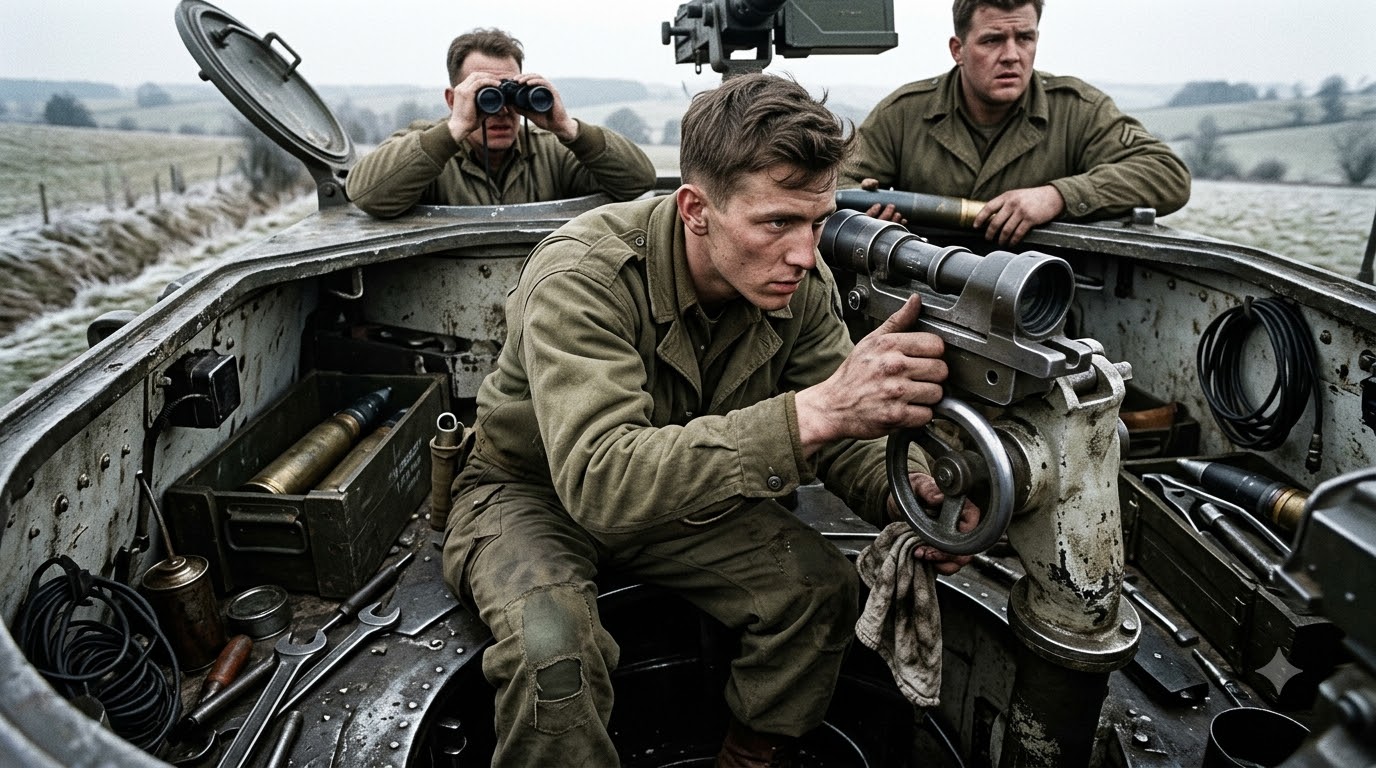
The brass ring on the elevation wheel bit into Alfred Rose’s bare palm through a grease-stained mechanic’s rag.
10:42 AM. December 1st, 1944.
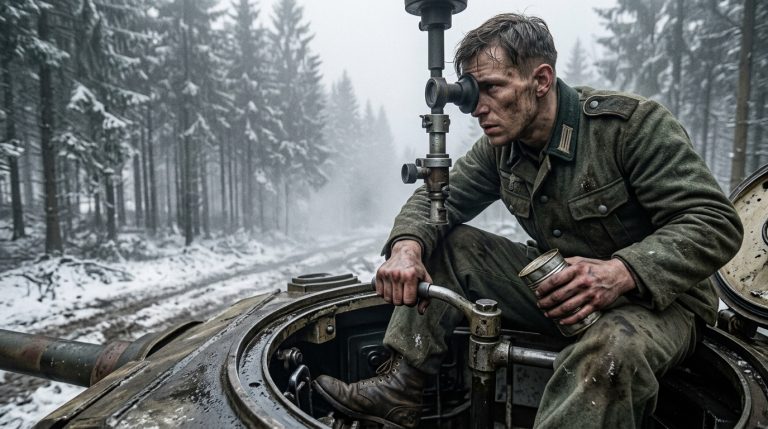
The steel inside the turret of the M36 Jackson destroyer smelled like cold cosmoline, burnt hydraulic fluid, and old wet wool. Outside, the high ground northeast of Beak offered a wide, desaturated view of the German countryside—bare trees, frost-rimmed ditches, and a grey ribbon of highway cutting through two miles of empty farmland.
Below the hull, the Ford V8 engine rattled the floorboards, sending a steady vibration straight up through Rose’s boots. Three weeks with the 814th Tank Destroyer Battalion. Zero confirmed kills. Four test rounds fired through a 90mm main gun he barely understood.
His thumb dragged over a small, crude scratch etched into the steel housing right beside the M76F optic mount. Someone had scraped it there with a pocketknife before the driver brought the rig up the hill.
“Commander,” Rose muttered, his voice flat, stripped of clean diction by the raw frost lining his throat. “Movement on the highway. Extreme range.”
Captain Vance didn’t look up immediately from his map case. “How extreme, Rose?”
“Past the tree line. Moving left to right.” Rose pressed his eye against the rubber cup of the sight. The rubber was hard as horn in the December chill.
Through the lens, the dark shape resolved. Sloped glacis plate. Interleaved road wheels. The long, lethal barrel of a German Panther tank traveling at maybe seven miles an hour, completely exposed on the open asphalt.
“Distance?” Vance asked, finally leaning over the turret rim to peer through his binoculars.
“Two miles minimum,” Rose said. He rasped the rag across his knuckles, clearing a fresh smear of grease off the traverse casing. “Maybe two and a half. Four thousand yards plus.”
Vance stayed silent for five long seconds. The winter wind whipped a corner of his canvas map against the steel hatch. “Nobody shoots armor at two miles, Lieutenant. That’s artillery work. We don’t have spotters out there.”
“We don’t have artillery back-up either,” Rose said dryly. “Radio’s dead on this side of the ridge anyway. It’s just us.”
“Your call,” Vance said, tapping the turret rim once. “Your shot.”
Rose adjusted his grip on the handwheel. The gear teeth clicked inside the turret ring—a mechanical, stubborn sound. The Panther wasn’t weaving. It wasn’t taking cover. The German crew moved with the lazy, unbothered confidence of men who believed their 80-millimeter sloped front plate made them invisible to anything firing from the Allied side of the river.
They thought the range protected them. They thought no gunner on this hill could stretch a shell across two miles of open air and make it land.
Rose leaned into the eyepiece, his thumb tracing the reticle markings down past the standard 1,000-yard crosshairs, down past the 2,000-yard notches, all the way to the tiny line stamped at the very bottom edge of the glass: 4,600 yards.
“AP chambered?” Rose asked without looking back.
Behind him, the loader slammed his palm against the breech block with a dull, heavy metallic thud.
“Armor-piercing loaded,” the loader grunted.
Rose took a slow, deep breath, feeling the frost burn his lungs as he calculated the lead.
CHAPTER 2: THE GEOMETRY OF IRON
The steel housing of the M76F optic was cold enough to stick to the skin of his cheek. Rose didn’t pull back.
In the grey lens, the Panther looked no bigger than a beetle crawling over a frozen rut. Two and a half miles. Forty-six hundred yards. The manual sitting in the rack behind the loader’s seat gave exact figures for five hundred yards, eight hundred yards, maybe a thousand if the air was dry and the target stood still. Beyond that, the ink on the charts simply stopped.
“Elevation set for four thousand,” Rose muttered. His voice was a flat, dry rasped whisper in the tight metal space. “Ranging shot.”
Captain Vance hung halfway out the top hatch, his field jacket stiffened by frost. “No radio to call the strike back to command if you miss, Rose. Nobody’s covering our flank if you draw their eye.”
“I know,” Rose said.
He didn’t need a spotter team down in the valley to tell him what he could see with his own eyes. He had the high ground. He had the 90-millimeter barrel extending like a dead tree trunk out over the frost-covered glacis plate.
He squeezed the firing lever.
The Jackson’s hull slammed back against its suspension. A sheet of orange flame and gray cordite smoke slapped outward from the muzzle brake, blinding the sight picture for two full seconds. The sound was a sudden, dry sledgehammer blow that rattled the loose teeth in Rose’s jaw and left a metallic ringing humming in his ears.
Inside the turret, the empty brass casing ejected with a heavy clatter, bouncing off the steel floor grating and filling the air with the sharp, acidic reek of burnt powder.
“Six seconds flight time,” Rose said aloud. He didn’t count out loud; he counted in his chest, matching the pulse in his neck. One. Two. Three. Four. Five. Six.
Nothing.
Through the clearing haze, the distant highway showed no smoke, no dust. The Panther kept its steady, insolent pace, heading east toward the Allied supply corridor.
“Short,” Vance grunted from the hatch. “Or it buried itself in the mud before the ridge.”
Rose reached for the grease-stained rag wedged into the elevation assembly. He wiped a streak of cold sweat off his thumb and leaned closer to the sight dial. The factory markings were clean, stamped in neat black paint. But right beside the notch for 4,100 yards, that handwritten scratch mark in the steel caught the light from the open hatch.
It wasn’t a flaw in the metal. It was a manual offset. Whoever had tested this gun before it shipped from the depot had known the reticle alignment was off by three arc-minutes.
The technical manual was a lie. The standard factory calibration was built for a warm range in Maryland, not the heavy, wet air over the German lowlands.
“He didn’t hear it,” Rose said. His hands moved on the traverse gear, smooth and methodical. “The wind’s blowing off the ridge. At two miles, the sound hits him long after the round buries itself.”
“You’re wasting steel, Lieutenant,” the loader muttered, his shoulder muscles straining as he hoisted another seventy-pound armor-piercing round toward the open breech. “We only got twenty-four AP shells in the rack.”
“Load the shell, Miller,” Rose said, his tone leaving no room for argument.
The breech block slammed home with a cold, definitive clack.
Rose dialed the elevation wheel past the factory notch, aligning the scratched groove directly with the indicator arrow. He added another hundred yards for the crosswind pushing through the valley, leading the moving shape of the tank by twice its own length.
“Second shot,” Rose said.
He pulled the trigger.
CHAPTER 3: THE THIRD ROUND
The second round’s impact blossomed forty yards short of the highway asphalt—a sharp, dark geyser of frozen mud and shattered gravel kicking up against the winter gray.
“You’re walking it in,” Vance said, his voice dropping into the low, tight register of a man who suddenly realized he was watching history or suicide. “Target’s not slowing down.”
The Panther kept rolling. Smooth. Methodical. Its commander had no idea a heavy 90-millimeter slug had just carved a crater fifty feet from his tracks. At two and a half miles, the noise of the impact was nothing more than a dull thump lost in the clack of their own diesel engine.
Rose didn’t breathe. The air in his lungs was stale, cold, and sour with cordite smoke.
His left hand cranked the elevation dial. He bypassed the factory markings entirely, locking the sight alignment directly onto the crude, hand-scratched groove in the mounting steel. He dialed in forty-six hundred yards—the absolute limit of the glass.
Then he pushed the reticle forward, leading the Panther’s sloped nose by three full vehicle lengths to account for seven long seconds of airtime.
“M82 armor-piercing,” Rose rasped. “This is the one.”
“Loaded!” Miller barked behind him, slamming the breech shut with a force that shook the gun housing.
Rose didn’t wait for a command. He squeezed the firing lever.
The Jackson roared. The whole ten-ton tank destroyer rocked back on its treads, the steel suspension groaning under the recoil. A fresh cloud of acrid smoke surged into the fighting compartment before the wind swept it through the open turret top.
Rose kept his eye clamped to the cold rubber eyepiece.
One.
Two.
Three.
The Panther crossed a narrow concrete culvert along the highway.
Four.
Five.
Six.
“Come on,” Miller muttered under his breath, leaning over the spent brass casings piling up at his boots.
Seven.
A blinding white flash erupted right where the Panther’s left flank met the upper track line.
For half a second, the German tank simply absorbed the kinetic blow. Then, a massive orange fire ball ripped out of the engine compartment and burst upward through the open crew hatches. The ninety-millimeter armor-piercing shell had punched straight through the thin forty-millimeter side plate, tumbling directly into the main ammunition racks.
Seventy-nine rounds of German seventy-five-millimeter high explosive detonated all at once inside the enclosed steel hull.
The Panther’s turret lifted six feet into the air on a column of black grease fire before slamming back down onto the burning chassis.
Vance lowered his field glasses, his knuckles white against the metal casing. “Direct hit. Christ almighty, Rose… you hit him at two and a half miles.”
Rose didn’t smile. He reached for the grease-stained mechanic’s rag, his fingers shaking just enough that he had to wrap the cloth tight around his palm to stop the tremor.
“He’s burning,” Rose said softly. “Load the next shell, Miller.”
CHAPTER 4: ENSURING THE WRECK
A stopped tank on a mapsheet was never a dead tank until it burned to the roadwheels.
“Hit it again,” Rose said, his tone flat as an iron plate.
Behind him, Miller was already swinging another twenty-four-pound armor-piercing casing out of the steel wall rack. “Lieutenant, it’s a torch. Nobody’s walking out of that.”
“Hit it again,” Rose repeated. “They play dead. They wait for us to turn our backs, then they crawl back in with a wrench and a spare battery. Fire.”
Miller slammed the breech. The heavy bronze wedge locked into the ring with a violent metallic snap.
Rose didn’t bother recalibrating the sight dial. The scratch mark on the optic housing held true. He pulled the firing lever, sending a fourth ninety-millimeter shell ripping through the cold air across the two-mile gap.
Six seconds later, the shell punched into the burning hull near the rear sprocket. A fresh plume of orange sparks showers across the pavement.
Rose kept his hand on the elevation wheel, feeling the heat radiate up from the breech block as Miller loaded a high-explosive round. He fired a fifth time. Then a sixth.
He didn’t stop until six distinct plumes of thick, black diesel smoke rolled together into a single column towering three hundred feet above the German treeline.
“That’s enough, Rose,” Captain Vance said, leaning down into the turret ring. His eyes were wide, tracking the smoke column that now marked their position to every enemy battery within five miles. “They know where we are now. The whole valley knows.”
Rose finally let go of the elevation wheel. His fingers were stiff, locked into a curve from holding the cold iron. He unwrapped the grease-stained rag from his palm and wiped the layer of gray cordite dust from his forehead.
“They know a gun is up here,” Rose said, looking at the hand-scratched notch on the sight casing. “They don’t know who fired it.”
To the east, a distant rumble rolled over the frost-covered ridge—not the sharp crack of tank armor, but the heavy, rhythmic thud of incoming heavy artillery. The Germans were adjusting their batteries to blanket the high ground over Beak.
Without a radio spotter network to coordinate counter-battery fire, there was no holding the ridge. The high ground had served its purpose.
“Driver, turn us around,” Vance ordered, slapping the rear steel bulkhead. “Get us down into the treeline before those eighty-eights start walking up the slope.”
Rose stayed in his seat as the M36’s V8 engine roared, the steel treads churning through frozen mud as the tank destroyer backed off the crest. He kept his eyes fixed on the rubber eyepiece, watching the black smoke of his forty-six-hundred-yard kill vanish behind the rise.
Two miles out, a single shot had rewritten the rules of the sector. But down in the lowlands, the war was waiting.
CHAPTER 5: THE CRUCIBLE OF ST VITH
December 20th. The long calculations across open countryside were gone.
The Ardennes forest had exploded into chaos, and St. Vith was a meat grinder of burning timber, choking smoke, and rubble-choked intersections. There was no radio spotter network to lean on, no artillery batteries answering calls, and no two-mile sightlines.
Through the M76F optic, the world wasn’t a sprawling landscape—it was forty yards of brick dust, shattered cobblestones, and the massive, square nose of a German Panther breaching a collapsed storefront directly ahead.
“Gun right!” Vance roared, his hand slamming onto Rose’s shoulder as masonry rained down onto the open turret top. “Eight hundred yards! Road junction!”
Rose’s hands didn’t shake. The muscle memory carved into his bones at Beak took over.
He spun the traverse handwheel, the gears screaming as the heavy ninety-millimeter barrel swung across the narrow street. He didn’t check the manual. He didn’t look for complex ballistic drop tables.
He aligned the sight crosshairs directly on the center mass of the advancing Panther’s lower glacis plate. At eight hundred yards, the manual claimed the German steel was impenetrable.
Rose knew better. He knew every tolerance of his gun, every flaw in the optical mount, and every millimeter of leverage the heavy armor-piercing slug possessed when pushed to its limit.
“M82 AP!” Rose barked.
Miller slammed the shell into the breach. “Clear!”
The German tank’s main gun began to traverse toward their position, its heavy muzzle brake clearing the corner of a ruined bakery. They had maybe two seconds before an eighty-eight-millimeter round turned the Jackson into an open iron coffin.
Rose squeezed the firing lever.
The blast inside the narrow alley was deafening, the pressure wave blowing out every remaining pane of glass in the surrounding buildings. The heavy armor-piercing shell struck the Panther’s sloped front armor at a severe angle, skittering up the plate before punching straight through the driver’s vision port.
The Panther shuddered, its left track thrown clear off the sprocket with a violent clatter of snapped iron links. A dark plume of smoke billowed instantly from the hull.
“Target immobilized!” Vance yelled over the ringing in their ears. “Reverse! Driver, back us behind the wall before the second one clears the treeline!”
The V8 engine screamed in reverse, the M36 tearing back through the brick dust as two high-explosive shells detonated against the cobblestones where they had stood a fraction of a second before.
Rose pulled back from the rubber eyepiece, his chest heaving, his palm automatically reaching for the grease-stained mechanic’s rag wedged into the elevation frame.
In the chaotic madness of point-blank survival, there was no room for record-setting distance. There was only cold, hard precision—and the stubborn refusal to give an inch of ground.
CHAPTER 6: THE QUIET AFTERMATH
The air in the Midwest smelled of damp earth, sweet clover, and fresh-mown grass—not burnt cordite, cold cosmoline, or pulverized concrete.
Rose unfolded the grease-stained mechanic’s rag from his pocket. It was dry now, faded to a light gray, the oil long since washed out by soap and water. He turned it slowly in his hands, feeling the soft, frayed edges between his thumbs.
Forty-seven years would pass before a modern battle tank in the sands of the Gulf War would stretch a computer-guided shot far enough to surpass what an overworked twenty-six-year-old lieutenant had done with a hand-scratched optic sight in the mud of Beak.
Four thousand, six hundred yards. Two point six miles of frozen air, crossed in seven seconds by a round fired by a man who simply refused to let poor tools or arrogant odds dictate the outcome.
When army historians came looking decades later, digging through yellowed after-action reports and asking for interviews, Rose declined. He didn’t write memoirs. He didn’t pose for photos with artillery models or boast at legion halls.
The war had demanded work, and he had done it with cold, hard common sense. Once the work was finished, he laid down the iron and stepped back into the quiet life he’d fought to protect.
The distant rumble that occasionally rolled over the Ohio hills wasn’t artillery—it was just summer thunder, passing harmlessly over open fields.
Rose smoothed the old rag over his knee, took a deep, clear breath of clean country air, and let his hands rest. The burden was gone. The peace was earned.