The Brass Standard: How One Outcast Engineer Silent-Handed the Air Ministry and Saved the Skies
CHAPTER 1: THE COLD GARAGE
The kerosene heater in the corner of the RAE laboratory gave off more fumes than heat. Beatrice Schilling didn’t mind the cold. Cold metal gave honest measurements. Warm metal expanded, lied to the calipers, and wasted time.
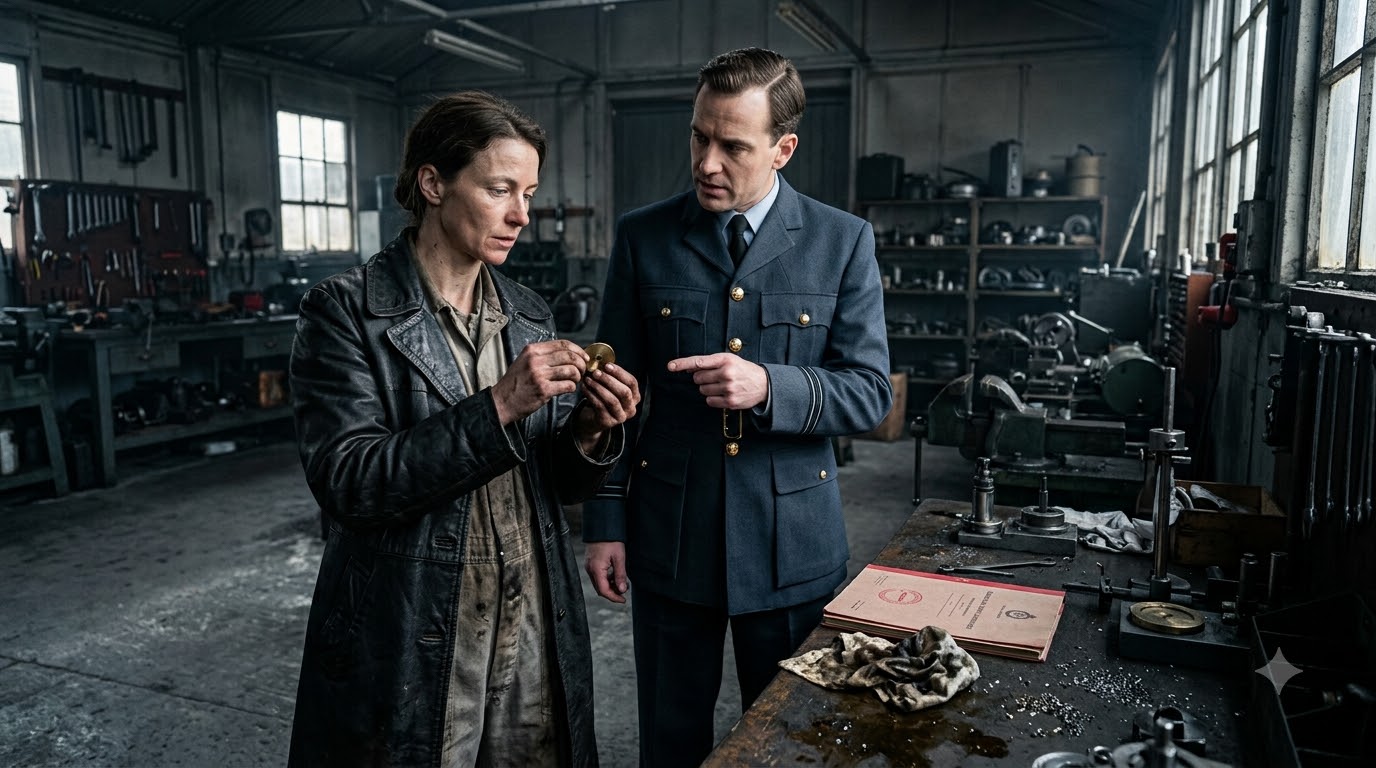
She twirled the small brass disc between her knuckles, feeling the precise, razor-thin ridge of the 0.04-inch aperture she had lathe-cut three hours before dawn.
The heavy oak door of the bench-testing shed slammed open. Draft swept across the concrete floor, carrying the smell of damp London rain and expensive cigar smoke. Wing Commander Vance didn’t wipe his boots. He stepped directly onto the chalk lines Beatrice had drawn across the floor to measure fuel-pump recoil.
“You’re late with the quarterly carburation summary, Miss Schilling,” Vance said. He didn’t look at the rig set up on her workbench—a stripped-down SU float-chamber suspended in a steel cradle. He looked at his pocket watch. “The Ministry needs the binder by four o’clock. The Minister is briefing the supply committee on the 1943 pressure-injection rollout.”
Beatrice didn’t drop the brass disc. She set it down on the oily rag beside her micrometer with a soft, metallic click.
“The 1943 rollout is two years too late,” she said. Her voice was flat, dried out by cold air and engine exhaust. “Forty-three percent of diving engagements this month ended in starved superchargers. The pilots are cutting out before they even clear three hundred yards.”
Vance smiled, the tight, practiced curve of a man who managed men who managed paper. “Engine development follows strict procurement schedules. Rolls-Royce has the contract in hand. We do not field unvetted modifications without six months of static stress testing and full Air Staff signatures.”
He reached out a manicured finger, intending to tap the open logbook on her bench.
Beatrice moved her hand six inches, placing her palm flat over the ledger before his finger touched the paper. She didn’t look up at his face. She looked at the brass buttons on his tunic, bright and unpitted by battery acid.
“Six months is eighty pilots, Vance,” she said softly. “I don’t need six months. I need a motorcycle and four hours on a flight line.”
“You need to know your place,” Vance replied, his tone dropping the polite veneer. He pulled a thick, red-stamped folder from under his arm and dropped it on the far end of the bench. It hit a tray of copper washers with a sharp rattle. “Your assignment is to catalog the failure reports from the Kent sector. Sort them by squadron. Do not attempt to engineer a bypass around the official Rolls-Royce contract.”
As Vance turned on his heel, his coat swept past the edge of her desk, shifting a loose sheet inside the red folder.
Beatrice’s eyes caught the top margin. It wasn’t a failure log. It was a requisition hold from the Air Ministry’s priority board—a stamped delay order on existing fuel-line fittings, signed three weeks before the Battle of Britain reached its peak.
She didn’t ask questions. She didn’t raise her voice.
Therefore, the moment the heavy oak door clicked shut behind Vance’s polished boots, Beatrice grabbed her leather riding coat from the peg. She swept the six prototype brass restrictors into her jacket pocket, picked up her heavy toolbox, and walked out the side door toward her Norton motorcycle.
She didn’t have an order signed by the Ministry. She didn’t have permission to leave Farnborough. All she had was a brass disc in her pocket with a hole no larger than a pinhead, and forty miles of wet country road between her and the nearest squadron of Spitfires.
CHAPTER 2: THE MUD OF BIGGIN HILL
The sentry at the gate didn’t raise his rifle, but he didn’t unhook the chain either. He looked at Beatrice’s grease-stained leather coat, then at the heavy wooden toolbox strapped across her pillion seat with oil-soaked hemp rope.
“Farnborough civilian pass doesn’t mean a thing today, miss,” the guard said, his breath fogging in the damp air. “Group Captain’s got the base on lockdown. Scramble dropped ten minutes ago.”
Beatrice didn’t reach for a badge she didn’t have. She didn’t argue military protocol with a nineteen-year-old corporal holding a wet Lee-Enfield.
She turned her right wrist, revving the Norton just enough to drown his voice, and pointed a gloved finger toward the maintenance hangars three hundred yards down the perimeter track. A Spitfire was idling on the hardstand, its three-bladed propeller a gray blur in the mist, blue smoke snapping from its exhaust stacks.
“I’m not here for the Group Captain,” Beatrice said over the engine. “I’m here for Sergeant Harris.”
The sentry hesitated, caught between the rigid authority of his post and the sheer, unbothered certainty of a woman who looked like she had built the motorcycle she was sitting on. He spat into the mud and unhooked the cold iron link.
Beatrice dropped the bike onto its center stand outside Hangar Three. The concrete apron was slick with a mixture of rainwater and spilled 100-octane aviation fuel.
Inside, the air smelled of hot mineral oil, cordite, and copper. Ground crewmen in oil-blackened overalls were moving around three Mk II Spitfires like ants on a disturbed nest.
Sergeant Harris was standing under the tail assembly of a fighter, a nine-inch spanner tucked into his back pocket. His face was gray with forty-eight hours of missed sleep, his eyes rimmed with red grit.
“We aren’t taking deliveries, miss,” Harris barked without looking up from the rudder trim tab he was adjusting. “And if you’re from the Ministry asking about the readiness logs, tell ’em to come down here and turn the wrenches themselves.”
Beatrice walked straight past two junior riggers dragging a trolley of 20mm drum magazines. She stopped two feet from Harris, reached into her coat pocket, and pulled out the brass disc.
She didn’t offer a speech. She held the small, cold circle of metal between her thumb and forefinger, letting the harsh overhead hangar lights catch the clean, lathe-cut edge of the 0.04-inch hole in its center.
Harris stopped tweaking the turnbuckle. His eyes shifted from the brass to her face, then down to her hands. He knew those hands. They weren’t the hands of an office clerk or a Ministry Inspector. The knuckles were scarred, the cuticles stained with indelible black grease.
“What is it?” Harris asked, his voice dropping an octave.
“The cure for the English disease,” Beatrice said.
Harris didn’t move. A hundred yards away on the grass runway, two Merlins roared to full battle power, the high-frequency vibration rattling the tin roof of the hangar above their heads.
“The Air Ministry says it’s a six-month redesign,” Harris said, stepping closer, his boots squelching on the damp concrete. “They sent a circular last Tuesday. Said any modification to the SU float chamber without a factory rep present is a court-martial offense for the line chief.”
Beatrice twirled the brass disc once, the smooth metal clicking against her silver signet ring.
“The Ministry isn’t flying those planes, Sergeant. And neither are the factory reps.” She pulled a folded sheet of greaseproof paper from her coat pocket—not an official order, but her own hand-drawn schematic of the Merlin’s fuel delivery line. “Your boys are diving on BF 109s over the Channel. They push the stick forward, the fuel surges, the float drops, and the supercharger drowns in raw petrol. Two point three seconds of dead silence. Just long enough for a cannon shell to come through the armor plate behind their head.”
Harris took the brass disc from her fingers. He held it up to the glare of a bare hanging bulb, his thick, oil-stained thumb covering half the metal.
“It restricts the line,” Harris muttered, the mechanical logic taking hold instantly. “Prevents the surge when the negative G hits.”
“It starves the flood without starving the engine,” Beatrice said. “Bench-tested for six weeks. But I don’t have an Air Ministry authorization stamp, Harris. I don’t have a signature from Whitehall. If I put this in that plane and the engine quits, they’ll put me in Holloway Prison and take your stripes.”
Harris looked away from the metal disc, his gaze drifting across the dark hangar toward a chalkboard hung on the brick wall. Eleven names were crossed out in rough white chalk under the header 72 Squadron.
“McLeod was twenty,” Harris said quietly, his thumb rubbing the edge of the brass disc. “Dived on a Heinkel over Dungeness. Engine died at six thousand feet. German didn’t even have to maneuver. Just circled around and walked his fire right down McLeod’s wing.”
He turned back to Beatrice. The weariness was still in his eyes, but the hesitation was gone.
“Flight Lieutenant Deere takes off at zero-seven-fifteen,” Harris said, snapping his spanner out of his back pocket. “His crew chief is taking a bacon sandwich behind the oil drums. You’ve got four minutes before Deere walks out of the briefing hut.”
CHAPTER 3: THE SILENT TWO HOURS
The copper union nut backed off with a dull crack. Raw 100-octane petrol trickled over Harris’s knuckles, dripping onto the concrete with a sharp, sweet chemical stench.
Beatrice reached into the dark, oil-slick cavity behind the carburetor mounting flange. Her thumb pressed the brass washer—0.04-inch aperture facing forward—flat against the delivery seat.
“Wire it,” she muttered around the casing of the torch.
Harris didn’t hesitate. His pliers twirled lock-wire around the brass hex nut, snapping it tight with a quick twist of his wrist.
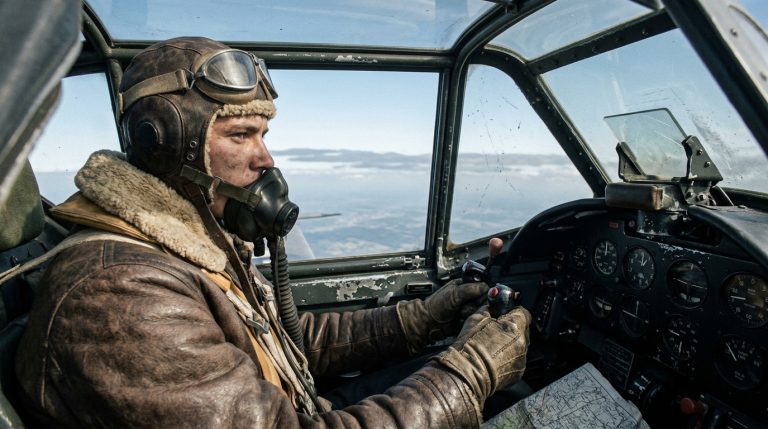
Thirty seconds later, the cowling latch slammed shut. The metal pinned into place just as Flight Lieutenant Al Deere swung his leg over the cockpit sill, his silk scarf tucked loosely into the neck of his sheepskin jacket.
Deere didn’t ask why the chief mechanic was wiping grease off the port side panels. He strapped his harness tight, pulled his goggle straps down, and primed the Merlin.
The engine kicked, threw a cloud of black smoke across the tarmac, and roared into a smooth, deafening idle.
Beatrice stepped back into the shadow of Hangar Three. She watched the Spitfire bounce across the uneven turf, hit the throttle, and lift into the low, gray cloud cover over the English Channel.
Then came the waiting.
Two hours of empty sky. Two hours of listening to the wind rattle the loose tin on the hangar roof.
Harris sat on an empty wooden oil crate, methodically wiping the jaws of his pliers with an oily rag. He didn’t speak. Neither did Beatrice.
She stood by the perimeter fence, her knuckles raw from the wind, twirling a spare copper washer between her thumb and index finger. Every five minutes, she pulled her pocket watch from her coat.
The hands barely moved.
If the hole was too small, the Merlin would starve at fifteen thousand feet. Deere’s engine would freeze mid-turn, turning his fighter into a twelve-ton iron brick over open water.
If the weld failed under pressure, fuel would spray across the red-hot exhaust stubs. There wouldn’t even be a parachute.
At eighty minutes, the air-raid siren on the control tower gave a short, defensive wail. Ground crews scrambled toward the sandbagged gun pits, but Beatrice didn’t move from the fence line.
She kept her eyes fixed on the southern cloud wall, watching the gray mist blur into sea-fog.
At two hours and fourteen minutes, a high-pitched whine cut through the low rumble of coastal artillery.
A single Spitfire broke through the cloud base at three thousand feet. No smoke. No trailing glycol.
It banked sharply, slipped sideways to kill speed, and dropped its tailwheel onto the grass with a light puff of dry earth.
Deere taxied straight to Hangar Three, killing the magnetos before the prop had even stopped turning.
He didn’t wait for the ladder. He unbuckled, threw his boots over the side of the fuselage, and dropped four feet to the grass.
His face was flushed red from the altitude, his eyes wide and bright.
“Harris!” Deere shouted, tearing his leather helmet off. “What the hell did you do to that fuel pump?”
Harris froze, his hand stopping mid-wipe on the pliers. He looked at Beatrice.
Deere grabbed Harris by the shoulder, laughing out loud. “I dived on two 100-series Messerschmitts over Dover. Nose straight down—full negative G. Pushed the stick so hard my straps nearly took my collarbones off.”
He gestured wildly at the sky with his helmet.
“The Merlin never even hiccuped. Full power the entire bloody way down. I put forty rounds through the trailing 109 before he even knew I was still on his tail.”
Deere turned, looking past Harris toward Beatrice standing by the hangar wall in her oil-stained coat. He paused, his smile fading into a sharp, curious frown.
“I don’t know who you’ve got hiding in your workshop, Sergeant,” Deere said softly, “but I want every plane in 72 Squadron fitted with whatever you put in that fuel line before tomorrow’s dawn patrol.”
CHAPTER 4: THE THREAT OF COURTMARTIAL
The heavy mahogany door swung open without a warning latch-click.
Wing Commander Vance stepped out first, his polished leather belt creaking against his tunic. He carried his chin high, but his eyes narrowed the instant they locked onto Beatrice’s oil-blackened boots. Behind him, seated behind a wide oak desk buried under casualty maps and grease-pencil overlays, sat Air Vice Marshal Keith Park.
“Enter, Miss Schilling,” Park said. His voice was raspy, stripped raw by cigarettes and eighteen-hour shifts.
Beatrice walked in. She didn’t drop her toolbox. She set it down on the Persian rug beside Park’s desk with a deliberate, heavy thud.
Vance stepped up to the edge of the desk, snapping open a leather folder. “Air Vice Marshal, this civilian employee breached security protocols at Biggin Hill zero-six-hundred hours. She installed an unvetted, unauthorized modification into Flight Lieutenant Deere’s aircraft without Air Ministry clearance, factory oversight, or safety certification.”
He looked directly at Beatrice, his expression cold with institutional victory.
“She has endangered pilot lives and violated defense procurement law. I am requesting her immediate removal from Farnborough and the execution of military detention pending formal charges.”
Beatrice didn’t look at Vance. She twirled her scarred brass caliper between her knuckles once, then laid it flat on top of the combat log resting on Park’s blotter.
“Deere engaged two BF 109s over Dover forty minutes ago, Air Vice Marshal,” Beatrice said. Her tone was dry, completely devoid of defensive pleading. “He dived twelve thousand feet at full throttle. Zero engine cutout. One enemy damaged, zero British losses.”
Park slowly raised his head. He ignored Vance entirely. His sharp, bloodshot eyes fixed on the brass caliper, then shifted to Beatrice’s face.
“Is that a fact, Miss Schilling?” Park asked quietly.
“It is in Sergeant Harris’s flight line log,” she replied. “And Deere wants the rest of 72 Squadron fitted before dawn.”
Vance’s face flushed dark red. He slammed his hand onto the desk. “It doesn’t matter if it worked once! There are rules of authorization, Air Vice Marshal! If every civilian technician starts welding scrap metal into Merlin engines based on back-alley hunch, we lose command structure!”
“It isn’t scrap metal, Vance,” Beatrice said without raising her voice. “It’s a brass restrictor with a zero-point-zero-four-inch aperture. And it isn’t a hunch. It’s six weeks of bench tests that your office filed under ‘delayed pending contract review’.”
Layer 1 broke right there in the quiet room.
Park didn’t miss the slip. His eyes flicked to Vance, whose hand twitched against his leather sidearm holster.
“Contract review?” Park repeated, his voice dropping into a dangerous, razor-thin register. “The pressure-injection contract with Rolls-Royce isn’t due until late forty-three, Vance. You held her bench results to protect a timeline?”
Vance stiffened, his jaw working as he tried to claw back his authority. “The Air Ministry has financial commitments and engineering standards to maintain—”
“The Air Ministry isn’t losing three squadrons a week over Kent!” Park cut in, his palm coming down on the desk with a noise like a pistol shot.
The room went dead silent. The clock on the mantelpiece ticked twice.
Park leaned forward, resting his forearms on the map table. He looked at Beatrice’s oil-stained hands, then at the heavy toolbox sitting on his rug.
“How fast can you fit every fighter in 11 Group, Miss Schilling?” Park asked.
Beatrice didn’t blink. “Forty-three stations. Three thousand engines. Give me four weeks, three mechanics from Farnborough, and unrestricted access to the flight lines.”
“You have four weeks,” Park said flatly. “I will sign an operational exemption for the Group. If Vance or anyone from Whitehall gives you paperwork friction, tell them to take it up with my command staff.”
Vance stepped forward, his voice tight with desperation. “Sir, this is a flagrant bypass of Ministry authority—”
“Get out of my office, Wing Commander,” Park said without looking at him.
Beatrice picked up her toolbox by its cold iron handle. She looked Vance straight in the eye as he turned toward the door, his teeth clenched in helpless rage.
CHAPTER 5: THE FOURWEEK GRIND
The spring rain hit like driven glass across the Kent marshes. Beatrice wiped her goggles with the back of her wet leather glove, her eyes burning from forty-eight hours of open road and cold tea.
Under the canvas panniers behind her saddle, three hundred brass restrictors rattled in a wooden crate—each one machined to 0.04 inches, each one a middle finger to Vance’s paper pushing.
At RAF Kenley, the station commander stood in the doorway of the maintenance shed, his coat buttoned to his chin, holding an umbrella over his head.
“I have no written directive from the Ministry of Aircraft Production,” he said, stepping in front of the nearest Hurricane’s tailplane. “I don’t care if Keith Park signed a piece of paper in London. Until I get a signal through my adjutant, nobody touches these fuel lines.”
Beatrice didn’t pull out Park’s letter. She didn’t argue military hierarchy.
She walked past him into the hangar, dropped her heavy iron wrench onto a steel worktable with a deafening clang, and pulled a brass disc from her coat.
She held it up to the station’s lead mechanic—a corporal whose shirt was soaked through with glycol and sweat.
“Three seconds,” Beatrice said loudly over the roar of a taxying engine outside. “That’s how long your pilots stay helpless when they nose down on a Junkers. This hole stops it. Do you want to fix twelve engines today, or do you want to write twelve letters to mothers in Yorkshire?”
The corporal looked at the station commander. He looked at Beatrice’s oil-stained thumb.
Without saying a word, the corporal picked up his wire-cutters and walked toward the first Hurricane. The station commander opened his mouth, closed it, and walked back out into the rain.
Station after station, the friction was the same. Cold tea, wet boots, and arrogant officers demanding authorization stamps while nineteen-year-old boys climbed into cockpits with dead-end carburetors.
By week three, her hands were so swollen from cold and spanner-strain she couldn’t close her fist without her knuckles bleeding into her gloves.
At Hawkinge, two miles from the white cliffs, Vance’s legacy showed its teeth one last time.
An inspector from the Ministry’s regional contract office stood by the fuel dump with a clipboard, ordering the ground crew to halt the fittings pending a ‘safety audit’.
Beatrice didn’t slow down. She grabbed a spare fuel coupling off the bench, slammed the brass washer into the seat in front of his face, and torqued the nut down with a six-inch spanner in less than fifteen seconds.
“Audit complete,” she said, her voice dropping into a razor-thin growl. “Call Vance and tell him I’m on my way to Tangmere.”
By April 20th, forty-three stations were done.
Two thousand eight hundred and forty-seven Merlin engines carried a brass washer behind their carburetors.
The Luftwaffe’s tactical manuals dropped the diving escape route within fourteen days.
The ‘English disease’ wasn’t cured by a multi-million-pound contract or a committee in Whitehall. It was cured by a woman with a brass disc, a box of tools, and a motorcycle that didn’t stop for rain.
CHAPTER 6: THE UNBROKEN HORIZON
The laboratory was quiet. The kerosene heater in the corner hummed with a low, steady flame, burning off the chill of the early Hampshire spring.
On her workbench sat a fresh stack of combat reports from 11 Group, delivered by a courier at dawn. April 1941: engine cutouts down to zero point three percent. Kill-to-loss ratio shifted from one point four to three point one in favor of Fighter Command.
The door to the testing shed opened slowly.
It wasn’t Wing Commander Vance. Vance had been quietly reassigned to a supply depot in the Outer Hebrides three days after Keith Park submitted his monthly operational audit to the War Cabinet.
It was a young junior officer from the Air Ministry’s procurement office. He carried no red folders. He held a thin, unsealed envelope stamped with the royal crest.
“Miss Schilling?” the clerk asked, standing respectfully at the edge of the chalk lines she had drawn weeks ago. “Official communication regarding the 1943 pressure-injection contract.”
Beatrice didn’t drop her brass calipers. She set them down gently beside her micrometer.
“Read it to me,” she said, her hands already reaching for a rag to wipe down her lathe chuck.
The clerk opened the sheet. “The Air Ministry has adjusted the priority rating for the Rolls-Royce pressure carburetor rollout. In light of the operational performance of the RAE fuel restrictor, all existing frontline Spitfire and Hurricane squadrons will retain the current field modification until full-scale factory conversion is available without grounding active units.”
He paused, looking up from the paper. “They’ve also formally cataloged the part under official store codes. It’s listed as the ‘RAE Restrictor’.”
“The pilots call it something else,” Beatrice said dryly, picking up a tin of machine oil.
The clerk flushed slightly, clearing his throat. “Yes, well. The Ministry prefers the technical nomenclature. Is there a response for the file, Miss Schilling?”
Beatrice looked out the window. Across the airfield, the low hum of a Merlin engine being ground-tested echoed through the trees. Smooth. Unbroken. Holding steady at three thousand revolutions per minute without a single stutter.
“Tell them the hole is four-hundredths of an inch,” Beatrice said, turning back to her workbench. “If they keep it at four-hundredths, the engines won’t drown. That’s all the file needs.”
The clerk nodded once, folded the paper, and walked out, closing the heavy oak door quietly behind him.
Beatrice sat down on her wooden stool. She pulled a worn piece of emery cloth from her drawer and began polishing the jaws of her calipers, stripping away the faint rust left by weeks of rain at Biggin Hill, Hornchurch, and Tangmere.
The bureaucratic trap was gone. The contract delays, the red tape, the arrogant men in tailored suits who viewed young lives as acceptable numbers on a balance sheet—all of it had collapsed under the sheer, unyielding weight of a brass washer and a motorcycle.
She twirled the brass caliper between her fingers one last time, feeling the familiar, cold balance of the tool.
The skies over Kent were clear. The boys were coming home. Beatrice Schilling leaned back against the workshop wall, closed her eyes, and listened to the quiet rhythm of the engine running in the distance.