The Steel Supply Line: How Everyday Americans Out-Built Germany’s Deadliest Submarine Fleet
CHAPTER 1: THE GOLDEN WEST BURNS
The water forty miles off Cape Hatteras wasn’t dark. It was coal-black, dense and thick enough to swallow the thump of a heavy diesel engine before the sound ever reached the shore.
On the deck of the merchant tanker RP Resor, the night smelled of sulfur, raw crude, and stale tobacco. Sixty thousand barrels of fuel oil pressed the hull deep into the Atlantic swell, heavy and slow.
Lieutenant Commander Ernst Cals leaned his elbows against the freezing spray rail of U-578. The salt air stung the raw skin beneath his collar, but he didn’t shift his stance.
Through his binoculars, the American coastline glittered three miles behind the tanker like a county fair. Ferris wheels, boardwalk lanterns, and hotel porch lights painted bright yellow ribbons across the water.
“Running lights still lit,” his chief watch officer muttered, wiping grease from his sleeve. “They aren’t even zigzagging.”
“They think the ocean belongs to them,” Cals said. His voice was flat, dry as paper. “They think a declaration of war is something you print in a newspaper.”
He didn’t yell an order. He lifted two fingers toward the lower hatch.
The tube opened with a sound like a wet lung releasing air.
Eleven seconds passed in absolute silence, save for the slap of black chop against the steel hull.
The explosion didn’t make a sharp crack. It was a heavy, dull thud that vibrated through the soles of Cals’ boots before the fireball rose.
A pillar of orange flame shot three hundred feet into the low clouds, turning the black water to molten copper. The heat hit Cals’ wet cheeks three miles away.
Along the beach towns of North Carolina, windows rattled in their wooden sashes. Vacationers pulled back curtains, blinked at the artificial dawn, and assumed a boiler had blown at the local docks before turning back to bed.
Cals watched the tanker’s stern lift into the air, black shapes sliding off the slick deck into the burning water.
“Write it down,” Cals told the log officer, turning his back on the fire. “Twenty-five ships in fourteen days. Tell Berlin the coast is open.”
Three hundred miles inland, inside the drafty wooden office at the Richmond waterfront, Henry Kaiser didn’t look at the sky. He looked at a wooden desk covered in wet coffee rings and blue chalk lines.
The rain beat against the corrugated tin roof with the sound of machine-gun fire. Outside, thirty acres of tidal marshland had turned into a knee-deep swamp of red mud and crushed limestone.
“The Navy department says sixty days per hull is the absolute physical limit,” an engineer said, tossing a telegram onto the desk. “They say if we push the welds faster, the plates will warp.”
Kaiser picked up a scarred steel welding gauge, turning the cold notch between his thumb and forefinger until the metal bit into his calluses.
“The Navy is building cathedrals,” Kaiser said. His voice was raspy, heavy from three packs of unfiltered cigarettes a day. “We aren’t building cathedrals. We’re building boxes that float.”
“They won’t give us destroyers for escorts, Henry,” the engineer pressed, pointing a finger at the window. “The U-boats are taking them down faster than the yards can clear the slipways.”
Kaiser didn’t look up from his gauge. He spun the cold steel wheel until it clicked tight against his palm.
“Then we don’t wait for escorts,” Kaiser said. “We build the boxes faster than they can pack torpedoes.”
CHAPTER 2: COLD ARITHMETIC IN BERLIN
The skyline of New York didn’t turn off. It glowed like an open furnace against the night sky, casting long, pale shadows across the wet steel deck of U-123.
Captain Reinhard Hardegan leaned against the conning tower rail, listening to the hum of the city bouncing off the flat harbor water. Music from a hotel radio drifted across the three-mile gap, thin and sweet, completely unaware of the twin electric motors idling beneath his boots.
“They’re still leaving the streetlights on,” his junior officer whispered, shaking his head. “Look at the suspension bridge. It’s lit like a Christmas tree.”
Hardegan didn’t answer right away. He pulled a silver cigarette case from his heavy wool coat, snaps it open with one thumb, and let the cold wind take the unlit paper.
“They don’t believe the ocean can bleed,” Hardegan said. He looked down at the dark water where a four-thousand-ton freighter was silhouetted against the bright windows of Wall Street. “They think two thousand miles of water is a steel wall.”
He signaled down the voice tube. Two torpedoes left the bow tubes with a low, wet cough.
Hardegan didn’t wait to watch the impact. He lowered his hatch, stepped down into the cramped, grease-smelling heat of the command room, and opened his logbook. Nine ships in nine days.
Six thousand miles away in Berlin, Grand Admiral Carl Dönitz stood before a wall-sized map of the Atlantic ocean. The room smelled of wet wool, tobacco smoke, and floor wax.
A young staff officer pushed a small wooden marker across the blue paper off the coast of North Carolina, adding a red pin beside a long row of existing ones.
“One hundred and forty ships a month,” Dönitz said, his hand resting flat against the wooden frame of the map table. His fingers were stiff from the damp chill of the room. “That is the mathematical breaking point. If we sink one hundred and forty ships every thirty days, Britain starves by autumn.”
“The Americans have announced a new construction program, Admiral,” the staff officer said, handing over a translated newspaper clipping from a Washington daily. “They claim they will build merchant vessels using standardized pre-fabricated parts.”
Dönitz didn’t take the paper. He turned his eyes toward the window, where the gray Berlin rain washed down the glass in long, jagged streaks.
“A ship is not an automobile,” Dönitz said, his voice dropping into a dry, flat rhythm. “You cannot stamp out a hull on a press. You cannot train a farm boy to weld armor plate in four weeks. Their Navy Department knows this. Their engineers know this.”
He tapped a cold finger against the red pin marking the sunk tanker off Cape Hatteras.
“They have no escorts,” Dönitz said softly. “They have no blackout orders. And they do not have the technical discipline to build an ocean-going fleet from nothing. The arithmetic is entirely on our side.”
In Washington, inside a cramped basement room of the Navy Building, Admiral Ernest King stared at a stack of casualty reports printed on thin carbon paper. The radiator in the corner hissed and sputtered, blowing dry, dusty heat against his face.
Across the table, a civilian representative from the Maritime Commission sat with his hat balanced on his knee, clutching a leather briefcase.
“We need destroyers along the coast, Admiral,” the civilian said, his voice rasping from lack of sleep. “We’re losing tankers faster than the pipeline can haul crude to the docks.”
King didn’t lift his eyes from the carbon paper. His knuckles were raw, stained with black fountain-pen ink.
“I have no destroyers,” King said. Every word was clipped, heavy, and cold. “The Pacific fleet took the hit at Pearl Harbor. Every hull that can carry a depth charge is guarding troops headed for Ireland or hunting carriers in the Solomons.”
“Then the merchant fleet sails alone?” the civilian asked, his knuckles whitening around his briefcase handle.
“The merchant fleet sails,” King said, slamming the file folder shut. “And Mr. Kaiser had better figure out how to make his steel boxes float without a warship to hold their hand.”
CHAPTER 3: MUD AND MOLTEN STEEL
The cable hummed under the strain, dropping grease into the standing water around Kaiser’s boots. Across the yard, steam pipes hissed continuously, fighting the river dampness that coated every exposed girder in slick gray slime.
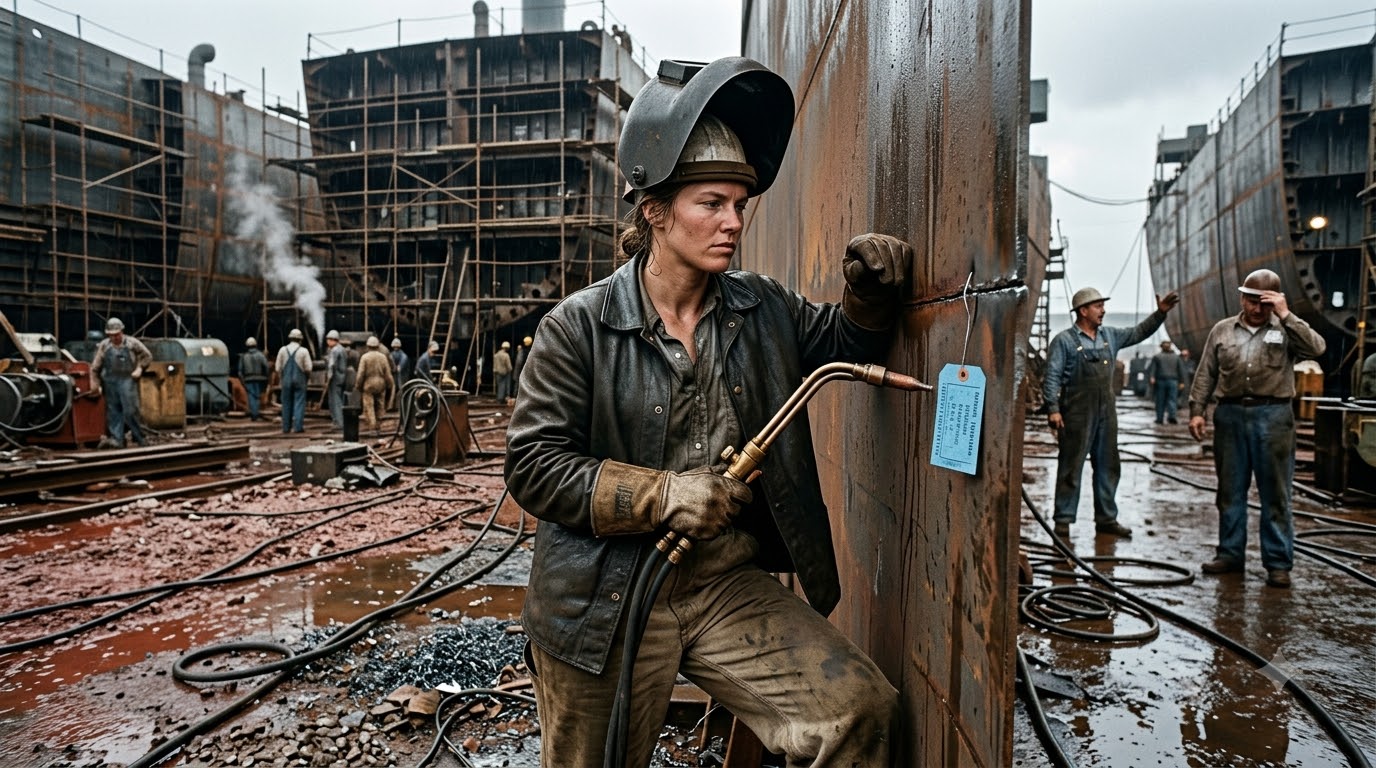
A few yards up the scaffolding, Ruby Holt wiped sweat from the bridge of her nose with a leather-gloved forearm. The arc light from her torch burned hot against her goggles, blinding her to everything except the six-inch pool of molten steel bubbling under her tip.
“Keep the bead tight, Holt!” her shift leader shouted over the clatter of pneumatic guns. “Inspection crew comes through at five!”
Ruby didn’t turn her head. She kept her right hand braced against the cold hull plate, her left thumb adjusting the gas valve by ear.
Four months ago, she was packing peaches into wooden crates in Stockton, worrying about thirty-five cents an hour and the price of milk. Now her shoulders throbbed with a dull, constant ache that stayed with her even in her sleep.
“Line’s slipping!” a dogger yelled from the staging floor below.
Ruby cut her flame instantly.
A seventy-foot section of side plating dangled thirty feet above Berth 2, twisting slowly in the river breeze. The steel plate hit the upright ribs with a sound like a cannon shot, sending a shower of rust and metal shavings down onto the wood decking.
Kaiser didn’t flinch as the metal shrieked. He stepped right over a tangled nest of live air hoses and slammed his wet blueprint against the steel staging frame.
“Where’s the delay?” Kaiser demanded, turning his glare on a floor manager whose rain slicker was caked in dried concrete dust.
“The steel yard sent the wrong gauge for the bottom strakes,” the manager said, wiping rain from his chin with a trembling hand. “We’re two shifts behind on the keel laying.”
“Then don’t wait for the yard,” Kaiser said, his raspy voice cutting through the roar of three different rivet guns. “Cut the heavy plate down here. Prefabricate the deck housing in the parking lot if you have to.”
“The Navy inspectors won’t sign off on off-site sub-assemblies,” the manager argued, shaking his head. “They want every weld certified on the berth.”
Kaiser reached into his coat pocket, pulled out the cold steel welding gauge, and tapped it against the manager’s wet chest.
“The Navy isn’t sailing these hulls against U-boats next month,” Kaiser said. “We are. You tell the inspector if he wants to check the seams on foot, he can do it while the crane moves the deck.”
Up on the scaffold, Ruby kicked a loose slag valve out of her way and restarted her torch with a sharp flint strike.
She pressed the blue flame against the seam, watching the metal turn bright cherry red. As the puddle formed, her eyes caught something odd along the edge of the newly delivered plate—a stamped, unrecorded blue inspection tag bolted directly over a hairline seam fracture that had no business passing factory checks.
She reached out with a gloved finger and rubbed the grease off the metal face, revealing a surface crack that ran six inches deep toward the structural rib.
CHAPTER 4: THE CRACK IN THE HULL
The grease on the blue metal tag came off in gray streaks across her knuckle. Beneath it, stamped in fresh ink, was a naval procurement seal that had never passed through the yard’s main intake desk.
“Hey! Girl! Step away from that seam!”
The voice barked from the catwalk above. Senior Inspector Vance stood leaning over the handrail, his polished leather boots untouched by the mud churning fifty feet below. His crisp wool coat looked completely out of place against the soot-stained wooden staging.
Ruby didn’t move her thumb.
“This plate has a shear line running straight through the weld path, sir,” she said, her voice dry from six hours of torch fumes. “If this hull takes a North Atlantic wave at three degrees, the seam splits like a tin can.”
Vance descended the steel ladder with deliberate, unhurried steps. He pulled a yellow inspection card from his breast pocket, flicking a pencil against his teeth.
“That steel was certified at the foundry in Pittsburgh,” Vance said, stepping onto her wooden scaffold platform. The wood groaned under his weight. “Your job is to lay down wire, Holt. Leave the metallurgy to men with degrees.”
“I don’t need a degree to see six inches of daylight through a plate gap,” Ruby said, backing up just enough to keep her balance on the planking. “Someone marked this fit for assembly before the mill even cooled.”
Vance leaned in closer, dropping his voice below the roar of the overhead cranes.
“Mr. Kaiser’s little assembly line experiment is running thirty percent over allocated steel quotas,” he said, tapping his pencil against the blue tag. “The Bureau isn’t going to hold up twelve merchant hulls just because a fruit packer turned welder thinks she sees a shadow in the iron.”
“It’s not a shadow,” a heavy voice rumbled from the staging ladder.
Henry Kaiser pulled his thick frame up onto the planking, his boots covered in red clay, his wet hat brim dripping water onto his shoulder. He didn’t look at Vance. He looked straight at the blue tag pinned to the cracked plate.
“Where did this batch come from, Vance?” Kaiser asked.
Vance straightened his collar, his chin coming up with an easy, practiced authority.
“It came from the Navy’s auxiliary allocation pool,” Vance said smoothly. “Standard procedure for emergency yard expansions. You wanted faster deliveries, Mr. Kaiser. The Department cleared the inventory.”
Kaiser reached out and pinched the blue metal tag between two thick fingers. He gave it a hard twist, snapping the soft wire tie, and held the stamped seal up to his eyes.
“This isn’t emergency allocation,” Kaiser said, turning the tag over to reveal a handwritten routing code hidden on the back. “This is rejected stock from the Norfolk navy yard. Your procurement division sat on this scrap for six months, then shipped it out here hoping we’d bury it under three passes of weld wire.”
Vance’s mouth tightened into a hard, thin line. His hand twitched toward his pocket before he caught himself.
“You’re making reckless allegations, Kaiser,” Vance spat. “If you refuse this shipment, your slipways sit empty for three weeks. Your four-day record goes in the trash, and the Maritime Commission reclaims your yard contracts.”
Kaiser slid the blue tag into his vest pocket alongside his steel gauge.
“My slipways don’t sit empty,” Kaiser said, his voice dropping into a quiet, icy register. “We’re going to grind this seam out ourselves, double-plate the backing, and weld it straight through the night.”
“You don’t have the authorization to alter structural plates without Bureau approval!” Vance snapped, his voice rising above the pneumatic hammers.
“Then go file a report,” Kaiser said, turning his back on the inspector. “Ruby, get your grinding wheel. We’ve got ninety-six hours to build a complete ship out of scrap, and I’m not wasting another minute listening to a pencil pusher tell me how to build a hull.”
CHAPTER 5: THE FOURDAY MIRACLE
The roar of the grinding wheel bit deep into her forearms, sending violent vibrations through her teeth until her entire jaw felt numb. Rain hissed as it struck the glowing white metal seam.
Behind her, Vance stood on the mud-slick catwalk with two armed naval guards. He held a clipboard high under his oilskin cloak, refusing to step down into the flying grit.
“I am issuing an administrative injunction!” Vance yelled above the screech of metal. “Altering inspected materials without Bureau authorization is a federal violation!”
Henry Kaiser didn’t even turn around. He hoisted a forty-pound box of low-hydrogen welding rods up the ladder himself, his knuckles bleeding through his canvas gloves.
“You can write the ticket when the hull hits the water, Vance,” Kaiser shouted back, slamming the box onto the planking beside Ruby. “Get those backing plates clamped down!”
Six men scrambled onto the staging, swinging heavy sledges in tight, rhythmic turns to force the reinforced steel straps tight against the seam. The noise was deafening, a relentless drumbeat of iron against iron.
Hour eighty-two.
Ruby’s hands trembled so violently she had to hold the torch hose with both elbows pinned against her ribs. Her visor was choked with soot, but she kept her eyes fixed on the narrow gap where red-hot slag ran off into the river.
Across the slipway, another team was already lowering the entire ninety-ton forward superstructure into place. They didn’t wait for the deck plates to cool. The crane dropped the house onto the mounting brackets while the welders were still crawling beneath the floorboards.
“Inspector’s trying to cut the power cables at the main junction!” a shift leader yelled down from the yard office.
Kaiser turned on his heel, his rubber boots tearing through the thick sludge as he met Vance at the transformer box.
Vance had his hand on the master disconnect switch, his eyes wide and bloodshot, his knuckles white around the iron lever.
“You don’t get to override the United States Navy, Kaiser!” Vance snarled, his breath coming in ragged gasps. “This yard belongs to the Maritime Commission!”
Kaiser stepped into Vance’s space until the brim of his wet hat brushed the inspector’s chin. He pulled the stamped blue tag from his vest pocket and shoved it straight into Vance’s coat pocket, pinning it there with two heavy fingers.
“That tag has your personal inspector code written on the back in waterproof ink,” Kaiser said, his voice dropping into a low, terrifying growl. “Shut this power off, and I won’t just publish the build timeline. I’ll hand every single piece of routed paper to the Senate Truman Committee before midnight.”
Vance’s hand froze on the lever. His throat worked silently as he stared at Kaiser’s mud-caked face, the audacity of the bureaucrat completely collapsing against the wall of raw, unrelenting labor surrounding them.
“Hour ninety-four,” Kaiser called out without looking back. “Clear the slipway!”
Ruby pulled her hood back, her hair soaked with cold grease, and watched as four hundred workers dropped their tools simultaneously. The wooden chocks beneath the keel groaned as the hydraulic jacks began to turn.
CHAPTER 6: THE IRON HORIZON
A towering wave of salt water rolled over the staging timbers, washing three days of red mud and iron filings right off Kaiser’s rubber boots.
Behind him, four hundred shipyard workers let out a single, hoarse roar that echoed off the corrugated metal sheds. Ruby Holt lifted her heavy welding visor, leaning her shoulder against the timber frame to keep her knees from buckling under the sudden drop in adrenaline.
Inspector Vance stood near the yard office door, clutching his leather briefcase against his ribs. His face was pale, his eyes fixed on the massive grey merchant vessel floating perfectly level in the channel tide.
“That hull won’t survive three weeks in Atlantic ice,” Vance rasped, his voice thin and desperate as he stepped toward Kaiser. “You bypassed three separate Navy procurement protocols! I am filing an immediate injunction to hold that ship in port!”
Kaiser slowly snapped the stopwatch shut, the metal casing clicking hard against his thumb. He turned to face Vance without moving his feet from the wet gravel.
“You aren’t holding anything in port, Vance,” Kaiser said. His voice was quiet, but it carried right through the hiss of the yard steam vents. “While you were standing on that catwalk with your clipboard, the Maritime Commission signed off on twenty-four more hulls using this exact pre-fabrication layout.”
Vance’s mouth twitched, his fingers digging into the leather seam of his briefcase.
“You think you can just out-build the entire bureaucracy?” Vance sneered, attempting a cold, superior smirk that completely failed to reach his eyes. “You don’t have the military authority. You don’t have the warship escorts. The U-boats are burning five hundred thousand tons of steel a month out there!”
“They can burn six hundred thousand,” Kaiser said, stepping closer and dropping his hand into his coat pocket. He pulled out his scarred steel welding gauge and tossed it onto the hood of Vance’s staff car with a dull clank. “Because starting tomorrow morning, this yard launches two ships a day. And the Portland yard launches three.”
Vance stared at the cold gauge resting on the black paint. He reached for his car door handle, his hand trembling so hard he missed the latch on his first attempt, before sliding into the front seat without another word.
Three thousand miles away, thirty miles off the icy coast of Nova Scotia, Captain Reinhard Hardegan raised his periscope through six feet of churning ocean.
The glass fogged for a second before he wiped the eyepiece with his sleeve. He expected to see a broken convoy—two or three battered freighters limping along without escort protection, easy targets for his remaining torpedoes.
Instead, the horizon was black with smoke.
Line after line of high-bowed merchant hulls stretched as far as his optics could reach, steaming steadily east in a wall of iron that seemed to fill the entire ocean.
“Target acquisition, Captain?” his weapons officer whispered, his fingers hovering over the firing keys in the dark, oil-scented tube room.
Hardegan stared through the reticle. He counted twelve Liberty ships in the front line alone. Then fourteen behind them. Then another row behind those, their gray decks loaded high with trucks, crates, and fuel drums.
He looked down at his clipboard. He had three torpedoes left in his bow tubes.
“Lower the periscope,” Hardegan said, his voice completely stripped of its previous arrogance.
“Captain?” the officer asked, bewildered.
“There’s no point,” Hardegan murmured, stepping back into the shadow of the conning tower hatch. “We’re shooting at a mountain with rifles.”
Back in Richmond, California, the 3:00 a.m. shift whistle blew across the mud flats, sharp and clear against the foggy air.
Ruby Holt sat on a wooden bench outside the fabrication shop, holding a tin cup of cold coffee in both hands to warm her fingers. Her knuckles were stained with black grease that wouldn’t wash out for weeks, but her grip on the tin cup was steady.
A fresh flatcar loaded with raw steel plates rolled past on the yard tracks, the iron squealing against the rails as it headed toward Slipway 2.
She took a slow sip of coffee, pulled her leather gloves back over her calloused hands, and stood up to meet the next shift.