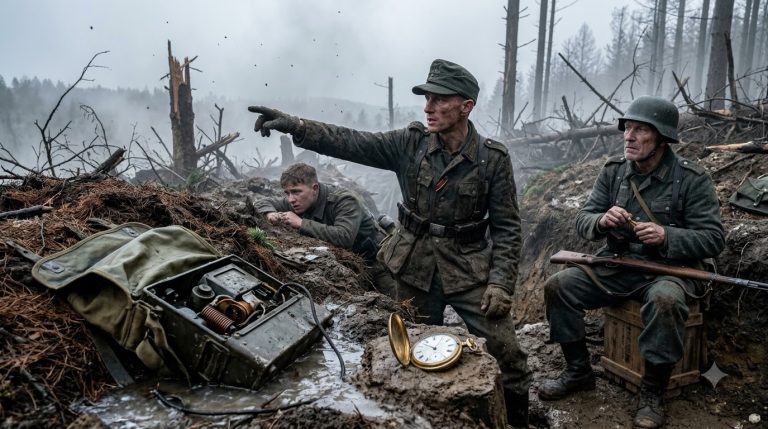
The Coal Miner’s Son Who Held the Line with Iron Will and Raw Grit
CHAPTER 1: THE SHATTERED LINE
The brass latch on the dented pocket compass clicked beneath my thumb.
One click. Two.
The steady, mechanical rhythm was the only thing keeping my pulse below my teeth while the night air over Sars-la-Brière turned thick with the smell of scorched earth and cordite.
To my left, the rest of Company H was pulling back.
Boot heels skidded through the loose shale of the drainage ditch as the order rattled down the line, passed in ragged, desperate whispers.
“Fall back! Second position, move!”
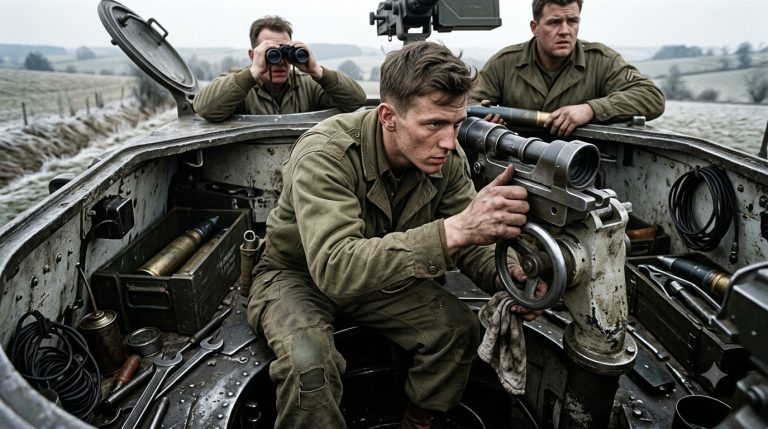
I didn’t move. My knees were jammed deep into the damp clay of the parapet, the chill of the Belgian mud soaking straight through the canvas of my trousers.
Beside me, Sergeant Miller didn’t look back at the dark tree line where the muzzle flashes flickered like angry fireflies.
He was staring at his own boots, his hand trembling so hard he couldn’t get his rifle strap over his shoulder.
“We’re cut off, Merli,” Miller rasped, his voice dropping into that wet, thin register men get when the panic takes over. “They’re past the flank. It’s over.”
“The company’s still moving on the road,” I said. My voice was flat, dry as coal dust. “If we clear out, that squad in the treeline takes them from behind.”
“They’ve got automatic fire!” Miller shoved himself up against the dirt wall, his palms slick with sweat. “We don’t have the heavy iron to match that. Look at the wire!”
He pointed a shaking finger at the field-telephone line dangling uselessly over the edge of the pit.
I reached out and pulled the black rubber cord into the faint light of a illumination flare fading overhead.
The copper core wasn’t frayed by shrapnel.
It was cut clean, the insulation sliced smooth with a straight blade.
Miller didn’t notice the cut. Or maybe he just didn’t care.
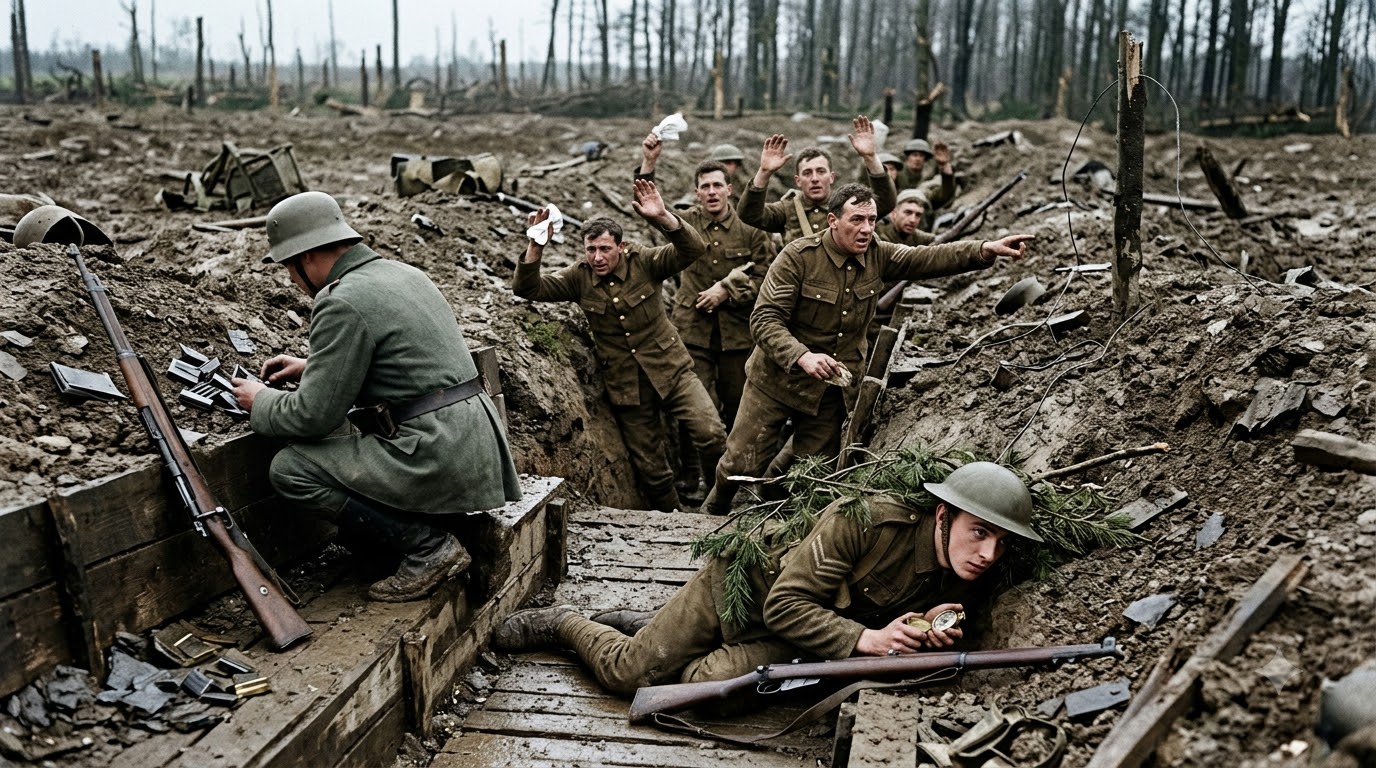
“Hands up!” Miller yelled toward the shadow of the trees, his arms shooting into the air before the flare even hit the grass. “We’re done! Don’t shoot!”
Seven other men from the section scrambled out of the ditch behind him, white handkerchiefs and bare palms raised high against the dark.
“Merli, get up!” Miller hissed over his shoulder. “Don’t be a fool!”
I didn’t answer. I slid flat into the bottom of the trench, my cheek pressing hard against the cold, mud-slicked pine planks at the bottom.
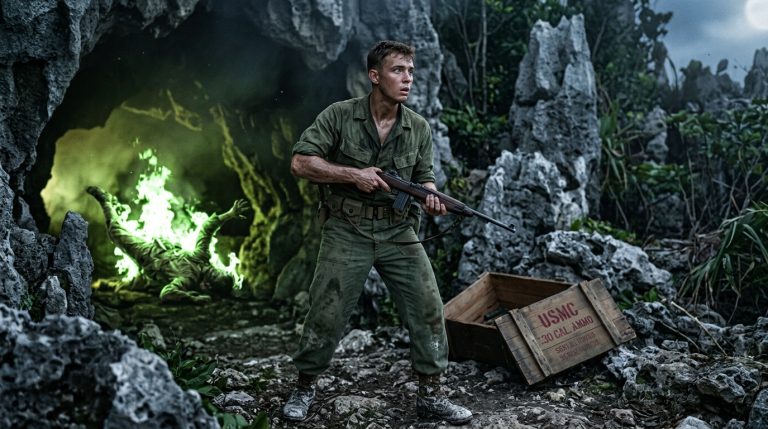
I dragged my M1 Garand under my ribs, pulled a dead pine branch over my shoulders, and clicked the brass compass latch one last time.
The footsteps came three seconds later—heavy, iron-shod boots crunching through the gravel right above my head.
CHAPTER 2: SHADOWS AND BRASS
I held my breath until the blood thudded in my temples, keeping my eyes squeezed shut.
The weight stayed there above the lip of the trench—a heavy, scraping heel dragging across the edge of the timber lining.
Two voices cut through the dark, speaking in fast, low gutturals.
They weren’t screaming or firing. They were casual, the calm tones of men walking through a room they already owned.
One of them kicked a loose casing into the ditch. It clinked against my M1’s receiver, but I didn’t flinch.
My right hand was pinned under my ribs, thumb locked tight against the brass latch of the pocket compass.
I counted the thuds of their boots as they moved down the parapet toward the road.
One. Two. Five steps. Seven.
When the chatter faded into the rustle of the wet pine needles forty yards out, I opened my eyes.
The squad had cleared the trench line, chasing Miller and the seven others who had put their hands up like sheep at a gate.
They thought the position was empty.
I pushed the dead pine branch off my shoulder and sat up slowly, my joints cracking like dry kindling.
The silence over the ditch was heavier than the gunfire had been.
To my right, the severed length of the field-telephone line dangled off the mud wall.
I reached out, running my thumbnail across the fresh, square edge of the cut.
Miller had been in a hurry to tell everyone the line was dead before the first mortar even dropped.
He hadn’t been waiting for orders from battalion; he’d been looking for a reason to run.
A shadow shifted near the bend in the ditch, twenty yards down toward the tree line.
A lone German soldier was leaning over a crate of abandoned rifle clips, his back turned, his shadow stretched long against the clay wall by the distant glow of a burning supply truck.
He didn’t have his rifle slung; it was propped against the dirt bank three feet away while he rummaged through our trash.
I didn’t yell. I didn’t call out a warning.
I stepped through the mud in soft, methodical strides, keeping my boots in the deepest water where the silt wouldn’t crunch.
When he heard the wet slide of my trousers, he started to turn, his mouth opening to form a word that never came out.
I brought the wooden stock of the Garand down hard into his sternum, driving the air from his lungs in a sharp, wheezing gasp that died in his throat.
He hit the wall of the trench and slid into the mud, his eyes wide and unfocused under the rim of his helmet.
I grabbed his rifle by the sling, tossed it over the rear bank into the brush, and pulled three full clips of American .30-06 ammunition out of his hands before he could gather his breath.
I didn’t finish him. I didn’t have to.
I just took his leverage and left him gasping in the dirt.
The main road behind Sars-la-Brière was quiet now, but from the low ridge half a mile south, the low rumble of heavy engines began to vibrate through the earth beneath my boots.
They weren’t just clearing the infantry. They were bringing up armor toward the crossroads.
And Miller’s shortcut home had left the entire gate wide open.
CHAPTER 3: THE LONG WATCH
The rumble in the earth wasn’t coming from tanks.
It was a convoy of three-ton troop trucks crawling up the access road, grinding their gears as they reached the mud flat below the ridge.
They were holding back, waiting for their forward scouts to clear the trench line and signal that the intersection was open.
If those trucks reached the paved fork before daybreak, battalion’s left flank wouldn’t just be turned—it would be ground to powder while they slept in their bivouacs.
I thumbed eight rounds into the Garand’s clip, the steel springs clicking into place with a dry, sharp snap.
Four hours passed in total darkness.
I didn’t move from the corner where the timber wall met the drainage sump.
Every twenty minutes, a flare would arch overhead, casting long, dancing shadows across the mud.
When the light flared, I froze, letting my gray canvas coat blend directly into the saturated earth.
When the light died, I shifted three yards to a new firing step, dragging my boots through the muck without making a sound.
At 03:00, the rustle started in the tall grass twenty feet to the right of the parapet.
Four men crawling on their belt buckles, helmets low, dragging rifles through the wet weeds.
They were testing the line, throwing small clods of dirt into the ditch to draw a panicked burst of fire.
They wanted to see if the position was held by a squad or an empty shadow.
I didn’t shoot. I pulled the brass compass from my pocket and thumbed the latch open.
Click.
The soft metallic sound carried across the four-foot gap between the trench lip and the grass.
The crawling stopped instantly.
A helmet rose two inches above the dirt rim, trying to locate the source of the noise.
I lined up the front sight post with the center of that shadow and pulled the trigger once.
The rifle kicked hard into my shoulder.
Before the casing hit the floorboards, I shifted six feet down the trench line, dropping flat against the duckboards.
A hail of return fire chewed into the wooden parapet where I’d stood a second before, splinters flying like needles into the dark.
Then silence fell again—heavy, cold, and absolute.
They stopped crawling.
They knew someone was still down in the ditch, but they couldn’t find the pattern.
Every time they pushed, the shadow moved, and every single shot came from a different angle.
My father used to tell me that the mine didn’t care how many men were in the shaft; it only cared who kept their feet planted when the timber started to groan.
I clicked the compass latch once more, sitting back against the damp clay wall as the eastern horizon began to turn from pitch black to a pale, bruised gray.
The long watch was almost over. Now came the hard part.
CHAPTER 4: THE SILENT DAWN
The sharp, rhythmic crackle of American artillery suddenly shook the valley, air-bursts chewing into the timber ridge half a mile out.
Company H was pushing back.
In the meadow below, white cloth began waving from behind an overturned logistics truck as a weary German officer stepped into the open, his hands raised high above his visor.
He wasn’t surrendering to the main force advancing along the road; he was looking straight down at the trench where one rifle had kept his flank pinned all night.
A battalion officer and two lieutenants picked their way through the mud ten minutes later, their boots squelching loud in the morning quiet.
When the captain rounded the timber bend and saw me sitting on the duckboards with dirt caked across my cheeks, he stopped dead in his tracks.
“Son,” he said, his voice tight as he looked at the spent casings scattered across the sump. “Where’s the rest of your section?”
“Surrendered around twenty-one forty-five last night, sir,” I said, sliding the Garand’s safety back onto its notch.
He stared down the ditch, counting the abandoned gear and the quiet shapes lying along the parapet where the probes had failed.
“And you stayed?”
“Yes, sir,” I said. “The position needed holding.”
Sergeant Miller was standing near the battalion jeep half an hour later, his uniform neat, his eyes darting to the dirt as I walked past the command tent toward the aid station.
He opened his mouth, trying to find some clean, official excuse for why he’d cut the wire and led seven men into a surrender fence.
“Merli—” he started, his voice strained, looking for a way to make it sound like a tactical retreat. “The line was dead. We were ordered—”
I didn’t stop. I didn’t raise my voice or throw a punch.
I just pulled the severed length of telephone wire from my pocket and dropped the clean-cut copper end onto the hood of his jeep right in front of the battalion captain.
Miller’s face went white, his mouth snapping shut as the captain picked up the cord and turned his cold stare directly onto the sergeant’s boots.
I kept walking toward the water trailer.
My father worked thirty years in the Scranton coal mines, six hundred feet down in the dark where there weren’t any officers or medals to keep you warm.
He taught me that when a job needs doing, you don’t look around to see who else is going to carry the weight.
You just set your feet, lock your jaw, and hold the line until the sun comes up.
I sat down on a dry wooden crate in the morning sun, pulled the brass compass from my pocket, and slowly wiped the Belgian mud off the latch with the thumb of my sleeve.