A Board President Changed My Locks for Unpaid Dues, Then Discovered Who Wore the Robe
CHAPTER 1: THE HIGHIDLE DRILL
The cordless hammer drill screamed through the brass cylinder of the front door before Warren even got the choke pushed back on the tractor. He left the diesel chugging at half-throttle, its blue exhaust drifting across the gravel toward a white cargo van he didn’t recognize.
Two men in gray canvas work shirts stood on his porch. One held an open plastic tray of Schlage locksets; the other leaned into the handle of the drill, shavings of metal falling into the bristles of Warren’s dried coir mat. Down near the cul-de-sac where the blacktop gave way to his washboard lane, a flatbed tow truck was already winching the rear axle of his utility trailer off the dirt.
Warren didn’t run. Running just ruined knees that were already stiff from forty years of framing and gravel hauling. He walked past the hydrangeas his wife had planted back in ninety-two, his work boots grinding steady on the crushed limestone.
“Who told you to take that bit to that door?” Warren asked. He kept his hands out of his jacket pockets, fingers loose at his sides.
The man on the drill didn’t look up, but the younger one with the tray tapped a magnetic badge on his chest. “Association work order. Property repossession under collateral lien. You’re trespassing if you step past the sill, sir.”
“This isn’t association ground,” Warren said.
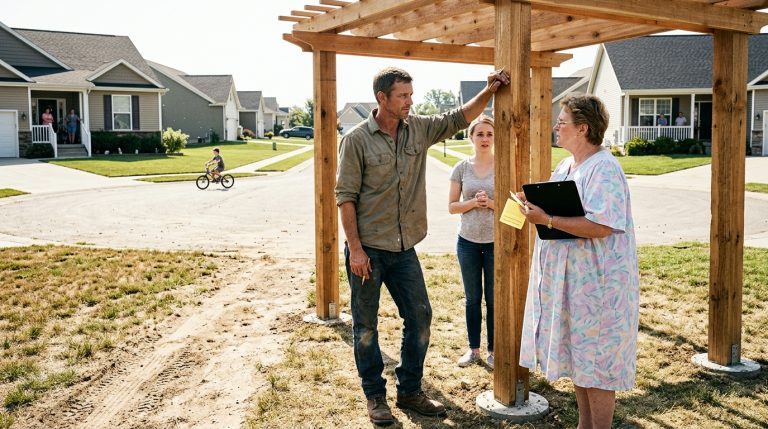
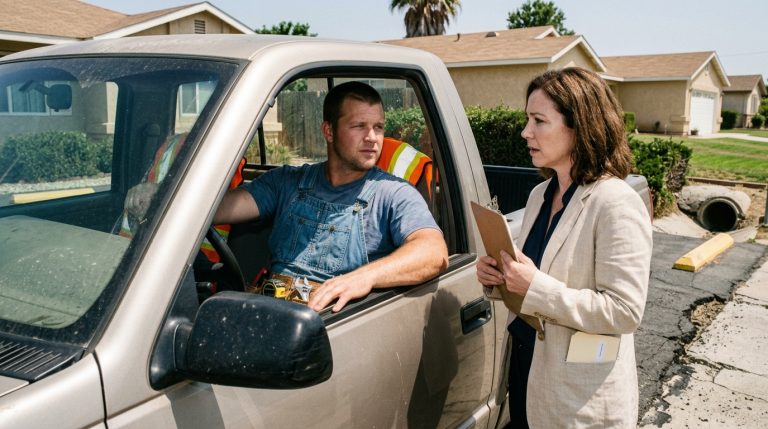
A white Lexus SUV crunched up the driveway, throwing gray dust across Warren’s front fender before its brakes squealed to a stop. Vanessa Whitlock stepped out. She didn’t shut the driver’s door all the way; she just let it click against the latch, her clipboard tucked under one arm like a ledger. Her wool blazer looked stiff, out of place against the raw morning damp.
“It’s association ground as of seven-thirty last night, Warren,” she said, her voice carrying the flat, rehearsed cadence of a woman reading an ordinance off a municipal board wall. “The board voted five to zero on the assessment delinquency. You were served sixty days ago.”
“I was served nothing,” Warren said. “The deed says this parcel carries no shared covenant except the culvert drainage and the snow plow split. You don’t have a judgment.”
“We don’t need a judge to tell us how to manage delinquent property inside Ridge Haven boundaries,” Vanessa said. She stepped past him without meeting his eyes, nodding to the locksmith. “Finish the deadbolt. Put the lockbox on the knob.”
The locksmith punched the broken brass plug out with a punch. The cylinder dropped onto the wood plank with a dry, hollow clatter.
Warren looked at the cylinder. It was the same Yale tumbler he’d keyed himself thirty-four years ago when the walls were nothing but yellow pine studs and tar paper. He felt the cold air creeping into his knuckles, the dull instinct to grab the young man by his gray collar and run him off the porch. But you touched a contractor on a work order, and the county sheriff had an excuse to put zip-ties on your wrists before noon. Vanessa had a camera running on the dashboard of her Lexus; the red light blinked through the windshield.
“You’ve got thirty minutes to clear personal essentials from the garage,” she said, tapping the edge of the clipboard against her hip. “After that, the gate goes on the lane.”
Warren reached into the pocket of his barn coat, pulled out the heavy ring of iron keys, and dropped them into the toolbox on the tractor’s fender. He walked past the men, through the broken threshold, and picked up the green fiberboard accordion file from his desk drawer. The original survey map from nineteen-eighty-nine was tucked inside, crisp on the folds.
He walked out to his truck, climbed into the cab, and dialed eleven digits from memory.
“Caleb,” Warren said into the receiver, watching Vanessa stick an adhesive warning to the fresh paint on his casing. “She brought drills and a wrecker. They’re changing the pins right now.”
On the other end of the line, through the faint hum of fluorescent bulbs and distant legal chatter, his son’s voice answered with cold, level weight.
“Don’t touch the locks,” Caleb said. “Don’t touch her car. Let them post the sign, Dad. Just drive to Miller’s office and let the paper hit the docket.”
Warren turned the key, the small-block V8 roaring to life with a belt squeal that drowned out the drill.
CHAPTER 2: THE SILENT DOCKET
Four hours and twenty minutes after the drill bit took the brass out of his door, Warren sat on a polished oak bench in Courtroom 3B with diesel oil still worked into the cracks of his thumb.
The air conditioning hummed through galvanized ducts overhead, cold enough to dry the sweat off his collar. Across the center aisle, Vanessa Whitlock sat beside Philip Caroway. She had taken off her wool jacket, smoothing the collar of a pale silk blouse. In front of her rested a manila folder stamped with the Ridge Haven seal, its corners square, unmarked by grease or rain. When she looked back over her shoulder at Warren, her chin stayed level. It was the look of a bank teller checking the clock ten minutes before closing.
Caroway leaned over, tapping a ballpoint against a yellow legal pad. “Emergency docket,” he murmured to her. “Three minutes per party. We get the temporary injunction confirmed, the sheriff locks the gate, and he has thirty days to file an answer.”
Warren said nothing. Beside him, Miller, an attorney whose cuffs were fraying at the buttons, thumbed through the nineteen-eighty-nine county parcel map. The paper was creased so deep the township line had worn away into white fuzz.
“Let the clerk call it,” Miller whispered. “Don’t lean forward. Don’t sigh. Judges smell agitation like dogs smell copper.”
A side door behind the mahogany bench clicked open.
The bailiff rose, his gun belt creaking like dry saddle leather. “All rise for the Court of Bellweather County.”
Warren stood with his weight on his good left heel. Across the aisle, Vanessa stood with her palms flat on the defense table, smiling toward the empty high-backed leather chair.
The man who walked through the door didn’t look at the gallery. He wore the black poly-blend robe with the zipper pulled tight to his throat, carrying a three-ring binder and two sharpened pencils. Caleb Mercer set the binder down on the blotter, adjusted the brass desk lamp, and pulled the leather chair forward.
The courtroom clerk didn’t look up from her monitor. “Docket item four-dash-zero-nine. Mercer versus Ridge Haven Estates Homeowners Association. Petition for emergency injunctive relief and restoration of possession.”
Vanessa’s head snapped toward the bench. The smile didn’t come off her face; it hardened into something stiff, like wax cooling on a sill. She gripped Caroway’s elbow with four fingers.
“Mercer?” she whispered. The word didn’t carry past the second row, but Caroway heard it. His pen stopped moving on the yellow pad.
Caleb turned the page in the docket ledger. His face had the same flat, weathered grain as the cedar fence posts along Hawthorne Ridge. He looked at the caption. He looked at Miller. Then his eyes drifted across the center aisle and rested on his father’s work boots.
There was no sudden intake of air. No gavel strike. The clock on the rear wall clicked through six heavy seconds.
“Mr. Miller,” Caleb said. His voice was lower than it had been on the telephone, scrubbed clean of everything except the dry timber of the room. “You represent the plaintiff?”
“I do, Your Honor,” Miller said, rising.
“Mr. Caroway, you represent Ridge Haven?”
“Yes, Your Honor,” Caroway said, but he remained half-bent over his papers, his face losing its gray courthouse pallor and going chalk white.
Caleb picked up one of the yellow pencils. He tapped the eraser against the blotter, once, twice.
“The clerk’s automated docket wheel assigned this emergency motion at eleven-forty this morning,” Caleb said into the microphone. “The plaintiff named in the caption is Warren Mercer. He is my father.”
Vanessa straightened her spine, her mouth opening to catch Caroway’s sleeve again. She leaned forward, the tactical calculation visible behind her eyes: a motion for mistrial, an immediate complaint to the judicial conduct commission, an accusation that the old man had dragged his son into a neighborhood fight.
Caleb didn’t give her the room to breathe.
“A court must not only act without bias,” Caleb continued, the words dropping like lead shot into grease. “It must avoid the barest shadow of partiality. I am recusing myself from this matter, effective this second. The record will reflect no rulings, findings of fact, or preliminary orders have been issued by this bench.”
Vanessa’s shoulders dropped a fraction. Relief flickered across her jaw.
“However,” Caleb added, his eyes fixing directly on the Court Clerk. “This petition alleges an active, extrajudicial lockout of a primary residence without a writ of assistance or a sheriff’s execution order. It cannot sit on a reassignment stack for forty-eight hours. Clerk, transfer the entire file immediately to Judge Hargrove in Courtroom One-A. Notify her bailiff that the parties are standing by for an emergency docket call at one-fifteen.”
Caleb closed his binder. The metal rings snapped shut with the crack of a dry branch.
He stood, turned on his heel, and walked through the rear door without looking at the gallery again.
In the hallway outside, the linoleum floors smelled of lemon wax and floor stripper. Vanessa pushed through the swinging double doors, her heels clicking fast and sharp against the stone.
“He can’t do that,” she hissed at Caroway, her knuckles white around her leather bag. “He’s his son. He routed it directly to a judge he works with.”
Caroway didn’t look at her. He shoved his legal pad into his briefcase, his fingers clumsy on the brass latches. “You don’t understand what just happened, Vanessa. If he’d stayed up there and yelled at you, we could have had the whole thing thrown out on prejudice. He just stepped out of the way. He left us alone in the room with your paperwork.”
Warren walked past them toward the water fountain. He didn’t look at Vanessa. He bent over the stainless steel basin, took a long pull of cold city water, and wiped his chin with the back of his thumb.
CHAPTER 3: THE CUT CYLINDER
Two hours and fifteen minutes after Judge Hargrove stamped the restoration order in purple county ink, Warren drove his truck up the gravel lane to find the laminated trespassing sign still taped across his door casing.
The contract security guard sitting in a gray sedan by the barn didn’t reach for his radio. He saw the white court carbon folded in Warren’s fist, started his engine without rolling down the window, and backed out onto Hawthorne Ridge Road with his tires spitting loose shale.
Warren walked up the porch steps. The wood was littered with yellow brass shavings from the morning drill. He reached into his coat, took out the single nickel-plated key the bailiff had pried from Caroway’s briefcase, and slid it into the new lock.
The cylinder turned half an inch, hitched against the misaligned strike plate, and bound tight.
The contractors had used three-inch drywall screws driven crooked into the yellow pine casing. The latch bolt rubbed hard on the lip. Warren didn’t kick the wood. He set his shoulder against the frame, took a flat-head screwdriver from his back pocket, and jammed the steel wedge into the gap. He leaned his weight into it until the latch popped with a dry snap that splintered a thumbnail-sized flake of white enamel off the jamb.
The house was cold. The furnace had kicked off when they left the storm door unlatched, and the stale smell of damp carpet hung in the entryway.
He didn’t check the television or the silverware drawer in the kitchen. A collection agency cared about electronics and scrap silver; a board president collecting dues looked for bank statements. Warren walked straight down the hallway to the back room he called his office.
The heavy steel four-drawer filing cabinet in the corner stood half-open.
The top drawer, the one with the brass wafer lock he’d bought surplus from the county annex in ninety-four, had a fresh crowbar scar punched straight through the sheet metal. The lip was curled back like a sardine tin. Inside, the green hanging folders had been thumbed through with enough hurry to rip the index tabs clean off their paper tracks.
Warren pulled the drawer all the way out until the stops clanged.
His tax returns for the last ten years were still bundled in their rubber bands. The title for the tractor was there. The insurance policies were there.
The red vinyl sleeve marked Hawthorne Ridge Section 4 – 1989 Survey and Right-of-Way Monuments was empty.
Warren laid his hand flat on the cold steel drawer. His knuckles were gray from the road dust, his thumb still black with diesel residue.
An association seizing property for eighteen thousand dollars in bogus landscaping fines didn’t care about a surveyor’s iron pins driven four feet into the creek bed thirty-five years ago. They didn’t need the boundary offsets for the original township culverts. But a commercial developer looking to punch a four-lane feeder road off Hawthorne Ridge Road straight into Ridge Haven Estates needed those exact pins pulled or redrawn before the county planning board met on the first of the month.
He walked over to the desk, picked up the landline receiver, and heard the dial tone humming unbroken. The contractors hadn’t thought to cut the copper wire on the outside wall.
He dialed Miller’s direct line.
“Miller,” the lawyer answered, papers rustling behind his voice.
“They didn’t touch the silver,” Warren said, looking down at the bent metal of the cabinet drawer. “They took the nineteen-eighty-nine survey seals and the deed baseline field notes.”
The line went silent for three seconds. A mechanical pencil clicked twice on the other end.
“A debt collector doesn’t look at property lines, Warren,” Miller said, his tone dropping flat and tactical. “They look for cash.”
“Vanessa Whitlock wasn’t collecting a debt,” Warren said. He ran his calloused thumb over the jagged iron edge where the crowbar had bit into the lock. “She was clearing the corridor.”
“Don’t touch that drawer again,” Miller said. “Leave the gouges in the paint. I’m filing a preservation order and a subpoena for every communication between Ridge Haven Estates and the engineering firm on the Stonebridge project before the clerk’s office locks the doors at five.”
Warren hung up the receiver.
He walked back out to the front porch, picked up the claw hammer from the bed of his truck, and drove the chisel end behind the newly installed Schlage deadbolt. With two sharp yanks of his forearm, the cheap pot metal tore free of the casing, dropping into the gravel below.
He didn’t replace it with an association key. He reached into his toolbox, pulled out an old bronze hasp and an American Lock padlock made of case-hardened steel, and drove four lag bolts straight into the yellow pine until the heads seated flush.
CHAPTER 4: THE SERVER GHOST
Forty-eight hours after Warren bolted the case-hardened padlock to his door casing, the floorboards of Miller’s office groaned under the wet boots of the one board member who wouldn’t sign her name to a lie.
Elaine Porter set her plastic umbrella in the corner, letting rain pool around the brass base of the coat rack. She didn’t take off her knit gloves until she sat down on the cracked vinyl chair opposite Miller’s desk. Her fingers were red from the raw October drizzle outside.
“I didn’t run the copier at the clubhouse,” Elaine said. Her voice was thin, pinched by the cold air coming off the street. “The server in the basement logs the badge reader every time the door clicks. Vanessa checks the printer spool every Monday at eight.”
She reached into her canvas tote bag, pulled out a gray thumb drive with a bent metal sleeve, and set it on Miller’s blotter between two stacks of title abstracts.
“What’s on it, Mrs. Porter?” Miller asked. He didn’t reach for it right away. He kept his ballpoint flat across his yellow pad.
“The meeting from Thursday night,” she said, looking straight at Warren’s gravel-dusted boots. “The actual meeting. Not the three pages Vanessa filed with the clerk’s office on Friday morning.”
Miller picked up the drive, slid it into the side port of his beige desktop tower, and waited. The fan whined like a table saw chewing through wet pine, ground to a halt, then spun back up as the directory flickered onto the CRT monitor. A single wave-format audio file sat inside a folder named HOA_ARCHIVE_TEMP.
Miller clicked the mouse.
The speaker on the desk gave a dry burst of static, followed by the clatter of plastic folding chairs scraping linoleum.
“…we don’t need a court order to protect association collateral,” Vanessa’s recorded voice came through the small plastic cone, clear and clipped, completely devoid of the hesitation she’d shown in Hargrove’s court. “The covenants give us the right to preserve the asset once delinquency exceeds ninety days.”
Then Russell Pike’s voice, muffled by distance: “Philip said the lien wasn’t stamped by the county recorder yet, Vanessa. If we change the locks without a sheriff’s writ, that’s self-help eviction. The state doesn’t look kindly on—”
“No one is going to check the paperwork if we move fast enough,” Vanessa interrupted. The tape caught the sharp slap of a folder hitting a table. “Stonebridge needs the access corridor cleared before the planning commission’s preliminary plat review on the twenty-fourth. Once the fence is down and the gravel is graded, the old man can sue for damages all he wants. The road will already be there.”
Warren didn’t move. He sat back in the wooden armchair, his hand resting on the armrest where the varnish had worn down to bare, gray maple.
“She cut seventeen minutes out of the official minutes,” Elaine whispered. “She altered the date on the notice to make it look like Warren received certified mail back in May. And the lien document she handed Philip? The notary seal at the bottom belongs to Patricia Webb. Patricia moved to Florida three years ago. The commission number on that stamp expired before Vanessa was even elected to the board.”
Miller stared at the blue audio wave pulsing across the green screen. His jaw tightened until the tendons stood out along his neck like baling wire.
“That’s not an overzealous board president,” Miller said, his hand reaching for the telephone on the desk. “That’s felony forgery of a public instrument, uttering a false record, and intentional tampering with evidence subject to a preservation order.”
“She thinks she deleted the emails, too,” Elaine added, leaning forward. “She spent Sunday afternoon purging her inbox on the web portal. But the association domain is hosted on an old Exchange server in the utility closet behind the water heater. It creates a shadow backup every night at midnight. The forensic contractor your team hired already cloned the image.”
Miller didn’t dial. He lifted the receiver, checked the dial tone, and looked across at Warren.
“Hargrove set the full evidentiary hearing for nine tomorrow morning,” Miller said. “Vanessa thinks we’re coming in with a property surveyor to argue over boundary pins. She thinks she’s walking into an equity dispute.”
Warren reached out, his rough, scarred fingers closing around the cold metal of the thumb drive. He pulled it from the tower port with a single, steady yank.
“Let her walk in thinking it,” Warren said.
CHAPTER 5: THE CROSSEXAMINATION OF SMALL KINGS
Eleven hours after the unedited audio clicked off in Miller’s office, the clerk of Courtroom One-A dropped a red-labeled evidence accordion onto the witness stand with a slap that rattled the water carafe.
Vanessa Whitlock sat in the oak box with her hands folded over a leather pocketbook. Her hair was pulled back so tight it stretched the skin over her cheekbones, but the ivory foundation on her jaw couldn’t hide the dark gray hollows beneath her eyes. Across the aisle, Philip Caroway sat three feet back from the defense table, his chair angled away from her, his appearance on the record limited solely to representing Ridge Haven Estates as a corporate entity.
Miller didn’t raise his voice. He walked to the wooden podium, his thumb smoothing down the dog-eared corner of a single printed page.
“Mrs. Whitlock,” Miller said, looking over his reading glasses. “I’m showing you Plaintiff’s Exhibit Fourteen, recovered from the Ridge Haven Estates Exchange server by forensic subpoena. It’s an email sent from your personal alias to Russell Pike on October fourth. Do you recognize the header?”
Vanessa adjusted her glasses, her fingernails clicking against the tortoiseshell frame. “I send hundreds of emails a week for association business. I don’t memorize server timestamps.”
“The court reporter can’t record a shrug, ma’am,” Judge Hargrove said from high above the bench. The judge hadn’t touched her coffee cup in an hour. Her pencil moved across her pad with dry, scraping strokes. “Answer the question directly.”
“It looks like an internal draft,” Vanessa murmured.
“Please read paragraph two out loud for the record,” Miller said.
Vanessa looked down at the paper. Her lips thinned until they were white as bone. When she spoke, the words came out low, scratching against the back of her throat.
“The court reporter needs you to speak into the microphone, Mrs. Whitlock,” Hargrove ordered without looking up from her notes.
Vanessa gripped the edges of the witness stand. “Stonebridge needs the access corridor cleared before the planning commission’s preliminary plat review,” she read, her voice shaking with hard, suppressed fury. “Once the fence is down and the gravel is graded, the old man can sue for damages all he wants. The road will already be there.”
The courtroom remained completely still. The only sound was the hum of the ceiling air handler pushing cold air across the varnished wood.
Miller didn’t pounce. He walked two steps to the cart, picked up a blue-backed document, and laid it flat in front of her.
“Plaintiff’s Exhibit Nineteen. A sworn deposition from Patricia Webb, taken yesterday evening in Orange County, Florida. Mrs. Webb testifies under oath that she has not resided in Bellweather County since twenty-twenty-one, that she has never notarized a document for Ridge Haven Estates, and that the seal affixed to the Mercer lien filing was cloned from an unrelated residential easement from seven years ago.”
Vanessa’s chest hitched. Her fingers let go of the wood and dug into the leather of her pocketbook.
“And finally, Mrs. Whitlock,” Miller continued, his voice dropping into a slow, rhythmic cadence that sounded like fence staples being driven into green cedar. “The thirty-five-thousand-dollar electronic wire transfer into your LLC account on the morning of October fifth, directly from Stonebridge Commercial Partners. What specific service did you perform for that developer?”
“It was a consulting retainer,” Vanessa snapped. Her chin came up, the defensive armor rattling as she fought for ground. “Advisory services on regional infrastructure. Completely separate from the association.”
“The contract lists the deliverables, Mrs. Whitlock,” Miller said, sliding the final page across the rail. “It promises a full payout of two hundred and eighty thousand dollars upon delivery of an unencumbered sixty-foot right-of-way across Warren Mercer’s parcel. You didn’t lock him out for nineteen thousand dollars in unpaid lawn fees. You locked him out to collect a private quarter-million-dollar bounty.”
Caroway stared straight ahead at the county seal on the wall, not opening his mouth.
“He held the entire neighborhood hostage!” Vanessa blurted out. Her voice cracked, echoing off the mahogany wainscoting as she leaned over the rail, her eyes locking onto Warren for the first time all morning. “Two acres of weeds and scrap iron sitting on the most valuable commercial junction in the township! He wouldn’t sell. He wouldn’t pave. He wouldn’t clean up that rusted equipment. He thinks because his name is on a nineteen-eighty-nine piece of paper that he can stop progress for five hundred families!”
She stopped, the words hanging toxic in the heavy silence of the room.
Warren didn’t blink. He sat at the plaintiff’s table, his hands resting flat on his knees, his face unchanged from the morning he’d watched her Lexus pull onto his lane. He looked at her not with anger, but with the cold, tired neutrality a man reserved for a fallen branch blocking his culvert.
Miller closed his folder. The paper made a dry, final whisper against the wood.
“Nothing further, Your Honor,” Miller said.
Judge Hargrove laid her pencil down. The wood rolled an inch across the blotter and stopped against the brass base of the gavel.
“The witness may step down,” Hargrove said, her voice dropping the bottom out of the room. “The court finds the lien void ab initio, procured through fraud and criminal forgery. The locks will be restored, the record cleared, and this file is referred to the District Attorney’s Special Prosecution Unit within the hour.”
Vanessa stayed in the chair for three full seconds, her hands frozen on her bag, before the court clerk coughed to clear the aisle.
CHAPTER 6: THE BRASS CORE
Three weeks after Judge Hargrove sent the forged lien to the county prosecutor, Warren knelt on his front porch with a strip of sandpaper wrapped around a cedar block, scouring gray primer off the yellow pine doorframe.
The dry grit rasped against the grain, dropping pale curls of wood dust over his boots. Down at the cul-de-sac, the road crew from the township had already taken down the temporary orange barricades. Stonebridge Commercial Partners had pulled their backhoes off the ridge two days prior, redirected by a county injunction to reroute their bypass through an old dairy cut three miles east.
A dark blue sedan came up the lane, moving at ten miles an hour to keep the shale from ticking against the undercarriage. It wasn’t the white Lexus, and it wasn’t a patrol cruiser.
The car stopped beside the tractor. Caleb got out wearing a faded gray flannel shirt and denim trousers with motor oil stained into the cuff. He carried a brown paper grocery bag in the crook of his arm.
Warren didn’t stop sanding until the edge of the mortise was square again. He blew the sawdust out of the hole and looked up.
“Coffee’s lukewarm,” Caleb said, setting the paper bag on the porch steps. “Diner on Four had the machine down for cleaning.”
“Lukewarm’s fine,” Warren said. He picked up the new brass deadbolt from its cardboard box. It was a solid Yale tumbler, identical in weight to the one the locksmith’s drill had chewed up four weeks ago. He slid the cylinder into the bore; it seated with a clean, dry click that needed no hammer.
Caleb leaned his shoulder against the porch post, his hands buried in his jacket pockets. He looked out past the barn toward the property line, where the hand-split cedar rails met the survey stakes Warren had driven back in nineteen-eighty-nine.
“Caroway filed his final withdrawal yesterday,” Caleb said, his voice level and quiet against the wind coming through the dry oak leaves. “The board accepted a receiver appointed by Hargrove. Vanessa’s vacation parcel up in the hills has a real judgment lien slapped on the title. Not a photocopy. An actual clerk’s seal.”
Warren ran a two-inch steel screw into the strike plate, turning the screwdriver with slow, deliberate torque until the head sank flush with the brass.
“She thought a gavel was just another hammer,” Warren said.
“Most people do until they see the machinery from the inside,” Caleb replied. He looked down at his own shoes, dust settling into the leather seams. “She told Russell in the hallway after the hearing that I set a trap for her.”
Warren picked up the screwdriver and tested the throw. The bolt shot forward, smooth and heavy, dropping into the pocket with a solid, mechanical thud. No bind. No scraping against crooked drywall screws.
“You didn’t set anything,” Warren said. “You walked out of the room.”
“Had to,” Caleb said. “You stay on that bench, you make it about a son backing his father. You step down, and it stays about the paper. The paper doesn’t have a pulse, Dad. It doesn’t get angry, and it doesn’t blink when someone lies about a meeting date.”
Warren picked up the paper bag, pulled out a white foam cup, and peeled the plastic tab back. The black coffee tasted of chicory and paper, hot enough to cut the autumn chill off his tongue. He looked out over the two acres—the high brome grass gone brown for the winter, the International Harvester trailer sitting square on its tires beside the shed, the survey pins buried deep beneath the limestone gravel where nobody’s backhoe was ever going to touch them.
“Your mother always said you took after your grandfather with that stubborn streak,” Warren murmured, looking at the brass key resting on the porch plank.
“I took after the man who built the porch,” Caleb said.
Warren took another slow sip of the coffee, reached out, and pulled the front door shut until the latch caught with an easy, unbroken click.