A Quiet Horizon: Master Chief Rachel White Finds Respite and Reconciliation Beneath the California Sun
CHAPTER 1: The Weight of Silence
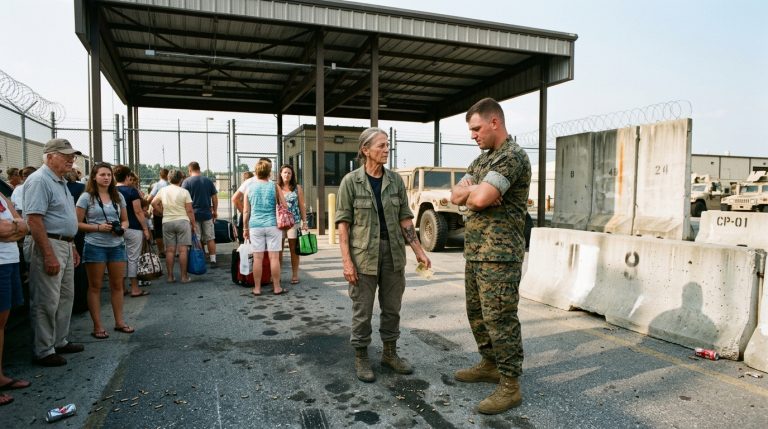
The heat shimmering off the asphalt at the Naval Amphibious Base Coronado was a physical weight, thick with salt and the distant, rhythmic chanting of a BUD/S class running through the sand. For Rachel White, the sound was an echo of a decade prior—a phantom frequency that lived in the marrow of her bones.
Petty Officer Davis loomed in front of her, his youthful face twisted into a sneer of performative authority. He held her retired Department of Defense credential as if it were a counterfeit bill, his eyes fixed on her forearm with a predatory focus. The trident tattoo, its ink faded by years of sun and saltwater, seemed to pulse against her skin as he leaned in.
“This little piece of plastic isn’t a golden ticket,” Davis scoffed, his voice echoing off the guard shack. He glanced toward Miller, his partner, looking for approval in the casual cruelty of the moment. “Spouse’s dependents have to use the main visitor center.”
Rachel felt the familiar, cold stillness wash over her. She did not raise her voice. She did not offer the defense they were fishing for. She simply stood, her posture relaxed yet coiled, her gaze fixed on the iconic Naval Special Warfare Center sign rising against the impossibly blue California sky. Every muscle in her body was a testament to twenty-four years of service, to the eight deployments where the stakes were measured in heartbeats and IED wires, not bureaucratic gate access.
“I’d appreciate it if you’d scan the card,” she said, her tone steady, devoid of the impatience he sought to provoke. “It’s in the system.”
Davis’s hand trembled slightly as he snatched the card back, his smirk deepening into a mask of triumph. He swiped it through the reader, waiting for the red light that would cement his narrative. When it flashed, he turned back, chest puffed, ready to deliver his verdict.
“Access denied,” he declared, the triumph ringing hollow against the silence that had suddenly descended on the area. The other sailors who had gathered, drawn by the scent of drama, fell quiet, their expressions shifting from amusement to an uneasy, simmering tension.
Rachel held out her hand, but as Davis moved to pull the card away, his finger brushed against the eagle’s wing on her forearm.
The contact was an electrical shock. The world of the Coronado gate dissolved into a fine mist. The smell of salt vanished, replaced by the acrid, heavy tang of ozone and cordite—the metallic perfume of an Afghan night. She was no longer on pavement; she was kneeling in grit that worked its way into her gloves, the sound of a drone humming high above, and the voice—Michael’s voice—achingly close, steadying her.
Easy, Ra. Steady hands. Just like we practiced.
The flash of lightning snapped, leaving her back on the asphalt, the heat of the California afternoon pressing down on her shoulders. Her jaw tightened, the only outward sign of the crater that had opened and closed inside her. She felt the heavy, rhythmic thrum of a convoy approaching from the base—not a routine sound, but one of urgent, calculated precision. She did not look behind her, but she felt the arrival of the command team like a shift in the gravity of the room, and she knew the silence was about to be broken in a way these young men would never recover from.
CHAPTER 2: The Weight of the Starched Collar
The ride to the headquarters building was a masterclass in suffocating silence. Commander Evans sat in the front passenger seat, his posture rigid, a statue carved from granite and indignation. Rachel occupied the backseat, flanked by the command master chief. Outside the tinted windows, the base blurred by—a sun-drenched landscape of gray concrete and lush, watered grass that felt more like a movie set than the place she had once called home.
She watched the passing world with a detachment that unnerved her. She wasn’t angry at the two sailors; their ignorance was a symptom of a larger, systemic thinning of memory. She was angry at the exhaustion that dragged at her own limbs, a weariness that had nothing to do with travel and everything to do with the fact that she was here, breathing the air, while the world moved forward, discarding the past as if it were a worn-out uniform.
When the vehicle pulled to a sharp stop in front of the headquarters, the gravel crunched under the tires with the finality of a gavel. Evans exited immediately, not waiting for his aide to open the door. He walked with a rhythmic, measured cadence that signaled a man who had already decided the outcome of the coming minutes.
“Master Chief,” Evans said, not turning back as he strode toward the entrance. “My office. Ten minutes. I’m going to make some calls.”
He didn’t apologize for the hurry. He didn’t have to. The headquarters building smelled of stale coffee, industrial floor wax, and the hum of servers—a scent profile so distinctly “Navy” that it triggered a sudden, unwanted memory. Rachel found herself back in a briefing room in 2012, the walls covered in topographical maps and satellite overlays, the air thick with the smell of wet sand and nervous energy. She could see Mikey’s hands as he traced a route, his movements precise, his focus absolute. The way he had tapped her shoulder, a silent promise that they would both make it back, was so vivid she actually felt the phantom pressure on her shoulder blade.
She blinked, the lobby of the headquarters snapping back into focus. The sharp, clean light of the high-ceilinged room felt intrusive.
“Master Chief?”
The command master chief was standing near the door, his expression softened by an empathy that was almost harder to bear than the hostility at the gate. He was an older man, his eyes holding the same weary geometry as her own.
“They’re going to give you hell, the higher-ups,” he said quietly, his voice a gravelly murmur meant only for her. “The optics are bad, but not for you. They’re bad for the command. You’re the loose thread, Rachel. You make the new guard look like children playing soldier.”
Rachel smoothed the front of her red jacket. The fabric was soft, frayed at the collar—a sharp contrast to the starch of the uniforms passing them by. “I didn’t come here to be a thread, Master Chief. I came to visit the memorial. I’d still like to do that.”
“You will,” he promised. “But Evans wants to talk. He’s going to offer you a formal apology, maybe a commendation. He’s going to try to fix it, but he can’t fix what those kids actually thought. They didn’t see a hero. They saw a civilian in a costume.”
“That’s the problem,” Rachel said, her voice dropping to a register of calm, unyielding bedrock. “They didn’t see the insignia. They saw their own projection. If we want them to learn, we don’t need a ceremony. We need them to understand that the badge isn’t the person.”
As they entered the inner sanctum of the headquarters, Rachel noted the way the junior officers turned, their eyes skimming her civilian clothes before hitting her face and lingering, confused. There was a dissonance in their reactions—the contrast between her unassuming appearance and the way the command master chief deferred to her, treating her with the gravity reserved for a flag officer.
She moved through the halls, her footsteps silent compared to the military boot-clack of the corridors. Every step was a negotiation with the ghost of who she used to be. She felt like a specter, a remnant of a time when the base meant something different—when the mission was the only thing that mattered and the lines between the living and the dead were blurred, tactical considerations.
Evans’s office was waiting. The door was open, and through the gap, she could see him on the phone, his back to the room, his shoulders tight enough to snap. He was fighting a war on her behalf, but she wondered if he understood that she had already lost the war she actually cared about. She wasn’t here for justice. She was here for a goodbye that had been ten years in the making. She stepped toward the doorway, prepared to explain that while the apology was appreciated, it was the silence she needed most.
CHAPTER 3: The Granite Echo
Rachel did not cross the threshold into Commander Evans’s office immediately. Instead, she paused, her hand hovering near the doorframe, sensing the tension radiating from within. Evans was still on the phone, his voice a low, rhythmic grumble of command, and the Command Master Chief stood sentinel a few paces behind her.
“Master Chief,” Rachel said, not turning to face him. “If I take this apology, does it change the culture, or just the optics?”
The older man sighed, a sound of profound structural fatigue. “It changes the day, Rachel. The culture is a slow-moving freighter. You don’t turn it with a single speech. You turn it by remaining visible.”
“I don’t want to be visible,” she whispered. “I just wanted to be a visitor.”
The irony wasn’t lost on her. She had spent a decade trying to dissolve into the quiet, colorless existence of a civilian, shedding the heavy armor of her identity piece by piece. But the base, with its relentless, cyclical nature, was a magnet for the past. She turned away from the door, a sudden, sharp clarity overriding her hesitation. The apology could wait. The memorial, however, existed in a state of eternal, suspended waiting.
She walked away from the office, her gait steady and deliberate. The Command Master Chief started to follow, but she held up a hand, a gesture of absolute, unarguable boundary. “I need this space alone, Master Chief.”
He hesitated, then bowed his head once. He knew the look of a person who had spent too many years walking through minefields; they didn’t need escorts. They needed the room to breathe.
Rachel exited the building and headed toward the memorial garden, a pocket of stillness tucked behind the barracks. The air here was drier, scented with the faint, sweet perfume of bougainvillea and the ozone of the coast. The memorial was a simple, brutalist structure of polished black granite, its surface reflecting the sky and the shifting shadows of the palm trees.
She approached the wall, her fingers tracing the names. They were etched with a precision that felt surgical, a permanent record of fleeting lives. Her skin felt cool against the stone, a stark contrast to the burning California sun. As she traced the letters of Michael’s name, the world seemed to narrow until there was only the cold granite and the persistent, throbbing pulse of her own blood.
Click.
The chime of a memorial bell from a distant chapel—or perhaps the base clock-tower—rippled through the air, vibrating in the hollow space behind her ribs. It was a simple, mechanical sound, but it caught her off guard, a butterfly detour in her mental landscape. She pulled her hand back as if burned.
She wasn’t alone. She could feel the gaze of others—not the hostile, performative judgment of the gate guards, but a heavier, more complex curiosity. She didn’t look up immediately. She stood in the shadow of the granite, forcing herself to regulate her breathing, to count the seconds between the wind-rustle in the palm leaves.
“Master Chief White?”
The voice was unfamiliar, yet imbued with the distinct, clipped cadence of a veteran. She turned slowly. A woman, older, her hair streaked with silver and tied back in a severe, practical knot, stood a few yards away. She was in civilian clothes, but the way she held her bag, the way her feet were planted—she was military to the core.
“I’m retired,” Rachel said, her voice sounding thin to her own ears.
“We’re all retired, Rachel,” the woman replied, moving closer. She didn’t offer a name, only a nod toward the wall. “I was in the EOD tech unit at Team 6. I heard about what happened at the gate. The base is buzzing. You managed to rattle a lot of cages in about fifteen minutes.”
“That wasn’t my intent.”
“Intent doesn’t matter,” the woman said, stopping beside her. She looked at the granite, her expression unreadable, a map of experiences she had clearly paid a high price for. “The system is rigid. It hates anything it doesn’t recognize. When you showed up, you didn’t look like what they were told to expect. That’s the most dangerous thing you can be here.”
Rachel looked back at the wall. The decoy of the situation—the “stolen valor” drama—felt increasingly small, a minor scuffle in the grand, weary march of her life. The true secret, the one that hummed beneath her skin, was that she wasn’t just here to visit a memorial. She was here to see if she could stand in the light of the life she had left behind without being consumed by it. She was testing her own boundaries, gauging whether the trauma was still a volatile, unexploded device or if it had finally been rendered safe.
“Why are you here?” Rachel asked, finally meeting the woman’s eyes.
“To make sure you didn’t leave,” the woman said. “There’s a shift happening. Evans is terrified that the institutional memory is eroding. He doesn’t need a visitor today. He needs a witness. And whether you like it or not, you’re the most credible witness we have left.”
The woman left as quietly as she had arrived, leaving Rachel in the cool shadow of the wall. She looked down at her forearm, at the trident that seemed to pulse in the midday light. She realized then that the decoy—the gate confrontation—was merely the trigger that had forced her back into the field. The real challenge was not the petty officers or the systemic failures; it was the work of reclaiming a legacy that had been forced into the darkness. She took a deep breath, the scent of the bougainvillea mixing with the cold stone, and started to walk, not toward the headquarters, but toward the periphery of the base, where the memories were raw and the horizon was wide enough to hold them all.
CHAPTER 4: The Commissary Collision
The walk from the memorial to the base commissary was a descent from the ethereal into the aggressively mundane. Rachel’s mind, still vibrating with the names on the granite wall and the woman’s cryptic warning, was ill-prepared for the sensory assault of the facility. The commissary was a cavern of fluorescent humming, the air thick with the scent of floor cleaner, industrial-strength coffee, and the overwhelming, plastic-wrapped abundance of a base that felt increasingly like a museum of her own history.
She moved through the aisles, her hand brushing against the cold plastic of a grocery basket, trying to maintain the equilibrium she had found in the garden. She was halfway through selecting items for her flight home when she turned a corner into the snack aisle and stopped.
Petty Officer Davis was there.
He was not in the crisp uniform he had worn at the gate. He was dressed in the stained, utilitarian coveralls of a groundskeeping crew, his shoulders slumped with a heavy, uncharacteristic fatigue. He was stocking shelves, moving with a mechanical slowness that suggested his world had been significantly diminished since the incident.
When he saw her, he froze. A plastic bag of snacks slipped from his hand, hitting the linoleum with a dull thud. For a heartbeat, the commissary seemed to vanish. There was only the aisle, the hum of the overhead lights, and the raw, unfiltered shame radiating from the young man.
Rachel didn’t look away. She didn’t offer a nod or a gesture of forgiveness. She simply stood, her presence a weight that seemed to bend the air between them. Davis’s face went through a frantic series of permutations—fear, defensive hostility, and finally, a hollowed-out, pathetic sort of resignation.
He took a hesitant step toward her, his movements jerky, uncoordinated. “Master Chief,” he whispered, the title now stripped of its mocking tone. He looked down at the floor, then forced his eyes to hers. “I… I’ve been reassigned. My clearance… it’s under review. They’re talking about a discharge.”
Rachel watched him, searching for the arrogance that had fueled his performance at the gate. It was gone, replaced by the bruised ego of a kid who had finally realized that the rules he thought he was protecting didn’t care about his version of the story. She felt a flicker of something—not pity, but a cold, clinical understanding. The system he served was designed to break people who didn’t fit, and he was currently experiencing the machinery firsthand.
She glanced at the shelf he was stocking. It was a chaotic mix of items, but among the boxes, she saw a stack of outdated logistics manifests—paperwork that shouldn’t have been in a public area, let alone handled by a grounds crew. It was a minor, procedural irregularity, but in a base that prided itself on precision, it stood out like a crack in a windshield.
“You’re making mistakes, Petty Officer,” she said, her voice neutral, cutting through the hum of the room. She pointed to the misplaced manifest. “You’re off-task. That doesn’t help your case, and it doesn’t help the command.”
Davis followed her gaze, his face flushing a deep, mottled red. He scrambled to grab the papers, his hands shaking. “I… I’m sorry. I’m just—I’m not thinking straight.”
“That’s the problem,” Rachel said, stepping closer. The air felt thin, the sterile light intensifying the lines on his face, the fraying edges of his coveralls. “You spent your energy trying to gatekeep a legacy you didn’t understand. Now, you’re trying to survive the fallout of your own arrogance. You think the issue is the gate? The issue is that you stopped looking at the people in front of you.”
“I just wanted to do it right,” he muttered, the words barely audible. “I wanted to be one of the ones who protected the trident.”
“Then stop trying to protect it,” Rachel said, the coldness in her voice deepening. “The trident doesn’t need your protection. It needs you to be better than the bias you were taught.”
She turned away, but as she started to move past him, he reached out, his hand hovering near her sleeve before pulling back as if he had been shocked.
“Why are you here?” he asked, his voice trembling. “They said you were coming to report me. They said you were the one who made the call to Evans.”
Rachel stopped. She didn’t turn back. “I didn’t make the call, Petty Officer. Your own cruelty did that. I was just the person standing in the way of it.”
She walked toward the checkout lanes, the weight of the interaction pressing down on her. She had come here for closure, for a quiet departure, but the base wouldn’t let her go. Every corner she turned, every interaction she had, was pulling her deeper into the machinery of the command. The systemic disconnect she had witnessed at the gate wasn’t an accident; it was a feature. And as she reached the register, the realization hit her—she hadn’t just rattled the cages; she had exposed the fact that the entire structure was built on a foundation of shifting, unexamined sand. She felt a new, urgent need to find Commander Evans, not for the apology, but to ask him what he intended to do about the cracks that were beginning to widen.
CHAPTER 5: The Architect of Memory
Rachel bypassed the main desk, her walk deliberate, each footfall echoing in the quiet hallway with the weight of a decade’s worth of unspoken demands. She didn’t need to ask for access; she was already here, a ghost in the machine, and the younger officers she passed parted instinctively, sensing the shift in the air that her arrival brought.
She reached Commander Evans’s office, the door standing slightly ajar. Inside, the light was clinical, a harsh, unforgiving fluorescent glow that bleached the color from the maps pinned to the walls. Evans was sitting behind his desk, his head in his hands. Opposite him, his aide—the sharp, young lieutenant who had been part of his arrival team—was pacing, her expression a mask of panicked motion.
The aide stopped when she saw Rachel, her hand going to the edge of the desk, her knuckles white. “Master Chief,” she said, her voice strained, verging on frantic. “You shouldn’t be here. The Commander is in the middle of a—of a situation.”
Rachel didn’t stop. She pushed the door open, the sound of the hinge a sharp, metallic bite in the room. “The situation is why I’m here, Lieutenant. I saw the logs at the commissary. Outdated manifests, procedural gaps, and kids like Davis being left to play soldier without the guardrails of experience. You aren’t just losing memory here. You’re losing the ability to tell the difference between a mission and a performance.”
Evans looked up. His eyes were red-rimmed, the exhaustion of the past few hours etched into the deep lines of his face. He didn’t look like a legend anymore. He looked like a man trying to hold up a ceiling that was slowly collapsing.
“I know, Rachel,” he said, his voice a low, raspy gravel. “The systemic rot is deeper than I thought. I’ve been trying to force a correction, but the inertia of the last few years… it’s like trying to turn an aircraft carrier with a rudder made of glass.”
“You’re trying to turn it with memos,” Rachel said, her voice hitting the room with the force of an indictment. She walked over to his desk and placed her bag down, the plastic crinkling loudly in the silence. She reached out and tapped the pile of paperwork he had been reviewing. “These aren’t just logs. These are the symptoms. You want to fix the culture? Stop looking at the top-down and start looking at the gaps between the rungs. The kids at the gate are just the ones who got caught.”
The aide, the lieutenant, took a sudden, erratic step toward the desk, her movements jerky, her breathing shallow. “It’s not just the gate, Master Chief! There’s a directive coming down—a reorganization of the support units—that’s going to strip the EOD teams of their remaining autonomy. They aren’t just forgetting the history, they’re deleting the evidence of why it matters!”
The room went still. The Lieutenant was trembling, her hand fluttering toward a stack of restricted files. The, “decoy” secret—the idea that the gate harassment was an isolated case of bad behavior—was officially dead. It was a planned, deliberate erasure.
Evans didn’t move. He sat there, staring at the files, his posture one of complete, defeated clarity. “I was told to implement the transition by the end of the week, Rachel. I didn’t want to tell you because I knew it would be the final nail.”
Rachel looked at the Commander, then at the lieutenant, then back at the files. The emotional reality of her journey—the need to forgive herself for surviving—crystallized. She hadn’t come back to Coronado to mourn the past; she had come back to realize that the fight didn’t end with the mission. It ended when the service lost the ability to honor the people who had built it.
“You aren’t going to implement the transition,” Rachel said, her tone absolute, a command forged in the fires of Fallujah and Helmand. She felt a surge of energy, a kinetic, grounded power that had been dormant for years. She realized then that she hadn’t come here to walk away into peace. She had come here to anchor the truth, one last time.
She leaned over the desk, looking Evans directly in the eyes. “Give me the log access. If you want a witness, Commander, I’m done watching from the sidelines. Let’s show them exactly what happens when you try to erase the foundation of this command.”
The room hummed with the weight of her demand. The Lieutenant, caught in the wake of the moment, let out a shaky, desperate breath, her panic replaced by a fragile, sudden hope. Evans looked at Rachel, his eyes searching hers for a flicker of doubt, finding only the hard, unyielding bedrock of a Master Chief who was finally ready to complete the last mission she had ever been given.
CHAPTER 6: The Final Horizon
The cursor on the terminal blinked with a steady, rhythmic pulse—a mechanical heartbeat that seemed to count down the seconds of the institution’s artifice. Rachel’s fingers, steady and calloused, moved across the keyboard with the same efficiency she had once used to strip a detonator. She wasn’t looking for a scandal; she was looking for the paper trail of the reorganization, the bureaucratic skeleton of the plan to dismantle the legacy she and Michael had helped build.
“It’s not just a reorganization,” she said, her voice quiet but resonant in the cramped, air-conditioned office. “It’s a deliberate sanitization. They’re folding the EOD assets into general maintenance. They aren’t just cutting the budget; they’re erasing the operational history. If these units don’t exist as specialized entities, the people who served in them, the ones who didn’t come back, become footnotes.”
Evans stood at the window, his silhouette dark against the encroaching twilight. “I couldn’t stop it, Rachel. I was part of it, in a way. I was the one who kept the files moving, who prioritized the readiness reports over the personnel.”
“You weren’t the one who made the choice to erase the past,” Rachel said, pulling a printout of the final directive from the printer. The paper was warm, smelling faintly of toner and ozone. She walked over to the desk and laid it out. “But you’re the one who has to decide if you’re still a commander, or just a clerk.”
The revelation of Layer 2—the deep, jagged truth—hit her with the force of a physical impact. She hadn’t been fighting the memory of Michael’s death; she had been fighting the erasure of the meaning behind it. She had been punishing herself for surviving, believing that if she let go of the pain, she was losing the last tether to him. But the truth, clear and cold as the granite wall at the memorial, was that she had survived to be the witness. That was the debt she owed—not to die with him, but to ensure that what they had done meant something.
“I’ll leak it,” Evans said, his voice stripped of all command pretense. It was the voice of a man who had finally reached the end of his rope. “To the oversight committee. To the families of the fallen. If this goes public, the reorganization will be scrapped. But it will end my career, Rachel. It might be the end of this command.”
“Then let it end,” Rachel said. “Let it be rebuilt on something that isn’t a lie.”
The standoff lasted only seconds, but in that time, the office—the place of budgets, directives, and cold efficiency—transformed. It became a theater of accountability. Evans didn’t reach for the phone to call his superiors. He reached for the secure line to the committee, his hand steady.
The aftermath came not as a crash, but as a slow, deliberate settlement. In the days that followed, the base shifted. The directive was pulled, the reorganization was put under investigation, and the gate protocols were rewritten with the input of those who had actually walked the line.
Rachel returned to the memorial on her final evening. The light was golden, catching the dust motes in the air and turning them into shimmering, floating light. She stood before the wall, the silence of the garden a balm rather than a burden. She reached out and touched the name—Michael. The name was no longer a wound. It was a point of reference.
She felt the cool granite under her fingertips, and for the first time in ten years, she didn’t feel the phantom weight of the desert air. She felt the warmth of the California sun. She reached into her pocket and pulled out a small, worn stone she had carried since that final mission—a talisman of guilt she had been unable to discard. She placed it at the base of the wall.
It wasn’t a repair of the past, but a closing of the account. She had survived. She had stood the ground. And as she turned away from the wall, the shadows of the palms stretched out before her, long and steady, leading toward the gate. She didn’t look back. She walked toward the horizon, the faded trident on her arm no longer a badge of mourning, but a quiet, enduring mark of a life that was finally, truly, her own.