The Concrete Silo At Carentan Where A Wisconsin Farm Boy Turned Vertical Elevation Into Silent Tactical Survival
CHAPTER 1: THE HOLLOW SILENCE
The wind didn’t carry much over the ruined fields outside Carentan, just the low rattle of diesel engines and the flat, wet snap of rifle fire three miles to the south.
I kept my thumb hooked in my belt loop, feeling the coarse weave of wool against a calloused knuckle while I stared down through the crack in the stone foundation.
Down in the mud near the hedgerow, Private Kowalski was already cold, though the sun hadn’t cleared the apple trees yet.
We’d shared a bunk in Dorset and played pitch with grease-stained cards until midnight, but he didn’t last forty seconds when the high-velocity round caught him below the collar.
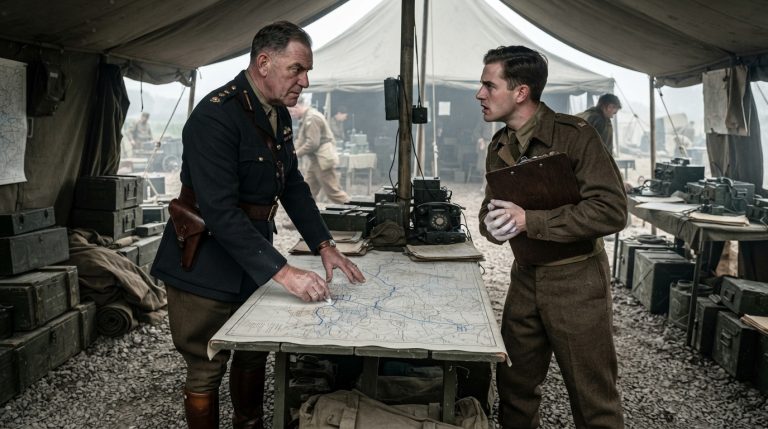
Lieutenant Freeman slumped against the wagon wheel fifty yards off, his head turned at an angle that told you everything was over before the smoke cleared from the second-floor window across the lane.
The German officers knew how to use the high ground, stacking themselves in church steeples and barn lofts where our tanks couldn’t elevate and our infantry couldn’t reach.
Our doctrine was built for flat ground and broad daylight, shouting orders across open fields while invisible marksmen picked off the radios and the leaders one by one.
It wasn’t a war anymore; it was an arithmetic problem where the other fellow held all the chalk.
I turned my back on the window and looked out across the valley toward the empty dairy farms, where the tall concrete cylinders rose up against the gray sky like forgotten grain silos back home in Sheboygan County.
Back home, those tubes meant forty feet of dark, suffocating labor with a sledgehammer and a prayer that the fermented corn wouldn’t shift and bury you alive.
Nobody in West Point ever spent a Tuesday afternoon breaking up clogged silage in the July heat, but they didn’t know the difference between a tactical hill and a thirty-foot feed storage tube either.
The metal snips in my pocket felt heavy against my thigh as I stepped out past the shattered doorframe and started walking north toward the abandoned concrete.
CHAPTER 2: CLIMBING INTO THE DARK
A cold thumb pressed hard against the hinge of the rusted tin snips while I wedged my boot onto the next greasy rung of the ladder.
Thirty-two feet of vertical concrete didn’t leave much room for hesitation when the morning wind started howling off the marshes.
I hauled my pack up behind me with a frayed hemp rope, listening to the heavy rattle of the canteen bumping against the rungs like a stray pebble in a tin bucket.
The hatch at the top gave way with a dull, popping suction, smelling instantly of dry oats, mouse droppings, and decades of forgotten harvest.
I dropped through the narrow opening headfirst, my shoulders scraping the rough aggregate until my boots hit the wooden flooring in total blackness.
The air inside was thick and still, heavy enough to chew, holding onto the previous afternoon’s heat like a woodstove with the damper shut.
I didn’t light a match because the Germans three miles down the road weren’t stupid enough to miss a flicker in an abandoned landscape.
Instead, I felt my way along the curved concrete wall until my fingers caught the edge of the ventilation slot cut high above the orchard side.
The metal here was thinner, but it still resisted every inch of the snips, forcing me to lean my whole weight against the bulkhead while my knees screamed from the climb.
Outside, a stray truck engine choked and died on the gravel track near the church, followed by the sharp, metallic slam of a staff car door.
I didn’t need to look through the glass to know what they were doing down there, mapping out defensive sectors and scratching lines on greaseproof paper.
They thought the high ground belonged to whoever could stack the most sandbags in a bell tower or a slate-roofed barn.
They never imagined a dairy farmer would look at a feed storage tube and see a front-row seat to their entire command structure.
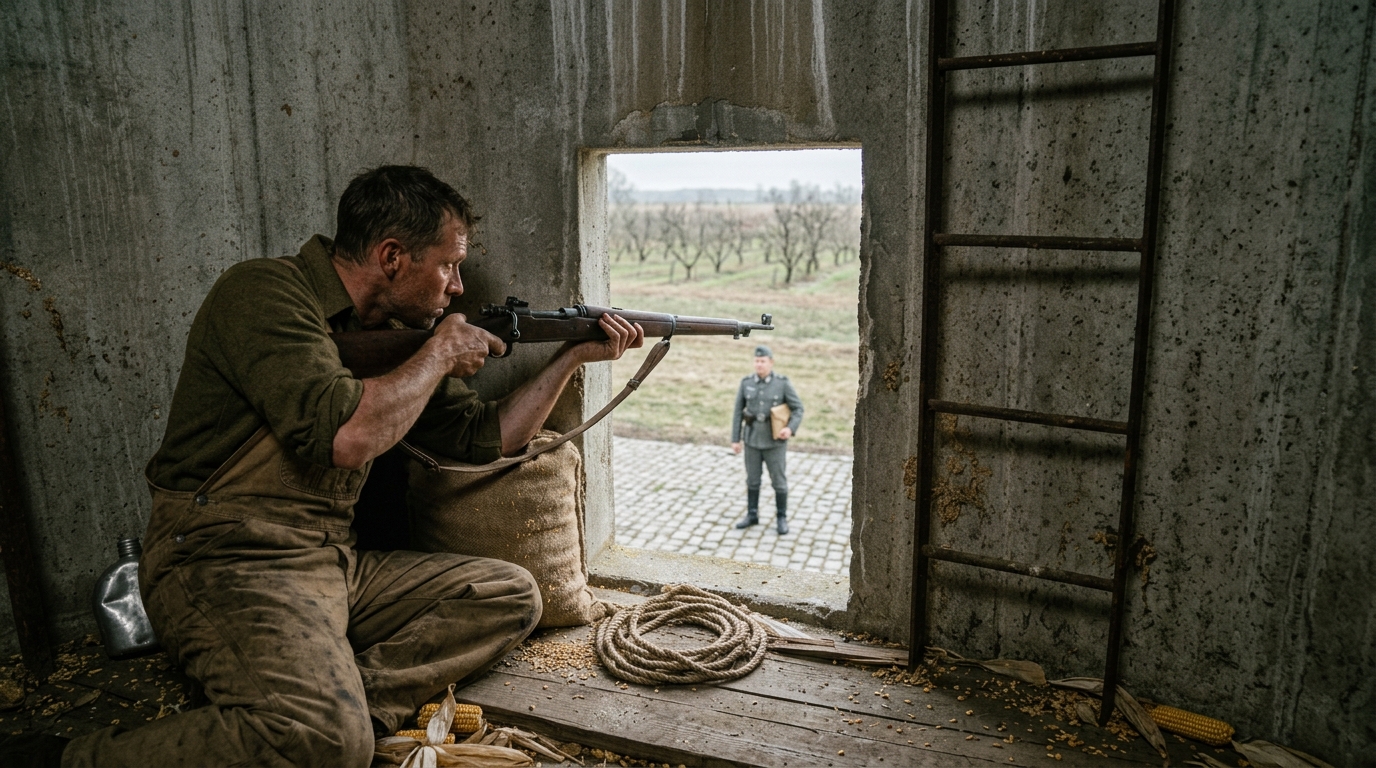
I slid the Springfield muzzle through the widened slot, resting the walnut stock against a burlap sack filled with dry sand.
The iron sights were dark against the gray morning sky, lacking the clean, bright magnification of the long-range glass left back at the supply depot.
I’d have to rely on the old geometry, the kind my uncle taught me when we cleared out groundhogs behind the north pasture at a hundred yards with open sights.
A shadow moved across the paddock below, pausing right beside the pump house where the German officers liked to gather for their morning coffee.
CHAPTER 3: ADJUSTING THE ANGLE
The sun climbed over the ridge like a heavy iron plate, baking the corrugated concrete until the air inside smelled of scorched dust and old corn husks.
I wiped a sleeve across my forehead, smearing salt and grit into the rough wool while the rifle barrel ticked as the metal expanded in the heat.
At a forty-degree downward angle, the old ballistics tables weren’t worth the paper they were printed on; gravity had a different idea when you were shooting straight down a vertical shaft.
I pulled the small notebook from my breast pocket, flipping past the grocery lists from Sheboygan to a page covered in pencil marks and scratched-out fractions.
Every inch of drop at eight hundred yards meant adjusting three inches right to account for the cross-breeze drifting off the marshland.
Outside the widened ventilation slot, a German corporal in a stiff gray tunic stepped out onto the cobblestone apron, holding a brass map case under his arm.
He didn’t look up, because men who live on flat ground never expect the sky to bite them.
I braced my left elbow against a burlap sack filled with dry feed, feeling the coarse fibers dig deep into the meat of my arm.
The iron bead on the muzzle danced three inches to the left of the corporal’s tunic button before I slowed my breathing down to a crawl.
Back home, my uncle used to say you don’t chase a groundhog across the yard; you wait until it stands up straight and forgets it’s a target.
The corporal stopped by the well curb, turning his head to shout an order toward the barn where the mortar crew was cursing at a jammed cart axle.
CHAPTER 4: THE FIRST COMMAND TARGET
The heavy bolt clicked home with a flat, dry snap that echoed softly inside the confined concrete walls.
Below, the German corporal stumbled backward against the stone well curb, clutching at his chest where the heavy-caliber round had found its mark through open air.
Two junior enlisted soldiers dropped their supply crates in the dirt and dragged their wounded superior into the dark shadow of the barn doorway.
They didn’t look up at the silo because men who spend their lives looking across fields never think to check the sky.
I cycled the smoking brass casing out of the chamber, catching it neatly in my calloused palm before it could ring against the wooden floorboards.
There was no room for celebration up here in the dark, only the steady buildup of heat and the lingering smell of dust and rancid linseed oil.
The command structure down in the valley was already starting to fray at the edges, reacting to the sudden loss of leadership with frantic, uncoordinated shouting.
A sergeant in an unbuttoned field jacket sprinted out of the headquarters shed, waving his arms wildly toward the eastern hedgerows.
He thought the fire was coming from the infantry lines three miles away, completely blind to the vertical elevation hovering right over his own courtyard.
I rested my cheek against the cold walnut stock again, sliding the iron notch into alignment with the center of the sergeant’s belt.
Back in Sheboygan, my father always said you don’t fight a stubborn bull by pushing back against its horns; you wait until it steps into its own fence line.
CHAPTER 5: THE DESPERATE COUNTERSWEEP
Heavy boots crunched across the gravel courtyard below as three armed patrols fanned out through the ruined orchard to scour the perimeter.
They kicked open rotting stable doors and smashed rifle butts against empty chicken coops, desperate to locate the phantom firing position that was tearing their command apart.
A junior officer with a red face screamed orders at the wall, demanding to know how any marksman could hit targets from an open field without a trace of smoke.
I crouched lower in the suffocating dark, pressing my back flat against the cold concrete while a stray boot heel scraped against the exterior base of the silo.
They were searching every horizontal space within a half-mile radius, turning over wagon beds and probing haylofts with fixed bayonets.
Yet not a single man tilted his chin upward to look past the rusted ladder rung where the old feed tube met the open sky.
Agricultural infrastructure didn’t fit into their tactical manuals, and that blind spot was about to cost them their last remaining line of communication.
The shouting outside intensified as the patrol leader slammed his fist against the corrugated steel door, insisting the Americans must be using an underground tunnel system.
I wrapped my fingers tighter around the wooden stock of the Springfield, waiting for the frantic energy below to burn itself out against the unyielding stone.
CHAPTER 6: THE LONG RETURN
The final echo of boots died away down the overgrown wagon trail as the remaining patrols withdrew toward the main column.
They left behind a shattered command structure and a countryside that finally belonged to the earth instead of their arrogance.
I cycled the last empty brass round from the chamber, letting it drop into the dark grain dust on the floorboards with a dull, heavy clink.
There were no medals waiting at the command post, and Captain Henshaw didn’t ask any questions when I tossed the logbook back onto his camp table.
We walked back through the Allied lines under a gray evening sky that smelled of wet clover and wood smoke from the field kitchens.
History would write it down as improved tactical doctrine and better training manuals, attributing the victory to modern military planning.
They could keep their ink and paper because a dairy farmer knows that a harvest isn’t made by the registry office, but by what you do when the bin is full.
Forty-two years later, back on the eighty acres in Sheboygan County, the sun sat low over the north pasture while the milking cows lined up at the gate.
My hands were thick with calluses from fence wire and shovel handles, and the old trophy from 1937 still sat quietly on the mantel collecting dust.
When my daughter asked me what the war was like, I didn’t tell her about the silos or the high ground or the twenty-three notches in my memory.
I just handed her the metal milk bucket and told her the cows needed milking before dark.