The Weight of Steel: A Fragile Descent Above the Shattered Landscape of Occupied Yugoslavia
CHAPTER 1: THE VAPORIZED HORIZON
The 88mm shell didn’t strike the Mispa so much as it erased the future.
One millisecond, Evald Swanson was commanding a machine of aluminum and heavy ordinance; the next, the front third of his world simply vanished. There was no sound of tearing metal, no crunch of impact. Just a blinding, instantaneous roar—a white-hot shockwave that turned the navigator’s station, the Norden bomb sight, and the very air in front of his face into an expanding cloud of plexiglass confetti and pulverized bone.
The yolk of the control column, moments ago a firm, reassuring weight in his grip, was now nothing more than a ragged steel pipe severed at the floorboard.
Swanson’s body jerked forward, restrained only by the stiff webbing of his harness. The wind slammed into him, a solid, brutal wall of negative-forty-degree air that shrieked through the now-open cavity of the fuselage. It wasn’t just cold; it was predatory, clawing at his flight suit, trying to pull him forward into the void where his nose had been.
He didn’t blink. He couldn’t. His eyes were locked on the horizon—the one that used to be framed by a reinforced glass windscreen, now a raw, jagged aperture that jittered with the dying spasms of the aircraft.
Shift. Compensate.
The Mispa pitched. The sudden loss of the nose—the heavy machinery, the internal weight that anchored the bomber’s flight profile—sent the craft into a violent, nose-up lurch. It was an aerodynamic death rattle. The stall warning was irrelevant; the plane was already trying to dance on its own tail.
Swanson didn’t reach for a missing lever. His hands flew to the throttle quadrant—the only mechanical remnants left on the scarred console. He shoved them forward. The three remaining Cyclone engines roared in protest, a symphony of overworked pistons and screaming turbines. He wasn’t flying an airplane anymore; he was wrestling a dying beast, coaxing the wings to generate lift from raw, desperate inertia.
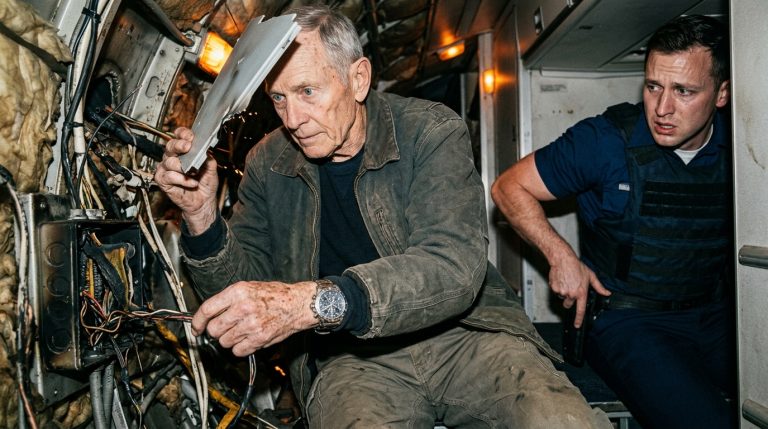
Behind him, through the jagged hole in the bulkhead that had once been the tunnel to the bomb bay, he saw movement. His crew, the men who had been working their stations just seconds ago, were now ghost-like shapes moving through a gale. They were clutching bundles of wire—steel cables that whipped and lashed in the wind like exposed nerves.
He didn’t need to turn around to know what they were doing. He could feel the difference in the rudder response, a slight, trembling correction that shouldn’t have been there. They were pulling. They were holding the flight surfaces of his shattered bird together with their own blistered palms.
He looked down at his own feet. The rudder pedals were static, dead weight bolted to the vibrating floor. But the plane was still tracking, ever so slightly, toward the southwest.
He glanced to his right. Second Lieutenant Paul Burnt sat in the co-pilot seat, his hands raised, hovering over a void. Burnt’s face was a mask of grey shock, his eyes fixed on the flapping, exposed remnants of the control cables.
Then, Swanson saw it—a flickering piece of metal near the floor of the bomb bay, rhythmic and wrong. It wasn’t a loose piece of debris. It was a rhythmic snapping, a distinct mechanical groan that pulsed through the frame of the plane, timed precisely with the buffeting wind.
The tail section was flexing. The explosion hadn’t just taken the nose; it had compromised the spine of the entire ship. The Mispa was already unzipping itself.
CHAPTER 2: THE EXPOSED VEINS
The aircraft didn’t just vibrate; it shuddered with the rhythmic, agonizing pulse of a wounded animal. Swanson’s hands, gloved and stiff, hovered inches from the throttle quadrant, feeling every tremor that raced from the crippled engines through the floorboards and into his own marrow. To his left, the gaping, irregular tear where the cockpit glass and instrument panel had once sat acted like a vacuum, dragging the heat from the cabin and replacing it with a biting, sub-zero draft that smelled of burnt ozone and ancient, frozen grease.
He caught a glimpse of his own reflection in the side of a fire-extinguisher bracket—a smear of grey against the darkness of the flight deck. He looked like a stranger. The sharp edges of the cabin interior, stripped of paint and exposed to the harsh, thin air of thirty thousand feet, seemed to be closing in.
Steady.
He forced his mind to disconnect from the chaos. Every instinct he’d honed over seventeen missions screamed at him to pull back, to bank left, to find the safety of the formation, but the Mispa was no longer a plane. It was a skeleton. He watched the control cables, three thick bundles of steel wire that snaked back toward the bomb bay. They were slack, then taut, then slack again, dancing to the tune of the wind.
A memory flashed, unbidden and cold: the pre-flight briefing in the Nissen hut at Sterperone. The coffee had been bitter, the maps laid out on the plywood table had seemed so orderly, so predictable. He remembered Dudley, laughing about the weather forecast, his voice a warm, human contrast to the mechanical, biting reality of the present. That version of the world—one where maps dictated movement and engines were reliable—felt like a dream from a different life. Now, there was only the rusted iron, the bite of the cold, and the horrifying awareness that the very structure of his ship was failing.
He didn’t need a gauge to know the Mispa was bleeding altitude. He could feel it in the pit of his stomach, a slow, sickening descent that matched the failing light of the day.
“Burnt!” he barked, but the word was shredded instantly by the gale.
He didn’t need to look. He knew the co-pilot was still there, a silhouette of frozen resolve. They were drifting, the ship’s nose dipping and rising as the crew behind them struggled to manipulate the cables with numbed fingers. The coordination was a clumsy, desperate language. When they pulled the rudder, the ship groaned—a long, deep-seated protest from the fuselage. The stress fractures, spider-webbing across the aluminum skin of the bomb bay, were widening. He saw a rivet pop, a tiny, insignificant star of bright metal disappearing into the slipstream.
The Mispa was unzipping.
Swanson tightened his grip on the throttles. He had to keep the power balance perfect. If he pushed too hard, the torque would snap the weakened frame; if he pulled back, the lack of airspeed would send them into a stall they would never recover from. It was a razor’s edge, a constant recalculation of tension and drag. He focused on the horizon, not the one he wanted to see, but the jagged, uneven line that moved with the ship’s unstable roll.
Every second was a choice between structural integrity and forward momentum. He was the protector of this floating iron coffin, the sovereign of a failing dominion. He had to hold the line, not just for the men, but for the principle of the thing—a desperate, stubborn refusal to let the machine surrender before its time.
The cold was creeping past his leather jacket now, seeping into his joints. His legs felt like lead weights, and his vision was beginning to narrow at the edges, a physiological response to the thin, starving air. But he didn’t look back. He kept his eyes forward, watching the cables, watching the way the ship swayed, waiting for the next tremor that would signal the end.
The Mispa groaned again, a sound like a giant tearing wet canvas. One of the cables sparked as it slapped against the edge of the bomb bay door. Swanson’s jaw tightened. They were running out of time, and the sky, vast and indifferent, waited for them to slip.
CHAPTER 3: THE WEIGHT OF LABOR
The sensation of flight had been replaced by the sensation of holding. Swanson didn’t feel the lift of the wings anymore; he felt the drag of the cables, the physical resistance of the rudder and elevators transmitted through the airframe like a warning pulse. Every time the crew in the bomb bay pulled to counter a gust or a drop in airspeed, the jolt traveled through the floor and up into the soles of his flight boots. It was a chaotic, organic form of piloting that defied every manual he had ever studied.
He kept his gaze locked on the horizon, but the edges of his vision were beginning to play tricks on him. The clouds, dark and bruised with the remnants of the flak barrage, seemed to swirl with an unnatural, hypnotic cadence. Was the plane descending, or was the horizon rising to meet them? He couldn’t trust his equilibrium, so he narrowed his focus to the only things that mattered: the throttle settings and the occasional, sharp glint of the sunlight off the exposed hydraulic lines that snaked through the ruin of his ship.
“Check the bomb bay!” he shouted, though his voice felt distant, as if it belonged to someone else standing at the far end of the fuselage.
He didn’t wait for a response. He leaned into the turn, his muscles aching with the effort of keeping the yoke—the ghost of a yoke—centered. To his right, Burnt was a statue of forced calm. The co-pilot’s eyes were bloodshot, fixed on the starboard engines. The number two engine was a charred husk, oil still weeping from the nacelle in dark, thick rivulets that froze almost instantly in the slipstream, turning into jagged, dark icicles that clattered against the wing’s skin.
The Mispa wasn’t just losing parts; it was shedding its history.
Swanson felt a sudden, sharp lurch as the plane yawed violently to the left. The crew behind him must have slipped. He compensated by slamming the outboard throttle forward, feeling the massive radial engine strain against its mounts. The metal screamed—a high, discordant vibration that set his teeth on edge.
He didn’t dare look back, but he could imagine them: the radio operator and the flight engineer, their hands wrapped in leather and steel, their knuckles white with the strain of holding the plane’s trajectory against the immense, uncaring pressure of the wind. They were the muscles, he was the brain, and the ship was the dying body they were all trying to force to walk one more mile.
A flash of bright, polished metal caught his eye—a tear in the floorboard near the pilot’s seat. It was widening. A small, serrated tongue of aluminum was peeling back, exposing the dark, empty space of the belly of the ship. He looked closer, and for a fleeting, terrifying second, he thought he saw the ground—the distant, muted greens and browns of the Yugoslavian countryside—flashing beneath his feet like a strobe light.
Stay focused.
He pushed the thought away. If he looked too closely at the gaps, if he acknowledged the fragility of the structure, he would lose his edge. This was the Rusted Truth: the plane wasn’t a fortress; it was a cage of tension held together by nothing more than willpower and the physics of the desperate.
He realized then that he wasn’t flying this ship; he was sustaining it. Every adjustment he made was an act of extreme, calculated maintenance. He had to keep the stress distributed evenly across the frame, not allowing the pull on the cables to focus on any single structural member. If they pulled too hard on the elevator, the tail would snap. If they pulled too soft, they would lose the attitude. It was a delicate, violent balance.
A drop of something cold hit his cheek. Not water, but oil—leaking from the damaged instruments somewhere above his head. He ignored it, his concentration locked on the way the plane’s nose dipped. He modulated the throttles, the rumble of the engines changing pitch, and the plane responded with a sluggish, reluctant heave.
He caught Burnt’s eye. The co-pilot nodded, a slow, stiff movement, and then pointed toward the rear. Through the gap in the bulkhead, Swanson saw the flight engineer, Frank, signaling with a frantic wave of his hand. He was pointing at the vertical stabilizer.
Swanson felt his blood run cold. Even without seeing it, he knew what Frank was seeing. The tail was oscillating, a slow, harmonic sway that suggested the main spar was buckling. The structural failure wasn’t coming from the outside; it was coming from within, a slow-motion unraveling of the very steel that held the Mispa together.
He didn’t move. He didn’t look. He just kept his hands steady on the throttles, his eyes glued to the horizon. They were still flying, and as long as they were in the air, the mission wasn’t over. But the definition of ‘mission’ had changed. It was no longer about the refinery or the railway yards. It was about the duration—how long they could keep this broken, rusted collection of parts defying the gravity that was already claiming them.
The cold was no longer a nuisance; it was a companion, settling into the cabin, freezing the condensation on the remaining bulkheads, and turning the Mispa into a flying tomb of iron and ice. Swanson felt a strange, detached clarity. He wasn’t afraid. He was simply waiting. He felt the plane lurch again, a heavy, grinding vibration that resonated through his boots, and he knew—the structure had shifted. The Mispa was losing the fight.
CHAPTER 4: THE TAILS SIGH
The clicking was not the sound of engine failure or the rattling of loose debris. It was precise, measured, and sickeningly rhythmic. Click-snap. Click-snap. It came from deep within the rear fuselage, behind the bomb bay where the tail gunner’s tunnel began. It was the sound of metal protesting under immense, uneven tension, a rhythmic metal-on-metal friction that suggested the load-bearing supports of the empennage were shifting, sliding off their rivets one by one.
Swanson didn’t turn around. He couldn’t. If he broke the line of sight with the forward horizon, he would lose the last bit of leverage he had on the aircraft’s pitch. Instead, he reached out and touched the metal console beside him, feeling the vibration translate through his fingertips. The pulse of the ship felt uneven. The port side was rigid, frozen into a brittle, solid state by the altitude’s unnatural cold, but the starboard side—the side with the dead engine and the shredded wing—was soft, flexible, and utterly exhausted.
“Burnt!” he barked, louder this time, not caring about the wind tearing the sound from his lips. “Check the stabilizer alignment! Now!”
Burnt didn’t hesitate. He unclipped his safety harness, a dangerous move that shifted the center of gravity and caused the Mispa to shudder, the nose dropping an agonizing few inches before Swanson jammed the throttles into a higher power setting. The co-pilot moved with the deliberate, careful fluidity of a man walking on thin ice, clutching the edge of the flight deck bulkhead as he hauled himself toward the crawlway.
Swanson watched the shadow of his co-pilot disappear into the dark tunnel of the fuselage. He felt the ship lighten, then heave, as if the loss of mass were a relief. But it wasn’t. The Mispa was a system of stresses and balances, and every movement, every shifting pound of weight, was an invitation to catastrophe.
He was alone now, save for the ghost of his crew in the bomb bay and the dying, rattling machinery around him. He felt an intrusive, sharp spike of doubt. Was this really flying? Or was he simply presiding over the funeral of a machine, keeping it aloft out of some misplaced, stubborn vanity? The Rusted Truth stared back at him from the jagged hole where the glass had been. It was the truth of entropy. The plane was falling apart not because of the flak, but because it had reached the limit of its mechanical endurance.
The click-snap grew faster, more desperate. It was joined by a new sound: a low, humming vibration that crawled up the legs of his chair. It wasn’t the sound of engines. It was the sound of the entire rear section of the ship trying to tear itself away from the central frame.
He grit his teeth, the cold air making his gums ache. He thought of the briefing again—the way the pilots had joked about the B-17’s legendary resilience, calling it the “Flying Fortress” as if it were an invincible god. They had believed in the metallurgy, the engineering, the sheer, solid mass of the aluminum. They hadn’t understood that when you remove the nose—when you gut the very anchor of the ship—you aren’t just flying a damaged plane. You are flying a structural paradox. The physics that kept the wings producing lift were now actively tearing the tail off. It was a self-consuming cycle.
Burnt scrambled back into view, his face white, his eyes wide with a terror he couldn’t hide. He didn’t speak. He just pointed back at the crawlway, his finger shaking, and then gestured for Swanson to look at the floor.
Swanson glanced down. Between his boots, a crack had formed in the floorboards. It was hair-thin, but as he watched, it opened a fraction, and a sliver of darkness appeared—the open sky below. It wasn’t just a crack; it was a path of least resistance for the entire ship. The fuselage was splitting right down the middle, a clean, logical separation.
The Mispa was tired. It wanted to be two pieces.
Swanson felt a strange, cold calm settle over him. This was the moment. The decoy secret—the idea that they could nurse this thing home—was dissolving. He saw it now, with the crystal clarity of the dying. The tail wasn’t going to hold until the Adriatic. It was going to hold only until the next major pressure shift. And he was the one who had to decide how to spend the remaining seconds of that structural integrity.
He looked at Burnt, whose hands were now hovering over the empty space where the controls should have been. The co-pilot’s mouth was open in a silent question. Jump? The word hung in the freezing air, unsaid but screaming in the silence between them.
Swanson didn’t nod. He didn’t shake his head. He just tightened his grip on the throttles, the rusted, cold metal biting into his palms, and looked once more at the horizon. The clicking behind them slowed, then synchronized into a single, terrifying metallic groan—a sound like the world snapping in half. The ship dipped, then dived.
CHAPTER 5: THE CALCULUS OF LOSS
The world inside the cockpit tilted past the point of recovery. Swanson didn’t have time to process the sensation; he only felt the violent, jarring shift of the floorboards beneath his flight boots. It was as if the ship had been struck by a giant’s hammer. The Mispa didn’t just drop—it pivoted, the severed nose-cavity acting as a pivot point for a downward arc that threatened to turn the entire bomber into a screaming, spiraling bullet.
He didn’t scream. There was no air to waste. He slammed the remaining throttles forward, his fingers bruising against the cold, unyielding metal, forcing the engines to scream in protest. The vibration was immense—the sound of overworked machinery straining against physics.
Beside him, Burnt was gone, having been thrown by the sudden lurch, but Swanson remained locked in his seat, the harness straps digging into his shoulders like teeth. He looked out through the jagged, open hole of the nose. The horizon was spinning, a nauseating blur of grey clouds and dark, jagged peaks that loomed in the distance.
The ship was dying. He knew it with the cold, unfeeling clarity of a mathematician. The tail section, already stressed beyond the capacity of its rivet-lines, was now acting as a drag-anchor, pulling them into a descent they couldn’t possibly climb out of. The “click-snap” had evolved into a constant, hollow thrumming, the sound of metal being stretched until it glowed white-hot in his imagination.
There is no other way.
The thought wasn’t a choice; it was a realization. He had spent the last hour acting as the sovereign protector of this craft, convincing himself that if he held it together long enough, if he maintained the perfect balance of throttle and tension, they would reach the safety of the Adriatic. But the Mispa wasn’t a vessel anymore. It was a weight, a heavy, iron-cold anchor that was going to pull ten men into the dirt of a country that didn’t know them, for a cause that was currently dissolving in the slipstream.
He reached for the emergency release, his fingers fumbling with the frozen buckles of his harness. His heart rate was high, a frantic, drum-like beat against his ribs, but his hands were steady. He was, for the first time, not a pilot. He was a passenger in a disaster he had facilitated.
“Burnt!” he roared, but his voice sounded thin, swallowed by the wind.
He didn’t need to see his co-pilot. He needed to see the sky. He leaned forward, ignoring the way the ship’s frame groaned, and looked back toward the bomb bay. It was a scene of controlled chaos. The remaining crew—those who hadn’t already been lost to the sheer, grinding friction of the descent—were moving. He saw the flash of an orange parachute pack being buckled. He saw a man, the radio operator, standing at the edge of the bomb bay’s open maw, his hand hovering over the release.
They were doing what he hadn’t yet dared to do: they were making the calculation. They understood the Rusted Truth. Survival wasn’t about the plane. Survival was about the distance between their bodies and the wreckage.
Swanson looked down at the throttles one last time. If he cut the power, the Mispa would instantly enter an uncontrollable spin. If he kept it, he might hold it level for another few seconds, buying them the final window they needed to clear the fuselage. The responsibility was a physical weight, heavier than the bomber itself. He was the one who had kept them in this cold, metallic tomb. He was the one who had tried to play God with a machine made of rust and stubbornness.
He moved his hands to the throttles and pulled.
The roar of the engines didn’t die; it shifted, changing from a steady, deep-throated growl to a stuttering, uneven mechanical whine. The plane bucked. The nose dropped, the angle of the descent steepening so violently that Swanson was thrown forward, his head striking the edge of the console. Pain exploded, sharp and white, but he didn’t black out. He watched, through a haze of blood, as the last of his crew leaped.
They vanished into the slipstream, small, dark shapes tumbling into the vast, indifferent sky. He felt a moment of profound, shattering loss—the loss of the mission, the loss of the ship, the loss of the version of himself who had believed in the invincibility of steel.
The ship was alone now. He was alone. The wind tore at his flight suit, demanding he follow his men, but his feet remained locked on the pedals, his hands on the controls. He was the last bit of friction holding the Mispa to the world. He felt the tail section flex one final time, a sound like a giant snapping a dry branch, and for a heartbeat, the ship felt weightless. The descent had turned into a plummet. It was time.
CHAPTER 6: THE THINNING LINE
The moment Swanson unbuckled, the Mispa seemed to recognize its abandonment. The internal pressure of the ship—the carefully managed equilibrium he had maintained for the last hour—collapsed instantly. Without his weight and his hands on the throttles to fight the drag, the bomber didn’t just drift; it plunged. The nose, already heavy with the ghost-weight of the missing section, snapped downward, and the entire fuselage performed a sickening, corkscrew roll.
Swanson was thrown violently against the side of the pilot’s seat, his shoulder catching the edge of the fire-extinguisher bracket with a dull, sickening thud. The world spun. One moment he was staring at the grey, indifferent sky; the next, he was staring at the floorboards, which were currently whipping past his field of vision in a blur of vibrating aluminum and exposed wiring.
He didn’t think. He reacted. His training—the muscle memory drilled into him until it was as reflexive as breathing—took over. He shoved himself away from the cockpit floor, crawling on his hands and knees toward the narrow, dark tunnel of the fuselage. The ship was tossing him like a ragdoll. Every time it rolled, gravity shifted, pinning him against the ceiling one second and slamming him into the floor the next.
The roar of the wind through the open bomb bay was deafening, a physical force that battered his ears. He moved with a brutal, single-minded urgency. He reached the entrance to the bomb bay, the small, narrow passage that now felt like a throat he had to squeeze through. The air here was even colder, smelling intensely of hydraulic fluid and the sharp, metallic tang of stripped copper.
He emerged into the bomb bay proper, a wide, hollow cathedral of destruction. The cables he had spent the last hour mentally monitoring were now whipping like broken lashes, slapping against the sides of the bay with a rhythmic, erratic violence. One of them caught him across the back of the legs, a sharp, stinging lash that nearly knocked him off his feet.
He didn’t stop. He navigated the narrow catwalk, his boots slipping on the slick, oil-coated surface. His eyes darted toward the rear. He had to reach the waist-gunner window, the only exit that remained unobstructed by the structural buckling of the ship.
Behind him, the roar of the engines—the only consistent reality of the last hour—suddenly faltered. Engine number four, the last of the survivors, gave a violent, spasmodic cough, then died.
The silence that followed was more terrifying than the noise. Without the rhythmic thrum of the engine, the Mispa became a glider of iron, its descent turning from a controlled plummet into a true, gravity-fed dive. The ship was dying in earnest now, its skin groaning under the pressure of the accelerated dive. He could feel the frame vibrating, a high-frequency buzz that made his teeth ache.
He reached the waist-gunner station. It was empty, a yawning hole looking out into the void. The wind was so strong here it felt like a solid object pressing against his chest, refusing to let him pass. He had to brace himself against the frame of the window, his fingers digging into the jagged, torn edge of the aluminum.
He saw the ground. It was no longer a blur of green and brown; it was sharpening, the details of the Yugoslavian forests—the individual trees, the jagged ravines, the thin, winding trails—becoming terrifyingly distinct. They were close. Much closer than he had calculated.
He clipped his parachute harness to his chest, the buckle clicking home with a sound that felt absurdly final. He didn’t look back at the flight deck. He didn’t look for Burnt. He simply lunged.
The slipstream grabbed him with the force of a train. He was pulled out of the fuselage so violently that for a second, he didn’t know which way was up. He was a piece of debris, a human scrap cast out by the dying machine. The air was a vacuum, cold and starving, and he felt his lungs seize. The Mispa vanished above him, a dark, spinning silhouette against the clouds, already beginning the final, structural failure he had been anticipating.
He waited for the count. One. Two. Three.
He pulled the ripcord, and the world vanished in a white, snapping canopy of nylon. The jerk was brutal, a wrenching, full-body arrest that threatened to snap his spine. Then, the silence. A strange, haunting, ringing silence that replaced the roar of the engines and the screaming of the wind.
He hung in the sky, suspended, as the Mispa continued its descent. He watched it go. He watched as the tail—the part that had groaned and clicked and sighed for an hour—finally gave up. It separated from the fuselage in a shower of sparks and loose debris, tumbling separately toward the earth. The rest of the bomber, a jagged, hollow shell, began to turn, end over end, in a slow, tragic rotation.
He was safe. He was alive. And he was watching the end of everything he had spent his life building.
CHAPTER 7: THE LAST LINK
Swanson’s descent was a slow, swaying pendulum through a purgatory of thin air and encroaching shadow. Above him, the white silk of his canopy hummed with a low-frequency vibration, the only sound in a world that had suddenly gone mute. The Mispa was gone. The roar of the engines, the rhythmic clicking of the failing tail, the physical drag of the cables—everything that had defined his existence for the last sixty minutes had been erased, replaced by this eerie, hollow isolation.
He was a spectator now, drifting toward the Yugoslavian tree line. He couldn’t steer; he couldn’t fight; he could only watch as the earth grew larger, transforming from a topographical abstraction into a dense, hostile reality of pine, jagged rock, and shadow. His legs dangled uselessly, his flight suit still damp with oil, and the cold—which had been a companion in the cockpit—now felt like a thief, stealing the warmth from his extremities.
Below, the forest was a dark, impenetrable tangle. He saw the impact point of the bomber—a distant, violent bloom of orange and black smoke that rose lazily through the canopy, a funeral pyre for the machine he had failed to save. He felt a sharp, sudden lurch in his gut. The realization hit him not with fear, but with a crushing sense of finality. He was alive, and his men were scattered somewhere in this vast, darkening wilderness, each of them a fragile point of life against the encroaching occupation forces.
The ground rushed up to meet him with terrifying speed.
He didn’t have time to brace. He didn’t have time to think about the landing procedure or the tactical situation. He was merely an object caught in the indifference of gravity. The canopy clipped the upper branches of a towering pine, the nylon snapping like a gunshot. Swanson was jerked sideways, his trajectory shattered as he slammed into the rough, unforgiving bark of the trunk.
Pain—a bright, blinding white flare—erased everything.
He was tossed through the air, branches whipping past his face with the force of lashes, tearing at his flight suit and skin. He felt a sickening, brittle pop in his lower leg, a sensation of structural failure that mirrored the bomber’s own collapse. Then, a final, jarring impact with a thick, lateral branch, and he went limp, his body entangled in the webbing of the parachute lines, swaying slightly five feet above the needle-strewn floor of the forest.
For a long time, there was nothing.
The silence was absolute. He hung there, suspended in a tangle of nylon and wood, the blood from a deep gash on his thigh dripping slowly, rhythmically, onto the earth below. The pain in his leg was a dull, thrumming roar, but he couldn’t move. He couldn’t even draw a full breath. His world had narrowed to the sensation of the cold air on his skin and the smell of sap and crushed pine needles.
Then, the silence was broken.
Voices. Not the voices of his crew, not the phantom roar of engines, but hard, guttural, rhythmic shouts that seemed to emanate from the very roots of the trees. German.
He forced his eyes open, squinting through the gloom. Below him, shadows were moving—men in field-grey, their silhouettes sharp against the muted light of the forest floor. They were moving toward the crash site with a grim, practiced efficiency, their rifles slung low, their eyes scanning the trees. They were looking for the survivors. They were looking for him.
He hung there, paralyzed, a prisoner of the forest before he had even touched the ground. He realized with a detached, chilling clarity that the mission was truly over. There were no more cables to pull, no more throttles to adjust, no more structural integrity to manage. There was only the dirt, the pain, and the slow, agonizing wait for the soldiers to look up and see him tangled like prey in their web.
The sovereignty he had fought to maintain in the cockpit was gone, replaced by the vulnerability of the defeated. He closed his eyes and felt the tree sway under the wind, a gentle, mockery of the flight he had just lost. The soldiers were closer now, their boots crunching on the dead leaves, the sound of their heavy equipment a steady, metallic rhythm that reminded him, one last time, of the clicking of the Mispa’s dying frame.
CHAPTER 8: THE IMPACT AND THE HORIZON
The forest floor was a cold, indifferent bed of pine needles and damp earth. Swanson lay exactly where he had been dropped, his breath coming in shallow, jagged gasps that steamed in the freezing air. The pain in his leg—a white-hot, rhythmic throb—was no longer a distraction; it was the entire world. He could feel the jagged edges of the splintered bone grinding against muscle every time he shifted, a brutal reminder that he was no longer a pilot of the clouds, but a prisoner of the gravity he had spent the last hour trying to defy.
The soldiers were over him now. Their faces were blurs of hard angles and shadow, framed by the dark green of their field tunics. One of them, a man with a face etched by the routine of war, leaned down, his eyes searching Swanson’s face. He spoke in a rapid, guttural German that Swanson couldn’t—or perhaps wouldn’t—understand. He simply stared up at the canopy of pines, through the gaps where the light was fading into the bruised purple of twilight.
He thought of the Mispa. He pictured it in his mind’s eye, not as the dying beast of iron and rust, but as it had been on the tarmac: gleaming, defiant, and whole. He realized then that the decoy secret he had carried—the idea that the ship could have been saved, that he had failed because of a tactical error or a lack of finesse—was just that: a decoy. The truth was far more clinical. The Mispa had done exactly what it was designed to do: it had carried its load until the stress of the mission exceeded its mechanical limit. It had sacrificed itself so that the crew could reach the threshold of survival. And in doing so, it had demanded the same from him.
“American,” the soldier grunted, his hand gripping Swanson’s shoulder. It wasn’t an act of malice; it was the simple, transactional touch of a man processing a piece of debris.
Swanson didn’t fight back. He had no more leverage to exert, no more controls to pull. His hands, still stained with the dark, oily grease of the flight deck, lay limp in the dirt. He felt a strange sense of catharsis, a quiet, hollow settling in his chest. The struggle to hold the ship together, the terror of the tail-failure, the desperate improvisation of the last hour—it had all been an elaborate, high-stakes ritual of surrender. He had been a protector of a ghost, a sovereign over a kingdom of rust, and now, he was finally free of the burden.
The soldier signaled to his companions, and they brought a stretcher—a crude, wooden frame that smelled of sawdust and age. They lifted Swanson with a jarring efficiency. As he was hoisted into the air, he caught a glimpse of the clearing. He saw the others—his crew—being gathered near the base of a large oak. They looked small, broken, and weary, but they were there. They were breathing. They were alive.
Burnt caught his eye from across the clearing. The co-pilot’s face was smeared with engine oil, his uniform torn, but he gave a single, imperceptible nod. It was a recognition of the math—the cold, hard calculation that had led them to this patch of dirt. They had paid the price of the mission, and they had bought their lives in exchange for the Mispa.
As they carried him away from the impact site, the trees began to close in, shielding him from the sight of the smoking ruin. The pain in his leg began to dull, a side effect of the cold or perhaps the shock, and for the first time in hours, Swanson allowed himself to simply exist. He was a prisoner, yes, and his war was over, but the silence of the forest was not the silence of the void. It was the silence of a transition.
He reached down, his fingers brushing the rough, cold metal of the splint the medic had fashioned from a crate, and felt the distinct, jagged shape of a rivet he’d tucked into his pocket before jumping—a piece of the flight deck. He closed his hand around it, the metal biting into his palm, a small, tangible piece of the iron sky he had left behind.
He looked up, one last time, at the fading light filtering through the branches, and felt the hum of the forest—the wind, the birds, the rustle of the earth—reclaim the space where the roar of the engines had been. He was a broken man in a broken land, but as he closed his eyes, he felt a strange, quiet peace. He had done his job. He had kept his men in the air for as long as physics would allow, and he had delivered them to the edge of the world, bruised and battered, but whole. The Mispa was gone, and with it, the necessity of the struggle. He was done.