The Sky Between Two Worlds: A Pilot’s Journey toward Wholeness and the Healing of Broken Flight
CHAPTER 1: THE TARMAC SILENCE
The silence in the Nellis ready room was heavy, a thick, pressurized stillness that reminded Rachel of the moments just before a storm breaks. She stood near the back, her contractor’s jumpsuit feeling heavier than the uniform she had left behind six years ago. The younger pilots were gathered around a tactical display, their voices pitched low and urgent, debating the efficiency of the Raptor’s new sensor array.
They looked at her with a mix of reverence and caution, treating her like a museum piece brought to life—a legend they were afraid to touch.
“Major?”
A young pilot, call sign ‘Volt’, shifted his weight, his eyes tracking the way Rachel’s gaze drifted past the briefing slides to the open hangar door. “The wingman protocol—you’ve been advocating for a staggered dispersion. Command is concerned it breaks the formation discipline.”
Rachel turned, the movement fluid and precise. She didn’t look at the screen. She looked at him. “Formation discipline is a comfort, Volt. Survival is a variable.”
She walked toward the console, her boots quiet against the epoxy floor. The textures of the room—the scratched plastic of the chairs, the dim glow of the monitors, the fraying edges of a map on the wall—felt like a collection of memories she had been trying to outrun. She picked up a digital stylus, its weight familiar, almost painfully so.
“If you maintain the standard formation, you’re predictable,” she said, her voice low, stripped of any ornamentation. “And if you’re predictable, you’re targetable. I didn’t come back to teach you how to fly by the book. I came back to teach you how to stay in the sky when the book is burned.”
She made a single, sharp stroke on the display, shifting the flight path vectors.
“Why?” Volt asked, his tone genuinely curious, devoid of the usual hero-worship. “Most instructors tell us the standard is the absolute limit of safety.”
Rachel paused. The scent of ozone hit her again, and for a fleeting second, the ready room faded. She saw the sky over the Brooks Range, not the sterile Nevada desert. She felt the vibration of the control stick—a phantom tactile sensation of a different aircraft, one that had been lost a long time ago. She blinked, pulling herself back.
“Safety is a relative concept,” she said, her voice softening, though her eyes remained focused on the screen. “You want to know why I’m changing the protocol? Because I know what it feels like to fly a wingman into a situation that doesn’t have a textbook solution.”
The room went quiet. She had said too much. The information gap widened between them, a chasm of unspoken history that hung in the air like smoke.
“I don’t need you to believe me,” she added, turning back toward the hangar door, where the afternoon sun was beginning to slant in, casting long, bruised shadows across the tarmac. “I just need you to understand that every maneuver has a cost. You’re asking for the protocol. I’m asking you to consider if you’re willing to pay the price of being the one who leads.”
She walked out into the hangar, leaving the young pilots staring at the screen, the silence behind her growing, heavier, and far more unsettling than before.
CHAPTER 2: THE ECHO IN THE HANGAR
Rachel stepped through the heavy blast door, the transition from the climate-controlled briefing room to the hangar floor hitting her like a physical blow. The air out here was different—thicker, layered with the scent of aviation fuel, hot oil, and the dry, dusty heat of the Nevada desert that seeped in through the bay doors. It was a texture she knew intimately, a sensory map that had been etched into her skin during her years as Eagle One.
Her heels clicked sharply against the concrete, the rhythm mechanical and measured. She didn’t look back at the ready room, but she could still feel the weight of Volt’s gaze on her back. They wanted answers, and she had given them riddles. It was the only way to keep the distance between who she was and what they needed her to be.
As she reached the perimeter of the F-22’s shadow, a maintenance cart rattled past, its metallic wheels squealing against a crack in the floor. The sound hit her with the violence of a gunshot. For a heartbeat, the rattling didn’t belong to a cart; it was the high-pitched, insistent warble of a flight recorder alarm—the specific, discordant warning of a cockpit losing pressurization.
The world tilted. Rachel’s hand snapped out, gripping the cold, unyielding curve of the F-22’s intake. She didn’t fall, but her vision swam, the hangar walls stretching and compressing like a breathing lung. She saw the cockpit of a Raptor, the glass canopy shattered, and the empty seat where her wingman—her partner, the only person who knew why she had truly walked away—should have been.
Breathe, she commanded herself. The word was a silent, hard-fought victory. Just breathe.
She forced her fingers to uncoil from the cold carbon fiber. The phantom alarm faded, replaced by the mundane drone of ground crew tools and the distant hum of a generator. She wiped her forehead with the back of her hand, finding a smear of dust and grease—the mark of a pilot who still did the work.
“Major Morgan?”
The voice was soft, hesitant. Rachel turned, her mask of cool professional detachment already sliding back into place, clicking into position like a locking mechanism.
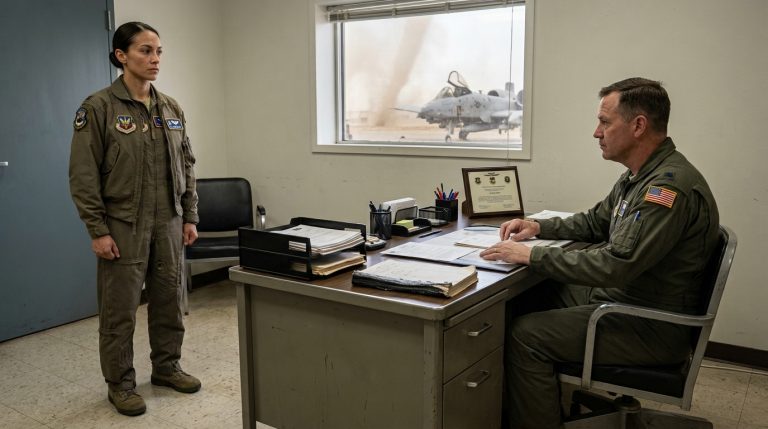
Colonel Sarah Brennan stood a few paces away, her posture relaxed but her eyes sharp, scanning Rachel with the unnerving precision of a commander. She held a tablet in her hand, the screen dark.
“You left the briefing room rather abruptly,” Brennan said, her voice devoid of reprimand. “I’m not sure the protocol allows for that kind of tactical exit.”
“The protocol doesn’t account for the fact that I’ve already lived through the consequences of the maneuvers I’m teaching,” Rachel replied. Her voice was steady, but she kept her hands tucked into her pockets to hide the lingering tremor. “They’re looking for a hero, Colonel. I’m just trying to make sure they survive long enough to realize they aren’t.”
Brennan walked closer, her boots quiet on the concrete. She stopped near the intake, looking up at the sleek, predatory lines of the Raptor. “Is that what you think they see? A hero?”
“I know what they see,” Rachel said, her eyes tracing a rivet pattern on the fuselage. “They see a call sign. They see a legend. They don’t see the cost of the fuel.”
Brennan sighed, a small, weary sound that broke the wall of her command presence for a split second. She extended the tablet. “There’s a file, Rachel. It’s not about the Crimson Tide missions, not exactly. It’s about the debriefings that were buried six years ago. Someone’s been probing the archive. Not from within our wing, but from somewhere higher up.”
Rachel stiffened. The phantom sound of the alarm was replaced by the cold, biting reality of the present. “If they’re digging, let them dig. I have nothing left to hide.”
“You have everything to hide,” Brennan corrected, her voice dropping to a near-whisper. “Because if they find the discrepancy in those medical flight logs—the ones you signed off on—it won’t just be your reputation that suffers. They’ll start questioning why the most successful pilot in the Air Force walked away the moment those records went dark.”
Rachel looked at the tablet. She didn’t reach for it. The air in the hangar felt suddenly thin, the vast space closing in until the F-22 seemed like a tomb rather than a weapon.
“I didn’t leave because of the record, Sarah,” Rachel said, her voice brittle. “I left because I was the one who kept the heart beating when the plane was coming down. And I was the only one who didn’t get to go home.”
She looked at Brennan, her eyes hard, reflecting the dull gray light of the hangar. “Keep your files. And if they come asking, tell them the truth: I’m not the pilot they think they’re looking for.”
She turned away, not waiting for a response, and walked toward the hangar’s side exit. She knew Brennan was watching, but she didn’t care. She needed air—real air, not the recycled, memory-choked atmosphere of the flight line—and she needed to find a way to silence the echo that was starting to scream in her head.
CHAPTER 3: THE HIDDEN PIN
Rachel pushed through the side exit, the heavy steel door swinging shut with a dampened thud that seemed to seal away the ghosts inside. The transition into the afternoon was jarring; the Nevada sun was a physical weight, bleaching the color from the tarmac and turning the horizon into a shimmering haze of heat. She didn’t stop. She walked toward the parking area with a purposeful stride, her jaw set, her mind running tactical diagnostics on the conversation with Colonel Brennan.
Discrepancy in the logs.
The words repeated themselves like a malfunctioning flight computer. She had filed those reports herself, six years ago, in the chaotic aftermath of the Crimson Tide operation. She remembered the ink, the smell of the paper, the way her hand had shaken as she signed the death certificates of the missions that never officially existed. She had been precise, calculated, and—she had thought—thorough.
She reached her vehicle, a weathered, dust-caked truck that looked entirely out of place among the gleaming government sedans. As she climbed inside, the interior smelled of stale coffee and the desert—faded, grounded, honest. She sat for a moment, her hands gripping the wheel until her knuckles turned white.
Inside the glovebox, tucked behind a bundle of crumpled flight charts, sat the silver flight pin. She hadn’t looked at it since the day she left the Air Force, yet she reached for it now, her thumb tracing the tarnished surface. It was a wing pin, but not one she had earned in the academy. It was a simple, unmarked silver feather, a token her partner had given her before their final flight.
The weight of it in her palm was a grounding anchor.
She started the engine, the roar of the truck’s motor a jarring contrast to the precision of the flight line. She needed to reach the base archives before the evening shift change, but as she pulled out of the parking area, she noticed a shadow shift near the perimeter fence. It was just a figure—a young pilot, perhaps one of the ones from the briefing, watching her with a look of hesitant, almost painful, uncertainty.
She didn’t stop. She couldn’t afford to acknowledge the vulnerability they seemed to be projecting onto her.
Twenty minutes later, Rachel stood before the access terminal of the wing’s secondary records office. The room was cool, lit by the flickering, fluorescent hum of an aging server rack. It was a space designed for storage, for the things that weren’t meant to be seen but were too important to destroy.
The archives were a labyrinth of physical folders and digitized history. She navigated the terminal with the fluidity of a pilot navigating a flight path, her fingers moving across the keyboard until the screen glowed with the header: CRIMSON TIDE – MISSION SUMMARIES.
She opened the directory, her heart hammering a slow, rhythmic beat against her ribs. She didn’t find the discrepancy immediately. She found something else.
On the corner of the primary desk, sitting atop a stack of sealed personnel files, was a single, manila folder. It was unmarked, out of place in the sterile, alphabetized organization of the archive. She picked it up, the paper cool and slightly textured under her fingertips. Inside, there was no mission log, no tactical readout. There was only a handwritten letter—a photocopy—and a series of hospital admission forms.
They were dated four days after she had filed the final mission report.
The names on the forms were redacted, but the location—a private infirmary in Alaska—and the specific notation of “Patient In-Transit via Unauthorized Transport” made the blood freeze in her veins. It wasn’t just a record of a medical evac. It was a record of a missing pilot.
Patient status: Critical. Recovery unlikely. Transfer to secondary facility pending authorization.
Rachel leaned against the desk, the room suddenly feeling too small. She wasn’t alone in the archive; she could hear the quiet murmur of a conversation echoing from the hallway, but it sounded like it was coming from miles away. Someone had left this folder here for her to find. It wasn’t a mistake; it was a beacon.
She tucked the folder into her bag, the weight of it suddenly transforming the space around her. The faded textures of the room—the yellowing labels, the worn metal drawers—felt like a setup. She had come here looking for a logistical error, a simple clerical oversight that she could fix to satisfy the Colonel. Instead, she had found the first thread of a story she thought she had buried in the ice and the sky.
She turned to leave, her movements now calibrated, cautious. As she stepped back into the hallway, she saw a figure standing near the vending machine at the end of the corridor. It was the same young pilot from the perimeter fence, his face pale, his eyes wide as he looked at her bag.
He didn’t speak. He didn’t move. He simply tipped his head, a silent acknowledgment, before turning and walking away into the darkness of the hangar complex.
Rachel didn’t follow. She walked toward the exit, the folder pressed tight against her side, the weight of the silver pin in her pocket burning against her skin. She had come here to fix a protocol. Now, she realized, she was trapped in a flight path she didn’t choose, flying blind toward a truth that had been waiting in the dark for six years.
CHAPTER 4: THE RED LIGHT LOCKDOWN
The archive hallway shifted from sterile white to a rhythmic, pulsating crimson. The overhead lights flickered once, then settled into a low, emergency hum. A robotic female voice announced, “Security Lockdown Initiated. Unauthorized Access Detected. Remain in place for verification.”
Rachel didn’t freeze. Years of high-altitude decision-making meant that even when the air was sucked out of the room, her lungs continued to work. She looked at the manila folder in her hand, the paper feeling unnaturally heavy, a beacon of truth in a room that was fast becoming a trap.
She turned back toward the terminal. The screen, previously a window into the past, now displayed a pulsing prompt: AUTHENTICATE COMMAND ACCESS OR FACILITATE SYSTEM PURGE.
“Dammit,” she hissed.
She had seconds before the physical locking mechanisms on the bulkhead doors engaged. If she were trapped here with the evidence, the narrative would be simple: a disgruntled former pilot stealing classified documents. She had to move.
Rachel shoved the folder into the depths of her bag, her fingers brushing against the silver pin. She didn’t head for the main exit—that was where the security protocols would focus first. Instead, she turned toward the ventilation maintenance hatch she had noted during her initial scan of the room’s layout. It was a tight, industrial space, smelling of stagnant air and dust, but it led to the sub-level corridors.
She jammed her shoulder against the hatch, the metal groaning in protest. It gave way with a sharp, piercing screech, and she scrambled through. Her movements were frantic but precise—the product of training that favored utility over grace. She landed on the metal grating of the sub-level crawlspace, the dust rising in a thick, gray cloud around her.
Above, she heard the heavy thud of the bulkhead doors slamming shut. Muffled footsteps echoed through the vents—rhythmic, professional, military. A search party was already in the building.
She crawled forward, the metal scraping against her jumpsuit, the texture of the environment grinding into her skin. Every movement was a calculated risk. She had the documents, but she didn’t have the context. Why had Brennan left this for her? Or had someone else—someone who knew what happened during the Crimson Tide—left the folder as a breadcrumb trail?
As she navigated the maze of pipes and cooling ducts, a thought occurred to her: the young pilot at the vending machine. He hadn’t just been standing there; he had been waiting. He knew she was inside.
She reached a junction and peered through a small, circular vent cover. Below, in a sterile-looking equipment storage room, the young pilot was standing with his back to her, speaking into a secure comms device. His posture was rigid, lacking the casual slouch of a junior airman.
“Target has the package,” he said, his voice clipped and devoid of emotion. “She’s inside the sub-level conduits. She’s exactly as tactical as the records suggested. Initiating the next phase of the perimeter sweep.”
Rachel’s breath hitched. Target. She wasn’t just a former pilot returning to teach; she was an asset being maneuvered into a theater of someone else’s design. The “decoy” secret—the mission log discrepancy—wasn’t the end of the mystery; it was the bait.
She watched as he pocketed the comms device and walked toward the exit, his movements practiced, his shadow long and predatory against the wall.
She had to get out. But more importantly, she had to understand who was pulling the strings. She wasn’t just reliving the past; she was actively being hunted by the present. She pulled the silver pin from her pocket, the cold metal a reminder of what she had lost. She wouldn’t be caught. She wouldn’t be the pilot who walked into a trap.
She crept through the crawlspace, her senses honed to the sound of every vent, every distant footfall, every shift in the mechanical hum of the base. The folder in her bag felt like a ticking clock. She needed to reach her truck, get off-base, and find a place where she could open the folder without eyes on her.
As she reached the final exit to the flight line, the emergency lighting flickered out, plunging the sub-level into total, suffocating darkness. She stood perfectly still, her heart a steady, calm thump against her ribs. She was Rachel Morgan. She was Eagle One. And she was done being the target.
She moved in the dark, silent as a ghost, every nerve ending firing with the precision of a HUD display. She didn’t know what the final truth was—the deep, jagged wound of her partner’s death was still a locked door—but she knew one thing: someone in this wing was trying to rewrite history, and they had chosen the wrong pilot to test.
She pressed her hand against the final exit panel. It was cold, vibrating with the pulse of the base’s power grid. She took a breath, centered her awareness, and waited for the sound of the approaching patrol to pass. When the footsteps faded, she bypassed the lock, stepped out into the crisp, biting night air, and didn’t look back. The game had begun, and for the first time in six years, she was the one flying the machine, not the one being flown.
CHAPTER 5: THE TRUTH OF THE TIDE
The desert night was a vast, hollow bowl, the air thin and biting against Rachel’s skin. She reached her truck, the metal door handle freezing under her palm, and she didn’t bother with the lights as she climbed inside. The cab smelled of old upholstery and the lingering ghost of the drive to the base—a space that felt, for the first time, like a sanctuary.
She turned the key. The engine coughed, a sluggish protest against the cold, then settled into a low, steady rumble. She shifted into gear, the movement mechanical, her eyes constantly flicking to the rearview mirror.
She wasn’t driving home. She was driving to the one place in the valley where the shadows were deep enough to hide the past: a disused hangar on the far side of the airfield, a relic of a time before the F-22s had transformed the base into a fortress.
Her mind was a storm of tactical analysis. The young pilot—the “target” designation—hadn’t just been waiting; he had been coordinating. Every turn she made, every flicker of the tail-lights, felt like a move on a board she hadn’t agreed to play on. She checked her mirrors again. A pair of high-beam headlights flared behind her, too fast, too aggressive.
Not a patrol, she thought, her pulse hammering in her ears. Something else.
She took a sharp, erratic turn onto a service road, the tires kicking up a spray of loose gravel and dust. The pursuit didn’t lose ground; it matched her speed with a terrifying, professional ease. She pushed the truck, the engine screaming in the quiet of the night, until the old hangar loomed ahead, a jagged, rusted silhouette against the starlight.
She skidded to a stop, the truck sliding sideways, and dived out before the engine had fully died. She scrambled through the side door, the rusted hinges shrieking, and pulled the door shut behind her.
She was in the dark now—total, suffocating, familiar darkness.
She leaned against the corrugated metal wall, her breath coming in ragged, painful gasps. She pulled the manila folder from her bag. Her hands were shaking—not from fear, but from the sudden, jarring adrenaline that had been suppressed for six years. She clicked on a small, keychain light, the beam a narrow, trembling needle in the gloom.
She opened the folder.
The documents weren’t just mission summaries. As she flipped past the medical forms, she saw the flight logs. They were signed, dated, and, most importantly, they bore the call sign of her wingman: Kestrel.
Her breath hitched. Kestrel.
She had been told, back then, that Kestrel had been lost in a low-altitude intercept, a textbook error that had cost him his life. But these logs showed he had been flying a medical transport—a modified Beechcraft, the same type of aircraft she had helped guide months ago over Denver.
It was all there: the transport mission, the unauthorized path, the secret stop in Alaska. And then, the notation in the margin, written in a hand she recognized as her own—a hand that had been forced, she now realized, under orders from a command that wanted the truth of that night buried in the permafrost.
The mission wasn’t a combat sortie.
The realization hit her with the force of a G-load. They hadn’t been fighting for airspace; they had been fighting to save a diplomat who had been compromised by a failed extraction. Kestrel hadn’t died in combat. He had died because she had been ordered to abandon him to keep the operation secret.
She felt the cold seep into her bones, not from the desert air, but from the realization that her “legendary” status was built on a lie she had been complicit in creating. She had carried the guilt of his death for six years, thinking it was a tactical failure, when it was, in fact, a tactical sacrifice she had been forced to sign off on.
A floorboard creaked somewhere in the front of the hangar.
She snapped the light off, the darkness rushing back in. She wasn’t alone. The heavy, deliberate thud of boots against the floor echoed in the cavernous space. Someone had followed her, and they weren’t interested in a conversation.
She reached into her pocket and gripped the silver pin. It was the only thing she had left of him. She stood, her posture shifting from the exhausted civilian pilot back into the predator she had tried to bury. She didn’t know who was coming, but as she listened to the rhythmic, calculated pace of the footsteps, she knew she wasn’t just fighting for her life anymore. She was fighting for the truth.
CHAPTER 6: THE MEMORY OF LOSS
The silence in the hangar was absolute, a heavy, suffocating weight that pressed against Rachel’s eardrums. She didn’t move. She stood perfectly still in the center of the dark space, the manila folder pressed against her side, her senses expanded to the absolute limit. She could hear the subtle shift of fabric, the soft, controlled intake of breath, and the faint, unmistakable scent of synthetic oil—the same brand used in the older F-22 maintenance bays.
She turned, her movements fluid and devoid of wasted energy. As she rotated, she caught the glint of a flashlight beam, narrow and harsh, cutting through the gloom. It didn’t aim for her; it swept across the floor, searching, before snapping toward her.
“I wouldn’t,” a voice said. It was calm, polished—the voice of an officer. “That folder doesn’t belong to you, Major.”
The light revealed Colonel Sarah Brennan, standing a few yards away, her service weapon drawn and held with a steady, practiced ease. She didn’t look like a friend, and she certainly didn’t look like an ally. She looked like a commanding officer who had been betrayed by the one asset she thought she could control.
“You left it on the desk, Sarah,” Rachel said, her voice low, steady, and entirely devoid of the deference she had shown earlier. “Or did you want me to find it?”
Brennan didn’t blink. The light from her tactical torch caught the edges of the dust motes, turning them into floating, suspended particles of regret. “I wanted you to understand that some truths aren’t buried—they’re preserved. But you were never meant to come back. You were meant to stay in the sky, anonymous, invisible. You were the perfect ghost.”
“I’m not a ghost,” Rachel replied. She shifted her weight, preparing for the strike, her mind calculating the distance, the angle, the probability of disarming a trained officer. “And Kestrel wasn’t a tactical sacrifice.”
The mention of the name hung in the air, a phantom presence that seemed to chill the very atmosphere of the hangar. Brennan’s expression didn’t flicker, but her grip on the weapon tightened. “Kestrel made a choice. He chose the objective. You were just the one who signed the paper.”
“I signed the paper because you told me he was already gone,” Rachel said, her voice rising, finally shedding the cold, professional veneer. “I spent six years thinking I failed him in a maneuver. I spent six years thinking I killed him with my own arrogance. But he was alive, wasn’t he? He was in that transport, waiting for an extraction that you cancelled.”
The shadow in the corner of her vision, a trick of the flashlight and her own frantic mind, seemed to take the shape of a pilot in a flight suit—the blurred, static-filled image of Kestrel. It was a psychological phantom, a manifestation of the grief she had been carrying, and it moved toward her with a ghostly, insistent weight.
He’s waiting, the phantom whispered in her memory. He’s waiting for the extraction.
“He was a liability, Rachel,” Brennan said, her voice colder now, stripped of the sympathy she’d shown on the tarmac. “He had seen the internal communication regarding the diplomat. He was going to leak the entire operation. You didn’t just sign a paper; you protected the integrity of the mission. Don’t act like a martyr now.”
Rachel felt the heat of fury rise, a white-hot, kinetic energy that burned away the exhaustion. She moved.
She didn’t run; she lunged, a short, sharp burst of momentum that carried her beneath the arc of Brennan’s flashlight. She hit the floor, rolled, and surged upward, her hand snapping onto the Colonel’s wrist. There was a brief, violent struggle—the screech of leather, the hard impact of a shoulder against metal, the sharp, metallic taste of iron in her mouth as she caught an elbow to the ribs.
She didn’t let go. She used the weight of her own body, a maneuver she had learned in the cockpit to handle high-G loads, to pivot and force Brennan backward. The weapon clattered to the concrete, skidding into the darkness.
“You didn’t protect the mission,” Rachel hissed, pinning Brennan against the corrugated wall. “You protected your career. You let a man die in the ice so you wouldn’t have to explain why the protocol failed.”
Brennan gasped, her face flushed, her eyes reflecting the cold, hard defiance of someone who still believed they were the hero of their own story. “I saved the wing. You have no idea what it costs to keep the F-22 program in the air, what it costs to maintain the illusion of absolute tactical control. Without that lie, we fall.”
“Then we fall,” Rachel said. She reached into her bag and retrieved the folder, pressing it against Brennan’s chest. “Because I’m not the ghost you thought I was. I’m the pilot who’s coming to finish the flight.”
She released her grip and stepped back, her ribs throbbing with the impact. She didn’t take the weapon. She didn’t need it. She had the documents—the raw, physical evidence that stripped away the legend of the Crimson Tide.
Brennan slumped against the wall, her gaze tracing Rachel’s shadow as she moved toward the door. “You release those,” Brennan warned, her voice trembling with a mix of fear and cold pragmatism, “and you burn everything. Not just me. You burn the wing. You burn the legacy.”
“Good,” Rachel replied, the word feeling like a final, necessary ignition. “Maybe it’s time we start flying in the light.”
She walked out into the night, the cold air hitting her face with a sharpness that felt like redemption. She wasn’t finished—she knew the Colonel wouldn’t just give up—but for the first time, the phantom in the corner of her mind had gone quiet. She wasn’t fighting for the ghost of her partner anymore. She was fighting for the pilot she had become.