A Legacy of Embers: The Quiet Architect of Salvation in the Ruins of Monte Cassino
CHAPTER 1: The Weight of Silence
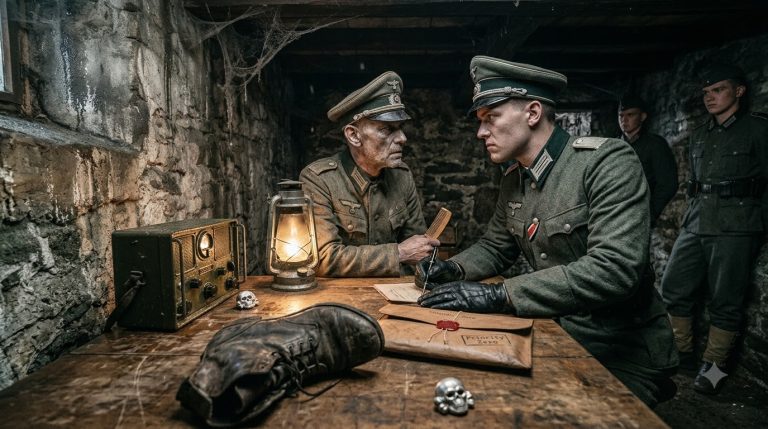
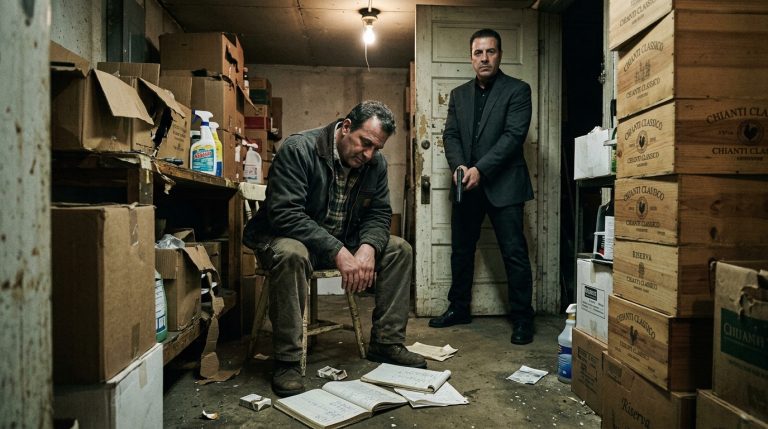
The basement was a tomb of damp limestone and broken timber, a place where time didn’t pass, but accumulated in layers of dust and misery. Sergeant William Hartley crouched in the corner, his back pressed against the weeping stone of the factory wall. The air was heavy, tasted of iron and long-stagnant air, the kind that reminded him too much of the deep, black shafts in Beckley.
He watched the faces of the men. Captain Morrison was slumped against a support beam, his eyes fixed on a point in the middle distance that no one else could see. Beside him, Private Chen was still, his breath coming in shallow, ragged bursts. The silence here wasn’t peaceful; it was a hungry thing, pressing in, demanding to be filled.
Hartley’s hands moved with a mechanical, almost reverent precision. He touched the crossbow he’d scavenged from a ruined farmhouse weeks ago. It was a cold, alien object, steel and wood, yet it felt more honest than the heavy, clumsy rifle he’d carried through the mud of Salerno. He wrapped the oil-soaked rags around the bolt heads. His fingers, calloused and scarred from the coal mines, worked without instruction. He knew how fire liked to move, how it could be seduced into climbing walls and eating oxygen, provided you gave it the right path.
The canteen lay on its side, empty. He had checked it twice already, a futile, rhythmic motion—tilt, empty, replace. It was the absence of sound that hurt the most.
He caught the glint of the moon through a crack in the upper masonry. 11:47 p.m.
The officers in the command post upstairs—the ones who sat in their offices with their maps and their clean, dry wool uniforms—didn’t know he was watching them. They didn’t know that he saw the building not as a fortress, but as a structure with a fatal flaw. A chimney effect. A draft. A hunger for air.
He looked at Morrison. The Captain didn’t move. He hadn’t spoken for six hours. The men were drifting into the quiet, final sleep of those who have lost the hope of rescue.
Hartley stood up, the wood of the basement floor groaning under his weight. He didn’t make a sound. He didn’t need to. He checked his wire cutters, tucked them into his belt, and adjusted the harness of his bow. The smell of pine resin, sharp and sweet, clung to his clothes—a memory of home that felt wildly out of place in this graveyard.
As he stepped toward the door, his boot hit something small. A canteen cap. It skittered across the floor, the sound echoing like a gunshot. He froze, his pulse thumping in his throat. He waited, his ears straining for the sound of movement above, for the heavy tread of German boots or the snap of a trigger being readied.
Nothing. Just the wind whistling through the ruins of Monte Cassino.
He reached the threshold. The cold was a physical weight, a mantle of freezing air that promised no mercy. Beyond the heavy stone door lay the night, the mud, and the impossible distance to the German headquarters. He took a breath, the cold air biting deep into his lungs, and thought of his daughter.
He didn’t realize he was speaking until the words were already out, barely a rasp. “Not today.”
He pushed the door open, just a fraction, and the darkness outside swallowed him whole. He didn’t look back. He couldn’t. If he looked back, he would see the faces of the men who had already given up, and he would join them in that silence. He moved into the night, a shadow among shadows, his mind focused entirely on the physics of the fire to come.
As he crawled through the mud, a flash of something white caught his eye in the shadow of a fallen girder. A second canteen, abandoned, half-buried in the grime. He reached out to grab it, hoping for a miracle of a stray drop, but his hand closed only on freezing slush.
It was empty.
He kept moving, but a cold, sharp realization settled in his gut: the fire had to be perfect. There was no room for a second attempt. If he failed, the silence in that basement would become absolute.
CHAPTER 2: The Logic of Combustion
The world beyond the basement door was not a landscape; it was a geography of hazards. Hartley moved with his shoulders hunched, his body folded into the jagged shadows cast by the half-moon. Every step was a calculated risk. He walked heel-to-toe, feeling the texture of the ground through the thin soles of his boots. The pulverized concrete and splintered wood of Casino didn’t just rattle; they groaned under the shifting weight of the earth, a sound that he knew—with a sudden, jarring clarity—meant structural instability.
He was back in the coal face.
The thought wasn’t a metaphor; it was a sensory intrusion, a phantom weight pressing against his ribs. He saw the dark, timbered tunnels of Beckley, heard the low-frequency shift of earth preparing to settle, and felt the sudden, metallic taste of ozone that preceded a methane buildup. He squeezed his eyes shut for a heartbeat, shaking his head to clear the vision, but the smell remained. It was the scent of trapped air, of coal dust, of a tomb waiting to be sealed.
He stopped, pressing himself into the hollow of a shattered brick archway. His breath hitched, a thin plume of vapor in the biting night air. He forced his mind to re-map his surroundings. This wasn’t a mine. It was a factory. The structures were stone, not timber, and the threat wasn’t a gas explosion—it was an interlocking field of fire.
He touched the crossbow slung across his back. The familiar, cold steel of the bowstring provided the anchor he needed. He was Hartley. He was a Sergeant. He was a father. He was a fire boss.
He needed to understand the command post’s ventilation, not for oxygen, but for the hungry, climbing appetite of the fire. The building loomed ahead, a dark, hulking silhouette against the starry sky. He could see the faint, amber glow of light bleeding from the second-floor curtains. That was the intake. If he fired the bolt right, the resin would hit the paper, the paper would feed the wooden floorboards, and the draft from the stairwell would pull the heat up like a flue. It was simple physics. A fire in a confined space followed the path of least resistance, and he would build that path.
He began to move again, staying low, his eyes scanning the ruins for the tell-tale shimmer of barbed wire or the rhythmic sweep of a searchlight. The cold was beginning to seep through his wool uniform, stiffening his joints, but he welcomed the numbness. It kept him detached. It kept him from thinking about the men in the basement—the way Private Chen had looked at him, not with hope, but with a quiet, resigned acceptance that had been more painful than any accusation.
He came to the edge of the open ground. Four hundred yards of cratered parking lot. It was an exposed, flat expanse that offered no cover save for the deep, jagged scars of artillery impacts. He dropped to his belly, the mud soaking into his coat instantly, freezing and heavy. He began the crawl.
It was slow work. He didn’t drag his body; he pushed with his knees and toes, keeping his torso inches above the frozen mire. He moved in increments, synchronized with the rhythmic sweep of the searchlights from the nearby nests. The light would pass—a cold, artificial white finger probing the darkness—and he would scramble forward five yards, his heart hammering against his ribs in a syncopated rhythm.
He was halfway across when the memory returned, more vivid this time. He was fourteen, holding his father’s lamp in a narrow drift, watching the way the flame danced as the air current shifted. His father had looked at him—a man gray with coal dust, his eyes sunken and tired—and said, “The fire tells you what it wants, Bill. You just have to be quiet enough to listen.”
Hartley pressed his cheek into the mud, his eyes wide, watching the sweep of the light. The irony wasn’t lost on him. He was using the same philosophy now to burn a command post, to silence the men who had decided that twenty-three American soldiers were worth less than a strategic holding pattern. He wasn’t doing it for the military. He wasn’t doing it for the medal he didn’t want. He was doing it because he couldn’t stand the thought of those men dying in the dark, forgotten, just like his father had died in the deep shafts of West Virginia.
A German voice drifted over the ruins, a harsh, guttural sound that sliced through the night. A patrol was passing somewhere to his right, obscured by a heap of tumbled masonry. Hartley stopped moving entirely. He didn’t hold his breath; he allowed it to escape in slow, shallow puffs, watching the steam disappear before it could catch the light.
The patrol passed, their boots crunching rhythmically on the gravel, and then silence returned. Hartley felt the weight of the crossbow, the rigid, unyielding frame of it digging into his spine. He shifted, adjusting his position, and felt the sharp bite of a stone against his knee. He didn’t flinch.
He had to get to the fence. He had to build the fire.
The path ahead looked like a nightmare of sharp, rusted metal and shattered glass, but to Hartley, it was just a series of structural problems. He checked his compass in the darkness, the radium dial a faint, glowing eye. He had enough time to reach the fence before the rotation, but his margins were thinner than he’d calculated.
He pressed his hands into the mud and began to crawl again, his movements fluid and precise, a ghost threading through the belly of a dying city. He was almost there. The fence—a dark, jagged line against the graying sky—was waiting.
CHAPTER 3: The Ghost in the Ruins
Hartley didn’t move. He stood, bent at the waist, one hand gripping the end of the newly cut wire, the other clamped over the cutter’s pivot to dampen the inevitable snap. His heart was a drum in his ears, a frantic, irregular rhythm that threatened to drown out the distant, low-frequency hum of the front line. The wire didn’t snap. It gave way with a dull, sickening thud of metal against metal, and the tension he had been holding for the last twenty minutes dissipated into the cold night air.
He looked at the opening. It was a jagged, toothy gap, just wide enough for a man of his build to slide through, provided he didn’t catch his gear. He tested the sharpness of the exposed ends with the tip of a gloved finger. They were burred, rusted, and lethal—the kind of obstacle that turned a routine movement into a bloody, visible error.
He inhaled, a slow, controlled expansion of his diaphragm, and pushed the crossbow through first, sliding it over the frost-slicked mud until it was clear of the barrier. Then, he followed. He drew his shoulders in, tucking his elbows tight against his ribs, and began to shimmy through the gap. The fabric of his field jacket caught on a barb. He stopped. A lesser man would have yanked, would have let the panic dictate the movement, and in doing so, would have torn the coat and made a noise that would have echoed for a hundred yards.
Hartley didn’t pull. He reached back with his left hand, his fingers moving with the delicate, practiced touch of a man who had spent his youth bracing timber in the dark. He found the point of tension, worked the heavy wool free, and breathed again. He slipped through to the other side, rolling onto his shoulder and coming to a stop in the shadow of a crumbled stone wall.
He was inside the perimeter.
The landscape here was different. It wasn’t just the ruins of a factory anymore; it was the interior, the machine-room floor of a German defensive machine. He was fifty yards from the main office building. The ground here was littered with discarded gear—empty ammunition crates, coils of field wire, and the crushed remnants of ration tins. It was a space designed for order, now completely surrendered to the chaotic, grinding entropy of the war.
He stood up, his knees popping—a sound like a snapped twig that made him freeze for a full ten seconds—and surveyed the path ahead. The office building loomed like a monolith. The lights in the second-story windows were still flickering, a dim, orange pulse that seemed to beat in time with the distant artillery.
He moved forward. He kept his feet flat, testing each surface for hollows or loose rubble before committing his weight. Every step was a decision. He wasn’t just walking; he was negotiating with the terrain. To his left, a stack of heavy industrial machinery, coated in a layer of grime that looked like black grease, offered a brief lane of concealment. He slipped behind it, his back pressed against the freezing iron, and peered out toward the side entrance of the office.
There, standing under the frame of a doorway that had once been an entry point for delivery trucks, was the guard.
He was leaning against the brickwork, his rifle slung lazily across his chest. He was smoking. Hartley could smell it—a sweet, pungent tobacco that felt offensively out of place in this tomb of soot and wet stone. The guard shifted his weight, his boots grinding into the gravel, and Hartley felt a surge of cold, analytical observation. The guard was bored. That was a vulnerability. It wasn’t an opening for an assault—Hartley wasn’t here to kill a nineteen-year-old boy—but it was an opening for a distraction.
Hartley looked down at the tools in his belt. The wire cutters. The friction matches. The resin-coated bolts. He had everything he needed, but he lacked the one thing that made a plan transition into a reality: the specific, granular knowledge of the guard’s rotation.
He watched. Five minutes passed. The guard took another drag, dropped the cigarette, and stamped it out with his boot. He didn’t move toward the door. He didn’t look up. He simply stood there, a sentry who had long ago forgotten the stakes of his post. Then, a second soldier appeared from the shadows of the alley, carrying a metal tray. They exchanged a few words, a low, murmuring sound of German that Hartley couldn’t parse, and the new arrival disappeared inside.
The guard didn’t go in. He stayed, leaning against the doorframe, checking his watch with a weary flick of his wrist.
Hartley pulled the crossbow into his lap. He hadn’t planned on the second man, but the pattern was clear: the relief was coming from inside, and the entrance was being serviced by a routine he hadn’t fully mapped. He needed to be closer. He needed to understand how the internal structure of the office building connected to the basement stairs, how the air—and the fire—would travel once he touched the match to the resin.
He began to crawl again, the mud turning into a slick, slurry-like mess that coated his hands and numbed his wrists. The smell of the earth was overwhelming here, the scent of crushed brick and forgotten things. He reached a point thirty yards from the entrance. A pile of debris, mostly twisted conduit and shattered slate, provided a perfect firing position.
He stopped and began to set up, his hands working by touch alone. He pulled the first bolt, the pine resin sticky and sharp-smelling against his palm. He checked the wiring one last time. It was a delicate, fragile thing, a work of art born from coal-mine chemistry and the desperation of a man who could still hear the silence of the men he had left behind in the basement.
He looked at the entrance one more time. The guard was still there, a silhouette against the dim, yellow light of the doorway. He was human. He was terrified. He was just as much a victim of this grinding, senseless machine as the men in the basement. Hartley felt a momentary, sharp prick of doubt—a ghost of his own conscience—but he suppressed it. He wasn’t doing this to kill the guard. He was doing this to break the silence.
He shifted his weight, felt the cold stone bite into his hip, and raised the crossbow. The weight of the weapon was perfect, a balanced, lethal extension of his own intent. He didn’t aim for the guard. He aimed for the space beside the door, the place where the draft would be strongest, where the fire would first find the oxygen it needed to feed.
He drew the string. The mechanical click was lost in the wind. He was ready.
CHAPTER 4: The Fragile Wire
The guard shifted again, his boots grinding into the debris. He sighed—a long, weary sound that carried the distinct fatigue of a man who had been awake for far too long. Hartley watched him through the narrow gap in the rubble, his eyes narrowed, his breathing disciplined into a rhythmic, shallow cycle that kept his chest still. The guard’s shift was almost over. Hartley knew that. Any second now, the rotation would begin, and the relative safety of this solitary boredom would be replaced by the organized, vigilant presence of a new watch.
He adjusted his grip on the crossbow. The wood of the stock was cold, slick with a fine layer of condensation that made his palm ache. He held his breath.
The guard moved. He turned, not toward the door, but away, looking out across the open expanse of the industrial sector. It was the moment Hartley had been waiting for, the narrow window of transition where the soldier’s focus was entirely on the dark, ruined landscape rather than his own post.
Hartley didn’t hesitate. He shifted his weight, felt the bite of the broken concrete against his shin, and triggered the weapon.
The string gave a soft, singing thrum that seemed to vibrate through his very bones. The bolt launched, a dark, feathered dart that whistled through the night air and buried itself deep into the thick wooden frame of the door. The impact was sharp, a dry thwack that was almost instantly drowned out by the sudden, violent eruption of fire.
The match heads, primed by the friction of the strike, flared into existence. The pine resin, acting as an anchor, caught instantly, and a bloom of orange flame crawled across the dry, sun-baked wood of the frame.
The guard jumped, spinning around, his rifle clattering against the stone floor. He shouted—a sharp, guttural burst of confusion—but by the time he had his hands on his weapon, the fire was already climbing. It was hungry. It licked at the peeling paint of the doorway, feeding on the dry timber with a speed that defied logic.
Hartley didn’t stay to watch. He was already moving, retracting his body into the shadows of the machinery. He needed to be in place. He needed to see if the flare was enough.
As he scrambled backward, the memory of the Beckley mine hit him with the force of a physical blow. He was fourteen again, in the narrow crawl-space of the Number Four drift, listening to the overhead timbers groan as the mountain settled above them. The smell of cedar and damp earth was so sharp he could taste it. The memory was a siren, a phantom pull toward the safety of the dark, the urge to simply lie down and let the weight of the world settle over him.
He bit the inside of his cheek, the metallic tang of blood bringing him back to the factory floor. Not here, he thought. Not now.
He reached the next point of concealment—a massive, rusted steel vat that had once been part of the factory’s processing line. He pressed his back against it, his lungs burning. Through the gaps in the metal, he watched the command post.
The alarm was rising. The fire at the doorway had become a wall of orange, casting long, dancing shadows against the courtyard. He saw figures moving in the windows upstairs—the officers, their silhouettes frantic and disjointed. They weren’t prepared for this. They had bunkers, they had artillery, they had machine gun nests; they didn’t have a defense against a fire that was growing not from the outside in, but from the very structure they stood upon.
He saw the guard from the doorway running toward the side entrance, screaming for help, his voice cracking with panic. That was the first domino.
The plan was working, but it was fragile. He needed to ensure the fire reached the ventilation ducts that serviced the second floor. If it stayed on the ground floor, it would be a nuisance; if it climbed, it would be an apocalypse.
Hartley reached into his belt and pulled out the second bolt. He moved with a cold, terrifying efficiency, his hands—which had been trembling only moments before—now steady as steel. He set the match heads, wrapped the resin-coated cloth, and felt a strange, detached pride. This wasn’t combat. Combat was messy, unpredictable, and loud. This was structural engineering. This was a fire boss clearing a blocked air-shaft.
He looked toward the command post. The upper windows were beginning to fill with black, heavy smoke. The draft was pulling.
He stood up, his eyes locked on a high, narrow ventilation grating on the second floor. It was a difficult shot, obscured by a tangled web of communication wires, but it was the only way to guarantee the outcome. He raised the bow, his breath held in a tight, motionless cage in his chest.
He wasn’t fighting the Germans. He wasn’t fighting the war. He was fighting the silence. And for the first time in his life, he was winning.
He squeezed the trigger. The string sang. The bolt arced, a tiny, glowing ember against the vast, indifferent darkness of the night, and sailed true.
CHAPTER 5: The Ignition
The sound of the building was changing. It was no longer the steady, rhythmic settling of old stone; it was a groan of deep, structural stress, a high-pitched metallic shrieking that told Hartley the internal iron supports were beginning to warp under the heat. He remained pressed against the rusted vat, his eyes fixed on the command post. The fifth bolt had done its work. The smoke pouring from the vent was thick, greasy, and black—the signature of burning paper and oil-soaked timber.
But then, the ground beneath him shuddered. It wasn’t the artillery; it was too close, too localized.
A section of the command post’s roof, weakened by the heat rising through the ventilation shaft, gave way. A cascade of slate and heavy timber crashed into the courtyard, kicking up a blinding, sulfurous cloud of dust that swallowed the entrance. The guard who had been standing there was nowhere to be seen, lost in the immediate aftermath of the collapse.
Hartley didn’t cheer. He felt a cold, sharp spike of alarm. This was the failure point. The building wasn’t just burning; it was failing. If the roof collapsed entirely, it might extinguish the fire by smothering the air supply before it could reach the lower levels where the officers were still trapped, or worse, it might bring down the very walls that kept the fire contained, turning the entire courtyard into an inferno that would make it impossible for the trapped men to escape.
He had to move. The strategy was shifting. He couldn’t just observe the chaos; he had to steer it.
He broke cover, his boots crunching loudly over the uneven ground. He ignored the risk of being seen. The German patrols were in full-scale confusion, their voices raised in jagged, panicked shouts that had lost all semblance of military order. He sprinted toward the side of the building, his lungs burning with the sharp, acidic tang of the smoke.
The heat hit him in a wave as he neared the structure—a dry, oppressive pressure that made his skin feel tight. He reached the side entrance, the doorframe now glowing with a dull, cherry-red heat from the fire he’d started. He looked for a way to ensure the draft kept pulling the flames through the interior rather than letting them burst through the exterior walls.
He found a window—a high, reinforced glass pane that was already cracked from the heat. He drew his knife, wrapped his hand in his sleeve, and punched the glass. It shattered inward, the shards clattering onto the floor inside. Immediately, a rush of air sucked into the hole, a violent, invisible hand that fed the inferno.
He felt the temperature spike. The fire was no longer a flicker; it was a gale.
Inside, he heard the screaming. It was distant, muffled by the thickness of the stone, but it was there—a frantic, high-pitched cacophony of voices that had suddenly realized the room was a box and the box was an oven. Hartley leaned his head against the cool, soot-stained stone of the exterior wall, his hand resting on his knee. He felt a wave of dizziness. The memory of the Beckley mine returned, but this time, he wasn’t the son watching the lamp. He was the man in the dark, watching the roof begin to sag, knowing that the timber was about to give.
He forced himself to push off the wall. He couldn’t afford the luxury of the memory. He turned and started the run toward the factory basement, his legs heavy and unresponsive.
The courtyard was a landscape of hell. Flames were erupting from the ground, fed by fuel drums that had been compromised by the collapse. The machine gun nests were completely abandoned, the soldiers having retreated into the rubble, their discipline shattered by the unpredictable, elemental nature of the assault.
Hartley didn’t look back at the inferno. He focused on the rhythm of his own stride—one foot, then the other, keeping his head down, his silhouette blending into the chaotic, shifting shadows. He reached the alley that led back to the prisoners’ basement, his breath coming in ragged, painful gasps.
He stopped at the steel door. It was still sealed, the surface hot to the touch. He waited for the vibration of the building to settle, then reached out and tapped the rhythm: three fast, two slow, three fast.
The door didn’t open.
He waited. He tapped again, louder, the sound of his knuckles against the steel ringing out with a desperate, metallic resonance.
Still nothing.
A cold, hollow sensation opened in his gut. The fire had been perfect, the draft had worked, but if he had miscalculated the internal air-flow, the smoke might have been pulled into the lower levels of the factory complex. If they were incapacitated, if they were already gone…
The door creaked. It opened just a sliver, a dark, narrow eye of space. Sergeant Eddie Malone was there, his face streaked with soot, his eyes wide and reflecting the distant, orange glow of the burning command post. He looked at Hartley not as a hero, but as an alien, a man who had brought the end of the world to their doorstep.
“They’re coming,” Hartley whispered, his voice cracked and raw. “The machine gun crews have abandoned their posts. You have to move now, or you’ll be trapped in the rubble when this place comes down.”
Malone blinked, then grabbed Hartley’s arm, his grip thin and frantic. “Chen’s gone, Hartley. He… he didn’t make it. But we’re coming.”
Hartley stared at the dark, narrow opening. The silence that followed wasn’t the silence of the basement anymore; it was the heavy, suffocating silence of a failure that he hadn’t planned for. He had saved the many, but he had lost the one. The physics of the fire had been perfect, but the human cost was not a variable he had been able to control.
He nodded once, a sharp, mechanical motion. “Move,” he said, and turned to lead them into the fire.
CHAPTER 6: The Echo of Fire
The corridor was a furnace of shifting shadows and heat. Hartley moved first, his body angled forward, his hand pressing against the burning stone of the wall. Beside him, Malone was struggling to keep the men upright. They were barely walking, their movements jerky and uncoordinated, the dehydration having turned their muscles into taut, trembling wires.
“Stay close,” Hartley hissed, though his voice was swallowed by the roar of the building above. “Don’t break the line. If you see light, get low.”
They pushed through the factory complex, a phalanx of ghosts moving through the guts of the building. The fire was no longer just in the command post; it had jumped the courtyard, catching on the timber-rich debris that cluttered the exterior. Sparks drifted through the broken windows like glowing snow, settling on the men’s wool uniforms and smoldering instantly. Hartley swatted one away from Malone’s sleeve, his motions automatic, his focus entirely on the navigation.
He was navigating by instinct now, his perception warped by the thick, acrid smoke. Every shadow looked like a German sentry; every shift in the wind felt like an enemy patrol closing in. He felt the phantom weight of the mine-shaft roof again, the way the air would thin out before a collapse, and he realized with a jolt of terror that the factory was mimicking that same final, heavy stillness.
“Hartley!” Malone gasped, stumbling as the floor shifted beneath them. “The stairs—the stairwell is blocked!”
Hartley lunged forward, grabbing Malone by the jacket to haul him upright. They were in the main administrative foyer. The ceiling had caved in, a massive, jagged pyramid of broken concrete and twisted rebar sealing the primary exit. The only way out was the loading dock, a hundred feet away, but between them and that freedom lay the open expanse of the factory’s central floor—a space now fully illuminated by the uncontrolled blaze pouring down from the upper stories.
He looked at the men. They were shattered, their eyes glassy with a delirium that sat somewhere between exhaustion and pure, unadulterated fear.
“We can’t go through the center,” one of the privates whispered, his voice cracking. “They’ll see us. The gunners are still out there.”
“The gunners are running,” Hartley said, his voice flat, stripped of all emotion. He reached into his belt and pulled out the last two fire arrows. He looked at them—crude, improvised, and useless for the task ahead. He dropped them into the ash at his feet. “They aren’t looking for men. They’re looking for the fire. We move with the smoke.”
He stripped off his own jacket and threw it onto a smoldering pile of rags near the center of the foyer. The fabric caught instantly, a bright, welcoming flare of orange.
“When that goes up, we move,” Hartley commanded. “Stay in the shadow of the smoke. If you get separated, do not run. Crawl. If you hear a voice that isn’t ours, freeze.”
He didn’t wait for a reply. He sprinted toward the far wall, his boots silent on the dust-covered concrete. The fire he’d set began to climb the wall, a sudden, bright flare that drew the eyes of the entire courtyard. He heard a shout from outside—a frantic, high-pitched scream of alarm—and then the stutter of a machine gun, but the fire was doing its job. It was a distraction, a brilliant, blinding beacon that drew the panicked attention of the German defenders away from the dark, soot-choked corners of the loading bay.
Hartley reached the dock. He threw his shoulder into the heavy, rusted steel of the rolling door. It was jammed, held by the warped metal of the frame. He didn’t curse; he didn’t panic. He braced his feet, hooked his hands into the lower edge, and poured everything he had into the lift. His muscles screamed—a sharp, tearing pain in his shoulder—but he didn’t stop.
Just like the timber, he told himself. Find the weakness. Find the point of balance.
The door shrieked—a high, piercing sound of grinding metal—and then it gave, sliding upward just enough for a man to crawl under.
“Go!” he barked, his voice coming out as a strangled, desperate rasp.
He watched as the men scrambled through, one by one, dragging the wounded, their movements frantic and uncoordinated. He stayed by the door, watching the courtyard. The command post was a torch, a violent, beautiful, and terrible sight. He saw a German officer standing in the middle of the flames, his hands covering his face, his uniform smoking as he tried to walk through the inferno that had been his headquarters.
Hartley felt no triumph. He felt only a profound, hollow exhaustion. He saw the fire not as a weapon, but as a mirror—a reflection of the same uncontrollable force that had taken his father, the same darkness he had spent his entire life trying to outrun.
Malone was the last one in, clutching the door as he slid underneath. He looked back at Hartley, his eyes wide and pleading. “Hartley, move!”
Hartley ducked under the door, the metal catching his hair as he tumbled into the dirt of the exterior alley. He was out. He was in the cold, biting air of the night, the smell of cordite and death replaced by the damp, sweet scent of the coming rain.
They weren’t safe yet. The German lines were still in front of them, and they were still twenty-one broken men in a world of rubble. But as he looked at the men huddled in the mud, gasping for air, he realized that the impossible had happened. The fire had burned through the grid, and in the space it left behind, there was finally a way out.
He stood up, the pain in his shoulder a dull, thudding rhythm, and looked toward the American lines.
“We walk,” he said. “Quietly. If we make it, we make it. If we don’t, we don’t stop moving.”
He didn’t look back at the command post. He didn’t need to. The fire was its own monument, a pillar of ash and light that told the only story that mattered: that he had chosen to act, and in doing so, he had forced the world to change.
CHAPTER 7: The Bridge of Return
The ground was a cruel, unforgiving expanse of cratered mud and splintered timber. Hartley stayed at the point, his body low, his eyes scanning the horizon for the unnatural movement of a German patrol. Behind him, the men moved like shadows—a disjointed, erratic line of exhaustion and survival instinct. Every time someone stumbled, the entire chain halted, a collective gasp of breath frozen in the frigid morning air.
They were in the “no man’s land” of the industrial sector, a place where the ruins offered no protection, only obstacles. The fire behind them had dimmed to a sullen, pulsing glow, a beacon of destruction that served as their only compass. It was a strange, haunting comfort—to know that for all the death that fire had wrought, it had also carved a path through the blockade.
Hartley stopped. He signaled for the line to halt.
He leaned his forehead against the cold, wet flank of a discarded tank tread, his lungs burning with the effort of every movement. He felt the cold seeping through his clothes, a deep, numbing ache that went all the way to his marrow. He glanced down at his wrist, looking for his watch, but the sleeve of his jacket was torn and empty. It was gone—lost somewhere in the crawl, in the mud, or in the fire.
The loss felt profound, a sudden, sharp disconnection from the linear progression of time. He didn’t know if it was four in the morning or six. He only knew that the light was coming, and with the light, the Germans would regain their vision.
“Hartley,” Malone whispered, appearing beside him. He looked like a corpse, his face gaunt, his eyes rimmed with red. “Chen’s gone. We know that. But the others… they’re starting to give out.”
Hartley looked back. A few of the men were curled into the mud, their eyes fixed on the gray, empty sky. They weren’t resting; they were surrendering to the cold. The Kintsugi of survival—the beauty of the effort—was failing, the cracks in their resolve growing wider with every passing yard.
“They don’t have to walk to the end,” Hartley said, his voice a low, gravelly rasp. “They just have to walk to the next crater. Tell them to focus on the next crater, not the lines.”
He moved again. He didn’t look at the men. He couldn’t. If he acknowledged their pain, he would have to acknowledge his own, and he knew that if he stopped to feel the weight of what he had done—the lives he had ended, the men he had pushed to this breaking point—he would never get back up. He had to be the machine. He had to be the fire boss who knew how to balance the pressure and keep the ventilation moving.
They crept past a collapsed drainage pipe, the metal twisted and rusted like the bones of some long-dead beast. Hartley paused, listening.
There. A low, rhythmic thud.
Footsteps.
He pushed Malone and the others down into the slush. He pressed his face into the dirt, the smell of wet earth and ancient, decomposed life filling his senses. He held his breath, his heart a frantic bird in his chest. A German patrol was moving along the perimeter, the sound of their voices—sharp, clinical, and devoid of the panic that had characterized the command post guards—drifting over the ruins.
One soldier stopped. Hartley could hear the snick of a rifle bolt. He felt the vibration of the boots on the ground, a rhythmic, terrifying pulse that traveled through the soil and into his own shivering frame.
He reached for the knife at his belt, but his fingers were numb, stiffened by the cold into useless hooks. He couldn’t draw it. He realized, with a sudden, icy clarity, that if they were spotted, there would be no more fire, no more engineering, no more escape. It would just be the end.
The soldier walked on.
Hartley waited until the sound of the footsteps faded into the ambient noise of the morning wind. He didn’t move for another five minutes. When he finally stood, he felt an agonizing, sharp pain in his back, a reminder of the physical cost of the last six hours.
“Get up,” he whispered to the men. “Slowly.”
They rose like ghosts from the grave. They were silent now, the struggle for speech having been replaced by a singular, focused need to reach the other side.
The Allied perimeter was ahead. He could see it—a faint, flickering line of lights that marked the battalion’s forward outposts. It was only three hundred yards away, but it looked like a continent.
He looked at the ruins one last time. The fire in the command post was still smoldering, a faint, dying ember of the chaos he had unleashed. He thought of his father, the way he had once seen him stand at the mouth of the mine after a collapse, staring at the darkness as if he could command it to release the men who had been left inside. He understood now that his father hadn’t been waiting for the darkness to relent; he had been waiting for the strength to face the fact that he was the only one left.
Hartley turned his back on the fire. He took a step toward the lights. Then another. He wasn’t a hero. He was just a man who had built a path through the ruin, and now, he had to walk it to the end.
CHAPTER 8: The Architecture of Memory
The transition was not a relief; it was an impact. As Hartley crossed the invisible threshold into the Allied perimeter, the adrenaline that had been his skeletal structure for the last ten hours simply dissolved. He stumbled, his legs buckling, and for a moment, he thought he would join the mud and the ruins he had just left behind.
Hands caught him.
They weren’t German hands. They were the rough, calloused hands of American infantry, men who had been watching the fire from the ridge and waiting for a miracle they didn’t believe in. He felt the jarring, rhythmic thud of feet on grass, the low, urgent murmur of voices—”Medic! Over here! We got survivors!”—and then, the world tilted sideways.
He was laid out on a stretcher, the canvas rough against his cheek. He tried to speak, to ask about Malone, about the men, but the words were trapped in a throat raw from smoke and exhaustion. He watched the sky, a pale, washed-out blue that promised a morning he hadn’t believed he would ever see.
The aid station was a canvas tent, the interior illuminated by the clinical, harsh light of a hanging lantern. He saw them moving—the medics, their faces masks of professional detachment, working with a speed that mirrored his own mechanical precision from the night before.
Morrison was there.
The Captain was sitting on a wooden crate near the entrance, his uniform stained, his face gaunt, his eyes holding a haunted, distant look that Hartley recognized all too well. He saw Hartley, and for a moment, the distance collapsed. Morrison stood, his movements slow and pained, and walked over.
“You did it,” Morrison said, his voice a soft, disbelieving murmur.
Hartley didn’t respond. He looked at the tent ceiling, at the way the canvas rippled in the breeze, and felt the final, crushing weight of the mission. He thought of the fire, the way it had climbed the walls, the way he had steered it like a man guiding a timber beam in a mine. He hadn’t just saved those men; he had burned the ghost of his father out of his own head. The darkness of the mines—the fear that had governed his life, the terror that he would be the man who stayed home while others died—had been consumed in that inferno.
He looked at his hands. They were trembling, the tremor deep and bone-shaking, a physical manifestation of the silence he had finally broken.
“Seven,” Hartley whispered, his voice barely audible. “Seven of them.”
Morrison knelt beside the stretcher. “They’re gone, Bill. The building is a shell. You didn’t just save us… you took the fight away from them. They’re retreating. The whole line is collapsing.”
Hartley closed his eyes. The revelation wasn’t a triumph; it was a settling. The core truth he had carried—the fear that he was an imposter, a man hiding behind the guise of a soldier to escape the failure of his own past—had been laid bare. He wasn’t a soldier. He was a man who knew how to stop things from falling down. And he had used that to bring his friends home.
He felt a hand on his shoulder—a steady, anchoring pressure. It was the symbolic closure he hadn’t known he needed. It wasn’t the medal the division would talk about; it was the simple, human contact of a man who was alive because Hartley had decided that his life mattered more than the probability of success.
In the days that followed, the world blurred into a series of bureaucratic reports and medical evaluations. The “Fire Arrow” was dismantled, its components cataloged as if they were alien artifacts. He watched them handle his crossbow with gloves, their eyes filled with a clinical curiosity that missed the point entirely. They didn’t see the resin; they didn’t smell the pine. They saw a weapon. He saw the tool that had allowed him to build a bridge back to his own humanity.
He sat on the back of a supply truck, watching the ruins of Casino disappear behind a veil of dust and morning mist. He reached into his pocket and pulled out a small, smooth stone he had picked up in the basement before they left—a piece of the floor where Chen had fallen. It was cold, gray, and solid.
He held it, the weight of it a quiet, grounding reminder.
He would go home. He would build cabinets, he would smell the sawdust and the pine, and he would raise his daughter to know that the world was a place that could be made, not just suffered. He wouldn’t speak of the fire. He wouldn’t speak of the night. But every year, when the calendar turned, he would listen to the voices on the other end of the line, and he would know that the silence was finally, permanently, broken.
He opened his hand, looked at the stone, and then, with a slow, deliberate motion, placed it in his palm and closed his fingers around it.
He was home. He was alive. And for the first time in his life, the darkness had no more lessons for him to learn.