The Quiet Echo of Shadows: A Veteran’s Burden and the Unspoken Promise of the Last Titan
CHAPTER 1: THE WEIGHT OF A GHOST
The air in the bar tasted of stale hops and the faint, bitter metallic tang of a life lived too long in the margins. Gordon Hughes sat motionless, his gnarled hand wrapped around a glass of amber liquid, watching the condensation bead and slide toward the mahogany surface. Beside him, the air shifted. It was a kinetic energy, sharp and intrusive—the kind of movement that belonged on a training ground, not in a neighborhood dive.
“You sure you’re in the right place, old-timer?”
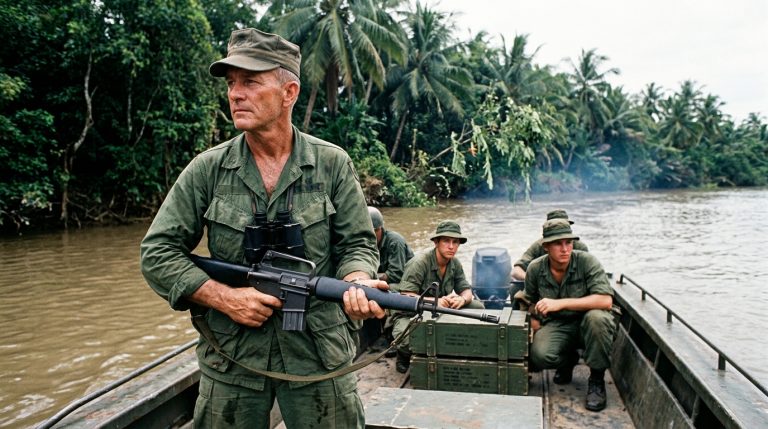
The voice was young, polished with a dangerous sort of confidence. Gordon did not turn. He felt the weight of his hearing aid humming, a tiny, synthetic heartbeat in his ear. He kept his eyes on the glass. The condensation tracing its path looked remarkably like the jungle rain that had once plastered his uniform to his skin.
“I’m just having a drink,” Gordon murmured, the words feeling like dry leaves against his palate.
“This isn’t exactly the VFW, pops,” the man—Jake—pressed, his voice dropping into the register of a man who enjoyed the thrill of a confrontation. Jake’s fingers, restless and groomed, hovered near the back of Gordon’s chair. His gaze settled on the faded, circular patch stitched onto the sleeve of the field jacket. It was a ghost of a design, threads fraying into a gray, unrecognizable blur. “You pick that up at a flea market? Trying to play the part?”
The laughter from the booth behind them reached Gordon like a physical push. The other men—Delta operators, by the set of their shoulders and the way they watched the door—were waiting for the punchline.
Gordon shifted. The stiffness in his hip flared, a sharp reminder of a drop-zone accident three decades ago. He reached over, shielding the sleeve, not out of fear, but out of a sudden, deep-seated exhaustion. He felt the weight of the patch, not as a badge, but as a heavy, leaden thing pulling at his heart.
“It’s just an old patch,” Gordon said, his voice a low, gravelly rumble.
“An old patch,” Jake echoed, his tone sharpening, losing its playfulness. The camaraderie in the bar soured instantly. Maria, the bartender, was watching from the far end, her hand frozen over a cleaning towel, her eyes reflecting the sudden, violent tension. “Look, I’ve bled for the unit I wear. Everyone here has. You wearing a lie is a direct hit to every man who didn’t make it home. What unit, old man?”
Gordon finally turned. His pale blue eyes were clear, ancient, and utterly detached from the anger radiating off the younger man. He searched Jake’s face for a glimmer of anything beyond pride, finding only the dangerous, hollow certainty of the uninitiated.
Then, as Jake’s finger brushed the frayed fabric of the patch, the world warped. The smell of stale beer vanished, obliterated by the scent of cordite and wet, rotting earth. The ambient noise of the bar became the deafening, rhythmic thrum of rotors beating against an ink-black sky. He was twenty-five again, the cabin floor slick with blood, the man beside him pressing the patch into his palm with a dying hand.
Gordon blinked. The bar snapped back into focus. Jake was still there, looming, his hand still tight on the sleeve. But as Gordon looked down, he saw something tucked into the inner lining of his jacket—a small, silver key that should have been locked in a safe at the bank. He had felt it pressing against his ribs all night, but now, he realized the lining was ripped. The key was visible.
If they saw it, the quiet life would end before he even finished his glass.
CHAPTER 2: THE ECHO OF DISCIPLINE
The silence in the bar was not empty; it was pressurized. Jake’s hand remained suspended mid-air, inches from the sleeve of Gordon’s jacket, frozen by a sudden, irrational spike of adrenaline. He felt the shift in the room before he understood it. The air—usually thick with the scent of spilled beer and burnt coffee—seemed to thin, turning sharp and cold.
Gordon didn’t move. He kept his gaze fixed on the mahogany bar, his heartrate steady, a rhythm honed by decades of survival. He could feel the cold edge of the silver key through the thin, worn material of his undershirt, a sharp bite against his skin. It was a small, innocuous thing, yet it held the potential to shatter the lives of everyone in the room. He didn’t glance at Jake; he didn’t need to. He could hear the tremor in the boy’s shallow breaths and the way the other operators in the booth shifted, their boots scuffing the floorboards in an unconscious, rhythmic retreat.
“You’re shaking, son,” Gordon said. His voice was not an accusation; it was a simple observation, a statement of fact that cut through the tension like a razor.
Jake pulled his hand back as if he had been burned. He stood upright, his face flushed, though the color was rapidly draining away to leave him pale, his youthful arrogance colliding with a wall of unexplained dread. He looked at Gordon, then at the other men, his eyes searching for the bravado they usually shared, only to find them staring at the door.
The front entrance of the bar remained closed, yet the atmosphere had irrevocably changed. Gordon slowly turned his head. His pale blue eyes were no longer detached; they were focused, pinning Jake in place with the weight of someone who had seen the world end and had simply decided to keep walking.
“I…” Jake began, his voice failing him. He cleared his throat, trying to reclaim the authority he had wielded only moments ago. “I thought you were—”
“You thought,” Gordon interrupted, his tone soft but possessing a gravity that commanded silence. He pushed the whiskey glass away, the movement slow and deliberate. “Thinking is a dangerous habit when you don’t have all the variables, Jake. You’re looking for a fraud because it’s easier to fight a liar than to face the truth of what you don’t know.”
The memory that had flared in the jungle—the blood, the heat, the dying leader’s hand pressing the Titan patch into his palm—surged again. Gordon saw the phantom image of that man, his face a mosaic of shadow and light, a reminder of the burden he had carried in silence for over fifty years. He felt a phantom warmth on his own shoulder, the weight of a hand that had long since turned to dust. It was a hallucination of the psyche, a sudden, intrusive fracture in his reality triggered by the proximity of men who played at war without knowing the taste of its true, bitter iron.
He stood up, his hip protesting with a dull, throbbing ache. He didn’t look at the other patrons; he focused only on the path to the door. He was a creature of habit, and tonight, the habit of invisibility had been breached.
“Leave the badge on the sleeve,” Gordon said, passing Jake. He didn’t look back. “It’s not yours to judge, and it’s certainly not yours to claim.”
As he moved, the floor seemed to tilt beneath him. The smell of the bar—the dusty, familiar comfort of wood and age—seemed to be replaced by the sterile, antiseptic chill of a government office he hadn’t stepped foot in for decades. He saw, with terrifying clarity, the image of a folder on a desk, a red-stamped ‘Titan’ file left open, the pages fluttering in a draft.
He reached the door and pushed it open. The night air was crisp, smelling of rain on hot asphalt. He stepped out, his breathing ragged, his hand instinctively moving to his jacket to cover the jagged tear in the lining where the key was hidden. He needed to get home. He needed to be under the cover of the familiar. But as he stepped into the pool of light from the streetlamp, he froze.
A black sedan was idling at the curb, its headlights doused. A man sat in the driver’s seat, staring straight ahead, his posture a mirror image of the discipline Gordon had just left behind in the bar. The man didn’t move as Gordon approached, but the lock clicked with a resonant, metallic snap.
Gordon halted, his heart hammering against his ribs. The key felt like a brand. He wasn’t just being followed; he was being retrieved. The quiet life was not just over—it had never truly belonged to him. It had been a temporary arrangement, and the lease had just expired.
CHAPTER 3: THE ARCHITECT OF SILENCE
Gordon didn’t move. He stood on the damp pavement, his shoes soaking in a shallow puddle that mirrored the pale, sickly light of the streetlamp above. The sedan’s door didn’t open. The driver simply sat there, a silhouette of absolute stillness behind the glass, waiting for the older man to accept the inevitability of the moment.
The silver key, hidden in the lining of his jacket, felt heavier now—a leaden anchor dragging him away from the simple, predictable rhythm of his life. He looked at the closed door, then back toward the entrance of Maria’s bar, where the low, muffled sound of voices still trickled into the night. They were still in there, the young operators, likely confused and shaken, wondering why their world had tilted on its axis because of an old man in a frayed coat.
Gordon reached out, his hand trembling only slightly, and gripped the door handle of the sedan. It opened with a smooth, silent precision that spoke of top-tier maintenance and resources that didn’t exist in the civilian world.
“Get in, Mr. Hughes,” the driver said. He was a man of middle age, wearing a dark, nondescript suit that seemed designed to blend into the shadows of any room. He didn’t look at Gordon; he kept his eyes on the rearview mirror, tracking the street behind them with the detached efficiency of a machine.
Gordon slid into the passenger seat. The leather smelled of new car and suppressed secrets. He didn’t ask who the man was. In the life he had lived, names were the first things to be discarded.
“You weren’t supposed to be visible tonight,” the driver remarked as he pulled the car away from the curb. The vehicle moved with a ghostly grace, tires whispering against the wet asphalt.
“Things change,” Gordon replied, his voice barely audible over the hum of the engine. He stared out the window, watching the familiar neighborhood—the quiet houses, the trees, the stillness—drift away, replaced by the harsher, industrial geometry of the outskirts.
“They do,” the man agreed. “But the files remain. You’ve been quiet, Gordon. Fifty years of quiet. Why start talking now?”
“I didn’t start talking,” Gordon said, his mind flashing back to the bar, to the moment he had seen the key. “The world started asking.”
The driver accelerated, weaving through the empty streets with a calculated speed that defied the posted limits. As they turned onto a lonely stretch of road flanked by dense, dark woods, the sedan’s radio flickered to life. It didn’t play music; it emitted a series of rhythmic, low-frequency pulses—the kind of coded signal that sent a chill down Gordon’s spine. It was a language he hadn’t heard in decades, a ghost signal from the Titan days.
He looked at the driver, his gaze sharpening. “Who authorized this?”
“The authorization is irrelevant, Titan 3,” the man replied, his voice dropping into a tone that was both respectful and chillingly final. “What matters is that the security protocols you helped draft are failing. The young men you met tonight—they were just the beginning. The system is probing, looking for the weaknesses in the perimeter you’ve maintained.”
The car swerved suddenly, the tires screeching on the wet road as the driver slammed on the brakes. A large, dark shape had obstructed their path—a heavy equipment hauler stalled across the lane, its emergency lights flashing in a frantic, strobe-like rhythm. It wasn’t an accident. The timing was too precise, the placement too tactical.
“We have a detour,” the driver stated, his voice flat. He reached into the glove box, pulling out a heavy, compact sidearm, which he tucked into the small of his back.
Gordon didn’t reach for a weapon. He didn’t have one, and he hadn’t needed one for years. Instead, he reached for the lining of his jacket. The tear was wider now, the silver key almost entirely exposed. He felt the weight of it, the cold, sharp truth that it wasn’t just a key to a safe, but a key to a narrative that the government had spent billions to erase.
“They know,” Gordon said, realization dawning as he watched the dark trees beyond the hauler. “They didn’t just come to retrieve me. They came to test the lock.”
The driver looked at him, a flicker of genuine alarm crossing his impassive features. “If you have it with you, Gordon, we need to move. Now.”
The driver kicked the door open, the sound of the rain drumming against the roof instantly filling the cabin. Gordon didn’t wait. He stepped out, his hip screaming in protest, and looked toward the woods. From the shadows, the silhouette of a man emerged, his movements too practiced, his posture too familiar. It was one of the operators from the bar—not Jake, but one of his subordinates, holding a tablet that glowed with a faint, blue light, tracking a digital signal that was clearly tethered to the object hidden in Gordon’s jacket.
The hunt was no longer about valor or honor. It was about the cold, hard recovery of a ghost.
CHAPTER 4: THE UNWELCOME VISITOR
The forest was a wall of black geometry against the bruised purple of the night sky. Gordon remained motionless, the rain turning the fabric of his jacket heavy and cold, plastering the frayed patch against his shoulder. The operator who emerged from the tree line moved with the singular, predatory focus of a man who had spent his entire career hunting shadows. He didn’t rush. He didn’t shout. He simply walked toward the sedan, his eyes locked not on Gordon, but on the small, glowing tablet held in his left hand.
The blue light cast an unnatural, sickly pallor over the operator’s face, highlighting the hard lines of his jaw and the twitch of his gaze as he adjusted his pace. Gordon felt the silver key in his pocket—a jagged, cold piece of metal that seemed to vibrate against his thigh with every step the man took.
“Step away from the vehicle, Mr. Hughes,” the operator said. His voice was a calm, professional murmur, devoid of heat. He wasn’t acting on personal animosity; he was acting on an algorithm.
The driver of the sedan emerged on the other side of the vehicle, his own sidearm drawn and held in a low, controlled ready-position. The tension between the two men was electric, a physical barrier of intent that kept the rain from feeling like anything other than an annoyance. Gordon felt the familiar, crushing weight of the ‘Titan’ legacy pressing down on his shoulders—the obligation to survive, not for himself, but for the story he was the last to carry.
“He’s not a target,” the driver warned, his voice a low, gravelly command that cut through the drumming of the rain.
“Orders are absolute,” the operator replied, his focus never leaving the device in his hand. He tapped the screen, and the light shifted from blue to a sharp, aggressive red. “The protocol has been updated. The asset is to be contained, and the anomaly extracted.”
Gordon realized then that they didn’t want him—they wanted the key. They wanted the proof. The decoy secret—the idea that he was a relic of a failed operation—was being discarded. The reality, he understood with a sinking, visceral clarity, was that he was the living record of an operation that the agency still considered active.
Gordon took a half-step back, his heel catching on a slick root. He didn’t fall, but the movement was enough to provoke the operator. The man shifted, his hand moving to his sidearm with a blur of practiced speed.
“Don’t,” Gordon said, his voice quiet but carrying the force of command he hadn’t used in decades. It wasn’t the voice of an old man; it was the voice of a ghost.
The operator hesitated, his fingers hovering over his holster. For a micro-second, the mask of the professional soldier slipped, revealing a flicker of raw, unadulterated fear. He had seen the name ‘Titan’ in the briefing, but he hadn’t believed it. He was a modern soldier, a product of sanitized, high-tech warfare, and he was staring at a man who was the antithesis of everything he knew.
“You have no idea what you’re tracking,” Gordon added, his gaze boring into the operator’s eyes. “You think it’s data. You think it’s a file. But it’s a ledger of ghosts. If you touch it, you become part of the record.”
The operator looked at the tablet, the red light reflecting in his pupils, then back at Gordon. The silence stretched, filled only by the rhythmic dripping of rain from the dense canopy above. The driver of the sedan remained rigid, his weapon trained on the operator’s chest, but his eyes were darting to Gordon, assessing the old man’s next move with a mixture of awe and panic.
Then, the operator’s tablet pinged—a sharp, digital dissonance that shattered the air. A new command scrolled across the display. The man’s expression hardened, the vulnerability replaced by a sudden, robotic compliance. He ignored the driver’s weapon, took a step toward Gordon, and reached into his jacket.
“The asset is not the man,” the operator muttered, his voice cold, as if he were reciting from a manual. “The asset is the burden.”
He lunged. It wasn’t an attack on Gordon’s life; it was a grab for the jacket, for the torn lining where the key was hidden. Gordon, fueled by the reflexive instinct of a man who had spent his youth in the dark, didn’t retreat. He pivoted, using the weight of his own body to deflect the operator’s reach, his hand catching the man’s wrist in a grip that felt like iron.
They collided in the mud, the rain turning the ground into a treacherous slurry. The driver roared a warning, but he couldn’t fire without risking a hit on Gordon. The operator was strong, quick, and fueled by the cold logic of the system, but he was fighting a man who had literally written the book on close-quarters survival.
Gordon didn’t fight to win; he fought to survive the next ten seconds. He used the man’s momentum against him, driving him into the side of the sedan with a sickening thud. The tablet skittered across the wet ground, its screen cracking as it landed face-down in the mud, the red light dying out.
The operator sagged against the car, his breath coming in jagged, desperate gasps. He looked at Gordon, his face smeared with dark, slick mud, and for a fleeting moment, he looked like a soldier from another time—lost, broken, and terrified.
“You’re not supposed to be here,” the operator whispered, his voice trembling. “None of you are.”
Gordon pulled his jacket tight, his hand firmly over the key. He didn’t look at the driver, who was now approaching, his gun still drawn, his face a mask of shock. Gordon turned and walked back toward the sedan, his hip burning, his resolve crystallizing into something hard and absolute. He realized now that the system wasn’t just probing the lock—it was trying to destroy the evidence. And he was the only thing standing between the truth and the abyss.
CHAPTER 5: THE FRACTURE OF MEMORY
The mud beneath Gordon’s boots was slick, a chaotic, shifting surface that seemed to protest his every attempt to steady himself. The operator lay slumped against the side of the sedan, his breathing heavy and rattling. Beyond him, the driver stood with his weapon leveled, a silent sentinel in the dark, watching Gordon with an expression that had shifted from professional detachment to something closer to reverence—or perhaps, fear.
“We need to move, Gordon,” the driver said, his voice taut. “The signal we were just tracking, it’s being routed through the base. Every local patrol is going to converge on this sector in under five minutes.”
Gordon barely registered the man’s words. The rain had intensified, turning the night into a blurred, weeping landscape. In his mind, the roadside was dissolving. The sedan was no longer a piece of modern machinery; it was the vibrating, oil-slicked floor of a transport chopper. He could hear the low, throbbing beat of rotors that weren’t there, and he could see the face of his team leader, the young man whose blood had soaked into the soil of a jungle floor half a world away.
Don’t let them forget us.
The words echoed in his mind, not as a whisper, but as a command. He tightened his grip on the jacket lining. The key wasn’t just a physical object anymore; it was the weight of that promise, the physical tether that had anchored him to the world for fifty years of intentional anonymity.
“Gordon?” The driver stepped forward, his hand extending as if to physically pull Gordon back from the edge of his own memory.
Gordon blinked, and the jungle retreated, leaving him standing in the rain-soaked darkness of a North Carolina backroad. He looked at the driver, his eyes unfocused, the pale blue of his irises bright against the deep shadows of his face. He felt the cold, sharp bite of the key in his pocket, a sensation that grounded him, yet simultaneously reminded him of everything he had lost.
“They aren’t just looking for the key,” Gordon said, his voice raspy, as if he hadn’t used it for hours. “They’re looking for the ghost that holds it. If they find me, they don’t just get the proof. They get the narrative.”
He walked toward the sedan, his movements slow and pained, his body feeling like an old house held together by fraying timber and iron nails. He sat down in the passenger seat and waited for the driver to climb in. The operator, still dazed, was already beginning to stir in the mud, his hand reflexively searching for the tablet that lay shattered nearby.
The driver started the engine. The sedan hummed, a smooth, purring sound that felt violently at odds with the chaos of the night. As they pulled back onto the road, the headlights swept over the dark, encroaching trees.
“Where are we going?” the driver asked, keeping his eyes on the road.
“The only place they won’t look,” Gordon replied. He reached into his pocket and pulled out the key. It was a simple, tarnished piece of metal, but in the dim light of the dashboard, it seemed to absorb the shadows around it. “Back to the beginning. Back to the archive.”
“That’s a suicide mission, Gordon. The entire facility is under digital lockdown. We won’t even make it past the perimeter.”
“Then we don’t go through the perimeter,” Gordon said, his gaze fixed on the road ahead, where the dark woods seemed to swallow the light. “We go through the history.”
The drive was a blur of shadows and sharp, jagged turns. Gordon sat in silence, his mind flickering between the immediate tactical threat and the long, slow erosion of his own past. He felt the burden of the Titan legacy not as an external weight, but as something woven into his very marrow. Every mile they put between them and the site of the confrontation was a mile closer to the inevitable collision with the truth—the truth that Project Titan had never been a story of heroes, but a story of sacrifice that the powers above were still trying to bury.
He looked at his hands, speckled with age, the skin thin and fragile. These hands had done things that no history book would ever record. They had held the line in the dark, and they had kept the promise.
“Are you ready to see it?” Gordon asked, his voice soft, directed at the driver, yet speaking to the ghost of the man who had handed him the patch all those years ago.
“I’m ready to finish it,” the driver replied, his voice firm.
The sedan rounded a bend, and in the distance, a dull, orange glow illuminated the horizon—the lights of the facility. It was a massive, sprawling complex, a tomb for the secrets of an era, and for the first time in fifty years, Gordon felt a strange, chilling sense of calm. The game was ending. The decoy was dead, and the truth was finally starting to breathe.