A Quiet Horizon: Reclaiming the Ridge and the Architecture of Forgiveness in the Mountain Shadow
CHAPTER 1: THE MEASURE OF GROUND
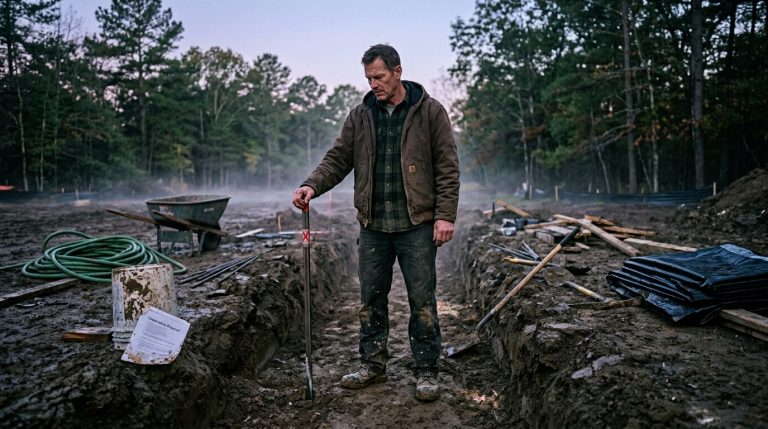
The wind up here didn’t whistle; it hummed through the dry scrub, a low vibration that caught in the throat. I stood with the orange survey stake in my hand, its jagged plastic tip crusted with red clay. It felt cheap—a flimsy, neon-bright lie hammered into the bedrock of my life.
Twenty feet away, Karen stood with her hands tucked into the pockets of her cream-colored jacket. She didn’t flinch when I pulled the stake. She just watched me with that specific, hollow intensity, the kind that usually accompanies people who are terrified of losing their grip on the world. The survey tech beside her cleared his throat, shifting his weight. He looked at the clipboard, then at the dirt, then at me.
“That’s a property line marker, sir,” the tech said. His voice was polite, drained of any real authority. He was just doing a job, a pawn in a game he clearly didn’t care to play.
“It’s an intrusion,” I said. My voice sounded flat, even to me. I looked past the tech, fixing my gaze on the empty space where the view opened up over the valley. The sunlight was starting to lose its edge, turning the distant rooftops of the Golden Summit subdivision into soft, hazy shapes.
Karen stepped forward, her heels sinking slightly into the soft, uncompacted soil. “It’s a courtesy, actually. We’re trying to prevent a long-term conflict. If you’d just reconsider the roof line, we wouldn’t have to be out here on a Tuesday afternoon.”
She said it with a practiced, gentle grace, but her knuckles were white where she gripped the edge of her roll-out map. I noticed the fraying at the cuffs of her jacket, a small, stubborn detail that didn’t match the luxury watch on her wrist. It was a tremor of something deeper—a desperation, perhaps, or a fear that the image she projected was finally starting to thin at the edges.
“My roof line is a matter of code, Karen,” I said, my voice barely above a whisper. “Not a matter of community taste.”
“The community is the code,” she replied, her eyes searching mine for an opening, a flicker of weakness she could leverage.
I held the plastic stake out to her, handle-first. For a second, the silence between us felt heavy, charged with the weight of the years we’d both spent trying to anchor ourselves to this ridge. She didn’t take it. She just looked at the dirt, then back at the valley.
I realized then that she wasn’t looking at my house at all. She was looking at her own, hidden somewhere in that sea of matching mailboxes, perhaps wondering if the walls she’d built around her life were any stronger than the ones she was trying to force on mine.
“You’re out of bounds,” I said, and for the first time, I wasn’t just talking about the survey lines.
The tech looked at Karen, waiting for a command that wouldn’t come. She turned away, her posture rigid, and began the long, slow walk back toward her SUV. She didn’t look back, but as the engine turned over, I saw a folder sitting on her passenger seat—a thick, weathered stack of documents with handwritten notes scribbled in the margins. It wasn’t just an HOA complaint. It looked like a life’s work of paperwork.
The wind picked up, swirling the dust around my boots. I stood alone on the ridge, the plastic stake still in my grip, feeling the first, cold ripple of a mystery that was only just beginning to show its shape.
CHAPTER 2: THE DIGITAL ECHO
I watched the SUV disappear down the winding access road, the dust cloud it kicked up hanging in the stagnant air like a ghost. I didn’t move for a long time. The orange survey stake was heavy in my hand, an absurdly bright piece of plastic that felt like a mockery of the landscape.
When I finally turned back toward my house, the half-finished frame looked different. Before, I had seen it as a sequence of stages—foundation, framing, sheathing, roof. Now, it looked like a target. Karen’s desperation hadn’t felt like malice; it had felt like the frantic, clawing grip of someone who was losing their footing. And those documents on her seat—the weathered folder with the handwritten marginalia—it had all the hallmarks of a project that was no longer about the view, but about survival.
I walked into the unfinished shell of the living room, the smell of fresh cedar and sawdust clinging to the damp concrete floor. My laptop was sitting on a makeshift desk of sawn-off plywood. I didn’t go straight to work. I sat there, the silence of the ridge pressing against my ears.
A sudden, sharp memory flared—the sound of an old brick wall shifting in the dark, the way the mortar turned to grit between my fingers during that renovation back in the city years ago. I remembered the feeling of total, structural loss, the way the world can slip away when you’ve built your foundation on someone else’s promises. I shivered, despite the heat of the afternoon.
I opened the laptop. The fan whirred to life, a small, synthetic sound that seemed too loud in the stillness. I pulled the memory card from my camera. The footage of Karen and her survey crew uploaded in seconds. I didn’t just watch the video; I scrubbed through the metadata.
There it was—the hidden stamp in the file properties. The document Karen had referenced, the one she’d been citing to justify the “scenic buffer,” hadn’t been generated by an official planning board. It was a local file, created on a personal machine. I opened the file itself, the PDF blurry, the text barely legible, but the edit history told the story. It had been opened and closed forty times in the last three days.
I went to the permit portal. I had a shared design-review credential, a relic from the initial site clearance months ago when I’d first considered the viability of the lot. I hadn’t used it since, but the login prompt blinked, waiting. I typed in the credentials.
The system groaned, then opened. My own permit dashboard appeared, but layered over it were the activity logs. My eyes tracked the timestamps. Every time I had uploaded a new architectural drawing, a new structural plan, or a material specification, a corresponding query had come from an internal administrative account. The same account Karen used for her “neighborhood continuity” reviews.
She wasn’t just watching; she was auditing every single bolt, every piece of lumber, every inch of square footage. She was hunting for a discrepancy, a reason to stop the clock.
I closed the laptop and walked over to the window—or rather, the space where the window would eventually be. The valley below was beginning to soften into twilight, the streetlights of Golden Summit flickering on like a grid of artificial stars.
I thought about the fraying cuffs of her jacket. If she were really the neighborhood’s champion, she wouldn’t be tracking my foundation depth at 3:00 AM. She would be sleeping. She was leveraged—emotionally, maybe financially, and certainly psychologically. She had bet everything on the idea that if she could control the horizon, she could control the chaos of her own life.
I felt a strange, cold clarity take root. I wasn’t just building a house anymore. I was dismantling a mirror. Every time I checked a permit, every time I verified a boundary, I was pulling another thread from the tapestry she had woven to keep her own world together.
I reached for my phone, but stopped. I didn’t need to call my lawyer yet. Not until I had the rest of the picture. I needed to see exactly where her fear was anchored. I walked back to the laptop and began to cross-reference the addresses of the other homes in her subdivision. If she was this desperate to protect the view from her own patio, the answer wasn’t in my land—it was in the history of the ground she stood on.
The air in the room felt cooler now, the texture of the dusk turning the unfinished interior into a space of hard, geometric shadows. I started pulling the public records for the entire development. It was going to be a long night, but for the first time since the staking incident, the pressure in my chest eased. I wasn’t waiting for her next move. I was reading her next move before she even made it.
The silence of the house seemed to shift, no longer oppressive, but focused. It was just me, the data, and the ridge, waiting for the truth to finally break the surface.
CHAPTER 3: THE VALLEY TURNOUT
The generator stuttered—a wet, hacking cough that rattled the plywood walls of my site office. The lights flickered, dimmed to a dull amber, and then the hum died entirely, leaving the ridge in a sudden, ringing silence. My laptop screen remained the only source of illumination, casting a harsh, blue-tinted glare across the scattered paper files.
I didn’t reach for the pull-cord immediately. I sat still, breathing in the smell of hot oil and ozone. Outside, the valley below was a tapestry of distant, tranquil lights, seemingly oblivious to the fact that up here, the infrastructure of my project was quietly fraying. The silence was the worst part; it felt like the mountain was holding its breath.
I climbed out of the office, my boots crunching on the dry gravel of the grade. The night air was sharp, carrying the scent of pine and impending rain. I checked the generator’s fuel line, finding nothing but the rhythmic dripping of oil onto the parched earth. It wasn’t just a mechanical failure; it felt symbolic. Everything I had tried to build here, every calculation and permit, was being tested by forces that didn’t care about my planning.
As I worked to bypass the fuel intake, the sound of a vehicle braking on the lower road drifted up to me. Tires on gravel—distinct, deliberate. I stood up, wiping the grease from my hands onto my jeans, and looked down. A sedan, its headlights dimmed, pulled off at the shoulder near the Valley Turnout.
It was the spot Karen had used for her staged protest. I didn’t see a landscape consultant this time. Just one car, its engine idling, a single silhouette framed by the dashboard light. I watched as the driver door opened and a figure stepped out, moving with a hesitation that looked entirely foreign to the woman I’d seen earlier.
The figure stood near the turnout’s railing, looking up toward my ridge. I could see the glow of a phone screen in their hand, a tiny, solitary light in the darkness. They weren’t there to protest. They were there to watch.
I could have gone back to the laptop, back to the public records that were slowly peeling away the layers of Karen’s house of cards. But there was a gravity to that solitary figure that I couldn’t ignore. I left the generator, the smell of oil still clinging to my palms, and walked toward the edge of my property where the slope dipped down toward the turnout.
I moved with the caution of a scavenger, keeping to the shadows of the scrub oak. The distance wasn’t great, but the uneven terrain made every step a negotiation with the dark. When I got close enough, I stopped. The wind had shifted, and I could hear the murmur of a voice—soft, broken, and unmoored.
“I can’t… I just don’t know how,” the person was saying into the phone.
It was Karen. She wasn’t the polished HOA chairwoman here; she was slumped against the railing, her posture ruined. The cream jacket I’d seen her wear was discarded, balled up on the hood of her car. She looked small, a fragile knot of nerves in the middle of the dark valley.
I felt a sudden, sharp pang of something that wasn’t anger. It was recognition. I had been there—the feeling of the world shrinking until all you had left was the desperate need to hold on to the last, recognizable edge of your life. She wasn’t fighting for a view; she was fighting to remain visible in a world that was rapidly moving on without her.
She hung up the phone and pressed her face into her hands. The sound she made was thin, a shuddering breath that cut through the silence of the valley. She didn’t stay there long. She pulled herself upright, wiped her face, and moved back to the car with a jagged, unnatural grace. The engine turned over, and she drove away, leaving nothing behind but the scent of exhaust and the weight of a secret she couldn’t afford to share.
I remained in the brush for a long time after the taillights vanished. The generator was still cold, the power still dead, but the urgency I’d felt earlier had shifted. I realized then that my investigation into her records wasn’t just about winning a lawsuit. It was about uncovering the truth of why she was here, why she was breaking, and what it cost to build a life that was so fragile it could be destroyed by a single roof line.
I walked back up to the house, my legs aching, the grit of the ridge under my boots feeling more like a foundation than it had in weeks. The darkness of the living room no longer felt empty. It felt full of questions that were finally starting to have answers. I went to the laptop and turned it back on, the battery light flashing a warning.
I didn’t care about the power anymore. I had seen the shadow behind the mask, and it looked nothing like a villain. It looked like someone who had run out of ground. I went back to the public records, but this time, I wasn’t just looking for discrepancies. I was looking for the point of failure—the moment when her world started to collapse. I started searching for bank records, for liens, for the quiet, unnoticed paperwork that precedes a fall.
The wind began to howl around the eaves of the house, a low, mournful sound. I worked in the flickering light of the screen, the smell of the night air filling the office, knowing that by morning, I would have the rest of the map. I wasn’t just building a home; I was learning how to survive the collapse of someone else’s.
CHAPTER 4: THE COMPLIANCE AUDIT
The fluorescent lights of the county planning office hummed with a sterile, low-frequency buzz that grated against my temples. I had been here since the doors opened at eight, my coat still smelling of the woodsmoke and damp earth from the ridge. Before me sat a stack of files thick enough to serve as a footstool, their manila jackets frayed at the corners, smelling of decades of dust and municipal neglect.
I didn’t care about the architecture anymore. I was looking for the paper trail of a life coming undone.
I flipped through the records of Golden Summit Estates, the subdivision where Karen lived. It was an orderly, well-maintained file until about three years ago. Then, the signatures changed. The maintenance requests became more frequent, the board meeting minutes shifted from discussions of landscaping and community events to frantic, circular arguments about budget deficits and “reserve fund mitigation.”
I pulled the ledger for the overlook pavilion—the same stone structure that featured the very view corridor Karen claimed I was blocking. The construction permit had been signed off by the previous HOA president, but the supplemental funding requests were all authorized by Karen. The numbers didn’t make sense. The costs for “aesthetic restoration” were inflated, nearly triple the market rate for the work done. She wasn’t just managing the neighborhood; she was subsidizing a drain on the community’s resources, likely trying to keep the facade of the subdivision from crumbling.
A clerk, a man with tired eyes and a perpetually rumpled tie, stopped by my table. “Find what you’re looking for?”
“Just history,” I said, not looking up. I tapped the file on the pavilion. “Why were these costs so high? It seems like a lot of money for a stone pergola.”
The clerk leaned in, his voice dropping to a conspiratorial whisper. “That whole hillside has been shifting for years. The drainage is a nightmare. They’ve spent more on grading and retaining walls than they have on actual landscaping. It’s a sinkhole for money.”
He drifted away, leaving me with the realization that the “scenic beauty” of Golden Summit was a constant battle against the literal erosion of the mountain. And Karen was the one at the helm, trying to hold back the tide with nothing but paperwork and willpower.
I found the discrepancy on page forty-two of a supplemental audit. There it was—a transfer of funds from the HOA reserve account to a private landscape design firm. The firm’s address was a PO Box in a neighboring county, and the registered owner shared a last name with Karen’s husband. She wasn’t just overspending; she was siphoning funds to keep the subdivision’s crumbling infrastructure from being exposed.
My heart hammered a slow, steady beat against my ribs. I had the decoy secret—the misuse of funds. It was enough to bury her, to force her out of the HOA, and to stop the harassment entirely. But as I traced the dates of the transfers, I saw something else. They coincided exactly with the time her husband had been let go from his firm.
She was drowning. Her entire life—the house, the social standing, the curated view of her perfect, suburban world—was built on a foundation of debt and deception. She wasn’t fighting me because she was a bully. She was fighting me because if my house proceeded, the county would be forced to re-evaluate the entire ridge’s drainage and zoning. A real, objective inspection would expose the foundation failures of her own subdivision.
My house wasn’t the problem. My house was the catalyst that would reveal her fraud.
I sat back, the cool, dry air of the office feeling suddenly thin. The texture of the papers in my hand—the rough, heavy-duty cardstock of the permits, the slick, synthetic feel of the audit reports—felt like physical proof of a life spent constructing a prison of her own making. I wasn’t just building a house; I was standing in the path of a landslide that she had created, and it was only a matter of time before it buried us both.
I took a photograph of the audit page with my phone, the shutter click sounding unnaturally loud in the quiet room. I didn’t need to steal the files. I had enough to end the case, to win, to be right. But as I closed the manila jacket, I felt a heavy, sinking weight in my stomach.
I looked at the notes I had scribbled in the margins of my own notebook—the names, the dates, the systemic failures. I was holding the thread that would unravel her world. I stood up, the chair scraping sharply against the linoleum, and walked toward the exit. The sunlight hitting the glass doors felt harsh, almost judgmental. I pushed through, stepping out into the heat of the day, my mind already running the calculations for how to use this, how to win, and what it would cost to hold the truth in my hands.
The walk to the parking lot felt like an eternity. I felt the weight of the phone in my pocket, the digital image stored within it like a ticking clock. I had the truth now. The question was no longer how to stop her, but how to live with the knowledge of what it would mean when I finally set the record straight.
I sat in my truck and started the engine, the familiar vibration of the wheel grounding me. I looked up at the ridge, a distant, hazy silhouette against the bright blue sky. My home. My sanctuary. It was becoming something else entirely—a witness to a slow, inevitable collapse.
CHAPTER 5: THE COURTROOM AS A MIRROR
The air in the courtroom was dry, processed by an industrial HVAC system that stripped the moisture right out of your lungs. It smelled of floor wax and old paper, a sterile scent that felt completely disconnected from the raw, red-clay reality of the ridge. I sat at the counsel table, my hands resting on the hard, polished oak, feeling the slight vibration of the floor as people shuffled in.
Karen sat across the aisle, surrounded by two of her “loyal” homeowners. She looked different today. The cream jacket was replaced by a dark, structured blazer that seemed designed to hold her together. She didn’t look at me, but I could see the tension in the set of her jaw, the way her eyes darted toward the judge’s bench every few seconds. She was a woman waiting for a storm she knew she’d summoned.
The bailiff called the court to order. The judge—a man with deep-set eyes and a reputation for despising wasted time—took his seat with a heavy thump of his gavel.
“Counsel, we are here for the injunction hearing regarding the development at the ridge,” he said, his voice flat. “Proceed.”
Karen’s lawyer stood up, a man in an expensive suit who moved with the rehearsed elegance of someone who had never actually seen a shovel hit dirt. He began his monologue, talking about “community standards” and “uninterrupted vistas,” but as I listened, I found it increasingly difficult to focus on his words.
I looked at Karen. Behind the polished exterior, I caught a glimpse of the woman I’d seen at the turnout—the one who was falling apart. The sunlight hit her at an angle, exposing the fine, spiderweb lines around her eyes and the way her fingers trembled against the wooden surface of the table.
I was hit by a sudden, jarring wave of doubt. Was I really looking at a villain, or was I staring into a reflection? I had built my own home as a shield against a world that had once failed me, and she was doing the same, only her shield was made of HOA bylaws and scenic buffers.
“Mr. Counsel?” the judge prompted, looking at my attorney.
My attorney rose. She didn’t lead with the audio recordings or the survey stakes. She led with the audit. She walked to the screen, the projector humming to life, and displayed the transfer logs I had uncovered in the county planning office.
The courtroom shifted. A murmur of disbelief rippled through the gallery. Karen’s lawyer paused, his face flushing a mottled, angry red. He started to object, but the judge silenced him with a sharp gesture.
“Let her continue,” the judge commanded.
My attorney walked the judge through the timeline—the connection between the subdivision’s deficit, the husband’s firm, and the desperate attempts to delay my construction. It wasn’t a speech; it was a cold, surgical dismantling of a facade.
Karen sat motionless. I watched her. For a heartbeat, our eyes met. There was no hatred in her gaze, no fire. Just a profound, hollow exhaustion. She looked like a house that had been stripped to the studs, its internal structure failing under the weight of everything it had been forced to carry.
She wasn’t trying to win anymore. She was just waiting for the final, inevitable collapse.
I reached into my bag and touched the corner of the folder containing the records I’d copied. It was the “killing blow” we had planned, but suddenly, the victory felt muted, shadowed by the cost of achieving it. The judge leaned forward, his brow furrowed as he scanned the documents.
“Is this accurate, Counsel?” he asked, looking at the defense.
“Your Honor, this is—this is irrelevant to the matter of the scenic easement,” Karen’s lawyer stammered, but he was already losing his grip on the room.
I saw Karen reach down to her purse, her movements slow, as if she were moving through water. She pulled out a small, silver pen and began to fidget with it, the metallic click echoing in the sudden silence. It was a rhythmic, nervous habit, the sound of a countdown.
The judge’s gaze shifted to me. I felt the weight of his stare, an old man who had seen enough broken lives to recognize one when it sat in front of him. I stood up, the chair scraping, the sound echoing like a gunshot.
“Your Honor,” I began, my voice steady, though my heart was hammering against my ribs. “There is more.”
I didn’t have to say it. The room already knew. The mystery wasn’t about the land anymore. It was about the fragility of the people who stood upon it, and as I walked toward the witness stand, I realized that the hardest part wasn’t going to be the argument—it was going to be the aftermath of the truth I was about to unleash.
CHAPTER 6: THE QUIET DISMANTLING
The transition from the gallery to the witness stand felt like walking through deep, freezing water. Every eye in the room was fixed on me, the weight of their collective curiosity pressing against my shoulders like a physical force. I took the seat, the wood cool and hard beneath my palms, and adjusted the microphone. It squeaked, a high-pitched, metallic sound that made the judge frown.
I looked down at my hands. They were steady, but beneath the surface, there was a tremor of pure, kinetic energy. I wasn’t just testifying; I was burning the bridge that Karen had spent three years building.
“Mr. Counsel,” the judge prompted, his voice echoing in the chamber. “You have the floor. You stated there was ‘more.’ Explain.”
I didn’t look at my lawyer. I looked at the screen, where the audit trail still glowed in the dim light. I started with the most mundane of facts: the utility bills. Not the big, dramatic figures, but the small, recurring anomalies in the subdivision’s maintenance records. I described the way the irrigation systems were never fully upgraded, despite the invoices claiming otherwise. I detailed the discrepancies in the road maintenance logs—work charged to the HOA that had been performed by the very firm Karen’s husband had been ousted from years ago.
It wasn’t a grand, sweeping declaration of guilt. It was the slow, methodical erosion of a foundation.
With every sentence, the atmosphere in the room changed. The tension shifted from the aggressive, confrontational energy of the defense to something colder, more final. Karen stopped fidgeting with the silver pen. She went entirely still, her head bowed, her gaze fixed on the table in front of her. She looked like someone who had just realized the floor beneath her had vanished, and she was waiting for the sensation of the fall.
“And this,” I continued, gesturing to the projection, “indicates a systematic redirection of funds to cover maintenance deficits that were, in fact, direct consequences of the subdivision’s unstable grading.”
My lawyer stood, her movements sharp and deliberate. “Your Honor, we submit this not to argue a criminal matter, but to provide context for the pattern of harassment and malicious litigation initiated by the defendant.”
The judge leaned back, his eyes narrowing as he scanned the documentation. He wasn’t looking for a villain anymore; he was looking for the truth of the situation. He turned his attention to Karen. “Ms. Holloway, do you wish to respond to these allegations?”
Karen stood. The movement was difficult, as if she were lifting a great, invisible weight. She didn’t look at her lawyer, who was frantically signaling for her to stay seated. She looked at me.
For the first time, I saw it—not the armor of the HOA chair, but the raw, unadorned truth of a woman who had spent years trying to maintain a version of her life that never existed. She didn’t speak immediately. The silence stretched until it felt like the walls were closing in, the air thick with the scent of ozone and the stale, dry dust of the courtroom.
“I just wanted the ridge to be perfect,” she whispered. Her voice was thin, barely reaching the bench. “Everything is so… broken. I just wanted one place that stayed the way it was supposed to be.”
It wasn’t a confession of malice. It was a confession of exhaustion. She had been fighting the erosion of her world with the only tools she had, and in the process, she had become the force that was destroying everything she touched.
The judge’s gaze softened, just a fraction, but the ruling remained absolute. He tapped the gavel, a sound that seemed to signal the final closure of the chapter. “The court will take these documents into account during the sentencing briefing for the trespass and false filing issues. Counsel, I suggest you advise your client that any further contact with the plaintiff will be met with immediate contempt.”
The proceeding didn’t end with a bang, but with the quiet, devastating sound of the truth settling into the room. As I stepped down from the stand, my legs felt weak, the adrenaline draining out of me and leaving a strange, hollow space in its wake. I walked past the counsel table. Karen didn’t look up. She was sitting with her hands clasped tightly in her lap, her knuckles white, staring at the grain of the wood as if it held the answer to her undoing.
I reached the exit and pushed through the heavy, soundproof doors. The sudden transition to the hallway, with its bright, natural light and the distant, muffled sound of the outside world, felt like coming up for air after a long, dark dive. My lawyer joined me a moment later, her face unreadable.
“It’s over,” she said, her voice neutral.
I looked back at the doors, the thick, solid wood a barrier between the reality I had just dismantled and the life that was waiting for me outside. I had won. The record was clean, the ridge was mine, and the threat of the HOA was gone. But as I walked toward the parking lot, the weight of what I had done—and the weight of what Karen was now facing—sat heavy in my chest.
The wind outside was picking up, swirling the dry grit of the parking lot around my boots. I found my truck, the metal cool and familiar under my touch. I didn’t get in immediately. I stood there, looking up at the sky, the vast, open horizon of the valley spreading out before me. It was beautiful, untamed, and entirely indifferent to the mess we had made of our own lives. I realized then that the silence I had fought so hard to reclaim wasn’t empty. It was full of the echoes of everything we had built, and everything we had lost to get here.
CHAPTER 7: THE RIDGE UNCOVERED
The drive back to the ridge was a blur of gray highway and shifting shadows. My hands felt detached from the steering wheel, my mind replaying the courtroom in jagged, strobe-light flashes—Karen’s bowed head, the judge’s steady gaze, the sound of the gavel that hadn’t just settled a dispute, but had effectively dismantled a life. I reached the trailhead as the sky began to bruise with purple, the first heavy drops of an autumn rain beginning to pockmark the dust of the access road.
I left the truck and started the walk up the incline. The physical exertion was a relief, a grounding force against the surreal numbness that had set in since the hearing. As I climbed, the house came into view, its skeleton stark against the darkening sky. Without the permits, the flags, and the constant, buzzing anxiety of the HOA’s interference, it looked almost fragile.
I stopped at the edge of the patio—the very line where I had first confronted Karen over those orange stakes. The plastic markers were gone now, removed by the court order, but the ghost of the line remained, a scar in the soil that the rain was already starting to heal.
I sat on the edge of the unfinished concrete slab, my boots dangling over the drop-off. The ridge fell away into the valley, and for a long time, I just listened to the rain. It was a rhythmic, drumming sound against the exposed rafters, a steady heartbeat for a structure that had been born out of conflict.
A sudden, sharp memory flickered—the sensation of my own childhood home, a place that had felt just as fragile, just as susceptible to the whims of forces I couldn’t control. I remembered the feeling of helplessness, the way I had watched my father struggle to keep the roof over our heads, and I realized that my obsession with this build wasn’t about the view or the property value. I had been trying to build a fortress that no one could breach, a space where I would never again have to watch someone else’s life erode.
But looking at the valley, at the lights of Golden Summit flickering on in the gloom, I saw the truth of it. I had achieved my “victory,” but it hadn’t made me safe. It had only made me a participant in the same cycle of destruction I had once feared. Karen hadn’t been a monster; she had been a mirror.
I leaned back, my palms flat against the cold, damp concrete. The rain was intensifying, soaking into my jacket and running down the bridge of my nose, but I didn’t move. The silence of the mountain felt less like a conquest and more like a heavy, contemplative weight.
I wasn’t the victor here. I was just the survivor.
I thought about the audit report, the systemic failure of the subdivision, and the husband’s firm. Karen hadn’t just been stealing funds to maintain her lifestyle; she had been trying to keep the mountain itself from swallowing her home. The erosion wasn’t just physical—it was existential. The more I looked, the more I realized that the house I was building was the only thing standing between the ridge and the same inevitable, slow collapse that had claimed Golden Summit.
I stood up, the movement slow and deliberate, and walked into the shell of the house. I found a tarp in the corner and pulled it over my plywood workspace, covering the plans and the digital records. They were just paper now. They didn’t matter anymore.
As the storm broke in earnest, the sound of the rain against the wood became deafening, a roar that filled every corner of the structure. I walked to the window, watching the rain wash the dust from the valley below. The ridge felt cleaner, sharper, the air filled with the scent of wet stone and wild, uncultivated growth.
I had won the war, but I had lost the certainty that had carried me here. I realized then that my identity wasn’t found in the permanence of the walls I was raising, but in the willingness to let them be weathered, to let the mountain be exactly what it was—unpredictable, eroding, and completely beyond my control.
I closed my eyes, letting the sound of the rain wash over me. The final hearing was tomorrow, the formal sanctions briefing, but that felt like a lifetime away. For tonight, there was only the storm, the ridge, and the quiet, sobering knowledge that the ground beneath me was always, and would always be, shifting.
CHAPTER 8: THE ECHO FADES
The rain had long since tapered off, leaving the air heavy with the scent of wet pine and the rich, dark musk of the earth. I stood on the finished deck, the wood grain smooth under my palm. The house was quiet—not the oppressive, expectant silence of the construction phase, but a peaceful, settled stillness. The final inspection had been signed off hours ago; the last of the clutter had been cleared away.
I looked down at the valley. The lights of Golden Summit were no longer a grid of artificial stars but a distant, softened glow. The legal storm had passed as surely as the weather. Karen had vacated her role, and the neighborhood had finally instituted the administrative barriers that would prevent another one-person crusade from ever gaining traction. She was gone—not just from the committee, but from the landscape. I heard, through the quiet grapevine of the community, that she had listed her home for sale, a move that felt less like a choice and more like an surrender to the erosion she had spent years fighting.
The front door clicked, and my three friends stepped onto the deck, carrying the remnants of a late-afternoon meal. The grill was cooling, its metal skin ticking as it contracted in the evening air.
“You did it,” one of them said, leaning against the railing. He traced the smooth edge of the wood, his eyes scanning the structure. “It’s solid. Really solid.”
I nodded, feeling a strange, hollow sort of relief. I had built my shield. The walls were plumb, the joints tight, the foundation poured deep into the bedrock of the ridge. I had done exactly what I set out to do. I had protected my space, my property, and my identity from the outside world.
But as the evening deepened and the conversation flowed around me—easy, unburdened talk about the valley, the weather, and the quiet beauty of the ridge—I found myself watching the way the light played on the deck. It wasn’t perfect. There were slight variations in the wood, small, human imperfections where I had hand-sanded the edges or adjusted for the natural slope of the ground.
My attorney arrived shortly after, moving with that brisk, professional efficiency that seemed to belong to a different world. She leaned against the railing, her gaze drifting toward the valley, then back to the house.
“For the record,” she said, her voice dropping into a register of uncharacteristic warmth, “that was one of the most frustrating cases I’ve ever had the pleasure of winning.”
She looked at me, her eyes sharp and assessing. “You spent a lot of time fighting for this, didn’t you?”
“I did,” I replied.
“Was it worth it?”
I looked at the deck, the wood I had meticulously finished, the space I had fought so hard to carve out of the mountain. It was safe. It was mine. But the victory felt like a mirror—it showed me exactly how much I was willing to harden myself to keep the world at bay. I had protected my identity, but I had also learned that the only way to truly survive the erosion was to stop trying to fight the mountain itself.
I walked over to the corner of the deck, where a small, overlooked board had been marred during the final framing stage. I knelt down, pulled a sanding block from my pocket, and began to work on it, the sound rhythmic and soft in the evening air. I wasn’t fixing it because it had to be perfect. I was fixing it because I finally understood that the process—the constant, iterative work of building, of failing, of adjusting—was the only real security I had.
The work was quiet, meditative. My friends didn’t interrupt; they moved to the side, letting the rhythm of the sanding take over. When I was finished, I brushed the fine dust from the wood, the texture smooth and weathered, perfectly integrated with the rest of the deck.
I stood up, the tension that had been locked in my shoulders for months finally draining away. I wasn’t just a builder, or a claimant, or a victim of a system. I was simply a person on a mountain, breathing in the cold, clean air of a life that was finally, truly, my own. The house was finished, the record was closed, and the ridge—unmoved, eternal, and perfectly indifferent—remained.
I looked out one last time before the light failed completely. The valley was dark, the noise of the conflict nothing more than a faint, distant echo in the settling wind. The silence wasn’t empty anymore; it was deep, expansive, and for the first time in a very long time, it belonged to me. I went inside, leaving the door unlocked, and for the first time since I broke ground, I slept without once checking the perimeter.