The Keystone Inheritance: A Calculated Defense of the Valley’s Soil and the Silence of Ownership
CHAPTER 1: THE ENGINES SHADOW
The iron teeth of the bulldozer tore into the valley floor with a rhythm that defied the morning stillness. It was a grinding, mechanical violence that chewed through moss and packed earth, sending a fine, suffocating grit of red clay against the cedar siding of the mansion. I stood on the porch, my boots planted firmly on weathered wood, watching the treads carve a jagged scar across the landscape.
The flagstones leading to my garden path, placed by my grandfather’s hands decades ago, were the first to shatter. The sound of stone grinding against stone under the weight of the machine was distinct—a sharp, high-pitched crack that resonated in my chest.
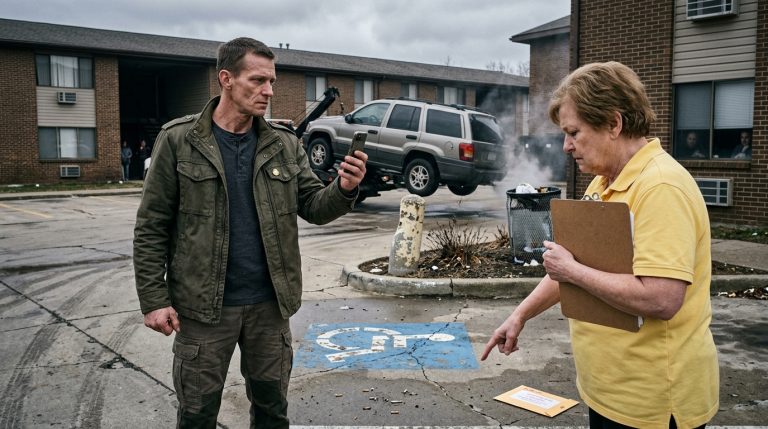
Renee Kesler stood near the edge of the clearing, her heels sinking into the mud she had forced into existence. She held her clipboard like a shield, her posture that of someone who had already decided the outcome of the war. She didn’t look at the ruin of the path; she looked at the mansion as if it were already a pile of lumber destined for the fire.
I reached out, my fingers brushing the heavy brass paperweight I kept tucked into the railing’s shadow. It was cold, dense, and grounded—an anchor against the sudden, sharp surge of heat climbing my throat. I had to force the air into my lungs, focusing on the way the sunlight hit the dust motes dancing in the wake of the machine. The HOA had cameras perched on the roof of their support truck, their lenses unblinking, waiting for me to step off this porch and give them the legal leverage they craved.
They wanted a confrontation. They wanted a shout, a shove, a shattered window—anything to categorize me as the aggressor.
I kept my hands at my sides. I calculated the distance between the bulldozer’s blade and the corner of the front terrace. Every inch of that gouged earth was a violation, a trespass that would eventually be itemized, analyzed, and repaid. But the rage, while potent, was an inefficient tool. I watched Renee check her watch, a flicker of impatience crossing her face, and I realized then that she was operating on a timeline that assumed I was merely a caretaker, not the foundation itself.
The truck idled, a low, guttural thrum that vibrated through the foundation of the house. Behind that machine lay not just the luxury villas they promised their investors, but a tangled web of intent I had only begun to unravel. As the bulldozer swung its blade back to make another pass, I noticed something that made the air in my lungs go still: a thin, yellow surveyor’s tape caught in the treads, trailing behind the machine like a discarded promise, cutting deep into the soil exactly where the original trust markers should have been.
It wasn’t just a road. They were carving right over the heart of the title.
CHAPTER 2: THE ARCHIVE OF OWNERSHIP
The bulldozer’s engine cut to a low, throaty idle, leaving behind a silence so absolute it felt heavy. I didn’t move from the porch. I watched the dust settle, a fine, metallic silt that coated the porch railing where my hands rested. My skin felt tight, a reaction to the sheer audacity of the encroachment. Renee Kesler had already turned her back to the mansion, her clipboard tucked firmly under her arm, walking toward the support truck as if the scar she’d left on the landscape were already forgotten.
I stepped off the porch. The ground here was uneven, the natural slope of the valley disturbed by the treads. My boots crunched over shattered flagstones—the remnants of a path that had survived a century of storms only to be decimated by a forty-five-minute HOA oversight. I reached down, my fingers grazing a piece of the broken stone. It was cool, damp with the morning dew, and carried the faint, earthy scent of disturbed root systems.
A sudden, sharp image flickered in my mind: my grandfather, his hands calloused and stained with the deep, iron-rich red of this valley’s soil. “The land doesn’t belong to the people who walk on it, lad. It belongs to the paper that records it. Don’t ever let the noise of the day drown out the silence of the deed.” I blinked, the phantom weight of his hand on my shoulder fading into the reality of the present. He had been right. The noise was constant—the roar of the machine, the confident clip of Renee’s heels, the manufactured urgency of their development—but it was all surface-level, a thin veneer over a history that was not theirs to rewrite.
I didn’t head for the bulldozer. I went to my study.
The transition from the chaos of the yard to the quiet, wood-paneled interior of the mansion was jarring. The air here was still, smelling of old paper and beeswax. I moved directly to the floor-to-ceiling shelves where the archives were stored. I knew exactly where the original land survey was kept—bound in a faded, leather-backed portfolio that had remained unopened for years.
The county clerk’s office was a thirty-minute drive, a route that cut through the edge of the valley. Every mile was a test of restraint. I kept my eyes on the road, but my mind was replaying the sight of that yellow tape in the treads. They were moving faster than I had anticipated. If they had already begun physically marking the route, they were operating on the assumption that the legal paperwork would catch up later—or that they could bury the truth under enough layers of bureaucratic red tape that it would never see the light of day.
The clerk’s office was a cramped, windowless room filled with the hum of fluorescent lights and the rhythmic thud of date stamps. The clerk behind the counter, a woman with tired eyes and a stack of folders, didn’t look up when I approached.
“I need to verify the plat filings for the Northern Ridge expansion,” I said, my voice steady, stripped of the residual frustration of the morning.
She sighed, a sound that suggested I was the third person to ask for something tedious in the last hour. She clicked her keyboard, her eyes tracking across the screen. “That’s under review. HOA-authorized. You’re listed as an ‘interested party,’ which means you don’t have direct access until the final zoning hearing.”
I didn’t argue. I didn’t get angry. I simply slid the weathered, leather-bound portfolio onto the counter. “I’m not interested in their filing, ma’am. I’m interested in the Master Trust deed from 1924. It covers the entire valley parcel. It’s never been subdivided.”
She glanced at me, then at the folder. Her skepticism was palpable, but when she opened the portfolio and saw the official, wax-sealed original—not a photocopy—her demeanor shifted. She pulled it toward her, her fingers moving with a sudden, cautious reverence.
“This is…” she started, then stopped, tracing a finger over the embossed seal. She turned to a nearby computer, abandoning the HOA’s digital file entirely in favor of the physical records stored in the deeper, older archive. She spent a long time typing. The silence in the room seemed to stretch, the hum of the lights becoming a low-frequency drone.
When she finally looked up, her expression had changed from indifference to a quiet, controlled alarm. “Mr. Nash,” she said, keeping her voice low, “the maps they submitted? They don’t just ‘not align.’ They show land that isn’t even in their jurisdiction. They’re claiming boundaries that haven’t existed for nearly a hundred years.”
I felt a cold, sharp clarity settle over me. They weren’t just incompetent; they were forging the physical reality of the valley to suit a project that was built on nothing but bad faith. I watched her pull a printout of their submitted map and lay it over the original survey. The difference was stark. The HOA’s red line sliced right through the keystone of the trust.
“They’re not building a road,” I said, the realization hardening into a strategy. “They’re trying to break the parcel.”
“If they do,” she whispered, “the whole deed gets tangled in litigation. By the time it’s cleared, they’ll have the villas halfway built.”
I took the documents back, sliding them into my bag with a calm, deliberate movement. The iron in the soil, the dust on the siding, the broken stones—it all felt like a singular weight now. I had the truth, but the truth was only as strong as the person willing to hold the line. I didn’t thank her; I just nodded and stepped back out into the bright, uncompromising afternoon sun. The valley was waiting, and I had the evidence they didn’t even know I held.
CHAPTER 3: THE ATTORNEYS GAMBIT
The air in Zachary’s office was cool, filtered through an old air-scrubber that hummed with a metallic, insistent rattle. I sat across from him, the leather of the chair creaking under the weight of my exhaustion. The documents I had recovered from the county office sat on the mahogany desk between us, looking deceptively thin against the dark wood. Zachary, a man whose life was measured in billable hours and procedural nuance, was busy sifting through a stack of HOA-related filings.
He didn’t look up when I entered. He only pushed a stack of bank statements toward me. “The HOA board is playing a different game than they’re letting on,” he said, his voice flat. “They’re not just re-zoning for the sake of the retreat. They’re burning through their capital at an unsustainable rate.”
I looked down at the statements. Numbers blurred, then sharpened. There were entries for ‘Consultant Fees’—repeated, five-figure payments made to an LLC I didn’t recognize. The recipient address was a PO box in the next county over, a common tactic for obscuring the true beneficiaries of large-scale development projects.
“These payments don’t match the labor logs,” I noted, tracing the dates with my finger. “They were cut during the months the board was claiming the valley was ‘unprofitable’ for current residents.”
Zachary leaned back, his eyes narrowing. “They’re funneling the operating budget into a private sinkhole. If the retreat falls through—or if they lose the property dispute—they’ve already cashed out the community’s reserves. It’s not just a land grab, Nash. It’s an exit strategy.”
The weight of it settled in my gut—not as a surprise, but as a confirmation. The bulldozer, the threats, the constant, low-level harassment from Renee Kesler—it wasn’t just arrogance. It was the desperate thrashing of a failing ship.
I picked up a stray invoice fragment that had been clipped to the back of the file. It was a partial record of a payment for ‘Environmental Impact Assessment’ services from that same mystery LLC. The total was staggering, far exceeding what any reputable firm would charge for a preliminary study of the valley. My pulse quickened. If they were faking the environmental approvals, they hadn’t just bypassed the law; they had actively subverted the safety regulations that protected the land.
“They’re cutting corners that could lead to criminal liability,” I said, my voice barely above a whisper.
“They’re gambling that they can finish the first phase before anyone audits the books,” Zachary countered. He opened his desk drawer and pulled out a small, encrypted flash drive. “I’ve been tracking the LLC’s registration. It’s a dead end, but the paper trail for the initial funding is linked to a private account held by the board’s treasurer. We have enough to initiate a formal inquiry, but if we do, they’ll know we’re watching.”
I looked out the window at the parking lot below, watching a car pull in—a dark sedan that lingered just a second too long before parking near the rear exit. My stomach tightened.
“If we wait, they’ll destroy the records,” I said. “If we move now, we have to be sure the county will act on it.”
Zachary nodded slowly. He understood the stakes. “The evidence in that folder you brought back? It’s the lock. The invoice? That’s the key. If we present both to the commission at the emergency hearing tomorrow, they won’t be able to ignore the discrepancy.”
I stood up, the chair scraping sharply against the hardwood floor. The atmosphere in the room felt suddenly charged, the metallic scent of the air-scrubber and the dry, dusty smell of the files creating a sensory backdrop that felt increasingly like the valley itself—rusted, brittle, and ready to break. I took the folder and the invoice fragment, tucking them into my bag.
“They expect me to be a nuisance,” I said, moving toward the door. “They don’t expect me to be an auditor.”
Zachary watched me go, his expression unreadable. “Be careful, Nash. When people like Kesler realize the trap is closing, they don’t look for an exit. They look for something to break.”
I stepped out of the office and into the hallway. The fluorescent lights flickered, casting long, erratic shadows across the linoleum. I thought of the bulldozer again—the yellow tape, the gouged earth—and realized that the damage they had done to my garden path was only the first sign of the ruin they intended for the entire ridge. My path forward was no longer a matter of defense; it was a matter of surgical precision. I would go to that board meeting tomorrow not as a resident, but as the person holding the wrecking ball.
CHAPTER 4: THE BOARDROOM SIEGE
The walk to the community center felt like wading through thick, stagnant water. Each step toward the double doors of the boardroom was measured, my shoulder bag heavy with the folder—the evidence that would turn the HOA’s manufactured authority into dust. The parking lot was full, a sea of sedans and SUVs that mirrored the entitlement of the people inside. I spotted Renee Kesler’s vehicle near the entrance, its engine cooling with a rhythmic metallic ticking. The same dark sedan I had seen earlier was parked two rows away, silent and observant.
I reached the security entrance, a glass-walled vestibule that required a badge scan—a recent addition, designed to keep “non-essential” residents out. I stepped up to the reader, but the light stayed stubbornly, coldly red.
“Access denied,” the automated voice chirped, a flat, mechanical rejection that echoed in the quiet lobby.
I tried again. Red. I checked the badge Zachary had managed to pull from the county records for ‘official oversight,’ a temporary pass that should have granted me entry. I felt a spike of heat in my chest, the familiar, grounding weight of the brass paperweight in my pocket reminding me to stay level.
A security guard, a man whose uniform looked two sizes too large and whose face was etched with the bored indifference of a gatekeeper, stepped out from a small side booth. “Can’t help you, sir. If the badge doesn’t register, you’re not on the list.”
“I am a property owner within this parcel,” I said, keeping my voice low and transactional. “The meeting is public notice. Check the ledger again.”
He stared at me, his hand resting on his radio. “Renee’s orders. No exceptions for anyone not on the pre-approved access sheet. Move along before I call the local sheriff to escort you off the premises for trespassing.”
This was it—the procedural wall. They had anticipated my attendance and had already moved to excise me from the room, effectively silencing the evidence before it could ever hit the table. I looked through the glass doors. Inside, the corridor was empty, but I could hear the muffled, resonant hum of voices emanating from the boardroom.
The security guard shifted his weight, his eyes darting to the camera mounted on the ceiling above the door. It was a digital feed, likely being monitored in real-time by someone inside. They were watching to see if I would cause a scene—if I would shout, push, or lose my temper. That was the trap. If I made this a physical confrontation, the evidence in my bag would be sidelined in favor of an assault charge.
I didn’t yell. I didn’t push. Instead, I pulled out my phone and dialed the county inspector’s office—the number Zachary had given me for the legal liaison. It was a gamble; if they didn’t pick up, I would be stuck on the outside, watching them pass resolutions that would legally bind me before I had a chance to argue.
The phone rang three times. Four. My thumb hovered over the screen, ready to hang up and try the state attorney’s office.
“This is Inspector Miller,” a voice finally cracked through.
“Inspector, this is Nash,” I said, keeping my eyes locked on the guard, who was now growing visibly uncomfortable with the fact that I wasn’t leaving. “I am currently at the entrance of the community board meeting. I have been formally denied access to a public meeting regarding land-use permits, despite being an affected property owner. The board is actively violating the county’s transparency ordinance regarding the resort expansion.”
The guard took a step forward, his hand raising to his radio. “Sir, step away from the entrance.”
I turned my back to him, facing the glass doors, and raised my voice just enough to be heard through the intercom. “I am currently on the line with the County Inspector. If you deny entry, you are confirming a breach of the county’s public access mandate. That will be documented as criminal obstruction.”
The effect was instantaneous. The guard stopped. He looked at the camera, then at his radio, then at me. His confidence shattered, replaced by the crushing weight of bureaucratic fear. He knew the HOA was powerful, but he also knew that defying a direct county mandate was a fast track to unemployment.
He hesitated, then pulled a keycard from his belt and swiped it against the reader. The lock clicked, a sharp, heavy sound that felt like the snapping of a tension wire. The door swung open.
I walked past him, my pace steady, not looking back. The hallway toward the boardroom smelled of industrial floor wax and stale coffee—a sterile, artificial scent that clung to the walls. My heart was a steady, rhythmic pulse in my ears. I reached the boardroom doors, the voices inside rising in an argument I couldn’t yet identify.
I paused at the threshold, smoothing my jacket. I could hear Renee’s voice—sharp, authoritative, cutting through the murmurs of the others. She was in the middle of a motion to approve the ‘final phase’ of the access route.
I pushed the doors open.
The sound of the room hit me all at once—the shuffling of papers, the low, panicked whisper of a board member, and the absolute, sudden silence as twenty pairs of eyes snapped toward me. Renee Kesler stood at the head of the table, a map of the valley fanned out before her, her finger pointing at the exact location of my porch.
She looked at me, her expression a mix of shock and icy, controlled rage. For a heartbeat, the room felt like it was suspended in amber. I didn’t say a word. I simply walked toward the empty chair at the end of the table, pulled it out, and sat down. I laid the leather-bound portfolio on the table, the wax seal catching the harsh overhead light, and waited for the silence to become unbearable.
Renee’s hand trembled, just a fraction, as she stared at the folder. She knew. She didn’t know what was inside, but she knew the era of her easy, unquestioned control had just ended.
“Proceed,” I said, the word hitting the room like a hammer. “I believe you were just discussing my property.”
CHAPTER 5: THE LEGAL SEVERANCE
The silence was a tangible thing, a heavy, airless weight that filled the corners of the boardroom and pressed against the glass-fronted cabinets. Renee Kesler hadn’t moved. Her hand was still frozen mid-air, a manicured finger hovering over the map of the valley, but her focus—and the focus of every person seated at the mahogany table—had shifted entirely to the leather-bound portfolio I had placed before me.
The wax seal, cracked and darkened by the passage of nearly a century, looked like a dark, unblinking eye in the harsh overhead light.
“It’s a forgery,” Renee said, but the sharpness was gone from her voice, replaced by a brittle, hollow tone that didn’t quite fill the space. She didn’t look at me; she looked at the map. “You’ve spent decades clinging to a property that exists only in your imagination, Mr. Nash. That trust was dissolved when the original corporation defaulted in the fifties.”
I didn’t answer. I reached out and slowly, deliberately, slid the portfolio across the table until it rested in front of the board secretary, a man whose hands were already twitching with the urge to reach for it.
“Open it,” I said. My voice was calm, a stark contrast to the thundering rhythm of my own heart.
The secretary hesitated, then looked at Renee for a sign. She gave none. Her face was a mask of cold, calculated stillness. When he finally unlatched the leather clasp, the sound was unnaturally loud in the quiet room. He spread the documents out—the primary survey, the original trust deed, and the series of tax records I had pulled from the county archive that morning.
I watched the faces of the board members as they leaned in. The confusion was the first thing to show, followed quickly by a slow, dawning comprehension. The documents weren’t just valid; they were definitive. They mapped the land with a precision that made the HOA’s color-coded planning diagrams look like the scribblings of a child.
“These are original filings,” one of the older board members muttered, his voice shaking. “I remember the boundary checks from the historical society report. These… these match the 1924 survey exactly.”
Renee’s posture finally broke. She pulled her hands away from the table, tucking them into her pockets as if they were suddenly useless. The mask of authority was slipping, revealing the raw, frantic calculation beneath. She wasn’t looking at the documents; she was looking at the board members, measuring their loyalty against the weight of the evidence.
“This changes nothing regarding the current development agreements,” she insisted, but her voice was rising now, losing its discipline. “We have the investors, we have the signed contracts—”
“You have contracts for land you don’t own,” I interrupted, my tone still steady, still quiet. I reached into my bag and pulled out the invoice fragment I had found in Zachary’s office—the one linking the ‘Consultant Fees’ to the board treasurer’s private LLC. I laid it on top of the deed, a small, unassuming slip of paper that carried the weight of a felony. “And you have a ledger that doesn’t quite account for where those ‘Consulting Fees’ actually went. I believe the term is embezzlement, Renee. Or is it just ‘community overhead’?”
The room seemed to tilt. The secretary looked up from the papers, his eyes wide, shifting from the invoice to the treasurer—a man who had been sitting quietly at the far end of the table, his face turning a sickly, mottled gray.
The treasurer made a move to stand, a desperate, clumsy motion, but the board members near him pushed their chairs back, creating an instant, insulating distance. The betrayal was sudden, total, and irreversible. The unity of the board, once their greatest weapon, had just fractured into a dozen individual survival instincts.
Renee’s eyes flicked toward the door. She was calculating the distance, the time it would take to reach her car, the possibility of shredding the remaining digital files before a subpoena could be served. But she wasn’t just looking at the exit—she was looking at me, and for a fleeting, terrifying moment, I saw the truth behind the mask. She wasn’t afraid of losing the land. She was afraid of what would happen when the money she had siphoned finally dried up.
“You think you’ve won,” she said, her voice dropping to a low, serrated edge. “You think the law is a shield. But when this place is empty, when the funding is gone and the community is nothing but a ghost town because of your ‘protection,’ what exactly will you be left with? A mansion full of dust?”
I looked at her, really looked at her, and saw only the exhaustion of a predator who had run out of prey. The anger that had simmered in me for days, the fury that had driven me to break the procedural walls—it all evaporated, leaving behind a cold, crystalline sense of purpose.
“I will be left with the valley,” I said. “And the silence. That is something you never understood, Renee. You thought the noise you made—the bulldozers, the threats, the maps—was power. It was just a distraction.”
I stood up, and the chair clattered against the floor—a signal that the siege was over. The secretary was already reaching for the boardroom phone, likely to call the county legal office, while the rest of the board was descending into a cacophony of frantic, finger-pointing recriminations. Renee Kesler stood alone in the center of the storm, her clipboard forgotten on the table, her authority dissolved into the stale air of the room. I didn’t wait to see the end of the argument. I walked toward the doors, my path unblocked, and stepped out into the hallway, leaving the wreckage of their ambition behind me.
CHAPTER 6: THE QUIETUDE OF RESTORATION
The hallway outside the boardroom was bathed in the dull, flickering glow of emergency lights, a stark, antiseptic contrast to the heat of the confrontation I had just left behind. I walked slowly, the heels of my boots clicking against the linoleum with a measured, rhythmic cadence. Behind me, the muffled cacophony of the board meeting—the raised voices, the scraping of chairs, the frantic, defensive stammering of Renee Kesler—faded into a singular, diminished sound, like a dying engine sputtering out of fuel.
I reached the lobby and pushed through the heavy glass doors into the cool, biting air of the evening. The transition was absolute. The artificial, sterile atmosphere of the community center was replaced by the sprawling, dark horizon of the valley. The scent of pine and damp earth was thick, grounding, a reminder of the scale I had been defending.
The bulldozer, once a looming, mechanical monster, sat parked near the perimeter of my property line. It looked smaller now, stripped of its menace by the legal reality I had just forced into place. The trenches it had carved into the soft, red clay were raw and ugly, but they were no longer a weapon; they were now just a liability for the HOA to clean up. I walked toward the edge of the property, the mud giving way beneath my boots, until I reached the garden path where the first flagstone had been shattered.
I knelt. The cool, damp soil stained my jeans, but I didn’t care. I reached into the loose dirt and found a shard of the original stone, jagged and worn by years of weather. I turned it over in my hand, feeling the weight of the material, the subtle, rough texture of a history that had been built, not taken.
I heard footsteps crunching on the gravel behind me. It wasn’t the hurried, purposeful stride of a board member, nor the aggressive, heavy step of the bulldozer operator. It was lighter, hesitant. I didn’t turn around. I knew the cadence. It was the junior board member who had whispered the warning to me outside the room, the one who had finally seen the ledger for what it truly was.
“They’ve already started pulling the funding,” the voice said. It was thin, weary. “The investors didn’t wait for the county audit. Once they saw the name of the Trust on the deed, they packed up. It’s over, Nash.”
“It was over the moment they decided to ignore the boundary,” I said, still looking at the shard of stone. I stood up and turned to face him. He looked younger than I had remembered, his face pale under the moonlight, his expression a mix of relief and the crushing, heavy weight of complicity.
“Renee is refusing to leave,” he continued, glancing back toward the community center. “She’s claiming it’s a technicality, that the county injunction is temporary. But she’s alone in there now. The rest of them… they’ve already started drafting their resignations.”
I nodded slowly. The collapse was total, exactly as the legal documents had dictated. It wasn’t a triumph of fire and fury; it was the quiet, inevitable crushing weight of the law, pressing down until the structure they had built on sand simply ceased to be.
“What happens to the path?” he asked, gesturing to the ruins of the garden.
“It gets repaired,” I said. “Stone by stone. It takes time, but the foundation hasn’t moved.”
He hesitated, then turned to walk back toward the parking lot, leaving me alone in the dark. I watched him go, the taillights of his car flickering as he pulled away, leaving the property to its natural, encroaching silence.
I turned back to the mansion. The cedar siding was covered in dust, and the front porch was marred by the treads, but as I climbed the steps, the house felt solid. I reached into my pocket and pulled out the brass paperweight. I walked to the porch railing—the one place that had been visibly scarred by the heavy machinery—and placed the weight on the wood. It was a small, tactile anchor. Then, I knelt by the railing and began to clear away the debris, brushing the loose dirt from the surface, smoothing the edges of the wood where the bulldozer’s reach had grazed the structure.
This was the cool-down. The kinetic energy that had sustained me for the last week—the calls to the county, the hours spent in the archives, the tactical silence in the boardroom—drained away, leaving me with a profound, aching stillness. The valley was mine. Not because I had claimed it with a shout, but because it had existed here long before the HOA was ever conceived, and it would remain here long after they were forgotten.
I spent the next hour in the dark, working the soil back into the trenches, lining up the fractured flagstones, and listening to the wind sweep through the ridge. It was a restorative, physical labor. My hands were tired, my knees were stiff, but every movement was a rejection of the chaos that had been imposed on this landscape.
By the time I stood up, the first grey light of morning was beginning to bleed over the eastern ridge. The valley was coming back into focus—the trees, the stream, the ancient, quiet slopes. It wasn’t perfect; the scars in the earth would take a season of rain to truly heal, and the mansion would need a thorough cleaning to erase the grit of the bulldozer’s passing. But the ownership was absolute. The Master Trust was the bedrock, and I was its keeper.
I went inside and hung the deed on the mantle, right next to the family photo. It wasn’t a trophy. It was a document of record, a piece of paper that served as the final word in a conversation that had never really been mine to start, only mine to finish. I sat in the chair by the window, watching the sun crest the ridge, and for the first time in weeks, I didn’t feel the need to calculate, to plan, or to monitor. I just watched the valley wake up, whole, silent, and entirely mine. The game had ended, and the land, having endured the reach of human hubris, returned to its own, quiet truth.