A Siege of Red Clay: One Man’s Stand Against a Suburban Empire Built on Stolen Water
CHAPTER 1: THE TICKET TO NOWHERE
The heat coming off the red clay of Caldwell County wasn’t just temperature; it was pressure. It pressed against the truck door as I pushed it open, the heavy steel swinging out to reveal the lake. It sat glass-still, a dark, reflective mirror that had caught my grandfather’s sweat and my father’s quiet pride for forty-five years.
Three days after the funeral, I’d come here looking for silence. What I found were the polos.
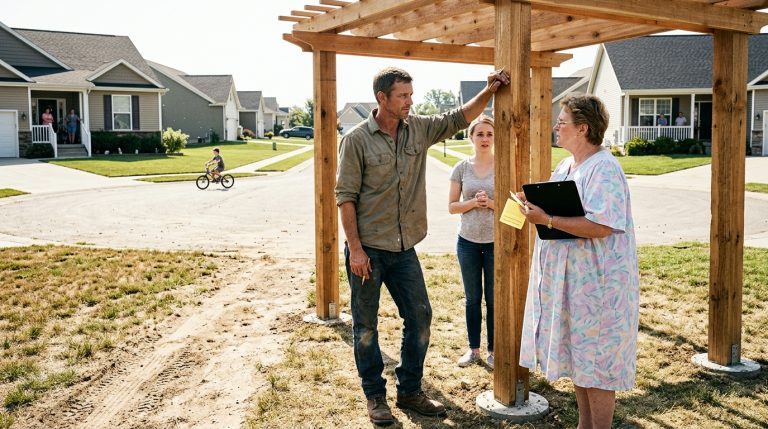
They were walking in lockstep, their sneakers finding no purchase in the loose dirt. One was named Bev, the other Trish—committee members from Stonebridge Meadows, the development that had choked the life out of the eastern horizon back in 2016. They didn’t look like invaders. They looked like accountants out for a Sunday stroll, clutching leather folios to their chests as if they were shields.
“Clint, right?” Bev said, her smile tight and practiced, the kind of expression designed to minimize friction. “I’m sorry about your father. Truly. But we have a procedure for non-residents using the Stonebridge waterfront.”
I stood by the truck, the keys still digging into my palm. I hadn’t even taken a breath of the morning air yet. My father’s scent—hickory smoke and old flannel—was still lingering on my jacket from the last time I’d been here, a week ago, when the land still felt like ours.
“This isn’t Stonebridge water, Bev,” I said, my voice sounding rough in the stillness. I kept my eyes on the shoreline, where the mud met the water in a jagged, natural line. “This is Puit property. Always has been.”
Trish shifted, her folio sliding slightly. She tapped the laminated paper she was holding. “The HOA board has managed this entire section of the cove for years, dear. We’ve issued badges for all registered homeowners to ensure security and compliance. Without an authorization badge, you’re technically trespassing on private community amenities.”
The absurdity of it hit me with the force of a physical blow. A badge. For water that ran through land my grandfather had worked with his bare hands before a single one of their decorative mailboxes had been planted in the dirt. My skin went hot, a slow, simmering burn, but my mind did that thing it had started doing lately—it went cold. It sharpened.
“Show me,” I said, my voice flat.
Trish blinked, clearly expecting an argument, not a request for evidence. She fumbled with her folio and pulled out a map. It was a glossy, color-coded sheet that highlighted the shoreline in a neat, clinical blue. It didn’t look like a real map. It looked like a sales pitch.
“We just need to see your lake use badge,” she repeated, her tone hardening. “If you don’t have one, we’re going to have to ask you to vacate the area. It’s for the protection of the residents.”
I stared at the map. I didn’t reach for it. Instead, I looked at the post where the mailbox sat further up the road—the one they’d been fining my father for over the last six months. It wasn’t about the lake. It wasn’t about the rules. It was about the fact that we were the only thing left in their way.
I looked back at them, and for the first time, I noticed a detail I’d missed before: a faint, handwritten tally on the back of Trish’s folio, a list of names and numbers that had nothing to do with property standards.
“You’re not going to ask me to leave,” I said, my voice steady, feeling the cold weight of the fight settling into my bones. “But I think you’re going to have a very long afternoon explaining to me who exactly authorized you to sell access to my family’s property.”
Trish’s smile faltered, replaced by a sudden, sharp flick of hesitation in her eyes—the exact moment the mask slipped.
CHAPTER 2: THE PAPER GRAVE
Trish didn’t answer. She just pulled the folio back against her chest, her knuckles turning white against the faux-leather. Beside her, Bev had stopped pretending to be a neutral administrator. Her jaw was set, and she was scanning the tree line as if she expected someone to jump out of the brush and challenge her authority.
“We aren’t discussing this here,” Bev said, her voice tight, the polished composure slipping into something sharper, something defensive. “If you have questions about the community bylaws, you can attend the next board meeting. Thursday night. Seven o’clock.”
They turned in unison, marching back toward the manicured gravel path that led to the Stonebridge fence line. I didn’t follow them. I just stood there, the sun now high enough to turn the red clay under my boots into a fine, choking powder. The silence rushed back in, but it wasn’t the same silence as before. It was heavy with the weight of that tally—those names and numbers scrawled on the back of the folio.
I waited until their silhouettes vanished behind the cluster of ornamental pines before I turned back to the farmhouse. The porch felt smaller than it had a week ago. The structure itself—cinder block, pine, and the stubborn geometry of my grandfather’s design—seemed to be waiting for me.
Inside, the house smelled of stale coffee and the damp, cool scent of the crawlspace. My father had kept everything in a pair of steel filing cabinets tucked under the stairs, a repository of five decades of dust and law. I didn’t turn on the lights. I let the dim morning sun filter through the blinds, casting long, sharp shadows across the floorboards.
I hauled the first drawer open. It screeched, metal grinding on metal—the sound of long-dormant machinery waking up. I started digging. I needed the original deed, the 1981 survey maps, and the specific easement descriptions that Constance had mentioned in her initial review.
As I sifted through the yellowing pages, my hands moved with a familiar rhythm. I remembered Granddad’s voice, rough as a rasp, telling me, “Clint, a man who doesn’t know his boundaries is just a guest on his own soil.” He’d spend hours on this very floor, tracing lines on maps with a thick, calloused thumb, marking where the cattle could graze and where the land needed to breathe. That memory felt like an intrusive weight, a phantom limb tugging at my focus. The land wasn’t just dirt; it was a record.
I pulled out a file marked County Assessment – 1982. The paper was brittle, the ink fading to a rusty brown. I laid it flat on the kitchen table, the surface stained with the ghosts of a thousand meals.
Constance was already sitting there, her laptop open, the screen glowing with an incongruous, sterile light. She didn’t look up as I dropped the stack of documents in front of her. She was cross-referencing digitized county records with the handwritten notes my father had kept.
“They’re playing a game of jurisdiction,” she said, not shifting her gaze. Her voice was calm, but there was an edge to it that suggested she’d already found something. “They treat the shoreline as a private utility for the development, but every tax record, every survey, every permit I’ve pulled today shows the boundary lines ending at the HOA’s fence line. They don’t just ‘manage’ the access, Clint. They’ve been filing internal reports that treat the cove as a ‘community asset’ for the sake of the HOA’s balance sheet.”
“Can they do that?” I asked, leaning over her shoulder.
“They can until someone asks to see the deed,” she replied, finally looking up. Her eyes were sharp, evaluating. “But look at this. The ‘lake use fees’ they’ve been collecting aren’t in the public ledger. They’re being funneled through a ‘maintenance reserve’ account. It’s not just petty tyranny, Clint. It’s a side business. They’re monetizing space they don’t even legally touch.”
She pointed to a line of signatures on a document from two years ago. The treasurer’s name was there, alongside Darla’s. The ink looked too clean, too deliberate.
“They need that money, don’t they?” I asked, looking out the window toward the lake. “Stonebridge isn’t exactly thriving. The maintenance costs on that infrastructure are astronomical.”
“Which is why they’re desperate,” Constance said. “If this gets out, if the homeowners realize they’ve been paying for access to land that isn’t under the HOA’s control—and that the board has been pocketing or misusing those funds—the board doesn’t just lose the argument. They lose their standing. And Darla? She loses everything.”
I stood still, the cold clarity of the situation settling over me. They weren’t just neighbors with a grievance; they were a sinking ship trying to patch their hull with my family’s history.
“What’s the next move?” I asked.
Constance leaned back, the chair groaning under her. “The next move is to make sure they know we’re watching, before they have a chance to hide the paper trail. We don’t go to the board. We go to the source.”
I looked at the documents—the maps, the stamps, the evidence of decades of hard, quiet work. The dust from the files hung in the air, swirling in the light. I knew then that there was no way to walk this back. The silence of the land had been broken, and the only way to get it back was to force the truth into the light until it burned.
CHAPTER 3: THE FIRST SALVO
The kitchen was still heavy with the scent of old paper and stale coffee, the air thick enough to taste. Constance hadn’t even looked up from her screen when the sound came—a rhythmic, hesitant knock against the weathered screen door. It wasn’t the confident rap of someone who belonged there, nor the casual thump of a delivery. It was a nervous, uneven beat.
I pushed back from the table, the chair legs scraping against the floorboards with a jarring, high-pitched screech. Outside, the sky was a bruised violet, the sun dipping behind the tree line and turning the red clay yard into a shadow-filled expanse. I walked to the door, my hand hovering near the frame, my pulse thrumming in my throat—not with fear, but with that cold, sharpening instinct that had been my constant companion since the funeral.
Standing on the porch was a man I recognized from the HOA’s quarterly meetings. Gene. He looked older than he had a few months back, his shoulders slumped as if he were carrying the weight of a guilty conscience. He didn’t look at me; he looked at the ground, at the way the dust had settled into the cracks of the porch wood.
“Clint,” he said, his voice barely rising above the evening hum of crickets. “I didn’t think you’d be home.”
“I’m always home, Gene,” I replied, opening the screen door just enough to create a barrier, but not enough to be rude. “What brings you all the way out here? You’re a few miles outside of Stonebridge’s jurisdiction, aren’t you?”
He winced, a small, involuntary twitch of the eye. He reached into his jacket pocket and pulled out a manila envelope, held together by a thick rubber band. “I heard what happened at the lake. With Trish and Bev.”
“They were trespassing,” I said, my voice as flat and hard as the cinder block of the smokehouse.
Gene nodded, though he couldn’t hold my gaze. He handed me the envelope. “The board hasn’t voted on half of what Darla’s been doing. She’s been using the letterhead, the seals, the legal notices—it’s all her. She’s running the place like a fiefdom, and she’s dragging us all into it. I’m not part of that, Clint. I never wanted this.”
I took the envelope, the weight of it surprisingly substantial. I didn’t open it. I held it, feeling the texture of the thick paper, a physical manifestation of a crack in their armor.
“Why now, Gene?” I asked. “You’ve watched her do this for two years. You’ve sat in those chairs and watched her invent rules out of thin air.”
“I was a coward,” he admitted, his voice cracking. “And I thought it would blow over. But the lake… the money, Clint. She’s pushing the treasurer to move funds that don’t belong to the HOA. It’s not just petty rules anymore. It’s theft. And I’m not going to jail for her.”
He didn’t wait for a reply. He turned, his boots clicking heavily against the porch, and walked back toward his car. He didn’t look back, not even when I called his name. He just climbed in and reversed, the gravel crunching under his tires as he fled back toward the gates of the development.
I walked back into the kitchen, the door clicking shut behind me. Constance was already standing, her eyes locked on the envelope in my hands. I placed it on the table and snapped the rubber band. Inside were meeting notes, unauthorized bank statements, and a series of emails—personal, messy, and dripping with a tone of casual malice that made my skin crawl.
“He’s giving us everything,” Constance said, her voice dropping to a whisper as she scanned the top page. “This isn’t just a list of complaints. This is the entire financial architecture of their fraud.”
“It’s not enough to win, though,” I said, looking at the papers. “This is just ammunition. We still need to force them into a position where they can’t hide it behind a ‘misunderstanding’ or a ‘clerical error’.”
“We will,” Constance said, her fingers dancing over the documents. She looked at me, and for the first time, I saw a hint of genuine excitement in her sharp, analytical gaze. “We’re going to send a notice. Not to the board, not to the county, but directly to Darla. We’re going to put her on formal notice that we have the financial trail of the ‘maintenance reserves’. It will rattle her. She’ll either try to bury it, or she’ll make a mistake trying to prove it’s legal. Either way, she’ll do our work for us.”
I watched the shadows lengthen in the room. The farmhouse felt alive again, not with the ghosts of the past, but with the cold, calculated energy of the present. I walked to the counter and picked up the kettle, the metal cold against my skin. I could feel the tension, a tight, vibrating string pulled across the distance between the farmhouse and the Stonebridge development.
This was the first move. The first strike. And as I set the kettle to boil, I knew that whatever happened next, the peace of the farm was gone—replaced by the slow, grinding process of turning the machinery of justice against those who had thought they could steal a piece of our world without paying the price.
CHAPTER 4: THE PAPER TRAIL
The ring was sharp, discordant, and altogether too loud for the quiet of the kitchen. I didn’t reach for the phone immediately. I let it ring, watching the display light up in the dim room, blinking UNKNOWN CALLER. Constance was still sitting at the table, her eyes tracking the movement of my hand as it hovered over the receiver. She didn’t have to say it; we both knew who it was. The timing was too clean, the intrusion too direct.
I pressed the button and didn’t say a word. I just let the line hum, the static of the connection filling the gap.
“Clint,” a voice said. It wasn’t Darla, but it sounded like her in pitch and cadence—the same clipped, artificial authority. It was the treasurer, the one who had signed off on the lake access fees Gene had highlighted in the files. “I think we need to have a conversation about the recent… rumors floating around the development.”
I leaned against the counter, the cool metal of the sink biting into my lower back. “I’m not interested in rumors, and I’m definitely not interested in conversations. Whatever you have to say, put it on letterhead. My attorney is sitting across from me.”
The silence on the other end was sudden and profound. I could hear the treasurer’s breathing, quick and shallow.
“The board is willing to discuss a settlement,” he said, the mask dropping just a fraction. “We recognize that there might have been… administrative oversights regarding the shoreline access. We can offer a payment for past use, a formal acknowledgment of your rights, and an agreement to stop any future interference with your property. All we ask is for the return of the documents you’ve recently acquired.”
I looked over at Constance. She was watching me, her expression unreadable, her pen poised over a notepad. She gave a slow, deliberate shake of her head.
“An oversight?” I asked, keeping my voice low. “You’ve been billing for access to my water for eleven years, and you’re calling it an administrative oversight?”
“We want to avoid a public dispute,” he insisted, his voice hardening. “Think about the reputation of your farm, Clint. A public battle will bring reporters, inspectors, all sorts of attention you don’t want. We have the resources to drag this out for years. You have a farm to run. Do you really want to spend your life in a courtroom?”
“I’m already in the middle of a battle,” I said. “And the only thing being dragged out is the truth.”
I cut the call. The silence that followed felt thicker, more oppressive than before. I set the phone face down on the granite.
“They’re terrified,” Constance said, standing up and walking toward the file stack. “That wasn’t an offer of settlement. That was a desperate reach for the exit. They know we have the documents Gene provided.”
I walked to the table and flipped open the envelope again. My eyes caught on a ledger page, a specific, neat entry detailing a payment from a landscape contractor for ‘Shoreline Maintenance Rights.’ I pulled it closer. There, in the corner, was a signature—a sprawling, confident scrawl that didn’t match the treasurer’s usual, tight hand. It was a forgery, and a sloppy one. It had been signed by someone else, but the stamp of approval—the official HOA board seal—was pressed firmly into the fiber of the page.
It was a physical discrepancy that shouted the truth: they hadn’t just been stealing; they had been building a house of cards, and they were the ones who had provided the paper.
“Constance,” I said, pointing to the signature. “Look at this. This isn’t just an administrative oversight. This is a deliberate fabrication. They didn’t just miss a rule; they broke the foundation to build the profit.”
She leaned in, her glasses catching the light. She traced the line of the signature, her face hardening. “If this is a forgery, then the entire ‘management’ structure is illegal. It’s not just a breach of contract, Clint. It’s fraud. This changes everything.”
The realization hit me with the weight of the red clay outside. They weren’t just protecting their neighborhood; they were covering up a crime that went far beyond my shoreline. The fear I had felt back at the lake—the feeling of the earth itself shifting under my boots—wasn’t just paranoia. It was an accurate assessment of the ground we were standing on.
“They won’t just offer money now,” I said, a cold resolve settling into my chest. “If we have this, they’ll come for us. They’ll try to shut this down before we can take it to the state.”
Constance nodded, her eyes flashing with a sharp, predatory intelligence. “Then we don’t wait for the meeting. We go to the county tomorrow morning. We bypass the board, we bypass Darla, and we put this directly into the hands of someone who has the power to seize their records.”
I stood up, the chair scraping again—a sound that echoed like a warning in the quiet house. The farmhouse was under watch; I could feel it in the way the shadows gathered against the windows. But for the first time, I didn’t feel like a victim of their encroachment. I felt like the architect of their collapse.
I walked to the window and looked out toward the lake. The moon was rising, casting a cold, silver light across the water. It was still, dark, and indifferent. But the men in the board meeting—they weren’t indifferent. They were running out of time. And I was going to make sure they saw the clock.
CHAPTER 5: THE ANNUAL MEETING
The county building was a cavernous, air-conditioned tomb of bureaucracy, smelling faintly of toner and floor wax. It was a sterile, unforgiving environment, a sharp contrast to the damp, living soil of the farm. I stood in the lobby, the binder tucked under my arm like a shield, feeling the weight of every sheet of paper inside. Beside me, Constance moved with a quiet, efficient grace, her presence an anchor in the dizzying sprawl of the corridor.
We were here to trigger the audit, to hand over the records Gene had provided and let the state pull at the loose thread of Stonebridge’s financial house of cards. But as we stepped into the planning office, the air felt thin, electric with the sudden, sharp sensation of being watched. I scanned the room—clerks in beige cubicles, a security guard near the elevator, a woman in a sharp blazer whispering into a phone in the corner.
It was paranoia, perhaps, or just the weight of the last few days, but the way they looked at us—not with curiosity, but with a guarded, calculating tension—made the hair on my arms stand up. I tightened my grip on the binder.
“You have the authorization forms?” I asked, keeping my voice low.
Constance nodded, her eyes fixed on the office door ahead. “I have everything. Once we file this, the board won’t just be dealing with us. They’ll be dealing with an investigation that they can’t bribe, threaten, or ignore. They’ll have to account for every cent.”
We reached the clerk’s desk, the laminate surface scarred by years of use. As we stood there, the woman in the blazer from the corner—a woman I vaguely recognized from the Stonebridge annual meeting—stepped toward the counter. She didn’t look at us. She looked at the clerk, her voice carrying a practiced, thin veneer of cordiality.
“I need to check the status of the Stonebridge Meadows water easement filing,” she said, her smile not reaching her eyes. She glanced at me, her gaze flickering for a fraction of a second, cold and sharp as a razor. “There seems to have been some… administrative confusion lately. We’re trying to clean up the records.”
My heart hammered against my ribs. Administrative confusion. It was the same language the treasurer had used on the phone. They were here to bury the evidence before we could even file it.
“Constance,” I whispered.
She caught the look, her posture stiffening. She stepped forward, reaching into her bag to pull out our own set of documents. “Excuse me,” she said, her voice cutting through the clerk’s concentration. “We’re here to file a formal request for an audit of that same easement, along with a list of financial irregularities involving the HOA’s management of those water rights.”
The clerk froze, her hand hovering over the keyboard. The woman in the blazer didn’t move, but the air in the room seemed to drop ten degrees. The security guard near the door took a step closer, his eyes narrowing.
This was the collision. The moment where the paper-thin reality of their power met the immovable object of the truth.
“I’m afraid that office is closed to public filings today,” the clerk said, her voice strained, avoiding our eyes. “We have a pending review of all current water management records for that district.”
“That is impossible,” Constance said, her voice rising, though still controlled. “This is a public record. We are entitled to file a grievance against a fraudulent instrument, and we have the supporting documentation right here.”
“I have my orders,” the clerk repeated, her finger hovering over the phone.
I felt the shift then—the feeling of the trap closing. They weren’t just protecting their budget; they were protecting the foundation. If they could keep us out, if they could force us into another week of ‘administrative review,’ they could shred every last piece of evidence before the state inspectors even opened their doors.
I looked at Constance, then at the clerk, then back to the woman in the blazer. She was still smiling, a thin, cruel expression that communicated exactly what she thought of us—two outsiders who didn’t understand the rules of the game.
“We aren’t leaving,” I said, stepping up to the counter. I opened the binder, the spine creaking in the sudden, absolute silence of the room. I spread the forged ledger page out on the laminate surface, right under the clerk’s nose. “You can tell whoever told you to close this office that you’ve already seen the evidence of the forgery. And you can tell them that if this filing isn’t processed within the hour, the next person to see this paper will be the district attorney.”
The room went still. Even the keyboard stopped clicking. The woman in the blazer’s smile faltered, her hand gripping the edge of her briefcase so tightly her knuckles turned white.
“You don’t know what you’re doing,” she said, her voice finally losing its polished edge, replaced by a raw, desperate anger. “You’re destroying a community for the sake of a farm that hasn’t made a profit in ten years. You have no idea what this costs.”
“It costs the truth,” I said, meeting her gaze. “And that’s a price I’m willing to pay.”
The clerk looked at the ledger page, then at the blazer-clad woman, then at the binder. For a long, agonizing moment, the balance of power teetered. I could feel the weight of it, the grinding, tectonic shift of a system that had worked for years suddenly hitting the wall of an inconvenient fact.
The clerk finally reached out and took the binder, her hands shaking slightly.
“I’ll… I’ll have to process this,” she whispered.
The woman in the blazer spun around and walked toward the exit, her heels clicking against the linoleum with a sound like pistol shots. I watched her go, the adrenaline beginning to ebb, leaving behind a cold, steady clarity. The first crack was already there. Now, we just had to wait for the whole thing to come down.
CHAPTER 6: THE SMOKE CLEARS
The walk back to the truck felt longer than the walk in, each step on the linoleum ringing with the finality of a gavel. Constance didn’t speak, but her stride was relaxed now, the frantic energy of the last twenty-four hours replaced by a steady, surgical calm. We had the receipt. We had the stamp. And outside, the North Carolina sun was already bleaching the intensity out of the day.
When we pulled back onto the gravel road leading to the farm, the world looked different. The red clay was the same, the smokehouse stood as solid as it had for forty years, but the tension that had tightened the atmosphere since my father’s funeral was gone. It was like a fever had broken, leaving the air thin and quiet.
We didn’t have to wait for the official summons. By the time we reached the farmhouse, the first wave of fallout had already hit. My phone was vibrating against the center console, a stream of messages from Gene and two other board members—apologies, panicked inquiries, and finally, a short, succinct text from the HOA’s lawyer asking for a meeting to discuss ‘resolution’.
I didn’t answer. I parked the truck and stepped out, the soles of my boots meeting the familiar, packed earth of the driveway. I walked to the fence line, to the display board I’d mounted there days ago. I stood in the silence, watching the light catch the clear covers of the documents—the deeds, the permits, the proof of a life built on responsibility rather than extraction.
The climax wasn’t a roar. It was the absence of one. Darla had tried to build a kingdom on the idea that she could curate reality, that if she just pushed hard enough, the truth would bend. But truth, I realized, was like the red clay itself: you could try to pave over it with manicured lawns and decorative mailboxes, but the earth always remained underneath, patient and unchanging.
That November, the smokehouse ran with a rhythm that felt entirely new. We didn’t just smoke pork; we held a gathering. I’d opened the gates to anyone from Stonebridge who wanted to come.
They came in twos and threes, some looking sheepish, others genuinely curious. I watched them walk through the hay barn, look at the old assessor photos, and stand in the shadow of the smokehouse. I saw Gene talking to a neighbor, explaining the clause in the declaration that had been there all along—the protection for lawful agriculture that they’d been too busy to notice.
I found myself standing by the water’s edge, where the two women had confronted me weeks before. The lake was still, the surface broken only by the occasional ripple of a rising fish. I reached down and picked up a stone—cool, smooth, and heavy—and skipped it across the surface. It danced three times before sinking.
There was no badge. There were no questions about ‘amenity access.’ Just the quiet, persistent sound of the water against the muddy bank.
Constance walked up beside me, carrying two cups of coffee. She looked tired, the kind of tired that comes from a long, necessary war, but her eyes were bright.
“The state’s investigator is coming on Monday,” she said, her voice soft. “They’re going to dismantle the board’s financial structure piece by piece. It’s going to be a long process, but it’s done. They can’t stop it now.”
I took the coffee, the heat of the ceramic grounding me. I looked back toward the farmstead. The scholarship fund had already received its first anonymous donation from the neighborhood’s newly formed treasury—an act of restitution that felt less like an apology and more like a necessary repair.
I walked to the smokehouse and ran my hand along the cinder block wall, finding a loose piece of mortar near the base that had been bothering me since I was a boy. I picked up a trowel from the workbench and pressed a new mix of lime and sand into the gap, smoothing it until it was flush with the rest of the wall. It was a small act, a simple repair, but it felt like the most important thing I’d done all week.
My father had been a man who knew the difference between owning land and stewarding it. He hadn’t been a fighter by nature, but he had understood that if you didn’t hold the line, the things that mattered would eventually be paved over by the noise.
I stood there in the quiet, the smell of hickory smoke drifting into the cool autumn air. The farm was still standing. The water was ours. And for the first time since I had come home to bury my father, I felt like I wasn’t just holding on to what he had left me—I was finally, truly, stepping into it.