The Fence Line War: A Legal Siege Over Property Lines, Suburban Lies, and Hard-Earned Silence
CHAPTER 1: THE IMPACT
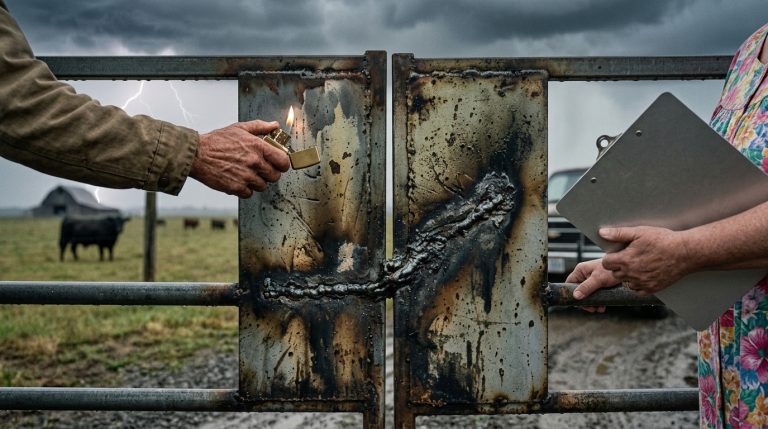
The sound of gravel crunching beneath tires had been the soundtrack of my erosion for six months. When the impact finally came, it wasn’t a symphony of destruction, but a dull, heavy thud—the sound of solid, hand-cut cedar meeting the cheap plastic chassis of a motorized toy.
I didn’t rush to the fence. I didn’t drop my mug. The coffee, black and bitter, remained steady in my hand as I watched the dust cloud settle over the trail I had meticulously blocked just forty-eight hours prior. Karen was airborne for a heartbeat, a tangled mess of limbs and indignant fury, before gravity claimed her. She landed hard, the sound of her back hitting the packed dirt a stark reminder that even in this suburban purgatory, physics was the only law that actually held authority.
Her dog, a creature of high-pitched shrieks and nervous energy, began a frantic, rhythmic yapping from the overturned wreckage.
“You tried to kill me!”
The voice was thin, reedy, and vibrating with the specific frequency of a woman who had never been told ‘no’ and lived to tell the tale. Karen sat up, her face a blotchy map of shock and impending litigation. One shoe, a high-heeled gardening clog, was missing. She pointed a trembling, manicured finger at me.
I took a slow, measured sip of my coffee. The heat grounded me. I didn’t look at her; I looked at the wall. The two game cameras I’d mounted yesterday—one hidden in the oak knothole, one buried in the brush—were humming with silent, digital vigilance. They were the only witnesses I cared about.
“Private property,” I said, my voice sounding flatter than I intended. “No access.”
I turned my back on her, walking toward the porch. Every muscle in my shoulder blades felt tight, anticipating the inevitable shrill escalation. I could hear her scrambling to her feet, the wet tearing of grass as she dragged her phone from the dirt. She was already composing the narrative in her head—the victim, the target, the aggrieved martyr of the cul-de-sac.
As I reached the wooden threshold of my home, my eyes caught a sliver of movement near the base of the fence. A strip of the reflective tape I’d applied yesterday was gone—peeled off cleanly, not torn. It wasn’t the wind.
I paused, hand on the doorframe, my pulse a steady, rhythmic thrum against my wrist. Karen was still shrieking behind me, promising lawyers and police, but my focus shifted to the empty patch of wood. Someone had tampered with my security measures long before the sun had risen.
The war wasn’t just about the trail. It was about who was watching, and who was really in control. I stepped inside, the latch clicking shut behind me with a finality that felt like the start of a very long, very quiet siege.
CHAPTER 2: THE PAPER TRAIL
The silence of the house was not the peaceful sanctuary I had anticipated when I bought this place. It was a heavy, expectant sort of quiet, the kind that gathers in corners where shadows linger too long. I stood in the entryway, the deadbolt fully engaged, staring at the wood grain of the door. My heart rate was finally beginning to level out, but the residual adrenaline made the fine muscles in my hands twitch.
I didn’t turn on the lights. I didn’t want to silhouette myself against the windows. Instead, I moved through the dark toward the study—the room that had convinced me to buy the property in the first place. It smelled of old paper and dust, a sharp, dry aroma that reminded me of my grandfather’s workshop. I flicked on a dim desk lamp, the warm amber glow cutting a circle into the gloom.
On the desk sat the heavy, leather-bound folder containing the original deed and the property surveys. I opened it, the pages crinkling with the crispness of age. I needed to see it again. I needed to confirm that I wasn’t the one losing my mind.
As I thumbed through the documents, my mind drifted to a memory I hadn’t touched in months: the day of the closing. The previous owner, a man whose skin looked like cured leather and whose eyes always seemed to be looking over my shoulder, had lingered on the doorstep. “It’s a good piece of land,” he’d said, his voice dropping to a gravelly rasp. “But don’t go digging too deep into the records at the county archives. Some things are better left buried under the grass. Keeps the taxes lower, keeps the neighbors from getting ideas.”
At the time, I’d laughed it off as the ramblings of a man who’d spent too much time alone. Now, staring at the legal description of the boundary lines, that warning felt less like an eccentricity and more like a tactical briefing.
I spread the survey out. My property was a jagged, irregular shape, a remnant of a larger agricultural plot that had been carved up decades ago. The “historic access route” Karen claimed was public was nowhere on the official map. It was a phantom, a ghost-road that existed in her rhetoric but not in the state’s registry.
I traced the line with my finger. The path ran directly behind my barn, cutting through a section of dense, overgrown scrub oak. According to this survey, the property line extended twenty feet past the path. I was entirely within my rights to block it, to burn it, to pave it over if I wanted.
But why would she be so desperate to keep a dead-end trail open?
I grabbed a magnifying glass from the drawer. I began to comb over the surveyor’s notes from 1984, the last time the lot had been officially subdivided. There, tucked in the margin in faded blue ink, was a cryptic annotation: “Subject to easement protocol 7-B: Restricted surface use, deep-soil sensitivity.”
I had no idea what “deep-soil sensitivity” meant in a legal context. I pulled out my laptop, my fingers flying over the keys. I checked the state’s online database for “Protocol 7-B.” Nothing. I checked the county tax assessor’s historical logs. Still nothing.
It was as if that specific section of the map had been scrubbed clean.
I stood up and walked to the window, peering out toward the backyard. The moon was a sliver, casting just enough light to reveal the silhouette of my wooden wall. It stood firm, a dark scar against the softer shapes of the trees. Beyond it, the path wound away into the darkness, deeper into the woods than I had ever dared to venture.
A flicker of movement near the barn pulled my eyes toward the perimeter. I stayed back, letting the darkness of the study hide my silhouette. Someone was out there—not Karen, not this time. The movement was too fluid, too methodical. A flashlight beam, thin as a needle, cut through the night, sweeping the ground near the base of my wall.
My stomach coiled. They weren’t just looking at the wall; they were checking the ground. They were looking for something I hadn’t even realized was there.
I went to the safe in the closet, pulled out the heavy industrial flashlight I kept for emergencies, and grabbed my coat. I wasn’t going to wait for them to finish their work. If there was a secret buried on my land that made people crawl through the dark at midnight, I was going to be the one to find it first.
The back door creaked as I opened it, but I caught the weight of it, muffling the sound. The air outside was cool and smelled of damp earth and coming rain. I moved toward the shadow of the barn, my boots silent on the grass. The intruder was still there, hunched over near the wall, their back to me.
I had to know. I had to know if the war was about the path, or if the path was just a cover for something much heavier, much older, and far more dangerous. I took a breath, centered my weight, and prepared to step out of the shadows.
CHAPTER 3: THE SURVEILLANCE
The transition from the warmth of the study to the biting chill of the backyard was absolute. I stepped into the tall, damp grass, the flashlight gripped firmly in my right hand, its beam cutting a harsh, white corridor through the encroaching darkness. Ahead, near the base of the cedar wall, the intruder froze.
They were dressed in dark, non-descript tactical gear—the kind of quiet, expensive clothing that whispered of purpose rather than hobby. As I leveled my light, the figure didn’t cower. They turned slowly, a deliberate, disciplined movement that made the hair on my neck stand up. They weren’t a common thief, and they certainly weren’t one of Karen’s bridge-club friends.
“You’re trespassing,” I said, my voice steady, though every nerve ending felt like a live wire.
The figure didn’t speak. Instead, they tapped a gloved hand against their thigh, a rhythmic signal that seemed to echo into the woods. Before I could close the distance, they pivoted, dropping low and disappearing into the dense line of scrub oak with the grace of a mountain cat.
I gave chase, but the thicket was a tangle of thorns and low-hanging branches. I slowed, sweeping my light over the area they had occupied. The ground was disturbed, the earth pushed aside as if someone had been frantically excavating a small, precise square.
I dropped to my knees, pushing aside the mulch. I expected to find a hidden cache or a boundary marker. Instead, tucked neatly into the dirt was a small, high-end electronic signaling device—a long-range transmitter, sleek and unmarked. My fingers brushed against its casing; it was still warm. They hadn’t been looking for a boundary; they had been checking a connection.
I stood up, the device heavy in my palm. The realization settled over me like a shroud: Karen’s “war” for the path was nothing more than noise, a frantic display designed to keep prying eyes focused on her antics while someone else—someone far more professional—kept watch over what was buried under my soil.
I retreated to the house, every rustle of the leaves sounding like an approaching footfall. Back in the sanctuary of the study, I laid the transmitter on the desk and pulled up the property logs again, ignoring the deed this time. I dug deeper, searching for any historical permits involving the property from the mid-1970s. I searched for utility lines, for land-survey anomalies, for anything that could explain why someone would be monitoring this specific coordinate.
My eyes landed on a grainy, black-and-white scan of an old environmental impact study. A thin, red circle was drawn around the section of woods where I had just been standing. The note in the corner was handwritten, dated August 1978: “Soil integrity compromised by unauthorized subterranean transit.”
The phrase “unauthorized subterranean transit” hung in the air of the room. It wasn’t about the environment. It was about passage.
I looked up at the wall clock—three in the morning. My mind raced, connecting the dots of Karen’s obsession. If the HOA was a front for something, what were they actually laundering? The fines? The property violations? The money wasn’t just staying in their bank accounts; it was the mechanism for keeping this land under a perpetual state of “standardized surveillance” so no one else would dig.
I went to my phone and pulled up the neighborhood’s public forum page. I clicked on the directory, scanning the list of board members. My eyes stopped on the treasurer, a man who, until now, had been nothing more than a name on a page. I cross-referenced his public employment history. He was a low-level supply chain manager for a defunct shipping conglomerate.
The pieces began to lock together. The path wasn’t for ATVs. It was an entry point.
I spent the next two hours mapping the terrain. The woods behind my house didn’t just end; they sloped toward a decommissioned freight railway that had been swallowed by the forest decades ago. If someone wanted to move goods without hitting the main roads, they would need a buffer zone. They would need a “private” plot of land that was aggressively shielded from the public eye by a busybody neighbor acting as a human barrier.
I picked up the transmitter again. It was a beacon. I hadn’t just found a piece of electronics; I had found the “on” switch for the neighborhood’s secret.
The phone rang, the sound jarringly loud in the quiet room. It was a blocked number. I hesitated, then pressed the button, putting it on speaker.
“You should have left the ground alone,” a voice said—a modulated, flat tone that lacked any humanity. “Some fences aren’t meant to be stood on. Some truths aren’t meant to be dug up.”
The line went dead before I could reply.
I looked toward the back of the house. The motion lights flickered on, illuminating the lawn. Through the glass, I saw a black sedan idling at the very edge of my property, its headlights extinguished. They weren’t hiding anymore. The facade was slipping, and I was holding the evidence that could pull the entire structure down.
I grabbed my coat and my keys. There was no safety in the house now. I had to get to someone who could look at the documents—not the HOA, not the police who were already clearly compromised—but someone who understood the weight of the paper trail I had unearthed. I left the house, not through the front, but through the side door, circling toward the edge of the woods. I had to reach the main road, but I had to do it without being tracked.
The war wasn’t just mine anymore. It was about the silence of the land, and tonight, the land was finally starting to speak.
CHAPTER 4: THE CLUBHOUSE SIEGE
The transition to the clubhouse was a study in controlled aggression. I reached the perimeter of the neighborhood, the rain hammering against my jacket with such force that it sounded like gravel hitting a tin roof. The clubhouse sat at the center of the development—a sterile, mock-colonial building that looked entirely out of place in the middle of a storm.
I didn’t stop to dry off. I didn’t care about the mud caking my boots. I moved straight to the side entrance, the one I’d noted during my previous reconnaissance. The door was locked, but the cheap, hollow-core construction of the building didn’t stand a chance against the leverage I’d brought from the barn. A single firm press with the flat of a pry-bar, and the latch groaned, surrendering with a splintering pop.
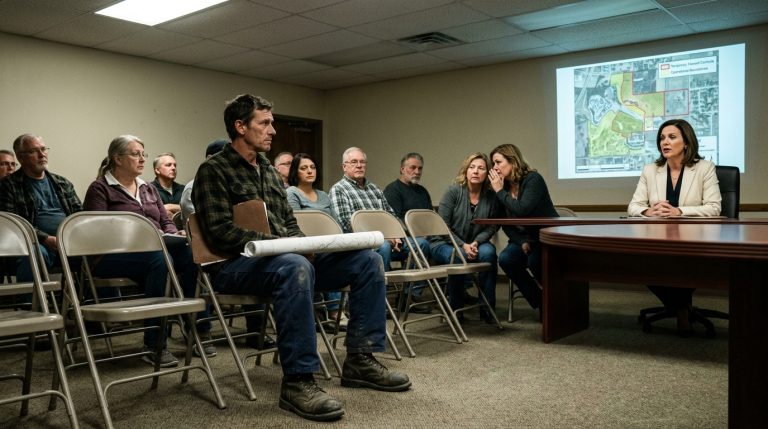
Inside, the air was warm, smelling of stale coffee and the floral, aggressive perfume Karen wore like a weapon. The emergency HOA meeting was already in full swing. Through the wall, I could hear her voice—pitched high, frantic, the cadence of someone realizing the walls were closing in.
I didn’t enter through the main doors. I stayed in the shadowed corridor, sliding behind a row of stackable chairs, until I found the small utility closet that shared a wall with the podium. I cracked the door just enough to see. The room was packed. Neighbors sat with folded arms, their faces unreadable. Karen was at the front, frantically adjusting a projector screen that showed a blurred, distorted image of my property.
“This is not just about a wall,” she was saying, her voice strained. “This is about the safety of our children, the preservation of our aesthetic, and the protection of our legal right to common access. If we let one individual set the precedent that they can block a historic path, we lose the very identity of this community.”
Her friends, the two board members who had measured my fence with such obsessive care, were seated nearby, their expressions stern, though I noticed the treasurer fidgeting—his eyes darting to the door every few seconds. He looked terrified.
I waited for the lull. It came when someone from the back of the room questioned the validity of the $12,000 fine. Karen immediately doubled down, but she was shaky. This was the opening.
I stepped out from the shadows.
The room went silent. The sound of the rain against the clubhouse roof seemed to magnify, a rhythmic pounding that underscored the sudden, sharp tension. Karen turned, her face draining of color until she looked like a ghost in a beige blazer.
“You,” she breathed, the word barely a whisper.
I walked toward the podium, the mud from my boots leaving dark, distinct tracks on the plush carpet. I didn’t look at her. I looked at the treasurer. I reached into my coat pocket and pulled out the transmitter, placing it on the table with a soft, heavy clatter that drew every eye in the room.
“You’re not here for the wall, Karen,” I said, my voice cutting through the silence. I kept my tone low, devoid of the theatrical anger she had been banking on. “And you, Mr. Treasurer, aren’t here for maintenance funds.”
I pulled the environmental impact study from my jacket, the pages damp but legible. I didn’t dump the full truth—that was for later, for the people who could actually bring charges—but I laid out the anomalies. I talked about the soil sensitivity, the “unauthorized transit,” and the signal-jamming equipment that had been recovered from my perimeter.
“This isn’t an HOA,” I continued, my gaze sweeping the room. “This is a cover. A multi-year, multi-layered operation to keep this specific corridor clear for transit that has nothing to do with this neighborhood.”
Karen tried to speak, her mouth working silently, but she had lost the room. The neighbors were looking at each other, the veneer of their suburban compliance finally cracking under the weight of something much more sinister. The treasurer stood up, his chair clattering backward, his face a mask of panicked realization.
“Get him out of here!” Karen shrieked, finally finding her voice, but nobody moved.
She wasn’t the authority anymore. She was just a woman in a soggy room, standing in front of a fake slideshow that had suddenly lost all meaning.
I reached into my bag and pulled out the cease-and-desist letter Allan had prepared, sliding it across the podium. The paper hit the wood with a sound like a gavel. I looked Karen dead in the eye—not with hatred, but with a cold, calm certainty that the game was finished.
“I’m not leaving,” I said. “And neither are you.”
The room felt like it was shrinking. The treasurer turned and bolted for the back exit, and the sound of his retreat triggered a domino effect. The board members rose, hesitating, then scrambling to pack their belongings. The facade of the HOA, built on years of petty fines and manufactured drama, was disintegrating in real-time.
But as the room emptied, I felt a new, colder chill settle in my gut. Outside, the headlights of the black sedan I had seen earlier swept across the clubhouse windows. They weren’t here to protect the HOA. They were here to clean up the mistake.
The war had shifted. It was no longer about the path. It was about what was coming through it.
CHAPTER 5: THE COLLAPSE
I didn’t run. Running would have been an admission of panic, and panic was the currency they were trading in. I stood my ground, my back to the splintered clubhouse door, watching as the sedan came to a stop at the edge of the parking lot. The rain drummed against the metal roof with a violence that drowned out the world, but in the silence of the cabin, the engine’s idle was a deep, guttural thrum.
The driver’s side door opened. A man in a dark trench coat stepped out, his movements stiff and precise. He didn’t look like a thug; he looked like a bureaucrat. He reached into his coat, and for a terrifying second, I thought he was reaching for a weapon. Instead, he pulled out a thick, manila envelope and held it up, a gesture of cold, clinical intent.
“You’ve been very busy, Mr. Miller,” he called out, his voice carrying easily over the storm. “But you’re looking for answers in the wrong place. The HOA is a nuisance, yes—a distraction that served its purpose. But you’re currently standing on a state-level headache that you aren’t equipped to manage.”
He began walking toward me, his shoes clicking sharply on the slick asphalt.
I didn’t move. I reached into my bag and pulled out the copy of the original 1984 environmental impact study, holding it up so the streetlight caught the official seal. “I don’t care about the state level,” I said, shouting to be heard over the gale. “I care about the fact that this ‘private’ corridor has been used to bypass port security for decades. You aren’t just embezzling HOA fees. You’re using the neighborhood as a transit hub for goods that don’t exist on any manifest.”
The man stopped, his face obscured by the shadow of his hat. He laughed—a short, dry sound that had no humor in it. “And you think revealing that will change anything? We aren’t the ones in control here, Miller. We’re just the janitors. We keep the grass cut and the neighbors occupied while the real business happens beneath your feet.”
He dropped the envelope at his feet and gestured toward the woods. “Open it. See what you’ve actually been living on. It’s not just transit. It’s a legacy project.”
I looked at the envelope, then back at him. My pulse was a jackhammer in my throat. I stepped forward and retrieved the package, the wet paper tearing as I pried it open. Inside were photographs—not of the path, but of the entire grid. Architectural schematics of a bunker complex that ran beneath the old railroad line, connected to the very ground under my barn. It was a Cold War relic, repurposed into a modern, illicit distribution network.
This wasn’t an HOA dispute. This was a systematic occupation of a piece of land that had been designated “dead” by the government decades ago.
“The HOA doesn’t exist because of the neighborhood,” he continued, his tone turning icy. “The neighborhood exists because of the HOA. They are the eyes, the ears, and the enforcement mechanism for a facility that cannot afford to be found.”
He reached for his jacket again. This time, there was no mistaking the shape of the pistol he withdrew. It wasn’t pointed at me—not yet. He held it down at his side, a warning of the finality he was prepared to bring.
“You have two choices,” he said. “You take the envelope, you sell the property to our holding company at market value, and you disappear. Or, you keep digging, and you become part of the ‘soil integrity’ issue mentioned in your file.”
My mind raced. The Consequence Loop I had triggered had finally caught up to me. There was no clean exit. My previous actions—blocking the path, the legal threats, the camera surveillance—had forced their hand, but they had also forced them to step out of the shadows. I looked at the clubhouse, at the empty windows where my neighbors had stood just moments ago.
I knew their names. I knew their faces. They weren’t just victims; they were participants who had been paid in quiet, subtle ways to keep their distance.
I tightened my grip on the envelope. The realization was heavy, cold, and absolute. I didn’t need the police, and I didn’t need the courts. I needed to burn the logic of their system to the ground. I looked at the man, then at the black sedan, and finally at the woods.
“I’m not selling,” I said.
I turned and dove into the thicket, the rain turning the terrain into a slide of slick clay. I heard the crack of a pistol shot, the sound swallowed by a peal of thunder, and the bark of a tree inches from my head exploded in a spray of wood chips. I scrambled, sliding down the embankment toward the railway line, my lungs burning, my hands raw from the branches.
They were behind me, but they weren’t in control anymore. They were reacting. They were desperate. And as I reached the dark, rusted tracks of the railway, I saw it—the ventilation shaft, partially obscured by overgrowth, exactly where the schematics said it would be.
If they wanted to keep their secret, they were going to have to watch me break it.
CHAPTER 6: THE STILLNESS
The grate gave way with a screech of tortured metal that echoed through the woods like a siren. I tumbled into the shaft, the air inside smelling of stagnant concrete and decades of trapped moisture. Behind me, the crunch of boots on the railway gravel signaled their approach—they were close, but in the dark, and in the maze of the rusted infrastructure, they were blind.
I pulled the transmitter I’d found earlier from my pocket and activated the frequency modulation I’d studied while I was hiding in the study. I didn’t need to destroy their network; I just needed to broadcast the truth of its location.
I sat in the dark, the rhythmic hum of the facility’s dormant ventilation fans vibrating through the floorboards. I tapped into the emergency override port, connected the transmitter, and hit the uplink. The signal didn’t go to the local authorities—they were compromised. It went to the regional oversight board for historical sites and the environmental protection office. It was a digital suicide note for the bunker.
The man in the trench coat appeared at the opening of the shaft, his flashlight beam slicing through the darkness. He stopped, his weapon raised, but I was already deeper in the crawlspace, moving toward the main junction box.
“It’s over, Miller,” he called out, his voice echoing. “You have nowhere to go. That line is encrypted. It won’t reach anyone.”
“It doesn’t need to be decrypted,” I shouted back, my voice steady. “It just needs to be detected by the satellite mesh. Once the signature hits the grid, the site is flagged as an active breach of national security. You aren’t janitors. You’re squatters.”
I didn’t wait for his response. I ripped the primary power coupling from the box. The hum of the facility died instantly, replaced by a sudden, terrifying silence. The man screamed in frustration as the backup systems failed to engage. The bunker, a marvel of Cold War engineering, was now a tomb.
He stumbled forward, but he wasn’t looking for me anymore. He was looking at his radio, his face illuminated by the frantic blinking of its display. The signal had gone through. Outside, I could hear the distant, growing thrum of rotors.
I crawled toward a secondary service hatch, my movements slow and deliberate. I reached the surface, emerging back into the woods near the edge of my property, just as the first searchlights from the hovering aircraft began to sweep the railway line. The black sedan was already being abandoned, its occupants scattering into the trees, their cover blown by the very system they had spent years hiding behind.
I walked back to my house. The adrenaline was leaving me, replaced by a deep, hollow ache in my bones. I reached my porch and sat down on the step, the wooden surface rough and familiar under my palms.
The next few days were a blur of federal investigators, suits, and the quiet, crushing realization of how deep the rot had gone. The bunker was excavated, its contents hauled away in unmarked trucks. Karen’s house was raided; she was picked up by the authorities at the county border, her “emergency” evacuation failing to account for the digital trail she’d left behind in her rush to escape.
The HOA collapsed within forty-eight hours. The board members were processed, the fake fines were vacated, and the neighborhood—previously a theater of manufactured anxiety—was suddenly quiet.
Two weeks later, the property felt like a different world. The sun was setting, casting long, golden shadows across the lawn. I walked to the edge of the trail, the one Karen had fought so hard to possess. I didn’t need the wall anymore. I knelt down and began to dismantle it, beam by beam, feeling the weight of the cedar in my hands. It was heavy, but the work was steadying.
I took the rusted iron pry-bar I had used to break into the clubhouse and used it to wedge the final, stubborn post from the earth. I cleaned the tool, wiped away the mud, and set it back in the barn.
The fence was gone. The path lay open, a simple, quiet trail through the woods. No one used it. The neighbors gave the property a wide berth, their respect for the boundary now tempered by a lingering, nervous awe.
I stood on the porch and drank my coffee, the liquid warm and clean. The silence wasn’t porous anymore; it was solid, honest, and earned. I looked out over the land—the state-level liability, the smuggler’s route, the bunker’s shadow—and realized that for the first time since I’d moved here, the property was just dirt and trees.
I didn’t need to own it. I just needed to be part of it. I leaned against the post, closed my eyes, and listened to the wind rustling through the oaks, a sound that finally felt like home.