A Thaw in the Frost: Reclaiming the Warmth of Community After the Longest Winter Night
CHAPTER 1: The Hollow Hum
The silence was the worst part. It wasn’t the natural quiet of a winter night, but the absence of the mechanical heartbeat that had hummed through these walls for months. I didn’t reach for the light switch; I already knew the grid was faltering, a casualty of the HOA’s prideful insistence on centralized reliance. Instead, I reached for my coat, the wool familiar and rough against my knuckles.
I stepped to the porch, the air hitting me like a physical blow. The streetlights flickered—a stuttering, dying pulse—and then vanished. In the sudden darkness, the neighborhood looked different. It looked fragile. Doors were opening up and down the row, tentative and fearful. I watched a neighbor, Mr. Henderson, step out onto his stoop. He was wrapped in a thick quilt, his movements clumsy and slow. He looked toward the clubhouse, the center of our supposed “emergency safety,” waiting for a signal, a siren, anything.
There was nothing. Just the wind, abrasive and hungry, tearing at the siding of the houses.
I walked to the edge of my porch, my breath blooming in front of me like a ghost. I didn’t need the clubhouse. I didn’t need the HOA’s permission to survive. My system sat behind the fence, buried in the snow, a silent piece of engineering I had fought to keep when they told me it was a risk. The irony wasn’t lost on me; their “risk” was the only thing standing between me and the encroaching frost, while their “solution” was busy failing in the dark.
A movement caught my eye near the fence line. It wasn’t the HOA president—she wouldn’t be out here tonight—but a younger couple from three houses down. They were huddled together, clutching a portable lantern that barely pushed back the shadows. They were walking toward the clubhouse, their heads bowed, looking for answers that wouldn’t come.
I considered staying inside, retreating to the small, insulated space I’d prepared. It would be safer. It would be quiet. But then I looked at the lantern’s weak, wavering light, and I remembered the look on the HOA president’s face when she told us that individual systems were “discouraged.” It hadn’t been advice. It had been a command to stay small, to stay dependent.
I stepped off the porch and into the snow. The frost crunched, loud and rhythmic, beneath my boots. As I reached the fence, I noticed something caught in the drift near the base—a metal thermos, tipped over and half-covered in powder. It was old, the paint chipped, a faded texture of everyday life left behind in the panic. I picked it up, the weight of it surprisingly grounding.
The wind shrieked, a high-pitched, desolate sound that felt like it was trying to erase the very memory of warmth. I didn’t turn back toward my house. I walked toward the couple. They didn’t see me at first, their eyes fixed on the dark, looming silhouette of the clubhouse.
“It’s not coming back on,” I said. My voice sounded thin against the gale.
The couple jumped, startled. The lantern light swung wildly, illuminating the fear etched into their faces—raw, unfiltered, and deeply human.
“They said… they said they had it under control,” the woman replied, her teeth chattering. “They said we were safer if we just waited.”
I looked toward the clubhouse, then back at them. The truth was a heavy, cold stone in my stomach. The infrastructure wasn’t just broken; it was never built to hold us through a night like this. And as I gripped the thermos, I realized that if I walked away, the morning would find us all a little less alive, a little more resigned to the cold.
“Come inside,” I said, pointing back toward my house. “The heat isn’t on yet, but I have the tools to fix it. We don’t have to wait for them.”
The woman looked at her partner, then back at me, her eyes searching for a lie. There wasn’t one. The wind pushed at our backs, an invisible hand guiding us toward a choice that the HOA had told us was forbidden. As we turned away from the dead clubhouse, the lantern flickered again, but this time, it held steady.
CHAPTER 2: The Sound of Quiet Mutiny
The couple hesitated, the lantern’s glow shivering against the snow. For a heartbeat, the only sound was the wind, which seemed to lose its initial ferocity as it hit the perimeter of my yard, as if the very air were surprised by the offer of shelter. The woman, her face pale and pinched by the sub-zero chill, looked back at the clubhouse. The structure loomed in the darkness, a monument to the very system that had just failed them.
“They told us it was dangerous,” the man whispered, his eyes flicking toward my fence. “They said unauthorized systems, even small ones, could trigger a cascading failure for the whole block.”
I didn’t answer with a debate. I didn’t have the energy for the HOA’s preferred vocabulary of ‘compliance’ and ‘safety.’ I simply turned and walked toward my front door, my boots finding purchase on the path I’d spent all morning clearing. The texture of the snow under my feet was granular, stiff with ice, the sound of it crunching like breaking glass. I didn’t look back to see if they followed; I knew they would. When the cold reaches the point of hunger, the promise of a hearth outweighs the fear of an HOA violation.
As I reached the door, the memory hit me with the sudden, sharp clarity of a flashback: the sound of a contractor’s laughter three days ago, muffled behind the reflective glass of his visor. It had been a casual, dismissive sound, the kind of laughter that dismissed the structural integrity of my home as a mere inconvenience. The ghost of that sound echoed in the back of my mind now, a psychological phantom that tightened my jaw. I had been foolish to think I could simply exist alongside them. They didn’t want co-existence; they wanted silence.
I unlocked the door, the mechanism stiff but turning true. Inside, the house was cool, but it held the remnants of the heat I had stored—a faded, familiar warmth that felt like a secret.
The couple followed, their movements hesitant as they stepped into my living room. They looked around with a kind of predatory curiosity, their eyes scanning the walls for the ‘unauthorized’ infrastructure they had been taught to fear. They expected a bunker, perhaps, or a sprawling, industrial monstrosity. Instead, they found the mundane reality of a home—books on shelves, a wooden table with coffee stains, the soft, fraying edges of a lived-in space.
“Sit,” I said, gesturing to the chairs near the intake vent. I didn’t offer apologies for the temperature. I went straight to the corner of the room where the access panel for my heating loop was housed.
“You’re not going to turn it on, are you?” the woman asked, her voice dropping to a whisper, as if the HOA president might be lurking behind the drywall. “If you turn it on and it’s not calibrated to the clubhouse feed, you’ll be flagged. They monitor the flow-meters.”
I looked at the pressure gauge, the needle hovering in the red. I had already bypassed the main HOA regulator hours ago, routing my intake through a secondary, independent manifold I’d secretly plumbed into the foundation months back. It was a crude solution, a piece of engineering built on necessity rather than code, but it worked.
“They can’t flag what they can’t see,” I said, my hands steady as I gripped the wrench.
I began to work, the familiar friction of the metal on metal a grounding sensation. The tool was cold, biting into my skin, but I welcomed the bite. It was a reminder that I was still in control of my own architecture. As I tightened the final nut, I felt a faint, rhythmic vibration travel through the pipes—a low, deep-seated hum that had been missing for too long.
“Why help us?” the man asked, his voice losing some of its tremor. “They’ll find out. If they see us here, they’ll list our homes as non-compliant. They’ll cut our access, too.”
I stood up, the heat beginning to bleed into the room, a slow, radiant expansion that softened the sharp lines of the furniture. I looked at them, really looked at them—the fraying cuffs of their coats, the hollows of their eyes, the way they stood together, not as two individuals, but as a shared burden.
“They’re counting on that fear,” I said, moving to the kitchen to fill the thermos with the last of the hot water from my reserve tank. “They’re counting on you believing that your survival is tied to their permission. But look around.”
I gestured to the room, where the air was already thickening with a more comfortable temperature. “Their system is built on a phantom—on the idea that if we all do the same thing, we’re safe. But when the winter hits, when the pipes burst and the wind turns mean, ‘the same’ is just another way of saying ‘helpless together.'”
The man looked at the vent, then at his hands, which were finally beginning to thaw. The woman touched the wall, her fingers tracing the texture of the plaster, surprised by the gentle warmth seeping through the surface. They were beginning to understand, and in that understanding, the frayed edges of their own resolve were knitting themselves back together.
I didn’t need to explain further. The heat was the argument, and it was winning. But I knew this was only the beginning. If word got out that my house was an island of heat in a sea of frozen HOA managed properties, the president would come. And she wouldn’t come with an HOA committee; she would come with the cold, hard logic of someone who had everything to lose if the illusion of her order broke.
“Finish the water,” I said, setting the thermos on the table. “Then we need to talk about the other houses. If we’re going to hold this line, we need to know who else is still shivering in the dark.”
CHAPTER 3: The Blueprint of Shadows
The blueprints spanned the length of the dining table, their edges curled and brittle. They were old, stained with the coffee rings of previous owners and the yellowing decay of paper left in a drafty basement. Beside them, the neighbor—a man named Elias who had spent his career as an electrical technician before the HOA deemed his skills ‘unnecessary’—traced a line with a calloused finger.
“This is the discrepancy,” he murmured, his voice barely audible over the low, rhythmic ticking of the heater. He pointed to a secondary conduit that wasn’t marked on any of the official community maps. “They told us the clubhouse was the primary feed for the entire row, but this line? It goes straight to the administrative offices and the president’s residence. It’s an insulated loop, independent of the community pressure drops.”
I leaned in, the fading light from the window catching the fine dust motes swirling in the air. The physical reality of the map was stark. While the HOA had spent months preaching the virtues of shared sacrifice and centralized austerity, they had been quietly siphoning the neighborhood’s reserves into a private, fortified line. It wasn’t just incompetence; it was a deliberate, architectural hoarding.
“They needed us to be dependent,” I said, my own voice tight. “If we had our own systems, we wouldn’t notice the pressure fluctuations. We wouldn’t ask why the clubhouse stayed warm while our pipes cracked.”
Elias nodded, his expression grim. He reached into his coat pocket and pulled out a small, thumb-worn notebook. “I started tracking the flow rates last week, before the big freeze. I thought I was losing my mind, or that my own unit was failing. But look at this.”
He flipped open the pages, revealing columns of neat, clinical data. Every time the HOA issued a ‘safety notice’ regarding individual heating usage, the pressure in the community grid dropped, only to surge in the isolated sector feeding the president’s home. It was a perfect, predatory cycle. They were manufacturing crises to justify tightening their grip, using the threat of the cold to keep the neighborhood in a state of perpetual, anxious compliance.
I felt a sudden, sharp coldness that had nothing to do with the winter outside. It was the realization that I wasn’t fighting a misguided policy; I was fighting an engineered trap.
“We need to document this,” I said, reaching for my camera. “If we can link the timing of these surges to the official notices, we have more than a suspicion. We have a ledger of the theft.”
We worked in silence for hours, the only sound the faint, metallic groan of the house settling as the temperature shifted. As I cataloged the files, I noticed something else—a recurring name in the maintenance logs appended to the back of the blueprints. It was a local logistics firm, one that specialized in ‘security infrastructure.’ They weren’t just contractors; they were the architects of our isolation.
The weight of the situation began to settle in. It wasn’t just about the heat anymore. It was about the way the entire neighborhood had been redesigned to function as a resource for those in charge. I looked at Elias, seeing the same quiet fury in his eyes. He wasn’t just a neighbor anymore; he was a witness.
“They’ll be coming around tomorrow,” Elias said, his gaze shifting to the window, where the storm continued to batter the glass. “Once they realize the pressure has stabilized in your sector, they’ll want to know why. They won’t just send a notice this time. They’ll send someone to ‘inspect’ the discrepancy.”
“Let them come,” I replied, standing up to clear the papers. “We have the data now. They’ve spent so much time hiding the infrastructure that they forgot how to defend it once it’s seen.”
I folded the blueprints carefully, tucking them into the hidden compartment beneath the floorboards of my workspace—a spot they had overlooked during their last ‘safety’ sweep. The air in the room felt heavy, charged with the tension of the coming confrontation. We had moved from a state of passive endurance to one of active discovery, and the transition felt like stepping off a cliff.
As Elias left, his silhouette disappearing into the swirling white of the storm, I stood by the door and watched the street. The lights in the houses across the way were still dark, but I saw a flicker of movement in the house directly opposite mine. Someone was watching. They were waiting to see what I would do, waiting to see if the warmth in my home would hold or if it would be snuffed out like everything else. I didn’t turn away. I stood in the doorway, a sentinel of the heat, and waited for the morning.
CHAPTER 4: The Fracture of Compliance
The knock was not a knock; it was a rhythmic, authoritative pounding that rattled my front door in its frame. I stood in the center of my living room, the blueprints now safely hidden, and took a slow, deliberate breath. The air in the house was warm—a sharp, comforting contrast to the biting cold already creeping against the outer walls as the day broke.
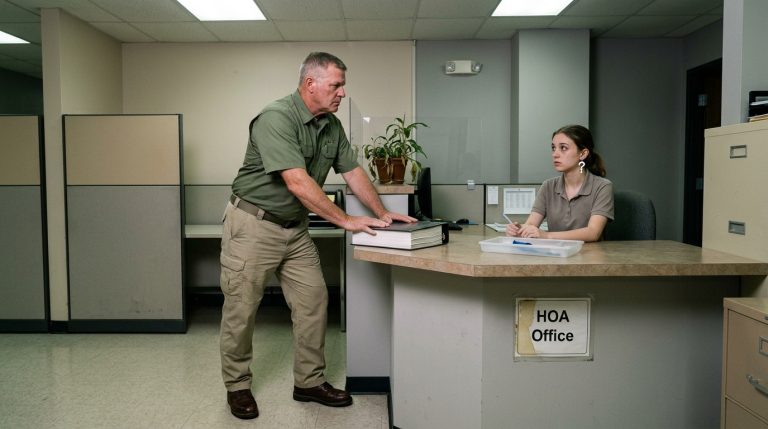
I walked to the door, my movements steady. When I opened it, the scene was exactly what I had anticipated: Clare Wells stood on my porch, flanked by two men in heavy, reflective-striped jackets. They looked like technicians, but the way they held themselves—the rigid posture, the lack of tool bags, the clinical, unblinking eyes—marked them as something else. Enforcers of the HOA’s version of reality.
“Inspection,” Clare said, her voice smooth, almost melodic against the harsh whistling of the wind. She didn’t offer a greeting, nor did she acknowledge the couple shivering behind her in the yard, watching the scene unfold. “We’ve noted an anomaly in the grid pressure in this sector. Routine safety measure.”
“My property is private,” I said, my voice quiet, cutting through the wind. “I have no record of any emergency declaration that overrides the basic requirement for notice, let alone a warrant.”
Clare smiled, a thin, practiced expression that didn’t reach her eyes. Behind her, one of the men took a half-step forward, his hand resting near a heavy, metallic device clipped to his belt. “The emergency bylaws are currently in effect, as you know. The safety of the community is at stake. We aren’t here to argue, we’re here to ensure the heating loop isn’t compromised by unauthorized interference.”
She stepped forward, expecting me to retreat. I didn’t. I held the line, my boots planted firmly on the threshold.
“The only interference here is the pressure drop you’ve been engineering,” I said, watching her eyes for a flicker of reaction. “I’ve seen the logs, Clare. I know about the independent conduit to your house. I know about the manufactured surges.”
For the first time, the smoothness of her facade cracked. A muscle in her jaw tightened, and the predatory confidence in her posture wavered, replaced by a momentary, defensive flicker. She stepped closer, her voice dropping to a sharp, transactional whisper.
“You have no idea what you’re dealing with,” she said. “This isn’t about heat. It’s about the survival of the neighborhood. If we let everyone decide their own path, there is no community. There is only chaos. We hold the order, and that requires sacrifice.”
“Your sacrifice, or ours?” I asked, my gaze shifting to the clubhouse in the distance.
At that exact moment, a low, guttural thud resonated through the ground, followed by a hiss of escaping steam. A plume of white smoke erupted from the direction of the clubhouse. The men behind Clare turned sharply, their faces losing their professional mask. The backup generator—the heart of the HOA’s promise—had failed. It had groaned once, a sound of dying metal, and then gone silent.
The neighborhood seemed to hold its collective breath. The clubhouse, the beacon of the ‘centralized emergency response,’ was now just a dark, sinking building in the middle of a dying street.
Clare spun around, her eyes wide with a sudden, frantic energy. “Fix it,” she snapped at the men. “If that unit goes, the whole sector drops.”
“It’s not just the unit, Clare,” one of the men said, looking at a handheld monitor. “The pressure is plummeting everywhere. The valves are locking down.”
They had pushed the system too far. By trying to force the grid to prioritize the inner circle, they had created a feedback loop that was now tearing the entire network apart. The very control they had used to dominate the street was now the instrument of their own undoing.
Clare turned back to me, her eyes darting toward the open door, toward the warmth still emanating from my house. “You have to open the valves,” she said, her tone no longer authoritative, but desperate. “If you don’t release the pressure into your line, the main trunk will rupture.”
“I am not a part of your grid, Clare,” I said, and for the first time, I felt the weight of the moment shift. The fear that had defined my winter was gone, replaced by the clear, cold truth of what was happening. “I’m just the one who stayed prepared.”
I watched as the neighborhood, hearing the silence of the clubhouse, began to emerge from their homes. They weren’t coming toward the clubhouse anymore; they were looking toward my house, toward the light in my window, and toward the realization that the center had not only failed—it had never been the center at all. I reached out and caught the edge of the door, ready to close it, knowing that the confrontation wasn’t over, but that the balance of power had finally, irrevocably, tipped.
As I watched Clare scramble, her authority dissolving with every dying flick of the streetlights, I knew the real fight was only just beginning. The storm wasn’t just hitting the houses; it was tearing down the walls we had built around ourselves.
CHAPTER 5: The Restoration of Truth
The silence that followed the generator’s death was total. It was as if the neighborhood itself had stopped breathing, caught in the suspension between the old, failed order and the uncertain, shivering promise of something new. Clare stood in the snow, her coat dusting with white, her eyes searching my face for the concession I wouldn’t provide. She looked smaller now, the veneer of administrative authority stripped away by the sheer, unyielding physics of the freeze.
“You don’t understand,” she said, her voice strained, echoing against the quiet houses. “If the pressure isn’t equalized, the entire trunk line will rupture. You’re not just saving your house, you’re potentially destroying the foundation of the street.”
“The foundation is already ruined, Clare,” I replied, my voice steady. I stepped out onto the porch, the cold air hitting my face with a familiar, abrasive sting. “You didn’t build a community. You built a tether. And the tether snapped because it was never meant to hold anything but you.”
Behind her, the two men shifted, their confidence evaporated. They looked at the darkening houses, then back at the clubhouse, realizing that their leverage was gone. One of them began to pull out a radio, but the air was dead; the local infrastructure had been so focused on centralized monitoring that it hadn’t prepared for the loss of its own hub.
“Open it,” Clare demanded, though the command lacked its former bite. It was a plea disguised as an order.
“I’ll open the valve,” I said, stepping down the stairs. The snow crunched under my boots, a crisp, grounding sound. “But not for you. And not because you told me to.”
I walked toward the fence, my gaze fixed on the valve housing. I felt the weight of the moment—not as a triumph of ego, but as a return to something fundamental. The neighbors began to gather at the edges of their driveways, wrapped in blankets and coats, their faces illuminated by the pale, eerie light of the morning. They weren’t looking at Clare anymore. They were watching the valve.
I reached the housing and knelt, my gloved hands clearing the ice. The metal was frozen, but the mechanism remained true. I looked up at Clare one last time. She was trembling, the cold finally beginning to penetrate the protective layers she’d kept between herself and the neighborhood.
“You always thought this was a game of procedure,” I said. “You thought if you wrote enough notices, if you controlled enough access, you could manufacture safety. But safety isn’t something you enforce, Clare. It’s something you build together.”
I didn’t wait for her response. I inserted the key, the metallic click echoing like a gunshot in the still air. With a slow, deliberate motion, I turned the wheel. The tension in the pipe, built up over days of forced silence, hissed as the flow returned. It was a soft, rushing sound—the sound of the neighborhood finally receiving what it needed.
The pipes beneath our feet began to tick, a soft, percussive rhythm of expansion as the heat returned. It was the sound of life reasserting itself.
Clare stared at the valve, her hands clenched at her sides. The defeat was written plainly on her face, not in a loss of power, but in the realization that she had become irrelevant. The street was no longer waiting for her notices. They were waiting for the warmth.
I stood up, wiping the frost from my gloves. I looked at the crowd. There was no cheering, no chaotic outburst. Just a collective, ragged exhale. A man I recognized—one who had been too afraid to speak to me days ago—stepped forward and nodded once, a gesture of profound, silent acknowledgment.
“The system is back online,” I said to the crowd, my voice carrying clearly in the crisp air. “But it’s ours now. We maintain it, we check the pressure, and we keep the lines open. No more centralized shut-offs. No more manufactured emergencies.”
Clare turned and began to walk away, her movements slow, uncoordinated. The two men followed, their shoulders slumped, the reflective tape on their jackets dull in the morning light. They didn’t look back. They were ghosts of a system that had already been dismantled by the simple, stubborn reality of the cold.
I turned back to my house, the warmth calling me home. The path ahead was still frozen, and the neighborhood still had a long way to go before the winter broke, but the uncertainty had changed. It was no longer the uncertainty of victims, but the uncertainty of people who were finally, painfully, awake. I reached the door and paused, looking back one last time at the street, which was slowly, steadily, coming back to life.
CHAPTER 6: The Thaw
The transition was not marked by a sudden, jarring change, but by the slow, steady reclamation of the ordinary. As the morning light pushed its way through the persistent cloud cover, it revealed a neighborhood that looked, at first glance, unchanged—identical houses, identical fences, the same snow-crusted lawns. But beneath the surface, the rhythm of the street had shifted. I walked down to the fence line where I had knelt hours before, the metal of the valve enclosure still rimmed with a fine layer of hoarfrost, and listened.
The low-frequency hum was everywhere. It was the sound of individual furnaces kicking on across the row, not synchronized by a clubhouse mandate, but firing in response to the specific, human needs of each home. I touched the surface of the fence—the wood was weathered, a faded texture of gray and silver—and felt a profound, grounding stillness. The system was no longer a weapon; it was just a tool, as it had always been intended to be.
I spent the next three hours retracing my steps, checking the valves and the conduits that the HOA had once tried to silence. Elias was there, working on the secondary junction box at the corner of the street. He didn’t look up as I approached, but his movements were fluid, devoid of the hesitation that had shackled him when the HOA’s influence was absolute. He was tightening a connection, his hands moving with the practiced efficiency of someone who was finally doing work that mattered.
“The pressure is holding steady,” he said, finally looking up. His face was weathered, his skin mapped with the lines of a man who had weathered many storms, but his eyes were bright, cleared of the fog of compliance. “They’ve cut the main feed from the clubhouse entirely. It’s better this way. We don’t have to worry about the surges anymore.”
“And the board?” I asked, watching as a group of neighbors emerged from the house across the street, carrying bags of gravel to clear the ice from their shared walkway.
“They’re busy answering to the county investigators,” Elias replied with a ghost of a smile. “Turns out, there’s a lot of paperwork that doesn’t hold up under scrutiny when you aren’t the one holding the pen.”
I nodded, feeling the last of the tension bleed out of my shoulders. The core truth—the one I had fought to hold onto—was finally plain for everyone to see: that resilience is not a policy, but a practice. The HOA hadn’t just lost their authority; they had been revealed as a hollow construct, an elaborate architecture built to sustain their own comfort at the expense of everyone else’s reality.
I walked back to my porch, the air feeling lighter, less hungry. Inside, my house was comfortable, the heat balanced and consistent. I took the small metal box—the one that had housed the valve—and sat down at the kitchen table. I picked up a roll of heavy-duty tape and a spare piece of aluminum sheeting, set aside for a repair I’d been meaning to make for weeks. My hands moved with a quiet, meditative purpose. I patched the small tear in the insulation of the main heating line, smoothing the edges until the seal was seamless, efficient, and, most importantly, mine.
It wasn’t a grand repair, but it was symbolic. I was fixing the things I had been forced to leave frayed during the chaos. As I worked, I thought about Clare Wells. I wondered if she truly believed the rhetoric she had spouted on my porch, or if she was just another gear in a machine that had ground itself to a halt. In the end, it didn’t matter. Her world had relied on our passivity, and that was a resource we were no longer willing to supply.
By late afternoon, the neighborhood felt entirely different. The unnatural, heavy silence had been replaced by the small, domestic sounds of recovery—doors opening and closing, the scrape of shovels against pavement, the murmur of voices discussing not schedules or violations, but the practicalities of survival. There was a sense of shared, quiet connection, a Kintsugi-like beauty in the way the street was mending its own cracks.
I stepped onto the porch one last time before the sun vanished behind the mountains. The sky was a pale, washed-out blue, fading into the deep, bruised purple of dusk. The cold was still there, of course—it was winter, after all—but it no longer felt like a threat. It felt like a season, something to be managed, respected, and endured, not something to be feared.
I had come into this winter convinced that I had to be an island, that to preserve my own autonomy I had to shut out the world. I had been wrong. The struggle had forced us into a shared vulnerability, and through that, we had found a strength that didn’t require a president or a board of directors to validate.
I looked down the street. The lights in every house were steady, warm, and individual. There was no clubhouse beacon, no central, flickering pulse, just the collective, unwavering glow of a hundred small fires, each one maintained by someone who had finally realized they had the right to tend their own hearth.
I went inside and closed the door, the latch clicking into place with a definitive, satisfying sound. I sat in the warmth, the quiet hum of the heater settling into the background of my life. The storm was over, the system was ours, and for the first time in a very long time, I didn’t have to look over my shoulder. I had built a home that could withstand the winter, and in the process, I had helped build a street that could survive the spring.