The Bureaucrat’s War: How a Retired Logistics Officer Dismantled a Suburban Dictator Paper by Paper
CHAPTER 1: THE DUMPSTER LINE
The plastic green lid of the dumpster rattled as the humid afternoon air carried the reek of leftover takeout and fresh cedar chips.
Karen stood two feet onto my bermudagrass, her tan orthopedic sneakers sinking slightly into the soft soil near the sidewalk. She held her plastic clipboard against her chest like a riot shield, her jowls rigid with the quiet satisfaction of a border guard who had just seized contraband.
“Section 4, subsection B,” she said, her voice dropping into that flat, practiced tone she used for covenant violations. “No unapproved permanent or semi-permanent fixtures. You were warned, Mr. Miller.”
I didn’t answer. Thirty years in Army logistics teaches you that when an opposing force overextends into your sector, you don’t engage until you know their precise position. I clicked my silver pen once, capped it, and slid it into the breast pocket of my work shirt.
I walked past her toward the curb. My boots felt heavy on the asphalt, each step making a dry crunching sound against the loose gravel near the gutter.
The dumpster lid yielded with a sharp scraping noise. Inside, resting atop two black trash bags, lay ten shattered boxes of hand-planed red cedar.
I reached in with my bare hand, ignoring the grease on the rim. My fingers brushed a jagged edge of pine where a micro-camera housing had been ripped out by the roots. A single blue feather hung caught in the splintered doorway of Unit Four—the nest box I had spent three hours mounting on Tuesday for the female bluebird that had been scouting my yard since sunrise.
“K&S Landscaping cleared them at twelve-thirty,” Karen said behind me. Her voice drifted closer, the soles of her shoes squeaking on the pavement. “The board authorized a hundred and fifty dollar disposal charge. It will be on your monthly assessment.”
I turned around slowly, keeping my left hand flat against the warm plastic rim of the dumpster.
She didn’t back up, but her grip on the aluminum edge of her clipboard tightened until the skin over her knuckles turned yellow. Her eyes darted once toward my shirt pocket, zeroing in on the silver clip of my pen.
“The architectural request was delivered to your front porch on October seventeenth,” I said, keeping my tone below a rise. “Signed for by your hand on the green return card.”
“Incomplete documentation,” she snapped, taking a half-step back onto the turf. “It was never added to the official register. If it isn’t in the binder at the clubhouse, it doesn’t exist.”
She pulled a ballpoint pen from her collar and made a sharp, aggressive checkmark on her sheet. The paper crinkled under the force of her hand.
“You have until five o’clock on Friday to clear the remaining mounting brackets from the tree line,” she added, her eyes narrowing as she looked past my shoulder toward the greenbelt. “Or I bring K&S back out with a chainsaw.”
I didn’t argue. I didn’t raise my voice. I took my silver pen out of my pocket, unclipped my notebook, and wrote down the exact time: 14:12.
“Friday,” I said, closing the cover with a soft snap. “Five o’clock.”
Karen adjusted her grip on her clipboard, turned on her heel, and marched down the sidewalk toward her brick two-story at the end of the cul-de-sac. Her footsteps were fast, loud, and completely devoid of rhythm.
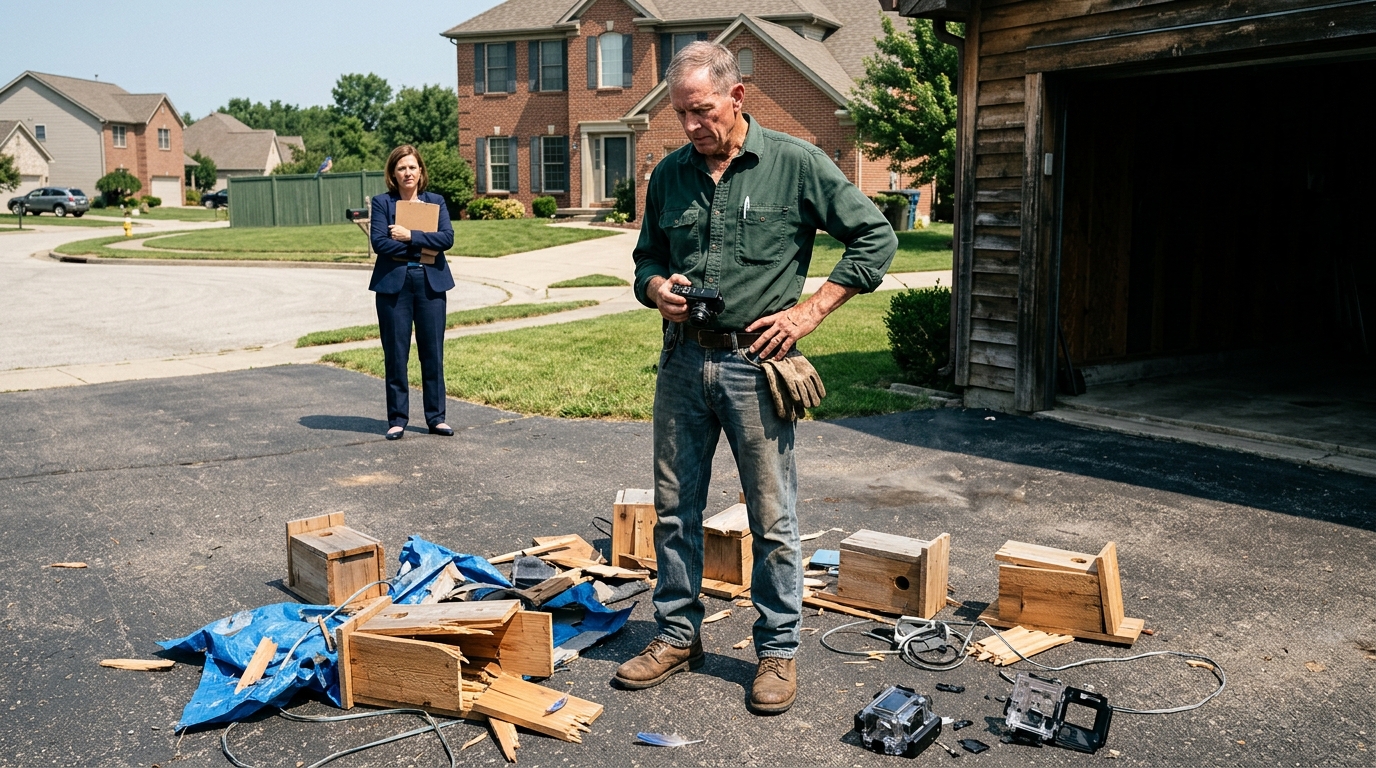
I turned back to the dumpster, pulled my heavy leather work gloves out of my back pocket, and started lifting the cedar fragments onto the driveway one piece at a time.
CHAPTER 2: THE PAPER FORTRESS
Sweat stung the corner of my left eye as I dropped the final jagged piece of red cedar onto the blue tarp spread across my driveway.
I wiped my brow with the back of my leather work glove, the heavy leather scratching against my damp forehead. Ten destroyed habitats lay arranged in neat rows like damaged aircraft components on an airfield tarmac.
I picked up my phone from the hood of my truck and took three wide shots showing the driveway, the dumpster at the curb, and Karen’s house down the block. Then I knelt, taking macro photos of every cracked micro-camera lens, every torn wire, and every crushed cedar board.
The heat radiating off the asphalt burned through the knees of my denim jeans, but I didn’t shift my posture.
My wife, Eleanor, had spent four years mapping the flight corridors of eastern bluebirds before the cancer took her voice. We had picked this specific half-acre because the greenbelt behind our lot was their natural staging ground.
When I finished photographing the last splintered entrance hole, I dragged the tarp inside the cooler shade of the garage, pulled down the heavy door, and went straight to my office.
My desk was a plain oak flat-top, organized with the same dry discipline I used during my thirty years as an Army logistics coordinator. On the left sat my green three-ring binder labeled Project Bluebird.
I unclipped my silver pen, opened the binder, and pulled out my primary document: the original architectural request form.
Stapled to the back was the green postal return receipt card. Karen’s sloppy signature sat right in the middle box, dated October seventeenth, eight months prior.
Section 8, subsection C of the Creekwood Commons covenants was crystal clear: Failure by the Architectural Review Committee to issue a written rejection within thirty days of certified delivery shall constitute full approval of submitted plans.
She hadn’t rejected it. She had simply ignored it, assuming a retired soldier wouldn’t know the bylaws better than she did.
The mail slot on my front door rattled with a loud, metallic slap.
I left my desk and walked down the hallway. A crisp white envelope rested on the rug, the Creekwood Commons logo printed in bright blue ink across the left corner.
I picked it up, sliced the top open with my pocket knife, and pulled out two single sheets of paper.
The first was a formal Violation Notice, backdated to April fourteenth—a week before the destruction. It cited Section 4, subsection B, and levied a $200 fine for maintaining unauthorized structures on common-facing land.
The second sheet was an invoice printed on K&S Landscaping letterhead.
For Services Rendered: Emergency removal and hazardous waste disposal of unauthorized lawn structures. Amount Due: $150.00.
I stared at the paper until the numbers stopped swimming in the afternoon heat.
They had smashed my property, thrown the pieces into a municipal bin, and now they were charging me for the labor.
I didn’t yell. I didn’t throw the paper down. I took my silver pen out of my pocket, flipped open my pocket notebook, and wrote two lines:
Received retroactive violation notice at 15:40. Sender attempting to establish paper trail post-incident.
I pulled out a fresh red three-ring binder from my closet shelf, opened the rings, and snapped the invoice and the fine right behind my postal receipt.
Karen thought she was playing a game of chicken on my front lawn. She didn’t understand that when you try to bully a logistics officer, you aren’t starting a fight—you’re opening a file.
CHAPTER 3: THE BROKEN LEDGER
I stood in the doorway of the HOA clubhouse office, holding the red binder firmly against my hip while checking my watch.
The clock above the brass mail slots read 13:58. Two minutes before the scheduled public inspection hour.
David Chen, the association treasurer, looked up from behind a metal desk stacked with manila folders. His wire-rimmed glasses slipped down the bridge of his nose as his hand froze over an open ledger book.
“Jack,” David said, his voice flat with immediate tension. “Office hours don’t officially open until two.”
“I’ve got two minutes,” I replied, stepping inside. The air conditioning hummed on high, blowing cold air that smelled faintly of lemon floor wax and old paper. “I’m here to review the architectural logbook for Section 4.”
David’s shoulders hunched inward. He didn’t reach for the logbook, but his right knuckles clicked against the laminate desktop.
“Karen left specific instructions regarding your file,” David murmured, his eyes darting toward the hallway behind me. “Any requests involving unapproved lawn items have to go through formal board review.”
“Section 12 of the bylaws guarantees any homeowner in good standing immediate access to the physical ledger during posted office hours,” I said. I set my red binder down on the corner of his desk with a heavy, wooden thud. “Unless the board wants to add a public records violation to the list.”
David swallowed hard. He pulled a thick, black canvas-bound binder from a shelf beneath his desk and slid it across the laminate surface.
“Ten minutes,” David said, standing up and pulling his ring of keys off the desk. “I have to check the pool filters.”
He walked out past me, his leather dress shoes squeaking softly on the polished linoleum.
I pulled out a wooden folding chair, sat down, and opened the canvas ledger to October of last year.
The pages were lined with black ink, detailing every architectural application by date, owner name, and board action. There was my entry on October eighteenth: Miller, Site 734 – Avian Monitoring Structures.
Beside it, in the status column, the word APPROVED had been neatly crossed out with a single line of black ink.
Written directly above it in tight, aggressive handwriting was the word DENIED.
I leaned closer, pulling my silver pen from my pocket. I used the plastic cap to trace the margin line without touching the paper.
The entry for the denial was marked with a date stamp: Oct 20.
The ink was a dark, distinct shade of purple. Every single other date entry on the entire three-hundred-page ledger—from January of that year to the present day—was stamped in standard black officer ink.
I pulled out my phone and took a clear, top-down photograph of the page, ensuring the purple stamp was framed by the black text above and below it.
I flipped back three pages to the financial ledger for property maintenance.
Four separate line items for “Emergency Lawn Restoration” were listed over the last six months, all made out to K&S Landscaping. Each payout was capped at precisely $499.00—one dollar under the $500 threshold that required a second board member’s signature.
Every single one of those four entries was stamped with the exact same purple date stamp.
The drawer behind the desk clicked. The air in the hallway shifted, bringing with it the heavy, floral perfume Karen wore like armor.
“You’re in restricted files, Jack,” her voice cut through the quiet of the office.
I didn’t jump. I didn’t snap the binder shut. I carefully adjusted my phone camera, took one last high-resolution photo of the invoice numbers, and leaned back in the chair.
Karen stood in the doorway, her arms crossed over a navy blue blazer, her clipboard tucked firmly under her left elbow. Her jaw was set so tight the muscles in her cheeks twitched.
“These are public association records, Karen,” I said, my voice quiet and steady. “And your purple stamp leaves a very clear paper trail.”
CHAPTER 4: THE NEIGHBORHOOD REVOLT
I leaned back in the folding chair, holding my phone in one hand while Karen stepped into the office doorway with her arms crossed tightly over her navy blazer.
“I’m giving you ten seconds to put that book away, Jack,” she said, her voice trembling with a sudden, sharp edge. “This is unauthorized access to private corporate records.”
I slipped my phone into my pocket, stood up, and pulled the red binder off the desk.
“The purple stamp was a nice touch, Karen,” I said, stepping past her into the hall. “Four checks to K&S Landscaping. Always four hundred and ninety-nine dollars. Always stamped on a Sunday.”
Her color drained, leaving her skin a mottled gray beneath the fluorescent hall lights. She didn’t follow me out to the parking lot.
By nineteen hundred hours, six folding chairs were set up in a half-circle on my front driveway.
Mr. Patel sat on the far left, his fingers tapping a rhythmic beat against a manila folder resting on his knees. Next to him sat Mrs. Gable, clutching her vinyl purse against her floral sweater like a shield. Three other neighbors from down the cul-de-sac stood near the open garage door, watching the street.
I brought out a wooden clipboard loaded with blank affidavit forms I’d printed from the county civil court template.
“She gave me forty-eight hours on the basketball hoop,” Patel said, his jaw tightening as he handed me a printed copy of his bank statement. “Five hundred dollar penalty, plus a lien threat signed only by her. No board vote.”
“She made my son dig up my late husband’s rose bushes,” Mrs. Gable whispered, her hands shaking as she pulled three yellowed violation letters from her purse. “She told me the wire border was an illegal fence structure. I paid ninety dollars in fines before I gave up.”
I took the papers from each of them, laid them flat on the hood of my truck, and filed them behind my photographic evidence of the birdhouse destruction.
“We aren’t filing a standard grievance with the board,” I said, uncapping my silver pen and passing it to Patel. “We’re filing a joint civil complaint for selective enforcement and breach of fiduciary duty. We name her personally.”
Patel took the pen without hesitation. He set the clipboard on his knee and pressed down hard, his signature thick and black on the bottom line.
A white sedan slowed down as it reached the edge of my lawn. The driver’s side window rolled down two inches, revealing Karen’s face in the dim glow of her dashboard.
She didn’t get out. She raised a digital camera, the flash popping twice against the dark dusk, capturing every person sitting on my driveway before she hit the gas and sped toward the cul-de-sac turn.
Mrs. Gable flinched, looking toward the street with a sudden flicker of doubt. “Jack… she can make our property assessments impossible.”
“She can try,” I said, taking the clipboard back from Patel and handing it to her. “Sign on line two, Mrs. Gable. She’s running out of ink.”
CHAPTER 5: THE TRAP AT THE CLUBHOUSE
I stood at the lectern inside the clubhouse meeting room, plugging my laptop HDMI cable into the wall projector while Karen slammed her wooden gavel against the long head table.
The loud crack echoed off the concrete walls. “This floor is closed to unscheduled presentations!” Karen shouted, standing up so fast her chair screeched against the tile. “Mr. Miller, you are out of order!”
I didn’t argue. I hit Control-P on my keyboard, and a high-resolution scan filled the white projection screen behind the board members.
The room, packed with over forty neighbors sitting shoulder-to-shoulder, went dead silent.
On the screen was the certified postal return receipt for my architectural request, dated October seventeenth, complete with Karen’s signature in blue ink.
“Section 8, subsection C,” I said, my voice steady through the lectern microphone. “Failure to respond in writing within thirty days constitutes automatic approval under our own bylaws.”
“That document was incomplete!” Karen snapped, her face flushing crimson as she gripped the edges of her clipboard until her thumbs turned white. “It was never formally received by the board!”
I clicked my wireless mouse once.
The screen shifted to a side-by-side comparison of the official ledger. On the left was my original entry marked APPROVED. On the right was the altered entry marked DENIED, stamped with the bright purple date stamp from October twentieth.
“This is the official association register,” I said, pointing a finger toward the wall. “The black ink entries run consistently for three years. The purple stamp appears only five times in the entire ledger.”
Karen turned toward David Chen, her breath coming in quick, shallow gasps. “David, shut the projector down. He’s displaying altered corporate property.”
David Chen didn’t move. He sat with his hands folded over his desk blotter, staring at the screen.
“The purple stamp appears on four other pages,” I continued, hitting the key to bring up the financial ledger. “Each one authorising a four-hundred-and-ninety-nine-dollar check to K&S Landscaping. Signed exclusively by Karen Miller, bypassing the full board approval limit by one dollar.”
A sharp murmur rippled through the rows of folding chairs behind me.
Mr. Patel stood up in the third row, holding his signed affidavit high in his hand. “She fined me five hundred dollars for a basketball hoop without a board vote! Where did that money go?”
Mrs. Gable stood up next, her voice trembling but clear. “She forced me to pull out my rose bushes and billed me ninety dollars!”
Karen slammed her gavel down three times in rapid succession, the wooden block chipping under the force. “Order! You are all being manipulated by a man who thinks his military background puts him above our community standards!”
“We aren’t discussing standards, Karen,” I said, stepping away from the lectern and holding up the thick red binder for the entire room to see. “We’re discussing six signed affidavits, a forged ledger entry, and a pattern of unauthorized payouts.”
The board member to Karen’s left, a quiet man named Thomas, leaned away from her, pulling his chair two inches to the side.
Karen glared at the crowd, her chest heaving as she pointed a finger directly at my chest. “This meeting is adjourned! None of this holds any weight, and you will all be receiving legal notices for disrupting association business!”
She snatched her binder, turned on her heel, and marched toward the side exit, leaving the rest of the board sitting in silence under the glow of the projector screen.
CHAPTER 6: THE FINAL AUDIT
I stood in my driveway watching David Chen and the remaining three board members walk up my concrete walkway, holding a thick white folder between them.
David stopped two feet from my porch steps, his shoulders no longer hunched. He pulled a signed document from the top of the stack and handed it to me.
“The board voted four to zero this morning, Jack,” David said, adjusting his glasses. “We stripped Karen of executive authority and executed a forced removal under Section 14 of the bylaws. She refused to sign the surrender order, so we changed the clubhouse locks at noon.”
I took the paper. It was a formal settlement agreement, stamped by the association’s legal counsel.
The terms were line-item clear: Full reimbursement for four thousand two hundred dollars in destroyed research equipment, immediate dismissal of all fines against every resident who signed an affidavit, and a formal written retraction on the front page of the monthly newsletter.
“What about the K&S payouts?” I asked, my thumb tracing the crisp black print on the bottom margin.
“Our insurance carrier refused to cover her individual actions once they saw your photos of the purple date stamp,” David said. His voice was flat, dry, and entirely devoid of sympathy. “The board is suing her personally to recover the kickback funds. She put her house up for sale yesterday afternoon to cover her personal liability.”
A yellow moving van rumbled slowly down the street, turning into the driveway at the end of the cul-de-sac.
Karen stepped out of her front door carrying two cardboard boxes. Her navy blazer was gone, replaced by a faded cardigan. Her posture was stiff, her chin tilted up in a desperate, brittle attempt at defiance, but she kept her eyes fixed firmly on the pavement ahead of her.
She didn’t look toward my yard. She didn’t look at David. She loaded the boxes into the back of the truck, clicked the latch shut, and got into her car without a word.
Patel walked over from across the street, carrying his ten-year-old son’s tool set under his arm. Behind him, Mrs. Gable crossed the lawn holding a small spade and two potted rose bushes.
“Where do you want the first post, Mr. Miller?” Patel asked, setting a pressure-treated four-by-four timber against my work bench.
I pulled my silver pen from my pocket, unclipped my notebook, and drew a quick x-mark on the lawn diagram laid out on my truck hood.
“Right on the boundary line,” I said. “Facing southeast toward the greenbelt.”
Mrs. Gable knelt near the edge of the bermudagrass, carefully digging a small round hole in the dark soil for her new rose bushes. “No wire border this time, Jack,” she said with a soft laugh. “David says the board approved it as a community pollinator patch.”
I picked up my cordless drill, set a stainless steel screw into the cedar backing of a brand-new nesting box, and drove it home with a single, smooth push.
The wood smelled clean, dry, and solid under the bright afternoon sun.
A sudden flash of vivid blue cut through the humid air above the driveway. A male bluebird dropped down onto the cedar roof, puffed out its chest feathers in the breeze, and let out a clear, three-note warble that echoed across the open lawn.
I set the drill down on the workbench, leaned my back against the tailgate of my truck, and watched the bird take flight toward the tree line.
The paper war was over. The lawn was quiet again.