The Fence Line War: How a Small-Town Farmer Melted an HOA Tyrant’s Empire
CHAPTER 1: THE MOLTEN BREACH
The smell of fresh, bubbly weld-slag on raw iron is something you never forget once you’ve seen a combat zone. It hit my nose before I even stepped off the gravel driveway, mixing with the sharp, ozone tang of the storm rolling in from the west.
“That gate,” Karen said, her voice dripping with the syrupy condescension of someone who had never been punched in the jaw, “is a flagrant violation of Article 7, Section 4, Paragraph B of the community bylaws. I am enforcing the rules effective immediately.”
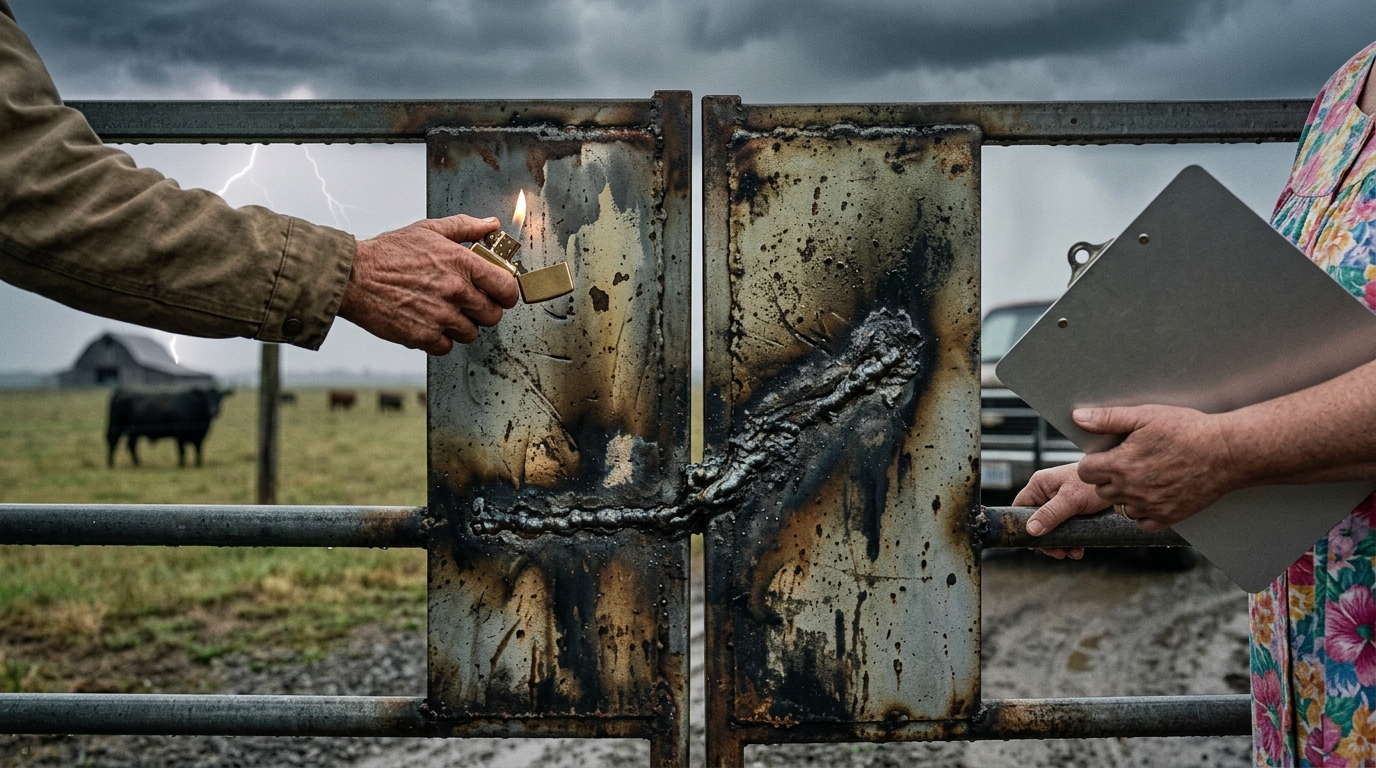
I didn’t answer right away. My thumb automatically reached for the brass Zippo in my jeans pocket, flicking the worn casing open and shut. Clack-click. Clack-click.
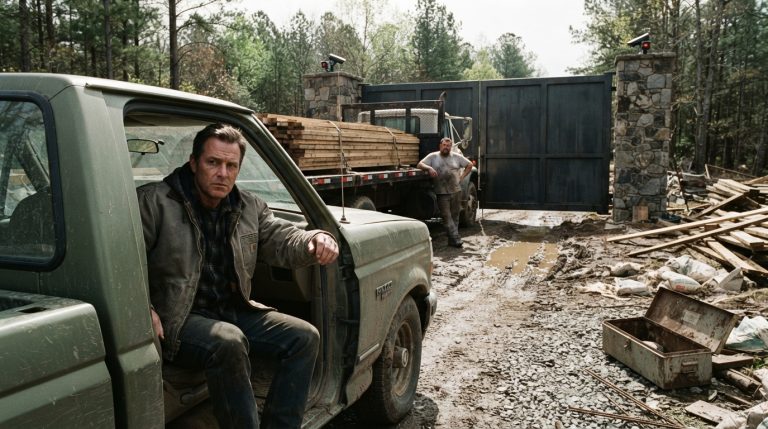
She stood on the asphalt in a floral muumuu that looked like a curtain pulled off a discount rack, clutching a metal clipboard against her chest like a shield. Behind her, the heavy steel hinge of my primary cattle gate was ruined—smeared with a jagged, glowing-hot line of crude arc-weld that locked the frame dead into the post.
Beyond that gate, twenty yards into the pasture, Titan lifted his massive black head. Two thousand pounds of prize-winning Angus bull, worth more than Karen’s mid-size sedan sitting in her driveway, twitched his ears at the low rumble of thunder echoing across the county line.
“There is no Paragraph B, Karen,” I said. My voice was low, flat, and stripped of temperature. Clack-click. “I’ve read the bylaws. Agricultural fences over five acres were grandfathered in before this subdivision was even mapped.”
“The board held an emergency vote,” she sniffed, pushing her thick-rimmed glasses up the bridge of her nose. “We amended the aesthetic harmony clause. You didn’t attend the social last Tuesday, Mr. Henderson, so you wouldn’t know.”
Dark, bruise-colored clouds swallowed the sun, dropping the temperature ten degrees in five seconds. The first heavy drop of rain hit the hood of my truck with a loud snap.
Deputy Miller’s patrol car pulled up ten minutes later, his tires crunching softly on the gravel. He didn’t even get out of the cruiser at first. He just rolled down his window, looked at the melted steel, and shook his head with a long, tired sigh.
“Jack,” Miller said, leaning his arm on the door. “I can take a report for property damage, but if she’s claiming it’s an official HOA action under color of their rules… my hands are tied. The District Attorney won’t touch this. It’s a civil boundary dispute.”
“She welded a gate shut with a bull in the pasture, Miller,” I said, holding the Zippo still in my palm. “That storm hits in twenty minutes. If that fence goes down, he’s on County Route 9.”
“Take it to a judge, Jack. I’m sorry.” He handed me a business card with a tiny, useless file number scrawled on the back and backed out onto the road.
No lawyer was answering their phone at 5:00 PM on a Friday, and I didn’t have five grand sitting in a retainer fund anyway. I was on my own.
I turned away from the main road and walked straight to the barn, pulling my phone from my belt. Sarah met me at the equipment bay, her eyes wide as she looked at the black sky.
“Get the F-250,” I told her, my voice dropping into the quiet cadence I used when a perimeter was compromised. “Hook up the trailer to the west access road by the ravine. We’re hauling him out through the old timber trail.”
“Jack, that trail hasn’t been cleared in three years,” she said, grabbing my arm. “The mud down by the creek will be hub-deep if that cell drops!”
“We don’t have a choice.” I pocketed the lighter and grabbed a heavy leather lead-rope off the wall hook. “Karen locked the front door. We take the back.”
The downpour hit before we reached the western fence line. The ground turned into a slick, grey soup under my boots, the rain beating against my coat until my shirt was soaked through. Lightning split the sky over the ridge, the crack of thunder slamming into the valley a split-second later.
Titan was spooked, his hooves tearing up the mud as he paced the wire. I didn’t rush him. I stepped into the enclosure sideways, keeping my silhouette small, speaking in the low, rhythmic hum I used during calving season.
“Easy, big guy. Easy.”
It took twenty agonizing minutes of dragging my boots through calf-deep clay, guiding two thousand pounds of muscle down a narrow, six-foot embankment while the rain blinded us. One slip on the slope would have snapped the bull’s leg—or pinned me under his flank. When the trailer gate finally slammed shut and the heavy iron pin slid into place, my hands were shaking from the raw physical strain.
I wiped the wet mud from my face, leaning my forehead against the cold metal of the trailer.
Karen thought she had just enforced a rule. She thought she had put a stubborn farmer in his place. She had no idea that all she’d really done was clear the battlefield.
CHAPTER 2: PAPER WARFARE
Rain dripped off the brim of my canvas hat directly into my left eye, but I couldn’t free a hand to wipe it away without letting Titan’s trailer gate drop back into the clay.
The heavy steel bolt slid home with a dull, wet thud. My thumb found the familiar brass casing in my jeans pocket, flipping the lid open and shut in a fast, silent rhythm. Clack-click.
Sarah leaned out the truck window, her face pale under the cab’s yellow interior light. “Jack! The sheriff’s car just turned off the main road! He didn’t even stop!”
“He isn’t coming back,” I said, wiping my forehead with the back of my wet sleeve. “Miller called it a civil matter. That means we don’t exist to them.”
I pulled a legal pad out of the glove box once we parked behind the house, the rain still drumming a heavy, relentless beat against the roof. I didn’t have five thousand dollars for an attorney’s retainer, and the local legal aid clinic had a three-month waiting list. If Karen wanted to fight with paper, I was going to turn my kitchen table into a war room.
By six the next morning, the sky was clear and bright, but the ground was still wrecked. I grabbed my camera, a thick yellow highlighter, and walked down the quarter-mile drive to where the front gate stood ruined.
The weld was ugly—a thick, bubbled worm of sloppy iron that charred the green paint down to bare, rusting metal. I snapped twenty photos from every angle: close-ups of the slag, wide shots showing the county road, and clear angles of the deep truck-tire ruts left in the ditch by whoever Karen hired.
“You’re wasting your time, Mr. Henderson.”
Karen was standing on the edge of her lawn across the asphalt, holding a steaming mug in one hand and her clipboard in the other. Her floral housecoat was gone, replaced by a crisp beige pant suit that looked like she was heading to a corporate audit.
I didn’t stop clicking the shutter. “Article 4, Section 2 requires forty-eight hours written notice before any structural alteration to shared access boundaries, Karen.”
“That applies to residential lots,” she said, taking a slow, deliberate sip. Her eyes were completely flat behind her thick lenses. “Your forty acres are categorized under community aesthetic management as of Tuesday’s emergency meeting.”
“An emergency meeting requires a quorum of five board members,” I said, dropping the camera to my chest. Clack-click. The brass Zippo felt heavy in my palm. “You only have three.”
“The bylaws permit a reduced quorum during urgent community safety threats.” She turned on her heel, her soft-soled shoes making no sound on the fresh grass. “Expect your administrative assessment in the mail.”
She didn’t know I spent four years logging supply manifests in Kandahar. Rules aren’t wall decorations; they’re grid coordinates. If you don’t know the terrain, you walk straight into an ambush.
Ten minutes later, I walked down the gravel road to Arthur Miller’s place. The old man was out front, his back bent over a bed of yellow marigolds, his hands trembling as he pulled weeds.
“Arthur,” I said quietly, keeping my boots on the ditch line so I didn’t startle him.
He flinched, his head jerking up, his eyes darting immediately toward Karen’s front porch down the block. “Jack. You shouldn’t be standing out here. She’s got cameras on the light pole.”
“Let her watch,” I said. “How much did she fine you last month?”
Arthur swallowed hard, his knuckles white around his trowel. “Eight hundred. Said the paint on my porch railing had micro-cracks. Threatened a foreclosure lien if I didn’t pay the HOA account by the fifteenth.”
“Did she give you an itemized receipt?”
“She gave me a letter,” he whispered, his voice cracking. “Said the board doesn’t issue itemized statements for standard compliance enforcement. Jack, we can’t afford another one. My pension—”
“Keep your money in the bank, Arthur,” I said. “Don’t sign anything else she hands you.”
I spent the next three hours knocking on doors down the two-mile stretch of Oak Meadows Lane. Carlos Garcia showed me a three-page violation notice for his kid’s wooden sandbox. A retired teacher named Martha showed me a four-hundred-dollar fine for leaving her trash cans out three hours past the seven-o’clock deadline.
Every single one of them had paid cash or sent cashier’s checks directly to a post office box listed under “Oak Meadows Management Services.” None of them had ever seen an official audit.
I sat back down at my kitchen table at noon, the legal pad covered in dates, dollar amounts, and receipt numbers.
I drafted a single document using the exact phrasing from State Property Code 720.303. It wasn’t a pleading, and it wasn’t a complaint. It was a formal Demand for Inspection of Official Association Records, requesting thirty-six consecutive months of bank statements, vendor contracts, and meeting minutes.
Under state law, she had ten business days to comply. Every day she delayed carried a mandatory fifty-dollar penalty paid directly to the requesting homeowner.
I drove to the main post office in town, handed the envelope to the clerk, and paid four dollars for certified mail with a green return-receipt card requested.
“Sign right here, sir,” the clerk said.
I stamped the tracking number into the corner of my legal pad. The fuse was lit.
When I got home, there was a bright neon-orange sticker slapped across the driver’s side window of my F-250, parked entirely on my own gravel driveway.
VIOLATION NOTICE: Commercial vehicle weight exceeding residential driveway allowances. Fine: $150. Immediate removal required.
I stood in the heat, looking at the wet adhesive tearing off on my glass. I didn’t get angry. I pulled out the Zippo, flipped it open, and let the small flame warm the edge of the sticker until the glue softened and peeled away in one clean strip.
Karen was sitting on her front porch across the road, watching me through a pair of black binoculars. I held the peeled orange sticker up, folded it neatly in half, and slid it into my shirt pocket next to the certified mail receipt.
CHAPTER 3: THE TRAP AT THE PODIUM
I stood on the gravel driveway in the afternoon sun, folding the neon-orange violation sticker into my shirt pocket, never taking my eyes off Karen’s front porch.
She thought the sticker was an exclamation point. She didn’t realize it was just evidence entry number fourteen.
By seven o’clock that evening, the community clubhouse smelled like stale Folgers coffee and damp carpet. Every metal folding chair was occupied. Fifty neighbors sat squeezed shoulder-to-shoulder, whispering in tense, muted bursts while Karen sat behind a long folding table at the front of the room.
Stan, her vice president, sat to her left, nervously adjusting his wire-rimmed glasses and shuffling a stack of blank index cards. To her right sat the board secretary, keeping her eyes glued strictly to a lit candle on the table.
Karen tapped her pen against the microphone. The harsh feedback squealed through the small room, cutting off the chatter instantly.
“This emergency session of the Oak Meadows Homeowners Association is called to order,” Karen announced, her voice booming over the cheap speakers. “We are facing an unprecedented operational deficit caused by malicious non-compliance from certain agricultural properties.”
She didn’t name me. She didn’t have to. Every head in the room turned two inches to the left to look at where I sat in the back row.
“Because of ongoing interference,” Karen continued, smoothing the lapel of her beige jacket, “the board has voted to levy an emergency special assessment of six hundred dollars per household, due thirty days from tonight.”
A collective gasp rippled through the room. Arthur Miller, sitting three rows ahead of me, visually sagged, his thin shoulders dropping as if someone had placed a sack of cement across his back.
“Six hundred dollars?” Carlos Garcia stood straight up, his work boots heavy on the linoleum. “For what? You doubled our dues last fall!”
“Sit down, Mr. Garcia,” Karen said, her tone smooth and entirely devoid of heat. “You are out of order. Financial allocation decisions are reserved strictly for executive board evaluation under Rule 12.”
“I have a point of order, Karen.”
I didn’t stand up right away. I pulled my brass Zippo from my pocket, letting the cold metal sit flat across my knuckles. Clack-click. The sound was small, but in the sudden dead silence of the room, it rang out like a dry twig snapping underfoot.
I walked down the center aisle, keeping my hands visible, my boots making a slow, steady rhythm on the floor. I stopped three feet from the podium.
“Under State Statute 720, Section 303,” I said, my voice carry effortlessly without the microphone, “any special assessment exceeding ten percent of the annual operating budget requires a general membership vote. Not a board vote. A neighborhood vote.”
Karen’s mascara twitched slightly at the outer corner of her left eye. “This meeting is an executive briefing, Jack. You don’t have the floor.”
“I’m not asking for the floor. I’m asking about Evergreen Solutions LLC.”
Stan’s hand jerked, knocking a pencil off the table. It rolled across the floor and hit my boot. He didn’t bend down to pick it up.
“Our vendor contracts are proprietary,” Karen snapped, her voice tightening by a quarter-octave. “We hire licensed professionals to maintain community standards.”
I pulled a single folded sheet of paper from my coat pocket—the certified public filing I’d pulled from the Secretary of State’s online business registry two hours before the meeting.
“Evergreen Solutions was formed twenty-six months ago,” I said, laying the paper flat on her table, right over her microphone cord. “The registered agent is Gary Peterson. That’s your brother-in-law, isn’t it, Karen?”
The silence in the clubhouse became absolute. You could hear the hum of the overhead fluorescent tubes.
“The HOA paid Evergreen forty-two thousand dollars last year for pasture weed control,” I continued, looking directly at Stan. “Stan, as treasurer, did you sign those checks to Gary Peterson?”
Stan’s face drained of color. He looked at Karen, then at the paper on the table, his throat working silently as he swallowed. “I… the invoices were submitted as standard board operational expenses…”
“That’s a lie!” Carlos yelled from the middle row.
“Order!” Karen slammed her palm on the table, but her voice cracked on the syllable. “This meeting is adjourned! Effective immediately—”
“You can’t adjourn a general meeting without a second motion, Karen,” I said quietly, leaning forward until I was level with her thick-rimmed glasses. “And you haven’t answered why Arthur Miller’s six-hundred-dollar porch fine went into an account registered under Gary’s home address.”
Arthur stood up. Then Martha. Within ten seconds, half the room was on their feet, the quiet fear that had governed Oak Meadows for three years evaporating in a single, roaring wave of common sense.
Karen grabbed her clipboard, her hands trembling so violently that her pen slipped out of her grip and clattered across the floor. She didn’t pick it up. She shoved past Stan, her face blotchy and red, and made a straight line for the side exit door.
I didn’t run after her. I didn’t need to. I turned back to the room, looking at fifty neighbors who were finally done being scared.
“Carlos,” I said, pulling my legal pad from my jacket. “Grab the sign-in sheet from the front desk. We’re starting a petition.”
CHAPTER 4: THE PAPER TRAIL CRACKDOWN
I stood at the front of the crowded clubhouse podium, holding the legal pad while Carlos grabbed the official sign-in sheet off the desk.
By midnight, thirty-eight signatures covered three pages. We didn’t need fifty percent of the development to force a recall vote under county rules; we only needed twenty-five. We had seventy.
The next afternoon, the summer heat baked the asphalt as Carlos and I walked door-to-door down Oak Meadows Lane. My thumb kept a steady rhythm on the brass Zippo in my pocket. Clack-click.
“She sent an email at noon,” Carlos said, slapping a rolled-up clipboard against his thigh. “Claiming the meeting wasn’t officially recorded so the petition isn’t valid.”
“Let her claim it,” I said, stepping onto Martha’s porch. “A petition doesn’t care about her emails. It only cares about ink.”
Martha opened her screen door before I even knocked, holding a fresh ballpoint pen in her trembling hand. “Jack, I signed last night, but Stan came by three hours ago. He said if we don’t drop this, the HOA insurance policy drops us, and everyone’s personal property values crash.”
“Stan’s trying to keep his name off an indictment, Martha,” I said, keeping my voice low and steady. “The policy doesn’t drop us. It drops them.”
She signed her name on line forty-two without another word.
By four o’clock, we had forty-six households locked in. But a petition only removes a board; it doesn’t dismantle a lie. I needed the original founding charter.
I drove straight to the township administration building on Main Street. The basement archives smelled like dry-rotted paper and damp concrete. A single fluorescent bulb flickered overhead as I walked down the metal shelving rows.
I pulled open the drawer labeled Oak Meadows Development 1988–1992.
The files were a mess of misfiled land plats and building permits. But sitting on the top shelf, squeezed behind a stack of tax assessments, was a yellowing, water-stained blue binder with a broken brass ring, mislabeled as Water District Access 1988.
I pulled it down, laying it on the dusty metal table.
Page fourteen contained the developer’s original agricultural covenant, signed before the first residential lot was ever surveyed. Paragraph 3, Section A was struck through with red ink, but the text beneath was completely legible:
All preexisting agricultural acreage exceeding ten acres retains unalterable, perpetual ingress and egress rights, explicitly exempt from all future residential home association governance, covenants, or aesthetic oversight.
Karen’s whole operation wasn’t just corrupt; it was legally nonexistent. My forty acres had never been part of her HOA in the first place. Every notice, every fine, every welded hinge was an act of illegal trespassing on a property she had zero authority over.
My phone vibrated in my pocket. It was Sarah.
“Jack,” her voice was tight over the speaker. “There’s a commercial flatbed truck parked across our driveway. Karen’s standing out front with two men in high-vis vests.”
I slammed the blue binder shut, slid it into my canvas coat, and walked out of the archive room without stopping at the front desk.
When I pulled up to my property line ten minutes later, a heavy iron tow chain was wrapped around my secondary cattle gate. A man with a portable grinding saw was plugging a power cord into a generator on the back of the flatbed.
Karen stood on the gravel shoulder, holding her clipboard like a shield.
“This access point is unpermitted under community road access rules, Mr. Henderson,” she called out over the rattle of the generator. “We are impounding the gate structure.”
I stepped out of the truck, taking my time, slipping my hands into my pockets. I didn’t reach for the Zippo. I reached for the blue binder under my arm.
“Cut that chain,” I said, my voice dropping so flat the saw operator stopped with his finger on the trigger, “and you’re paying for the flatbed out of your personal checking account, Karen.”
“This is an official board enforcement action!” she shrieked, her face turning a mottled red as she stepped toward my front bumper. “You don’t dictate policy here!”
“You don’t have a board,” I said. “And as of 1988, you don’t have an HOA over this dirt.”
CHAPTER 5: THE PUBLIC RECKONING
I stood on the gravel drive beside my F-250, holding the water-stained blue binder against my chest while Karen stood three feet away by the flatbed truck.
“You don’t have a board,” I said, flipping open the yellowing pages right under her nose. “And as of 1988, you don’t have authority over this dirt.”
She didn’t look at the paper. She didn’t have to. The anger in her eyes turned into something sour and desperate.
“That charter is forty years old!” Karen screamed, her arm swinging wildly as she gestured at the flatbed operator. “Cut the chain! I am commanding you to cut the chain!”
The man in the high-vis vest looked at her, then down at the official seal stamped into the water-stained document in my hands. He unplugged his generator cord with a sharp yank and tossed the saw onto the truck bed.
“We aren’t getting seized by the county for an illegal lockout, lady,” he muttered, climbing into his cab and slamming the door shut.
Karen’s face went completely white as the truck diesel roared to life and backed out onto the county road, leaving her standing alone in the gravel dust.
“This isn’t over, Henderson!” she yelled, her heels crunching as she backed away toward her lawn. “I will slap a hundred-dollar daily fine on your property until you’re forced to auction!”
“Try it,” I said, turning my back on her and walking into the house.
The recall meeting was set for six o’clock Friday night at the township municipal room. But Karen wasn’t going to let a vote happen quietly.
At four afternoon on Friday, my phone rang. It was Stan. His voice was shaking so hard I could hear his breath rattle against the receiver.
“Jack,” he stammered. “Karen just transferred thirty thousand dollars from the HOA reserve account into an escrow firm. She’s claiming it’s a retainer for a litigation firm to freeze the recall election.”
“She can’t freeze a statutory recall, Stan,” I said, my thumb working the brass Zippo in my pocket. Clack-click. “Did you sign the authorization form?”
“She forged my digital signature!” Stan choked out. “She told the bank I approved it verbally!”
That was her trap—drain the funds, tie the neighborhood up in procedural delays, and force us to give up out of sheer exhaustion. She thought she could outlast a room full of retirees and working folks.
She forgot about Channel 8 News.
Susan Vance, the lead consumer reporter for the capital city affiliate, was already waiting in the municipal hall parking lot when I arrived at five-thirty. Carlos had sent her the corporate registry filings for Evergreen Solutions three days ago.
“Mr. Henderson?” Susan walked up, her cameraman trailing behind with a heavy shoulder rig. “Is it true the HOA board president is funneling pasture maintenance contracts to her direct relative while threatening foreclosure on elderly residents?”
“I’ve got forty-six signed affidavits and three years of bank statements right here in this folder,” I said, handing her the dossier. “You can ask her yourself when she gets out of her car.”
Karen pulled her sedan into the handicap space five minutes later. She stepped out holding two thick leather binders, her chin held high, wearing a dark navy blazer like she was stepping into a courtroom.
Susan Vance didn’t give her five feet of space.
“Karen Peterson?” Susan moved in, the broadcast microphone bearing down on her face while the camera spotlight clicked on, blinding in the dusk light. “Channel 8 News. We’re here to ask about the thirty thousand dollars moved out of the Oak Meadows reserve fund this afternoon.”
Karen froze on the pavement, her foot caught mid-step. The arrogance drained out of her features in a single, terrifying split-second, replaced by pure, unadulterated panic.
“This—this is a private association matter!” she shrieked, ducking her head behind her leather binder and swatting at the camera lens. “Get that camera out of my face! You’re trespassing!”
“Is Gary Peterson your brother-in-law?” Susan pressed, following her right up the concrete steps of the hall. “Does he own Evergreen Solutions, the firm paid forty-two thousand dollars in un-itemized HOA fees?”
Karen fumbled with the brass door handle of the municipal hall, her keys clattering onto the concrete floor. She didn’t even bend down to pick them up. She shoved the door open, practically threw herself inside, and slammed it behind her so hard the glass pane rattled in its frame.
Inside the assembly room, fifty homeowners sat in absolute silence, watching the entire confrontation play out live on the wall-mounted television monitor tuned to the local six o’clock news.
When Karen finally stumbled into the room, sweat ruined her makeup and her hair was plastered to her forehead. She looked at the crowd, then at Stan, who was sitting at the front table with his hands folded neatly over his own signed affidavit.
“Stan,” she gasped, her voice hoarse. “Call the police. Tell them there’s a mob.”
Stan didn’t reach for his phone. He stood up, picked up a wooden gavel from the felt pad, and laid it down in front of Carlos.
“The meeting is called to order,” Stan said, his voice completely clear for the first time in three years. “First item on the agenda is the immediate, unappealable removal of Karen Peterson as board president.”
Karen didn’t sit down. She stood in the center aisle, her chest heaving, her fingers clutching her binder like a drowning person clutching a piece of driftwood.
“You can’t do this!” she screamed, her eyes darting from face to face across the room, searching for a single person to take her side. “I built this community! I protected your property values! You’re all ungrateful peasants!”
Not a single person spoke. Not a single head nodded.
“Motion carries,” Carlos said, slapping his hand onto the table. “Forty-six votes in favor. Zero opposed.”
CHAPTER 6: IRON JUSTICE
I stood in the center of the municipal assembly hall aisle, watching Karen stand frozen while Carlos announced the final recall vote tallies.
She didn’t sign the transfer documents. She didn’t offer a tearful apology. She pulled her coat around her shoulders, grabbed her leather binder, and marched out the double doors into the dark, her heels clicking a sharp, furious rhythm against the terrazzo tile.
Even cornered, she tried one last desperate move. The next morning, she attempted to file a civil injunction at the township clerk’s counter, alleging an illegal mob takeover.
I didn’t argue with her. I simply laid the water-stained 1988 founding charter on the counter right next to her motion, alongside the certified recall petition and the bank statements linking her brother-in-law’s company to the reserve funds.
The township clerk took one look at paragraph 3, section A, pushed Karen’s paperwork back across the glass, and told her to clear her personal items out of the clubhouse office before noon.
Without a legal leg to stand on, her resistance dissolved. The bank froze the escrow transfer, returning the thirty thousand dollars directly to the HOA account. Under threat of a township forensic review, Gary Peterson refunded every dime of the un-itemized pasture maintenance fees.
Every single illegal fine Karen had levied over three years—from Arthur Miller’s porch rail to Carlos’s sandbox—was reimbursed in full by the newly elected interim board.
A month later, a heavy flatbed truck pulled up to my front boundary line. Two mechanics unbolted the scarred, welded frame from my primary post and hoisted it away. In its place, they installed a heavy-duty, powder-coated double gate with a solar-powered automatic latch.
The HOA paid for every bolt out of their general improvement fund.
Across the road, a moving van was parked in Karen’s driveway. Two workers were carrying out rolled carpets and boxes while Karen stood on her lawn, supervising in silence, her floral housecoat nowhere to be seen. Her house was sold, the bank moving to clear her remaining liens before the end of the quarter.
She caught my eye once across the asphalt. I didn’t smile, and I didn’t wave. I just pulled the brass Zippo from my pocket, flipped the cap open, and clicked it closed. Clack-click.
She turned, got into her car, and drove down Oak Meadows Lane without looking back.
I walked down the driveway to where Arthur Miller was standing on his lawn. He wasn’t bending over his flower bed, and his hands weren’t shaking. He was leaning against his porch rail, watching a brand-new wooden birdhouse swing gently in the morning breeze.
“Mornin’, Jack,” Arthur said, raising a hand.
“Mornin’, Arthur,” I replied. “Sun’s coming up bright.”
“Sure is,” he said, smiling softly as he looked down the quiet road. “Sure is.”
I walked back to the pasture boundary and pressed the remote button on my visor. The heavy black steel gates swung open without a sound, gliding smoothly over the gravel.
Titan walked up to the fence line, dropping his massive head over the top rail to nudge my shoulder. I patted his thick neck, listening to the quiet hum of the morning breeze rustling through the pasture grass. The farm was quiet again, the boundary was held, and the iron was right where it belonged.