The Circuit of Retribution: How One Marine Engineer Dismantled a Suburban Tyrant’s Corrupt Empire
CHAPTER 1: The Severed Connection
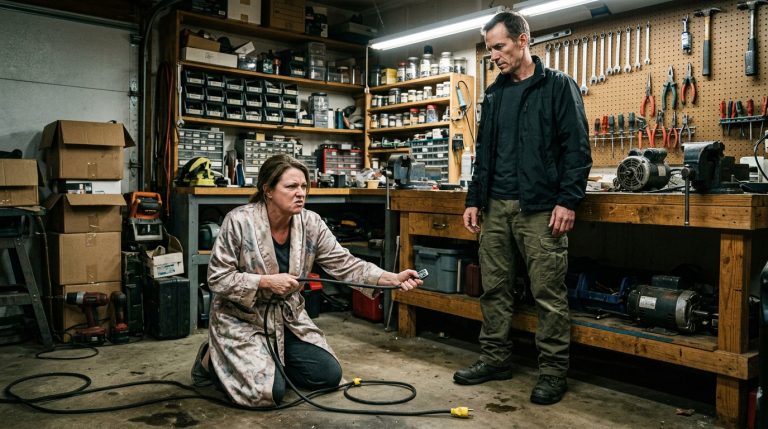
The silence was the most jarring part. For six months, the steady, rhythmic drone of my industrial lathe had been the heartbeat of my workshop, a low-frequency hum that signaled productivity and order. When the cable went—snapped by those yellow-handled bolt cutters—the silence didn’t just fall; it crushed.
I stood by the edge of my driveway, the engine of my truck still ticking as the metal contracted in the cooling air. Karen was five feet away, the bolt cutters still hanging in her grip, her expression one of serene, self-appointed triumph. She looked like she had just successfully pruned a dead branch from an otherwise pristine shrub.
My pulse, trained by twenty years of Marine Corps engineering, didn’t spike. It leveled off, cold and precise. I looked at the severed conduit, then at her, and finally at the trench she’d had the audacity to dig through the common property line. The soil was fresh, dark, and damp, a physical scar on the landscape that mirrored the one she’d just carved into my livelihood.
“You had no authority,” she said, her voice thin and airy, carrying that specific brand of suburban arrogance that presumes the law is merely a suggestion for the unrefined.
I looked at the cable. It was a 200-amp, three-phase line—the kind of infrastructure that required specific permits and professional installation. She had cut through it as if it were a garden hose, ignoring the potential for a catastrophic arc flash that could have incinerated her on the spot.
I didn’t yell. Yelling was a waste of calories, a concession that the opponent had achieved their goal of disruption. Instead, I reached into my pocket, pulled out my phone, and engaged the camera. The red light blinked, a small, glowing eye witnessing the truth.
“Karen,” I said, my voice steady, stripped of all warmth. “The line you’re holding is legally protected by the county utility easement.”
Her eyes flickered. For a split second, the smugness didn’t vanish, but it shifted, tightening at the corners. She stepped back, her gaze darting toward the street, looking for an audience, for a witness to her ‘community service.’
“I am enforcing the covenants,” she repeated, but the authority in her voice was fraying, like the copper strands dangling from her bolt cutters.
I stepped toward the trench, keeping the camera leveled on her. I didn’t care about the electricity—that was an inconvenience I could fix. I cared about the tactical error she had just committed. She had moved from passive-aggressive paperwork to the physical destruction of infrastructure. She had provided me with the objective evidence I needed to lock her into a permanent tactical disadvantage.
As I panned the camera from the severed cable to the freshly dug trench, I realized she wasn’t just being petty. Her movements, the way she had targeted this specific line, felt too deliberate. My phone buzzed—a notification I ignored. A dark, jagged sliver of intuition cut through my calm: this wasn’t about the aesthetics of a power line.
Karen turned, sensing the shift in the air, her face hardening into a mask of indignation. She marched toward her driveway, but she didn’t look at me. She looked at the green space behind the easement. And that’s when I noticed it—the way she avoided stepping on the patch of land she’d just mutilated. She wasn’t just protecting a view. She was guarding something else.
CHAPTER 2: The Tactical Assessment
The silence in the driveway didn’t just linger; it pressed against my eardrums like deep-water pressure. Karen was still standing near the property line, her posture shifting from the rigid defiance of an enforcer to something more… guarded. She wasn’t just standing there; she was hovering, her eyes tracking the path from the severed conduit to the rear green space.
“You’re done, Miller,” she said, her voice lacking the bite it held moments ago. She turned and walked toward her own property with a speed that felt suspiciously like a tactical retreat.
I didn’t follow. I stayed in the trench, the red recording light on my phone still blinking a steady, rhythmic pulse. The realization that had nudged me earlier now settled in my gut with the cold weight of a lead sinker. I looked at the property survey I’d kept in my truck—the laminated map I’d consulted a dozen times before buying this place. The utility easement wasn’t just a line on a paper; it was a physical artery connecting the main grid to the workshop. By cutting it, she hadn’t just inconvenienced me; she had effectively sterilized the utility potential of the land behind my house.
I walked to the edge of the common green space, my boots crunching on the dry suburban grass. My mind, usually a clean, geometric grid of logic, felt suddenly clouded by a creeping paranoia. Was I seeing this clearly? Was the professional engineer in me over-analyzing a petty HOA dispute? I focused on the ground. There were faint, smoothed-out tracks in the dirt, subtle impressions that didn’t match standard maintenance equipment. They looked like survey stakes had been placed and pulled, recent and hurried.
I pulled out my phone again, capturing the ground, the lack of erosion, the precise way the cable had been severed. My hands were steady, but my skin felt tight. I wasn’t just dealing with a power-tripping neighbor; I was looking at a pre-meditated obstacle.
I bypassed the front door of my house, heading straight for the workshop. The internal air was stagnant, smelling of metal shavings and gear oil. Without the low-frequency hum of the lathe, the shop felt like a tomb. I walked to the main breaker panel—the heart of the operation—and pried the cover off. It was dead. Completely, depressingly dead.
I didn’t reach for a voltmeter. I reached for my gear locker. I pulled out a heavy-duty tactical flashlight, its beam a stark, brilliant white that cut through the shadows of the shop with surgical precision. I began to map the internal wiring, checking for any secondary damage, any surge spikes she might have triggered when the cutters bit into the energized line.
As I worked, the silence of the neighborhood began to feel like a surveillance feed. I found myself checking the windows, the way the light played across the lawn. Every movement outside seemed intentional. Was that a car slowing down, or was I just expecting it to? The training I’d received at Parris Island—the constant, grinding repetition of situational awareness—was screaming that I was being watched.
I pulled up the local county plat files on my laptop, the screen glow illuminating the dark workspace. I cross-referenced the easement with the latest municipal development maps. My finger traced the route, following the line of the utility easement directly through the green space Karen was so obsessed with.
The map didn’t lie, but it did reveal something the physical world had hidden: a proposed zoning change, filed under a holding company I didn’t recognize. I stared at the name—Oak Creek Holdings, LLC. I opened a new tab, my fingers moving with a speed that belied my calm expression. The registered agent for the LLC wasn’t a developer. It was a local law firm, but the office address linked back to a P.O. Box registered to Karen Peterson’s husband.
The air in the shop felt thin. My breathing was slow, measured, the kind of rhythm I used when holding a site under fire. The decoy secret—the petty, aesthetic-based complaints about my shop—was a wall of smoke. The core truth was hidden in the dirt of that green space.
I picked up a piece of the severed copper cable from the workbench, feeling the heavy, cold bite of it in my palm. The ends were frayed, jagged, and entirely, violently wrong. I wasn’t just going to fix the power. I was going to use the trail she had left behind to pull the entire foundation out from under her.
I checked my watch. The sun was dipping below the horizon, casting long, bruised shadows across the neighborhood. I needed to document the easement markers, verify the zoning filings, and start building a file that would stand up in court. I sat in the dark, the only light coming from the laptop screen reflecting off the polished steel of my lathe, and began to draft a list. Not a list of repairs. A list of liabilities.
My reflection in the glass of the lathe looked back at me—composed, focused, the mask of a man who had seen structural failures before and knew exactly how to trigger a controlled collapse. Karen wanted a war of rules? She had opened the wrong conduit.
CHAPTER 3: The Paper Siege
The printer in the corner of my workshop hissed to life, the steady sound of paper feeding through rollers a jarring contrast to the silence of the dead machines. I didn’t rush the process. I let the documentation stack up on the workbench: copies of the county easement, the original property survey, the municipal zoning codes, and the aggressive, neatly typed violation notices Karen had sent over the last six months. Each one was a piece of evidence, a thread I was pulling to unravel the neat, oppressive blanket she had thrown over the neighborhood.
I sat back, the ergonomics of my chair suddenly feeling inadequate for the long night ahead. The list I’d drafted was growing. It wasn’t just about the power line anymore; it was about the pattern. I had categorized the violations, cross-referencing dates, times, and the specific bylaw cited. It was an engineering project—systematic, exhaustive, and designed to reveal the cracks in her administration.
I didn’t reach for the phone to call her. I reached for a fresh binder. The strategy was simple: I wouldn’t fight her on the streets, where she held the illusion of community authority. I would fight her where her influence was most brittle—in the bureaucratic processes she had weaponized against everyone else.
At 2:00 AM, the workshop felt like a command center. I had pinned the neighborhood map to a corkboard, using red and blue pushpins to mark every house where a resident had reportedly been bullied. The clusters were dense, centered around the common green space and the properties directly adjacent to the easement. It wasn’t random. Her ‘enforcement’ was a perimeter, a defensive line built to isolate the land she wanted to clear.
I heard the sound of a vehicle engine before I saw the lights. It was faint, the distinct, low-rumbling idle of a heavy truck turning into the cul-de-sac. I stood up, moving away from the light of my desk, and peered through the slat of the workshop blind. A black SUV, unmarked, pulled to a stop near the edge of the green space.
My heart rate didn’t elevate; it just tightened. I watched as a man stepped out—not Karen, not a neighbor. He carried a set of survey equipment. He moved with a practiced, familiar efficiency, checking the ground, marking the coordinates of the easement I had spent the last few hours studying. He was working in the dark, under the cover of the quietest hours of the night.
He wasn’t an HOA representative. He was a contractor, doing the real work that the paperwork was meant to disguise.
I reached for my phone, but I didn’t dial the police. Not yet. I started recording, the steady focus of the camera lens pulling in the details: the license plate, the logo on the side of the truck, the precise path he was mapping. He was measuring the exact distance between the severed conduit and the property line.
He was laying the groundwork for the access road.
I waited until he packed his equipment and drove away, the silence returning to the street like a physical weight. My hands, usually steady when welding high-carbon steel, were cold. This was the move I’d been waiting for—the mistake that brought the abstract threat into the real world. He had left behind a marker, a bright orange flag indicating the corner of the proposed route.
I didn’t leave the workshop immediately. I took the time to update the file, adding the timestamped photos to the folder titled Liabilities. Every piece of information was a lever, and I was positioning myself to pull. I poured a cup of lukewarm coffee, the bitter taste grounding me. The arrogance of it was staggering—the belief that they could rewrite the physical boundaries of the neighborhood without anyone noticing the displacement of the ground.
Karen thought she was the architect of this community’s future. She didn’t realize that in my twenty years as a combat engineer, I’d learned that every structure has a load-bearing point. If you cut the wrong beam, the whole thing comes down.
I turned off the desk lamp, the workshop sinking back into shadows. Tomorrow, I would start the hearings. I would file the formal disputes for every single fine she’d ever issued to me. I would force the HOA board into a cycle of meetings, testimony, and legal review that would bury their petty agenda under a mountain of mandatory compliance. I wouldn’t just defend my shop; I would drown their bureaucracy in its own rules.
I leaned against the workbench, the edge of the table digging into my hip, and looked out at the dark green space. The orange flag waved in the light breeze, a small, vibrant splash of color in the gloom. It was a beacon. And by the time I was finished, it would be the first thing to fall.
CHAPTER 4: The Underground Network
The orange flag didn’t just mark a survey line; it was a beacon for every fear I’d been cataloging. I left it there, an unsaid taunt for whoever would return, and walked back to my porch, where the air felt heavy with the stifling heat of a suburban evening.
I wasn’t alone. Dave, the retired Air Force veteran who’d lost his flagpole to a violation notice months ago, was waiting near the steps. He looked tired, his shoulders slumped in a way that spoke of a decade spent picking battles that never ended in victory.
“I heard about the power line, Frank,” Dave said, his voice low, glancing toward Karen’s house. “She’s not just bullying anymore. She’s escalating.”
“She’s clearing the field,” I replied, opening my front door and motioning him inside.
The interior of my house was a mirror of my workshop—methodical and sparse. I laid out the binders on the dining room table, the documents spread wide like a sprawling, complex diagram. Dave leaned in, his eyes tracking the red pins on the neighborhood map. As he looked at the layout, I saw his expression shift, a flicker of that old, institutional sharp-mindedness returning.
“I felt it,” Dave muttered, tapping a finger on the green space near the easement. “I always wondered why she was so obsessed with this patch of grass. My kid used to play here until she started the fines. She treated this spot like it was radioactive.”
“It’s not radioactive,” I said, sliding the municipal zoning filing across the table to him. “It’s a thoroughfare. She’s not maintaining an HOA; she’s managing a site survey.”
As we talked, the weight of the neighborhood’s history settled over us. I remembered a bridge I’d helped survey in a valley where the terrain had been deceptively stable until the rain hit; it was a lesson in how small, hidden shifts in the ground could eventually take down the strongest steel. Here, the “ground” was the people. They were exhausted, frayed by years of petty power trips, but they were also the only force capable of stopping this.
We didn’t call a town hall. We started making calls, one by one. I sat by the phone, listening to the timbre of my neighbors’ voices—some brittle with fear, others hardened by years of resentment. Mrs. Gable, the woman who’d been harassed over rose petals, answered on the second ring. She didn’t sound like a victim; she sounded like someone waiting for an invitation to fight back.
I wasn’t leading a revolution; I was conducting a logistical operation. Every person we reached was a new source of documentation. They had kept their own receipts, their own copies of the violation notices, the frantic, handwritten letters of protest they’d filed and Karen had ignored.
In the middle of a call, my mind drifted—a ghost of a memory from the corps. I was back in a desert, watching a structural stress test on a temporary bunker. The concrete looked solid, but I could see the hairline fractures widening with every impact. I had to know exactly when to pull the personnel out, or the whole thing would collapse on them. The neighbors’ hesitation, the way they checked their windows before speaking, reminded me of that same vibration. They weren’t afraid of Karen; they were afraid of the cost of losing another battle.
“We have enough,” Dave said, closing the binder. “If we bring this to the board meeting, if we present the zoning records and the pattern of harassment, the board can’t ignore it. It’s too much for them to bury.”
“It’s not just about the board, Dave,” I said, looking at the map. “It’s about the fact that she’s acting on behalf of a developer, not the residents. That changes the legal landscape entirely.”
The planning took hours. We defined the roles. We would present the evidence in a sequence that made it impossible to dismiss as petty squabbling. We would force the board members to choose between their community standing and Karen’s corrupt authority.
By the time Dave left, the house felt colder. I walked back into the workshop, the smell of ozone and dust greeting me. I stood by the workbench, my hands resting on the cold steel of the lathe. I looked at the severed cable ends, their jagged edges reflecting the thin, sharp light of the moon filtering through the window.
I was no longer just the neighbor with the industrial shop. I was the person holding the blueprints to their collapse. The logic was cold, but it was sound. I had built a network of proof, and every piece of it was ready to be deployed. The only question left was how Karen would react when she realized the ground she was standing on was no longer under her control.
I picked up the file labeled Liabilities, its weight satisfying in my hand. I would go to the meeting. I would present the facts. And I would watch the smug, self-appointed authority dissolve under the weight of the truth.
CHAPTER 5: The Paper Trail
The archive room of the Oak Creek Estates HOA was a cramped, airless closet off the community center, smelling of damp cardboard and fading toner. I sat under a flickering fluorescent bulb, the stack of documents Dave and I had retrieved from public records growing into a small, jagged tower on the metal desk. My eyes were burning, the fine print of local real estate filings blurring into a grey smear, but the pattern was undeniable.
Every time Karen had pushed for a “community standard,” a corresponding filing appeared for Oak Creek Holdings. She hadn’t just been enforcing rules; she had been clearing a path. The legal descriptions of the easements were being systematically challenged, modified, and eventually, vacated—all to accommodate a proposed access road that would slice through the heart of the green space.
I reached for the final folder, the one labeled “Internal Zoning Audits.” This was it—the physical link between her bullying and the developer’s interest. As I flipped through the pages, a sudden, sharp draft hit the back of my neck.
I froze. The archive room door, which I had pulled shut to keep out the sounds of the community center’s early morning yoga class, was standing open just a fraction of an inch. A silhouette blocked the corridor light.
“You shouldn’t be in here, Frank,” the voice was cool, measured, and entirely devoid of the smugness she usually wore like a costume. Karen stepped into the room. She wasn’t carrying a binder. She was carrying the weight of a woman who knew the game was changing.
I didn’t close the folder. I kept my hand on the page detailing the purchase option for the green space. “The public records are public, Karen. You know that as well as I do.”
“Records can be interpreted,” she said, her voice dropping into a tone that was almost dangerously soft. “You think you’re exposing a conspiracy. You’re just proving you don’t understand how a community functions. It needs direction. It needs structure.”
“It needs a board that doesn’t sell it out to the highest bidder.” I stood up, the chair scraping sharply against the concrete floor. “I’ve seen the filings. I’ve seen the path you’re clearing for the access road. You didn’t cut my power because it was an aesthetic violation. You cut it because it was a utility obstacle on your property deal.”
Her face went pale, then a flash of genuine, unadulterated fear crossed her eyes before she shoved it behind a wall of cold indignation. It was the first time I’d seen her truly shaken. She looked at the stack of documents, then back at me, her fingers twitching at her sides. She wasn’t an administrator anymore; she was a cornered operator.
“That road is for the benefit of this neighborhood,” she spat, the mask finally slipping. “It brings infrastructure. It brings value.”
“It brings a commercial thoroughfare through a residential easement,” I corrected, my voice steady, the calm I’d learned in the Corps acting like a cage. “You broke the law, Karen. And you used your position to do it.”
She stepped forward, her intent clearly to snatch the documents, but she stopped when I stepped toward her, dwarfing her in the narrow space. I didn’t raise my voice. I didn’t threaten. I just held the truth between us.
“The meeting is tomorrow night,” I said. “The entire board is going to see this. The neighbors are going to see this. And then, we’ll see who the community trusts.”
She looked at me, her eyes darting to the door, searching for an exit. She realized, in that moment, that the rules she had used to control everyone—the fines, the threats, the passive-aggressive letters—were now the very things holding her in place. She had built a fortress of bureaucracy, and I had just locked her inside it.
She didn’t answer. She turned and walked out, her footsteps sharp and erratic against the linoleum. I watched her go, the feeling of victory muted by the reality of the damage she’d caused. I gathered the files, my pulse finally returning to a normal rhythm. The escalation was complete. The decoy had been stripped away, and the core truth was laid bare on the desk.
I left the archive room, the air in the hallway feeling surprisingly fresh. The game had shifted. It was no longer a battle of wills; it was a battle of evidence. And as I walked toward the parking lot, the weight of the binders in my satchel felt like the turning point. The community was no longer a collection of targets. It was a witness. And tomorrow, the truth would have its day.
CHAPTER 6: The Confrontation
The air inside the Oak Creek Estates community center was thick, almost syrupy with the collective anxiety of forty-odd residents. Rows of folding chairs were packed tight, the metal legs scraping against the linoleum with a sound like grinding teeth. I stood at the back of the room, near the heavy double doors, watching the room fill. Karen was at the front, standing behind the dais, her posture almost too perfect—the rigid, defensive stance of someone who had practiced her calm in the mirror for hours.
But there was a hairline fracture in her composure. She kept checking her watch, her fingers drumming a frantic, irregular rhythm against the polished wood of the lectern.
I caught Dave’s eye. He nodded, a subtle signal that the neighbors were ready. I stepped forward, carrying the heavy satchel that contained the proof of the Oak Creek Holdings land deal. The floor felt solid, but the room itself felt like it was pressurized, the oxygen being slowly sucked out by the tension of a hundred unspoken grievances.
As I made my way toward the front, I noticed the double doors I’d just passed. There was a security seal on them—a piece of yellow tape that hadn’t been there when I arrived an hour ago. It was a petty, amateur move, an attempt to lock the room and control the flow of entry, but it had failed. The seal was ripped, hanging like a dead leaf. Karen hadn’t just expected a fight; she’d tried to wall off the battlefield.
I reached the front of the room, the collective gaze of the neighborhood turning toward me. Karen’s smile remained fixed, a brittle thing that didn’t reach her eyes.
“Mr. Miller,” she said, her voice amplified and echoing off the vaulted ceiling. “The agenda is set. You aren’t scheduled to speak.”
“The agenda is based on a fraudulent premise, Karen,” I said, my voice cutting through the room’s ambient hum. I didn’t shout. I didn’t need to. The silence that followed was immediate, heavy, and absolute.
I reached into my bag and pulled out the folder containing the zoning audits and the land sale contract. I didn’t hand it to her. I walked to the overhead projector, the mechanical whir of the cooling fan filling the space, and laid the document flat on the glass. A massive image of the contract, complete with her husband’s P.O. Box and the developer’s signature, bloomed onto the screen behind her.
The room erupted. It wasn’t a roar; it was a confused, chaotic surge of voices. Neighbors stood up, leaning over chairs to get a better look. The image was undeniable. The green space—the land they were told was “protected”—was being sold out from under them for a commercial road.
Karen’s face drained of color. She looked at the screen, then at the room, her composure disintegrating in real-time. She tried to speak, her mouth working without sound, her hands gripping the lectern so hard her knuckles turned the color of bone.
“This is… this is a misunderstanding,” she stammered, the words hollow, completely lacking the authority she’d wielded for years. “The road, it… it was for the good of the neighborhood!”
“It was for the good of your bank account,” Dave said from the middle of the room, his voice calm and devastatingly precise.
I didn’t stop. I fed the next document into the projector—the records of the fines, the timeline of the “violations,” and the map of how the easement had been cleared to make room for the construction. The logic was inescapable. The neighbors didn’t need me to explain it to them; they saw their own history in the ink. They saw the months of harassment, the petty, calculated cruelty, and the profit-seeking motive that had driven every single one of those letters.
The board members, seated to Karen’s left, were backing away, their own faces turning to masks of horror. They were looking at her not as a president, but as a liability. The shift was mechanical, inevitable. They were protecting their own interests, and Karen was now the only thing standing between them and the growing fury of the room.
“We move to a vote,” a voice called out from the back—the treasurer, a man who’d been silent for years. “A vote to remove the current board.”
Karen gripped the lectern, looking around the room as if searching for a lever to pull, a bypass, anything to return the world to the state it had been in ten minutes ago. But the structure had already failed. The load-bearing points had been compromised, and the roof was coming down. She looked at me, her eyes wide, glassy with the realization that the rules she had used to build her kingdom had just become the instruments of her exile.
I stood there, the cool, quiet satisfaction of an engineer who had finally confirmed his math. She had picked the wrong battlefield, and she had definitely picked the wrong person to cut off.
CHAPTER 7: The System Collapse
The community center had become a pressure cooker. The vote was a landslide, a rapid, surgical excision of the old board that left the room echoing with the sound of collective relief. Karen was still standing at the front, but the dais no longer offered her shelter. She looked small, her movements twitchy and uncoordinated as she tried to gather her papers, her hands shaking so violently she dropped a folder of violation notices. They scattered across the floor like dead leaves.
She didn’t try to defend herself. She didn’t offer a final speech. She simply looked at the room—at the faces of the people she’d spent years measuring and managing—with a look of genuine confusion, as if she couldn’t understand why the machine had suddenly stopped functioning.
I walked toward her, my footsteps echoing on the hard floor. The neighbors parted, a silent wake trailing behind me. I didn’t come to gloat; I came to see the result of the stress test. When I reached the lectern, I stopped. She looked up, her eyes wide, the blue irises sharp and glassy.
“You have no idea what you’ve done, Miller,” she whispered, her voice barely audible over the receding murmurs of the room.
“I know exactly what I’ve done,” I said, my voice low, steady, and devoid of the anger she clearly expected. “I exposed the structural integrity of your administration. It wasn’t built to last.”
She opened her mouth to argue, but the words died in her throat. She looked down at the floor, at the scattered violation notices—the same papers that had once been her instruments of control—and she finally seemed to see them for what they were: just paper. The weight of her own self-importance, the years of enforcing “standards” that existed only in her own mind, seemed to collapse inward. She looked frail, not like a villain, but like someone who had spent their entire life holding up a ceiling that was never actually falling.
The police arrived then, the flashing lights through the front windows casting long, pulsating blue and red shadows across the walls. The officer who had been there the day she cut my power cable stepped into the room. He didn’t look at me. He walked straight to the front, his gaze locked on Karen.
“Karen Peterson?”
She nodded once, a robotic, jerky movement. She didn’t fight when the officer placed the cuffs on her wrists. She didn’t shout. She just kept looking at the empty lectern. The irony was suffocating—the woman who had insisted on absolute adherence to every minute, trivial regulation had finally been broken by the very laws she claimed to uphold.
Watching her being led out of the community center was like watching a ghost leave a house. There was no grand confrontation at the door, no final, dramatic declaration. She was just a woman, caught in the gears of the system she’d tried to weaponize. The neighbors watched in silence, their faces not triumphant, but contemplative. They were looking at their own neighborhood, perhaps for the first time in years, without the filter of her rules.
I stayed behind as the room cleared. Dave came up to me, his hand resting on my shoulder. “It’s done, Frank. The developer has already pulled the project. They don’t want a legal firestorm.”
“I know,” I said, looking at the empty room. “But the power line is still cut.”
“We’ll fix that,” Dave said. “Tomorrow, we’ll start on the repairs.”
I looked at the spot where Karen had stood. My mind felt strangely empty, the tactical calculations and the defensive posturing draining away. I had focused so much on the structural collapse of her authority that I hadn’t considered what would happen once the dust settled.
I walked out of the building into the cool, still air of the night. The street was quiet, the houses standing in the shadows of the trees, looking exactly as they had before. But the air felt different. It was the silence of a structure that had been reinforced, the tension of the neighborhood finally, mercifully, released. I walked home, the weight in my chest gone, replaced by a deep, hollow fatigue. The war of the driveways was over.
CHAPTER 8: The Residual Voltage
The community center was empty now, the chairs stacked against the walls in neat, silent rows. The echo of the last police cruiser fading into the night felt like a final, definitive period at the end of a long, frantic sentence. I stood in the middle of the linoleum floor, the overhead lights humming a low, steady note that sounded nothing like the chaotic buzz of the meeting minutes ago.
I walked to the lectern where Karen had stood. It was just wood and laminate, scarred by years of frantic tapping. I placed my hand on it, feeling the texture—the cool, unyielding surface. This was where she had projected her will, where she had stood as the architect of our suburban misery. But looking at it now, stripped of the audience and the paperwork, it was nothing more than furniture.
The core truth of Layer 2, which I had sensed in the dark corners of her archive room, finally crystallized. She wasn’t a master manipulator. She wasn’t a criminal mastermind. She was a woman drowning in a desperate, frantic need for significance. The HOA was her world because it was the only world she could control. The bullying, the “standards,” the secret land deals—it was all a frantic effort to convince herself that she mattered, that her voice carried weight. She had been terrified of being invisible, and she had built a kingdom of paper to hide that fear. When I had exposed the fraud, I hadn’t just defeated her; I had forced her to face the fact that she was, and always had been, small.
I turned and walked toward the double doors, pushing them open. The night air was cool, smelling of damp earth and late-summer grass. I made my way home, my boots steady on the sidewalk. As I passed Karen’s house, I didn’t look at it. There was no victory to be found in staring at a dark, empty driveway.
When I reached my workshop, I unlocked the heavy steel door. I didn’t turn on the main lights. I went straight to the workbench and retrieved the paperweight I’d fashioned from the severed copper conduit—the jagged, bent piece of wire that had started the entire conflict.
I set it down on the clean, metal surface of my desk. Beside it lay the tools I’d used to dismantle her entire network: the binders, the records, the maps. I looked at the lathe, then at the workbench, then at the conduit.
I reached into the storage bin under the bench and pulled out the kit I needed for the repair. The utility company had finally cleared the site for me, leaving the line open and ready for a splice. I moved with a slow, deliberate precision. I stripped the ends of the cable, the copper shining like dull gold in the moonlight. I fitted the splice, tightened the connections, and ensured the seal was airtight. It was a simple task—the kind of infrastructure work I’d done in the Corps a thousand times over. It required no brilliance, only competence.
As I finished, I felt the familiar weight of the tools in my hands. The shop was quiet, but it was a comfortable, waiting silence. I walked to the main breaker and threw the switch.
A low, resonant hum flooded the room. The lights flickered to life, casting the familiar tools into sharp, clean relief. The lathe’s internal clock began to tick. The air filtration system sighed as it kicked on, pulling the stale air out and replacing it with the clean, sharp scent of metalwork.
I picked up the conduit paperweight and held it for a long time. It was just a scrap of metal, a symbol of a broken connection. I didn’t need it on my desk anymore. I opened the small trash bin beneath the bench and let it fall. It landed with a dull, final thud.
The door to the workshop opened, and Dave stood in the frame, his shadow stretching long across the floor. He didn’t say anything, just looked at the glowing status lights on my equipment.
“Everything’s back on,” I said, my voice steady.
“Everything,” Dave agreed.
I picked up a piece of steel, my hands moving with the instinctual knowledge of my trade. I started the lathe, the steady, rhythmic rotation grounding me. The neighborhood was quiet, the houses standing as they always had, but something was different. We had reclaimed the space. We had dismantled the fear. And as I turned the steel, letting the shavings curl away in delicate, shimmering ribbons, I knew that the silence was now ours to keep.
I had built a shop to be left alone, but I had ended up building a community that could stand on its own. It was a better foundation than I had originally planned.