The Iron Bridge Over Red Hollow Canyon Stood for Twenty Years Until Corporate Greed Tried to Erase My Legal Access Overnight
CHAPTER 1: THE EMPTY SPAN
The engine ticked as it cooled down in the dry afternoon heat. I left the gear in park and stared straight ahead across the gap.
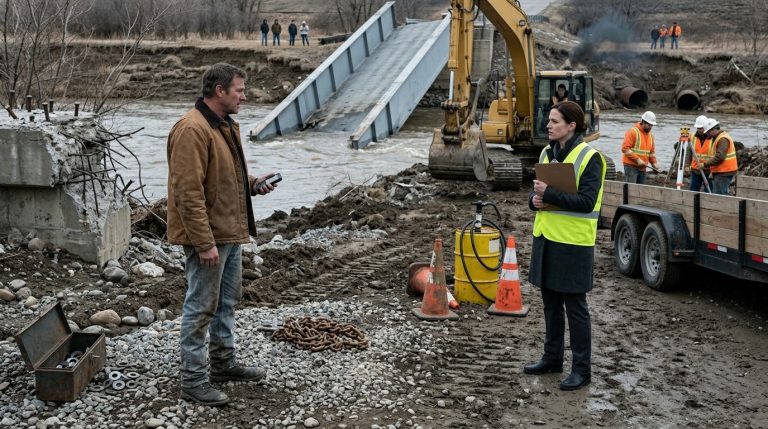
Forty feet of reinforced steel I-beams and concrete decking were simply gone.
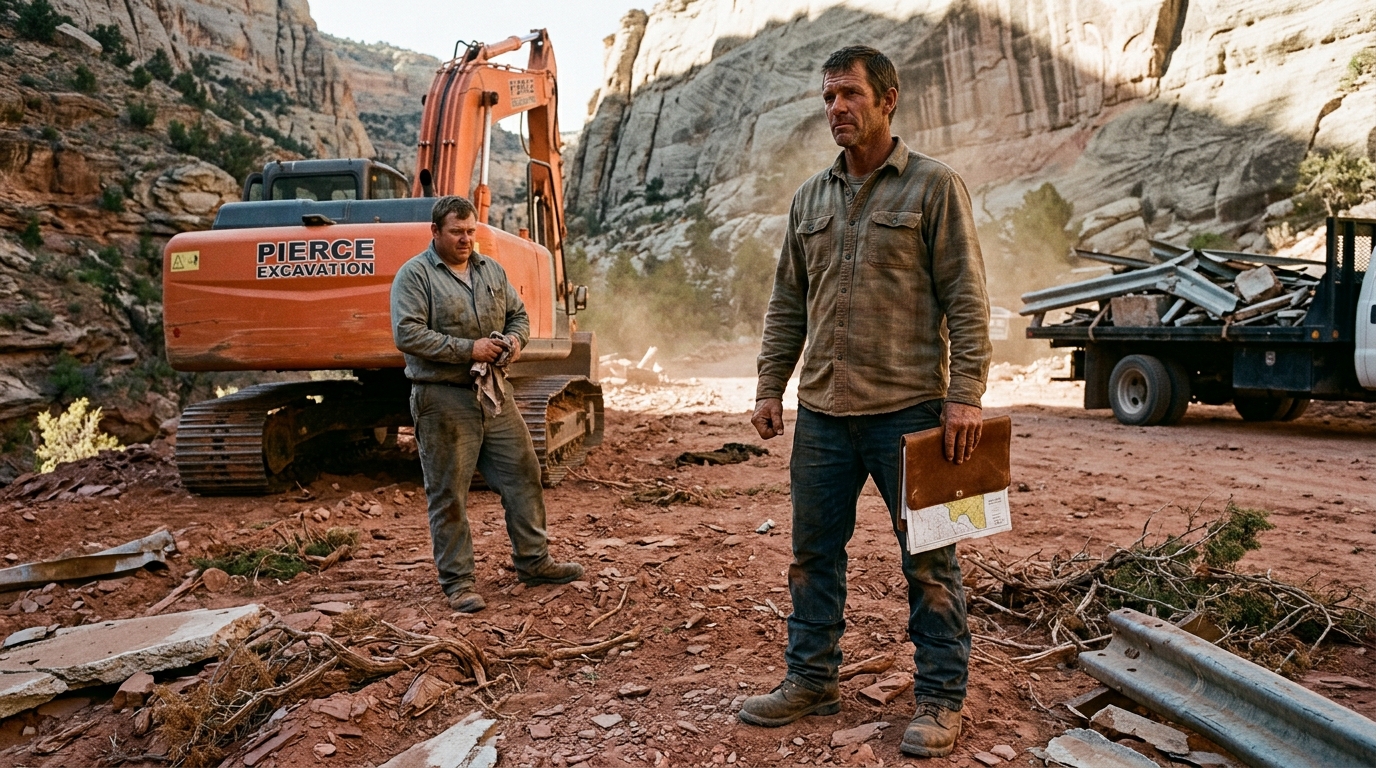
An orange excavator sat idling on the far side of Red Hollow Canyon, its steel bucket resting on a pile of freshly churned red dirt.
A flatbed transport truck was parked fifty yards back near a cluster of newly driven wooden stakes. Twisted chunks of my guardrails were tossed haphazardly across its bed like scrap metal.
I rubbed my thumb over the worn edge of the leather deed folder sitting on the passenger seat.
My knuckles felt stiff. I stepped out of the truck and let the door slam shut behind me, the sound echoing off the steep limestone canyon walls.
The heat hit the back of my neck instantly, carrying the dry scent of dust and crushed juniper needles.
The operator on the excavator killed the heavy diesel engine. The abrupt silence made my ears ring.
He climbed down the metal treads, wiping grease off his palms with a dirty rag while eyeing my boots as I walked toward the edge of the drop.
“Who gave you the order to pull that down?” I asked. My voice stayed low, measured against the rising hum of blood in my temples.
The operator stopped twenty feet away, his boots crunching on loose shale. He looked past my shoulder at the empty span before meeting my eyes.
“Just following work orders, mister,” he said, shifting his weight. “Structure was deemed an unsafe liability. High Mesa Horizons paperwork cleared it this morning.”
I pulled my phone from my shirt pocket and hit the camera icon without breaking his gaze.
I took three clear shots of the sheared anchor bolts on my side of the bank, then panned over to capture the company logo stenciled across the side of the flatbed.
“There was nothing wrong with these beams,” I said, framing the bent steel in my viewfinder. “That span was inspected and signed off two years ago.”
The operator held up a gloved hand, stepping back toward his machine. “You’ll have to talk to Nolan Pierce about that. I’m just here to clear the right of way.”
CHAPTER 2: THE UNANSWERED CALL
The excavator tracks ground to a halt fifty yards away, and the operator climbed back into his cab without another word.
I stared down at my phone screen as the call dropped straight to voicemail for the third time in a row.
High Mesa Horizons wasn’t picking up their field office line, and Nolan Pierce had turned his cell phone straight off.
I slid the phone back into my shirt pocket, the rough fabric catching on the edge of the leather deed folder resting against my ribs.
The silence that settled over Red Hollow Canyon was heavier now, weighted by the raw, jagged edges of torn steel where traffic used to cross.
I walked back to my truck, my boots kicking up puffs of dry red dust that clung instantly to the leather.
On the passenger seat, a small, laminated copy of my original 2002 county permit caught the late afternoon sun through the windshield.
Without a lawyer like Eleanor to draft an emergency injunction on an hour’s notice, every piece of legal leverage had to be dug out of the county archives by my own hands.
The county clerk’s office downtown closed in forty minutes, and the paved two-lane highway was fifteen miles out across the ridge.
I started the ignition, let the diesel clear its throat, and turned the steering wheel hard away from the drop-off.
The truck bounced over the unpaved washboard track, rattling the loose tools in the truck bed like a warning drum.
When I pulled into the county courthouse parking lot, the gravel was already empty except for a dusty municipal pickup truck near the back.
I pushed through the heavy glass double doors into the cool air-conditioned lobby, my boots squeaking slightly on the polished linoleum.
The records archivist, an older woman named Martha who had worked the desk since before I bought my land, looked up over her half-moon reading glasses.
“You’re cutting it close, Daniel,” she said, tapping a stack of folded blue blueprints against the counter. “We lock up at five.”
“I need to pull the original site filings for High Mesa Horizons,” I said, leaning my palms against the wooden counter. “Every single document they submitted for the eco-resort expansion.”
Martha paused, her fingers hovering over the keyboard as she eyed the dust on my shoulders. “That file is three inches thick, and most of it is restricted developer proprietary data.”
“Check the public easement appendices,” I said, my voice dropping into a steady, flat cadence. “They altered a recorded right-of-way on my parcel this morning, which makes their entire municipal infrastructure package public record under state compliance law.”
Martha studied my face for three seconds, reading the absolute exhaustion and stubborn resolve written in the lines around my eyes.
She turned back to her terminal, the screen casting a pale blue glow across her wrinkled cheeks as her fingers clacked against the keys.
“They filed their final environmental and utility layout three weeks ago,” she muttered, clicking through a subfolder. “Wait. That’s strange.”
I leaned closer, resting my weight on the counter as the printer behind her desk whirred to life.
“What is it?” I asked.
“Their designated septic and parking footprint,” Martha said, pulling a freshly printed overhead site map from the tray and sliding it across the wood. “They didn’t just route their utility lines across your approach. They mapped your private bridge span as the primary vehicle turnaround and guest overflow parking for Cabin Zone Four.”
CHAPTER 3: THE EMPTY PROMISE
Three days bled together without a single sound of heavy machinery or a returned phone call from the High Mesa site trailer across the canyon.
I spent the daylight hours clearing dead juniper branches around the cabin perimeter, keeping my hands busy while my mind turned over every line of the illegal parking blueprint Martha had printed for me.
Without a lawyer filing emergency motions at my elbow, the burden fell entirely on my own shoulders to compile the municipal infractions before the developer could push their asphalt across my land.
On the fourth morning, the bitter smell of stale coffee filled my kitchen as I stared out the window toward the empty gap where my bridge used to stand.
The morning fog hung low over the scrub oak, obscuring the orange excavator that still sat abandoned on the far bank.
My boots felt heavy as I laced them up, pulling the leather laces tight enough to bite into my ankles.
If Nolan Pierce thought three days of calculated stonewalling would make me pack up and drive away, he didn’t understand how long a common-sense man can wait when he’s standing on his own deed.
I picked up the leather deed folder, slipped the unauthorized municipal map inside, and walked out the front door to my truck.
The engine roared to life on the first turn, shaking the chassis as I pointed the hood toward the county road to gather the next piece of hard proof.
There were no shortcuts left, and waiting around for corporate compliance was a fool’s game when the property lines were written in ink that outlasted them all.
CHAPTER 4: THE PAPER TRAIL
The overhead fluorescent tubes hummed with a thin, irritating frequency as I slid my thumb down the column of water rights allocations.
High Mesa’s applications listed seasonal creek extraction rates that tripled the maximum legal flow volume for Red Hollow Canyon.
A loose slip of yellow carbon paper fluttered out from beneath the utility permits, catching on my calloused knuckle.
I picked it up and held it under the direct beam of my desk lamp.
It was an expired municipal grading addendum stamped with a corporate tax identification number that had lapsed two quarters prior.
The developer hadn’t just rushed their permits through local zoning; they were operating on dead paper and fraudulent capital before they ever touched my steel beams.
Martha walked past the wooden partition carrying a stack of ledger binders, glancing sideways at the piles of paper surrounding my elbows.
“You’re digging deep into their foundation files, Daniel,” she said, her voice dropping to a quiet professional murmur. “Most folks don’t realize how fast a glossy corporate binder falls apart when you check the back pages.”
“They built their entire resort layout on a house of cards,” I said, tapping the expired tax stamp against the grain of the table. “And they used my land for their parking lot math to make the numbers balance.”
Martha adjusted her reading glasses and pointed a pen tip at the bottom corner of the grading addendum.
“If that tax ID expired before they filed for the earthmoving variance,” she said slowly, “then every single work order they issued last week was legally void from the start.”
I leaned back in the wooden chair, the wood groaning under the shift in weight as the pieces clicked into place.
Without a lawyer to hand me the argument, the county’s own archive room had just handed me the leverage to break their entire operation wide open.
I scooped up the papers, squared them neatly against the tabletop, and slid them back into my leather folder.
CHAPTER 5: THE CONTEMPT HEARING
The judge’s gavel came down hard against the oak block, cutting through the low murmur of the gallery.
Nolan adjusted his expensive silk tie, leaning over to whisper something to his corporate counsel before turning his head to flash me a tight, unconvincing smile.
The presiding judge, an older man with wire-rimmed glasses and zero patience for corporate posturing, rested his forearms on the bench and stared down at the defense table.
“Mr. Pierce, we are four days past the court’s compliance window,” the judge said, his voice flat and level. “Your heavy machinery is still parked across a recorded access easement, and my explicit order to restore that crossing has been completely ignored.”
Nolan stood up, buttoning his suit jacket with an air of practiced grievance, spreading his hands wide.
“Your Honor, we’ve encountered severe logistical challenges regarding site safety liabilities,” Nolan stammered, his polished composure starting to fray at the edges. “We are merely attempting to protect future resort guests from substandard infrastructure built decades ago.”
I didn’t wait for permission. I stepped forward from the gallery aisle, placing the leather deed folder flat onto the wooden partition separating the seating area from the well of the court.
“That structure was certified by two independent municipal engineers,” I said, my voice carrying clearly across the quiet room. “And they didn’t tear it down for safety. They tore it down because their final site plan designated my private bridge span as vehicle overflow parking for Cabin Zone Four.”
Nolan’s face flushed a dark, mottled red, and he slammed his palm onto the defense table.
“That is a complete fabrication by a disgruntled property owner trying to obstruct regional economic progress!” Nolan snapped, his voice cracking slightly under the sudden public pressure.
The judge raised a single finger, silencing the courtroom instantly as he looked down at the expired municipal tax ID stamp I slid across the clerk’s rail.
“Mr. Pierce,” the judge said coldly, reading the yellow carbon paper under his desk lamp. “Your grading addendum carries an expired corporate tax identification number from two quarters ago. You’ve been operating on dead paper and unauthorized municipal filings while trespassing on private land.”
Nolan opened his mouth to argue, but no words came out as his lawyer frantically began flipping through a thick binder of corporate spreadsheets.
“Furthermore,” the judge continued, leveling a severe gaze at the defense table. “I am ordering an immediate, full-scale compliance review of every single permit, water right, and zoning variance High Mesa Horizons has submitted to this county.”
CHAPTER 6: THE DUSTY GRAY AFTERMATH
Within eight weeks of the judge’s compliance review, High Mesa Horizons filed for Chapter 11 bankruptcy.
Their glossy website vanished into a dead server link, and the colorful banners advertising wilderness luxury frayed against the juniper branches until the wind tore them down entirely.
Nolan Pierce made one final phone call late on a Tuesday evening, his voice hollow and stripped of its corporate varnish.
“You could have just taken the buyout offer,” he said, the line crackling with static.
“That was never what this was about,” I replied, my thumb tracing the worn spine of the leather deed folder on my kitchen table.
I didn’t gloat, and I didn’t offer comfort; I simply closed the receiver and listened to the steady hum of the dial tone before setting it back on its cradle.
A year later, a small conservation group out of Santa Fe acquired the surrounding acreage through court liquidation.
They walked the property line with me first, asking about seasonal runoff patterns and respecting the boundaries of the steel crossing.
Some folks in town called me a hypocrite for letting anyone build near the ridge at all, but they missed the point entirely.
Progress isn’t the enemy when it’s built on respect and legal boundaries; entitlement is what rots a community from the inside out.
The afternoon sun dipped below the rim of Red Hollow Canyon, casting long, sharp shadows across the dry creek bed below.
I walked out to the middle of the bridge, my work boots striking solid against the reinforced steel I-beams.
I gripped the cold steel guardrail with both hands and looked down at the red dirt settling quietly beneath the span.
The bridge held firm, exactly where I built it twenty years ago, refusing to budge for anyone who thought a work order could erase a deed.