A Stand on Stagnant Ground: The Procedural War for Sovereignty in a Subdivided World
CHAPTER 1: The First Stake
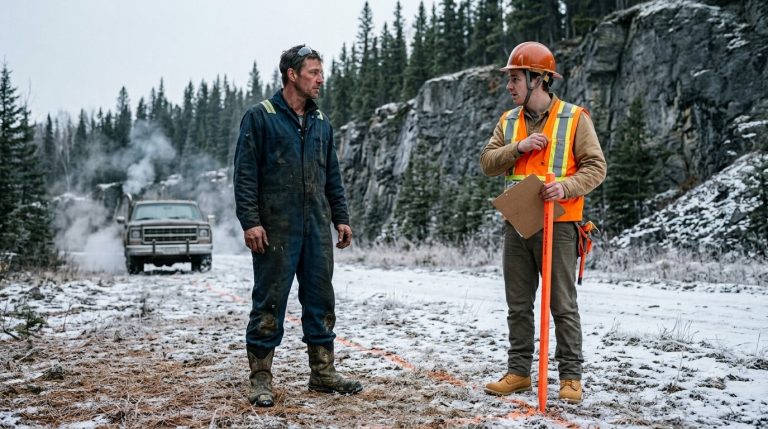
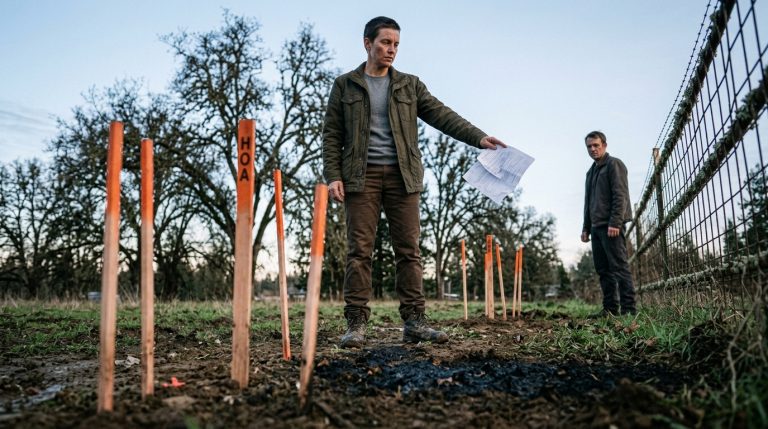
The morning air tasted like dry pine and the metallic tang of an approaching storm. I stood on my porch, the heels of my boots digging into the weathered cedar decking. At the mouth of my drive, where the gravel met the sterile, engineered curb of Cedar Ridge Estates, a man in a high-visibility vest was busy. He wasn’t just walking. He was setting up a transit level, his movements clinical, practiced, and deeply invasive.
He clicked a metal stake into the dirt—my dirt—just inches from the property line. It was a neon-bright flag that screamed violation.
I didn’t rush him. Rushing is a weakness; it’s a gift of energy to an antagonist who is counting on a visible reaction. I descended the porch steps slowly, the gravel crunching with a satisfying, rhythmic grit under my weight. My hand brushed the rusted bolt on the fence post, a reflex that anchored me in the present moment. The metal was cool, rough, and stable.
The man in the vest glanced up. He was young, his skin still smooth, holding a clipboard like a shield. He didn’t look like the usual HOA goons; he looked like a professional, someone hired to look legitimate.
“You’re on private property,” I said. My voice was low, devoid of urgency, but it carried the weight of a fact that didn’t require an exclamation point.
“Just marking coordinates for the utility corridor, sir,” he said, not pausing his work. He sounded bored, like he was repeating a line from a handbook. “Community safety initiative. We’re identifying drainage flow paths.”
I stopped ten feet from him. I didn’t enter his space, and I ensured he saw that I wasn’t going to cross the line to hit him. I just stood there, the embodiment of a roadblock.
“Cedar Ridge doesn’t have an easement for drainage on this parcel,” I said. “And the county hasn’t issued a survey permit for this sector. I checked the portal this morning.”
He paused then, his fingers hovering over the tripod screw. He looked at me, really looked at me, and his confidence flickered. He turned his head toward the subdivision, scanning the beige houses that lined the street like uniform headstones.
“I was told it was cleared,” he muttered, his thumb tracing the edge of his clipboard. “They said it was standard maintenance.”
I pulled my phone from my pocket and held it at waist height, the camera lens focused on his face and the neon stake he’d just driven into the earth. I didn’t make a scene. I just framed the shot.
“You have two minutes to pack that equipment and move back to the curb,” I said, my pulse steady. “If you drive that stake one inch deeper, I’m calling the county inspector. Not the HOA. The inspector.”
The man looked at the stake, then back at me. As he reached for the tripod, I noticed something else—something that hadn’t been there when I checked the property line at dawn. A small, blue ribbon was tied to the fence post just beyond the stake. It hadn’t been placed there by the wind. It was a marker, and it looked like it had been waiting for him.
CHAPTER 2: The Audit of Omissions
The man in the high-visibility vest had vanished by the time I walked back to the fence. He hadn’t left a card, a work order, or even a footprint that wasn’t already being swallowed by the loose gravel. He’d left behind the stake, a sharp, neon intruder in the silence of my property, and that small, deliberate blue ribbon—a silent signal that this wasn’t an isolated incident of incompetence, but a coordinated step in a larger sequence.
I didn’t pull the stake. Not yet. I left it there, a beacon for any future trespasser to see that I was watching. I retreated to the house, the grit under my boots acting as a reminder of the ground I was fighting to hold.
Inside, the silence was different. It wasn’t the peace of a home; it was the quiet of an office before the audit begins. I sat at my kitchen table, the laptop open, the blue glow reflecting in the darkened windowpanes. My fingers moved with the steady rhythm of a metronome. I wasn’t looking for broad theories or neighborhood gossip. I was hunting for the boring, unchangeable facts that sat in the county’s public record.
The Cedar Ridge Estates planning documents were a sprawling archive of bureaucratic shorthand. I spent the next three hours mapping the development’s original filing, scrolling through thousands of pages of zoning maps, infrastructure easements, and environmental impact studies from fifteen years ago. Every page was a testament to the developer’s intent: to homogenize, to standardize, and to control.
I looked for the utility corridors. They were arteries of the development—thick, black lines drawn across the parcel maps where pipes and cables were destined to go. I cross-referenced the current coordinates with the original survey. The corridor, as defined in the master plan, ended abruptly at the edge of the subdivision, a few hundred yards from my western boundary. There was no mention of an extension. No proposed pipeline. No municipal justification for a detour.
Then I found a buried attachment—a supplemental document filed three years ago, during the latest expansion phase. It was labeled “Infrastructure Optimization Strategy.” I pulled the PDF, the loading bar creeping across the screen with painful, deliberate slowness.
It was a proposal, not an approval. It outlined an “Access and Utility Enhancement” intended to support the new luxury phases. The map showed a shaded area of potential intervention, a polygon that overlapped perfectly with the three acres of pine and gravel I called home. It didn’t call it a seizure. It called it a “Utility Optimization Corridor.”
My chest tightened, a cold, hard knot of clarity. This wasn’t about my fence color or my trash cans. This was about the footprint of the land. If they could force a utility easement through here, they could effectively cut my property in two, rendering it unbuildable and, more importantly, unlivable. They were playing a long game, using the HOA’s “compliance” as a battering ram to weaken my legal standing until I had no choice but to accept the utility encroachment as a lesser evil than the constant litigation.
The phone rang. It was an unrecognized number, likely masked through a local exchange. I let it go to voicemail. I didn’t need to speak to anyone who wasn’t currently in the county’s records office.
I opened a fresh spreadsheet. I began to list every agent involved in the “Infrastructure Optimization Strategy”: the lead consultant, the municipal contact, the engineering firm. I needed to know if the blue ribbon on my fence was a mark of surveyor’s progress or a sign of an impending filing.
I stood up and walked to the window, looking out toward the fence line. The neon stake stood out, a small, vibrant puncture in the twilight. It wasn’t just a marker; it was a deadline. The developer was moving toward a goal I hadn’t yet identified, but the pattern was undeniable. They had the resources to wait, to pressure, and to wear me down. I had only the data.
I turned back to the screen. I needed to see if the county had received a new application for a survey permit. If they had, there would be a timestamp. A name. A trail of breadcrumbs leading straight back to the clubhouse. My jaw tightened. I wasn’t going to wait for them to come back with a drill and a crew. If they wanted to optimize my land, they were going to find out exactly how much resistance was built into the foundation.
I typed the query into the county portal again, my mind already calculating the next move: calling the municipal planning office under the guise of an adjacent property owner, checking the official status of the utility corridor. I needed to confirm if they’d already filed the motion for the easement. If they had, the game had shifted from defense to a race against a clock I was only just beginning to see.
The house creaked around me, the settling of wood and metal, but I didn’t hear it. I was buried in the files, the cold, hard logic of the law the only comfort in a room that suddenly felt like the front line of a very quiet, very deep war.
CHAPTER 3: The Boundary of Silence
The blue light of the laptop screen felt like a physical intrusion, cutting through the dimness of the kitchen. I didn’t close it. I stared at the map until the lines blurred into a single, ugly geometry—the proposed utility corridor cutting through my pines, a scar waiting to be carved into my landscape. The realization wasn’t a shock; it was a hardening. It was the confirmation that the neon stake from the morning wasn’t a random error. It was the first strike in a planned demolition of my autonomy.
I stood up, the chair scraping against the linoleum with a jarring, high-pitched screech. My legs felt heavy, but my mind was moving with a cold, frantic precision. I walked to the back door, stepping out onto the porch. The air outside was colder now, the night sky a deep, bruised violet above the treeline. The silence of Cedar Ridge Estates felt different tonight—not like a sleeping neighborhood, but like a predator holding its breath.
I didn’t stay on the porch. I stepped off the edge, my boots sinking into the dry, yielding earth. I walked to the fence line. The neon stake stood as a sentinel in the dark, and beside it, the small blue ribbon fluttered weakly in the light breeze.
I reached out, my fingers finding the rusted bolt on the fence post. It was a familiar anchor, the cold metal biting into my skin, reminding me of the friction required to hold a position. I pulled, testing the integrity of the post. It was solid. It was going to hold.
“You’re not going anywhere,” I murmured to the wood. It sounded ridiculous, talking to a barrier, but in the silence of the night, it was a declaration.
I looked toward the clubhouse, visible as a cluster of artificial, amber-hued lights beyond the dense stand of pines that acted as my natural screen. I wondered who, at this hour, was staring at the same map I was. Who was waiting for the surveyors to return tomorrow? Who was calculating the cost-benefit analysis of tearing up three acres of ancient pine to secure a developer’s quarterly bonus?
The paranoia flickered, a dark, thin thread of thought. I reminded myself of the Rule: observe, document, secure. If they were planning a utility corridor, they needed site clearance, soil tests, and environmental impact sign-offs. They couldn’t just roll in with a bulldozer and hope for the best. Not if I kept them on the record.
I retreated to the shed at the edge of the property, a structure that held the tools of my maintenance—the hardware that kept this land breathing. I pulled a flashlight from the workbench, the beam slicing through the dust-moted air. I didn’t need to check the tools; I needed to check the perimeter.
I circled the property in the dark, my boots crunching rhythmically on the gravel, a sound that seemed loud enough to echo across the entire valley. Every step was a survey, every shadow a potential point of failure. I felt like a sentry on a wall, monitoring the horizon for the first sign of movement.
As I reached the western corner, I stopped. The ground here dipped slightly, a natural drainage point that led into the deeper timber. I shone the light into the depression. The earth looked damp, strangely dark for a season of such prolonged dryness. I crouched, the fabric of my jeans pulling tight against my knees. The soil wasn’t just damp; it was rich, heavy with the smell of old, trapped water.
I traced the line with my flashlight. If this was a recharge zone, if the water table here was deeper and more vital than the rest of the tract, then the “utility corridor” would be a catastrophic mistake. It would be more than just an easement; it would be an environmental disaster they couldn’t possibly hide from the state.
My heart rate didn’t spike—it slowed. This wasn’t just about my land anymore. It was about the geological reality underneath it, a truth that could hold more weight than any legal deed or HOA covenant. I looked up toward the subdivision again. They thought they were dealing with a lone homeowner who cared about his property value. They had no idea they were about to trip over a secret buried ten feet beneath their manicured lawn.
I stood up, wiping the damp earth from my hands onto my pants. My reflection in the dark glass of the shed window looked hollow, tired, but the eyes staring back were alert. I had the motive, I had the evidence of their intent, and now, I had a potential leverage point that could freeze their entire development in its tracks.
I didn’t go back to the house immediately. I stood in the silence of the pines, listening to the wind moving through the needles, a soft, hushed sound that felt like it was whispering a warning. Tomorrow, the surveyors would return. Tomorrow, they would try to stake out the corridor again. And tomorrow, I would be ready.
I reached for my phone, my thumb hovering over the contact for the regional environmental monitoring board. I didn’t call. Not yet. I needed to document the saturation point first. I needed to make sure that when I finally dropped the hammer, there would be no way for them to deny the truth. I turned and walked back toward the house, the gravel path feeling less like a drive and more like the deck of a ship steering into a storm.
CHAPTER 4: The Paper Trail
The county building was a monolithic slab of brutalist concrete, humming with the low-frequency drone of industrial HVAC. It smelled of ozone, stale coffee, and the unique, dry-rot odor of aging paper files. I moved through the lobby, my boots heavy on the polished linoleum, feeling distinctly out of place against the backdrop of glass and brushed steel.
I wasn’t here to confront anyone. I was here to be a ghost in the machine—a property owner checking the status of his own land. My target was the Planning and Zoning department, located on the third floor. I had my notes on the “Infrastructure Optimization Strategy” printed on heavy, matte-finish paper, organized in a leather-bound folder that looked less like a legal threat and more like a routine inquiry.
I reached the intake desk. A woman with glasses on a beaded chain looked up, her expression as neutral as the beige walls surrounding her.
“Help you?” she asked.
“I’m Nate Holloway,” I said, my voice steady, stripped of the tension I felt coiled in my stomach. “I’m looking for the status of any pending utility easement filings for the Cedar Ridge periphery. Parcel 4-B.”
She didn’t look impressed. She tapped at her keyboard, the clicking sound rhythmic and monotonous. “That’s an HOA-managed boundary, Mr. Holloway. You’d need the HOA representative’s authorization for most permit data.”
“I’m the record owner of 4-B,” I said, my tone soft, insistent. “I’m not looking for their internal files. I’m looking for public filings. Any survey permits, any environmental impact assessments, any utility access requests. If they’ve submitted for a corridor, it has to be on the registry.”
She paused, her fingers hovering over the keys. She shifted, her gaze narrowing slightly as she looked back at the screen. She didn’t respond immediately. She clicked through a series of sub-menus, her face caught in the pale, flickering glow of the monitor.
“There’s an entry,” she said, finally. Her voice was lower now, professional and distant. “It’s not a permit. It’s an ‘Infrastructure Documentation Package’ filed by HearthSafe Risk Services on behalf of the developer.”
My skin went cold. HearthSafe. The same name I’d seen on the clipboard of the man who had tried to stake my property. I leaned in, just slightly, keeping my body language relaxed, non-threatening.
“And the status?”
“Under preliminary review by the Public Works Department,” she said. She reached over, tapped a key, and a document printed out in the tray beside her. She handed it to me.
I took the paper. It was a standard header, but the letterhead—the logo at the top—wasn’t the county’s. It was a digital stamp from an engineering firm I didn’t recognize: Vanguard Geo-Structural Solutions.
I didn’t let my reaction show. I folded the paper once, twice, and tucked it into my folder. “Thanks,” I said, offering a tight, brief nod.
I turned and walked toward the elevators, my mind already spinning the gears of the new information. Geo-Structural Solutions. They weren’t just planning for pipes; they were planning for structural changes to the topography. They were preparing for the weight of the new phases, for the displacement of soil, and for the reconfiguration of the drainage paths. And they were doing it under the guise of an “Infrastructure Documentation Package.”
I didn’t leave the building. I found a quiet bench in the corner of the lobby, away from the flow of traffic, and opened the folder. The document was a list of geological test sites. Most of them were within the subdivision itself, but two of them were located precisely at the western edge of my property—the exact spot where I had found the damp soil and the tell-tale sign of the recharge zone.
The pieces were aligning, and the picture wasn’t about property value. It was about stability. If the area was indeed a natural recharge zone, the developer knew that the weight of their new luxury phases would cause shifting and sinkholes unless they diverted the water. And to divert the water, they needed my land.
They were trying to steal my sovereignty to cover up a massive, potentially catastrophic engineering flaw in their own backyard.
I looked up, watching the people pass by—government employees with their lanyards, attorneys with their briefcases, citizens with their own small, quiet problems. None of them knew that less than five miles away, a neighborhood of beige houses was resting on a foundation they were desperately trying to re-engineer by forcing a change on an innocent party.
I stood up, the weight of the folder feeling significant in my hand. I hadn’t found a smoking gun, but I had found the geological survey they were using to justify their “optimization.” I walked out of the concrete lobby and into the bright, harsh glare of the afternoon sun. The air felt different here—less about the quiet of my pines, and more about the cold, hard logic of the battle I was now fully engaged in. I walked to my truck, my movements measured, focused. I knew where they were looking next, and for the first time, I knew how to stand in their way.
CHAPTER 5: The Architects Decoy
I sat in the cab of my truck, the engine idling, the vibration humming through the steering wheel like a warning. The sun was dipping lower, casting long, skeletal shadows across the county parking lot. I didn’t pull away immediately. I watched the lobby doors, waiting for anyone who might have been watching me, but the crowd was anonymous—government workers and citizens carrying the weight of their own mundane lives.
I looked down at the engineering report again. The name Vanguard Geo-Structural Solutions stood out, bold and officious. I reached for my phone, but I didn’t dial the environmental board. I dialed Maya. If anyone had the reach to find out who was pulling the strings at Vanguard, it was her.
“Nate?” Her voice was tight, professional. “I’m in the middle of a renewal audit.”
“I need a lookup,” I said, my voice low. “Vanguard Geo-Structural Solutions. See who they’re contracted with besides the Cedar Ridge developers. See if there’s a pattern of ‘utility optimizations’ in other subdivisions.”
There was a pause on the other end, the sound of her typing, sharp and precise. “You’re digging into the infrastructure, aren’t you?”
“I’m digging into the foundation,” I replied.
“I’ll see what I can pull,” she said, and then, more softly, “Be careful. If you’re right about the utilities, you’re not just fighting a neighborhood committee anymore. You’re fighting the city’s contractors.”
I hung up and stared out at the parking lot. The realization hit me with the force of a physical blow. The HOA’s harassment wasn’t the goal; it was the smoke. By creating a crisis with their “safety documentation,” they were forcing me into a defensive stance, making me look like a litigious, difficult homeowner. It served to isolate me, to make the county and the insurance companies view me as the source of the friction, not the victim of a land-grab.
A sharp, intrusive memory surfaced: five years ago, a property dispute in a different county, the same style of legal letterhead, the same pattern of “community risk” warnings. It hadn’t been an HOA back then. It had been a private developer using the local municipal council to redefine property lines for a sewage treatment plant. The sensation of the memory was visceral—the smell of freshly turned earth, the sound of a surveyor’s transit being set up in the dark. The same tactics. The same cold, calculated erosion of private property.
I shook the thought away. This was about this ground. I put the truck in gear and pulled out, heading back toward Cedar Ridge.
When I arrived at the entrance to my drive, the sun was almost gone. The neon stake was still there, but now there was a truck parked near it. Not a work truck, but a polished, dark-blue sedan. Cara Carver was leaning against the door, talking to a man in a suit.
I didn’t stop. I pulled up the gravel drive, my tires kicking up small, sharp stones, and parked in front of my porch. I didn’t get out immediately. I watched them in the rearview mirror. Cara was gesturing toward my property, her movements fluid, controlled. The man with her was nodding.
I stepped out of the truck, the sound of the door latch echoing in the quiet of the pines. I didn’t hurry. I walked to the porch, my posture deliberate, unbothered.
Cara turned. She didn’t look angry; she looked annoyed, the way a person might look at a stray dog that had wandered onto a clean patio. She walked toward the edge of my drive, stopping exactly at the property line.
“Mr. Holloway,” she said, her voice bright, practiced. “We’re just discussing the upcoming drainage improvements. It would be easier for everyone if you were included in the planning.”
“Included in the planning,” I repeated, my voice flat, holding no invitation for further conversation.
“The drainage is a community asset,” she said, stepping closer to the invisible barrier of my land. “The current situation at the western edge of your property is a risk to the integrity of the new phases. We’re looking at a standard easement.”
I looked at her, really looked at her. She wasn’t just a face for the HOA; she was a participant in the strategy. She knew about the geological reports. She knew about the recharge zone. She was the one who had cleared the path for the surveyor to come here this morning.
“You’re not here to manage drainage,” I said, my voice barely a whisper in the rising wind. “You’re here to fix a mistake you haven’t admitted to yet.”
Her smile faltered for a fraction of a second, just long enough for me to see the calculation behind her eyes. It wasn’t confusion; it was a realization that I knew more than I should. She recovered quickly, but the mask had slipped.
“If you continue to be an obstruction, Nate,” she said, her voice dropping into a cold, transactional register, “the county will simply condemn the corridor. It will be a standard eminent domain proceeding. You won’t have a choice.”
She turned and walked back to the sedan, her stride long and purposeful. The man in the suit followed, never looking back. I stood on the porch, the air cooling rapidly as the shadows deepened.
The threat was real, and it was immediate. Eminent domain. They were going to try to use the county’s power to take the very ground they knew was unstable. I watched them drive away, their taillights fading into the darkness of the subdivision.
I turned and walked inside, the silence of the house feeling like a heavy, protective blanket. I had the documents. I had the proof of their intent. Now, I needed to figure out how to stop the machine before it started rolling. I sat at the table, my hand trembling slightly—not from fear, but from the cold, hard adrenaline of the hunt.
CHAPTER 6: The Shadow Litigator
The house was still, the only sound the rhythmic ticking of the wall clock in the hallway—a steady, heart-like beat that punctuated the absolute quiet of the night. I had pushed the table against the wall, converting it into a command post. Files were laid out in a precise, geometric grid: the county surveys, the engineering reports from Vanguard, and the correspondence from the HOA. It was a map of their intent, and it was missing only one thing: an architect who understood how to dismantle their structure from the inside.
I didn’t call the number on the back of my phone book. I dialed the private line for Julia Reyes. It was 11:00 PM, an hour when most people were either asleep or winding down, but for someone like Julia, it was the time when the work actually began.
She picked up on the second ring. “Holloway. Tell me you’re not calling about a noise complaint.”
“I have the survey,” I said, my voice low, controlled. “They’re using Vanguard Geo-Structural Solutions. They’ve filed an ‘Infrastructure Documentation Package’ with Public Works. They’re positioning for eminent domain under the guise of drainage optimization.”
There was a silence on the other end, the kind of stillness that implies a rapid-fire calculation of legal precedents and municipal weak points. “Vanguard,” she repeated. “They’re heavy hitters. If they’re involved, this isn’t a local HOA initiative. They’re clearing the ground for the developer’s high-density expansion. What’s the leverage?”
“Geology,” I said. “I found a recharge zone at the western boundary. It’s saturated, deep, and—if my reading of the state environmental code is correct—protected. If they break ground to install a utility corridor, they aren’t just shifting dirt. They’re potentially violating a state-level groundwater mandate.”
“Are you sure?” Her voice was sharper now, the professional disinterest replaced by the predatory instinct of a litigator.
“The soil is saturated even in a drought,” I said. “I have photos, I have the logs, and I have the engineering report they submitted to the county—the one that completely omits the hydrological impact of their ‘optimization’.”
“They’re cooking the impact study,” she said. It wasn’t a question. “If they filed that with the county, that’s fraud. Not just civil liability—criminal.”
“I need you to look at the filing,” I said. “I need you to tell me how we trigger a mandatory environmental stay without giving them the chance to ‘adjust’ their report.”
“I’ll need the original filing number,” she said. I rattled off the sequence, my eyes tracking the numbers on the document in front of me. “Okay. I’m going to pull the electronic submission. Listen to me, Nate. If you move on this, they’re going to hit back with everything they have. They won’t just try to seize the land; they’ll try to bankrupt you through discovery. You’ll be in deposition for three years.”
“I’m not going anywhere,” I replied.
“I know,” she said, a hint of respect coloring her tone. “I’ll draft a formal objection for the Public Works commission. We won’t file it yet. We use it as a probe. We send a letter to the engineering firm, cc’ing the county’s lead inspector, flagging the omission. We force them to either admit the geology or commit perjury in the formal record. We put the choice in their hands.”
I hung up, the weight of the plan settling into place. It was a classic move—the squeeze. By forcing them to address the geological truth before the permit was even reviewed, I was stripping them of their most valuable asset: the appearance of bureaucratic legitimacy.
I looked at the rusted bolt on my fence post, visible through the kitchen window in the pale moonlight. It was still there, holding the structure together. I picked up my fountain pen, the nib cold and precise, and began to draft the final notes for Julia, mapping the specific soil saturation points and the dates I’d observed the water level.
I worked through the night, the world outside the window darkening and then slowly shifting toward the grey, pre-dawn light. I wasn’t fighting a neighborhood association anymore. I was fighting a system of shortcuts and greed, and for the first time, I had the data to make them pay for every inch.
I wasn’t the victim here. I was the anchor. And as the sun began to climb, casting the first long, thin rays across the pines, I felt a calm, steady resolve. They wanted to optimize the land? They were going to learn that some ground was never meant to be moved.
CHAPTER 7: The Unscheduled Obstruction
The idling engine rattled the windows of my porch, a low-frequency vibration that seemed to penetrate the very wood of the house. I stepped out, my boots thudding onto the deck, and saw it: a heavy-duty flatbed, emblazoned with a generic “Logistics Solutions” logo, parked squarely across the mouth of my drive. It wasn’t just blocking the path; it was angled in a way that effectively sealed off the entrance, its bulk creating a wall of cold, painted steel against the morning light.
I didn’t call out. I didn’t shout. I descended the porch steps, my pace measured and steady. The driver, a man in a nondescript jumpsuit, stood near the rear wheels, holding a clipboard and looking toward the house with a studied indifference. When he saw me, he didn’t move toward me. He just held his ground, his eyes scanning the property line with an intensity that had nothing to do with a simple delivery.
“You’re blocking private access,” I said. My voice was calm, a sharp contrast to the aggressive, throaty rumble of the truck’s exhaust.
“Got a manifest for drop-off,” he said, tapping the clipboard. “But the gate’s locked, and I can’t find the coordinates for the secondary entrance. I’m just waiting for instructions.”
“There is no secondary entrance,” I said, stopping ten feet from the cab. “And I didn’t order a delivery. Move the truck.”
He shrugged, a slow, calculated motion. “I was told to stage here until the supervisor arrived. If you have a problem with it, call the number on the manifest.” He held up the paper. It was blank.
I didn’t take it. I looked past him, toward the subdivision. The timing was too clean. This wasn’t a mistake; it was a blockade, a way to test my reaction and prevent any outside traffic from reaching my door while the “supervisors” were, no doubt, somewhere nearby, watching for my response. They were applying pressure, testing the structural integrity of my patience.
I walked back to the house, my movements deliberate. I didn’t argue. I didn’t try to force the truck to move. I went inside and walked straight to the mudroom, where I kept the emergency kit I’d assembled after the first encounter. I pulled out my digital camera and the laminated copy of the Temporary Restraining Order Julia had secured.
When I stepped back outside, the driver was still there, but now he was on his phone, his voice a low, gravelly murmur. He looked up, his expression hardening as he saw the camera in my hand. I didn’t point it at him. I simply walked to the edge of the drive, toward the public right-of-way, and began filming the truck, the license plate, and the obstruction of the entrance.
“You’re not allowed to do that,” he said, starting toward me.
“I’m on the right-of-way,” I replied, my voice steady, my gaze fixed on the lens. “And you are currently in violation of a restraining order that prohibits the staging of equipment to interfere with property access. I’ve already notified the county. A deputy is on the way.”
It was a bluff—or at least, a partial one. I hadn’t called the sheriff yet, but I reached for my phone and dialed the local non-emergency line, holding it so he could see the screen. I didn’t speak to the dispatcher; I just let the automated greeting play on speaker.
The driver hesitated. The sight of the camera and the sound of the phone changed the calculus. He wasn’t a professional soldier; he was a hired hand, and he wasn’t paid to deal with legal liability that could land on his own record. He glanced back toward the subdivision, looking for his “supervisor.” Finding no one, he climbed back into the cab.
The engine revved, a violent, guttural sound, and the truck began to back up, the tires spinning on the gravel, spraying dirt and rock across the shoulder. He didn’t say a word. He just pulled the vehicle out into the road and accelerated away, his tailpipe venting a cloud of thick, black smoke that hung in the air for a long, lingering moment.
The silence rushed back in, but it wasn’t the same. It was tainted by the smell of diesel and the residual tension of the confrontation. The obstruction was gone, but the intent was clearer than ever: they were no longer satisfied with legal letters and “risk assessments.” They were moving to active physical interference.
I walked back to the fence line, my heart rate finally beginning to settle. I touched the rusted bolt on the post—it felt colder, firmer than before. They were trying to rattle me, to turn my own home into a site of constant conflict. But they were forgetting the most important thing: the truth didn’t need to shout. It just needed to wait until the right moment to surface. And beneath the soles of my boots, in the deep, saturated earth of the recharge zone, the truth was already rising.
CHAPTER 8: The Clubhouse Consensus
The Cedar Ridge Clubhouse was a masterpiece of architectural gaslighting. It was all high ceilings, panoramic glass, and brushed-aluminum fixtures, designed to make the residents feel like they were living in a five-star resort rather than a collection of mass-produced suburban homes. I walked through the main doors, the automatic sensors whirring with a quiet, clinical efficiency. I wasn’t here for a invitation; I was here to witness.
The monthly HOA board meeting was in session. There were perhaps twenty people in the room, scattered across the theater-style seating. At the front, sitting behind a long, curved desk of polished mahogany, were Cara Carver and three other board members. They were reviewing a series of slide projections—maps, graphs, and bright, optimistic renderings of “Community Enhancement Projects.”
I took a seat in the back row, my coat buttoned tight, my presence a deliberate, quiet disruption. I didn’t announce myself. I simply sat, a silent observer in a room full of people who believed they were part of something legitimate.
“As we move forward with the utility optimization,” Cara was saying, her voice amplified just enough to fill the space without echoing, “it’s critical that we address the outdated infrastructure of the perimeter lots. These projects are the difference between maintaining our value and falling behind the market.”
She clicked a remote. A map appeared on the screen—a satellite view of the subdivision, with a highlighted corridor cutting straight through my property. It was presented as a benefit, a “stabilization measure” for the neighboring blocks.
My pulse remained steady, but the room felt suddenly smaller, the air thin and recycled. I watched the faces of the residents. They weren’t looking at the maps with skepticism; they were looking at the potential increase in their own property values. They were the engine of this machine, and Cara was the one steering it.
I waited for the floor to open for questions. When the silence finally took hold, I stood. The movement caused a ripple of heads to turn.
“Mr. Holloway,” Cara said, her voice smooth, not a hint of surprise in her tone. “We didn’t expect you to join us today.”
“I’m sure,” I said, my voice cutting through the space, flat and unadorned. “I’m looking at your map, Cara. I’m looking at the ‘stabilization measure’ you’re proposing for my land.”
“It’s a matter of community safety,” she said, her fingers tightening slightly on the remote.
“It’s a matter of geological fraud,” I replied. I didn’t move toward the desk. I stayed exactly where I was, my posture relaxed, my intent absolute. “You’ve submitted a proposal to the county that completely ignores the recharge zone on that parcel. You aren’t stabilizing infrastructure. You’re trying to drain an environmental asset to support a high-density expansion that your current zoning can’t handle.”
The room went dead silent. The board members shifted in their seats, their faces tight. One of them, a man in a gray suit, leaned into the microphone. “We have the support of our engineers, Mr. Holloway. Vanguard has reviewed the site extensively.”
“Then have them verify the soil saturation data for the western corner,” I said, meeting his gaze. “And while they’re at it, ask them why they omitted the 2012 environmental baseline from their submission. If you proceed with this, you aren’t just looking at a property dispute. You’re looking at a state-level investigation.”
Cara stood up. She didn’t look at me; she looked at the audience. “We’ll be taking a brief recess to handle this matter,” she said, her voice dropping into a register of practiced, dismissive authority. “Security, please ensure we have a productive environment for the remainder of our business.”
The man who had tried to block my drive earlier appeared from the back of the room, his hand on his radio. He walked toward me, his face a mask of compliance.
I didn’t wait for him to touch me. I turned and walked toward the exit, the heavy glass doors swinging open before me. I didn’t look back at the boardroom. I didn’t look at the residents. I just kept walking, the clatter of my heels on the marble floor sounding like a ticking clock.
I reached the parking lot, the night air cooling my skin. I had disrupted their narrative, forced them to acknowledge the geological reality in front of their own residents. It was a small victory, but it was a crack in their glass-and-steel facade. And as I reached my truck, I saw it: a shadow moving near the clubhouse side entrance—a figure watching me, then disappearing back into the building.
They weren’t done. The realization wasn’t a warning; it was a promise. I had forced them to accelerate, and in their hurry, they were going to make the kind of mistake I could use to bring the whole thing down. I climbed into the truck, my hands steady on the wheel, and turned the key. The engine roared to life, a low, predatory sound that matched the rhythm of the battle I was now firmly winning.
CHAPTER 9: The Saturated Foundation
The flashlight beam cut through the darkness, a thin, white finger of light dancing over the uneven ground at the western edge of my property. I had traded the sterile, climate-controlled air of the clubhouse for the raw, biting humidity of the timberline. My breath hitched in the cold, and the smell of the earth was thick—cloying and heavy, like wet wool.
I knelt. The ground here wasn’t just damp; it was yielding. I took a small hand trowel from my belt, the steel cold and solid against my palm. I began to dig. My movements were methodical, focused on the specific coordinates I had flagged during my earlier survey. Every scrape of the blade against a stone was a sharp, percussive sound in the absolute quiet of the night.
I wanted to find the stratum. I wanted to see, with my own eyes, the layer of porous rock that trapped the water in this specific basin. If I could map the extent of the saturation, I could force an independent environmental review that the county couldn’t ignore.
The earth was dark, almost black, and as I reached down to feel the texture, the moisture seeped through my gloves. It wasn’t just rainwater. It was cold—the steady, consistent chill of deep-ground seepage. I dug deeper, the sound of water trickling into the small pit I was creating. A small pool began to form at the bottom, the surface shimmering with a slight, oily sheen—the hallmark of high mineral content and undisturbed sediment.
This was the recharge zone. The core of their structural nightmare.
I pulled out my phone and switched to the camera, capturing the depth of the excavation, the clear evidence of the trapped water, and the surrounding topography. I needed the visual proof to be undeniable. I worked for nearly an hour, my muscles aching, the cold beginning to seep into my bones, but I didn’t stop. I was methodical, turning the dirt over, measuring the distance to the property line, and marking the boundaries with small, discreet stones.
As I finished, I sat back on my heels, the trowel resting in my lap. The silence of the pines was absolute, but it no longer felt like a threat. It felt like an ally. I was holding the evidence that could stop their development in its tracks, a physical truth that existed beneath the layer of beige paint and false engineering reports.
Suddenly, a snap—a sharp, dry sound, like a twig breaking under a heavy boot—ripped through the air from the direction of the subdivision.
I killed the flashlight instantly. The darkness rushed back, total and suffocating. I held my breath, my hand going to the hilt of the trowel, my body coiled in the dark. I didn’t move. I listened, my heart hammering against my ribs, a dull, thumping rhythm.
Another sound, closer this time: the soft, rhythmic crunch of gravel on the edge of my property, followed by the muffled murmur of voices. They were coming toward the western corner. They were following the same path I had.
They had been watching. The figure I’d seen in the clubhouse shadows wasn’t just a observer; they were a scout. They were coming to see what I had found.
I didn’t panic. I stood slowly, my movements fluid and silent, and moved back into the deeper shadows of the pine grove. I watched, my eyes adjusting to the low, ambient light of the moon filtering through the canopy. Two figures emerged from the edge of the subdivision, moving with the heavy, unhurried gait of men who were used to being in control. They were carrying equipment—not cameras, but something else: a small, portable core-drilling rig.
They stopped at the spot where I had just finished digging. I could hear them talking, their voices low and sharp.
“He was here,” one of them said. “The dirt’s still fresh.”
“Forget the dirt,” the other replied, his tone dismissive, impatient. “Just get the sample. If the water table is as high as the initial survey suggested, we have to start the diversion before the county inspector signs off on the utility alignment.”
My hand tightened on the trowel. The diversion. They weren’t just planning to optimize the land; they were planning to gut the hydrology of the entire region to save their investment. The proof was right there, spoken aloud in the dark.
I watched them set up the rig, the machine’s hum a low, predatory sound that seemed to vibrate through the earth beneath me. I didn’t engage. Not yet. I was a ghost in the woods, and I had everything I needed. They were doing the work for me, providing the evidence of their own malicious intent. I turned and slipped away, moving quietly through the trees, back toward the house. Every step was a calculation, every shadow a shield. I was no longer playing a game of defense; I was setting the trap.
CHAPTER 10: The Fracture Point
I didn’t move toward them. I waited in the shadows, my muscles tense, my eyes tracking the two men. The rig continued to vibrate, a low, mechanical growl that seemed to vibrate through the soles of my boots. They were focused, their backs to the tree line, oblivious to the fact that I was standing less than twenty feet away.
The man who had dismissed the dirt earlier reached into the back of the rig and pulled out a rolled-up set of blueprints. He spread them out on the flatbed, anchoring the edges with heavy wrenches. Even from here, in the dim, filtered moonlight, I could see the red ink—a series of hand-drawn calculations that didn’t appear in the official county filings.
“If this saturation persists,” he muttered, his voice just audible over the rig’s drone, “the diversion won’t hold for more than a single wet season. We’d have to sink pilings down to the limestone, and that would triple the budget for the entire expansion phase.”
“Then don’t tell the board,” the other man replied, adjusting a gauge on the rig. “Just ensure the corridor is established. Once it’s public property, the maintenance of the drainage—and the liability for any shifting—falls on the county, not the developer.”
My stomach turned. It was even more cynical than I’d imagined. They weren’t just clearing the way; they were offloading a structural catastrophe onto the municipality. If the land shifted, if the houses began to crack, the HOA and the developer would have already washed their hands of it.
I needed that map.
I waited until they turned to check the drilling depth, moving toward the far side of the clearing. I shifted my position, moving like a ghost through the pines, keeping the dense trunks between me and the light of the rig. I reached the edge of the flatbed, my movements silent, instinctive. I didn’t reach for the map—I reached for the small, leather-bound case lying on the edge of the bed. It contained their field notes, their original survey data.
My hand closed over the cool, synthetic fabric of the case just as the rig shuddered and groaned, the drill bit hitting a pocket of compressed air and water. The sound was like a gunshot.
“What was that?” the man by the rig hissed.
“Just the pressure,” the other said, though he stopped his work, his head snapping toward the darkness where I stood. “Keep the light steady.”
I didn’t wait. I retreated, my feet moving with a frantic, silent speed. I didn’t look back until I was deep in the heart of the grove, the voices of the two men becoming little more than background noise. I clutched the case to my chest, the weight of it feeling like a death warrant for their plan.
I didn’t return to the house. I drove—not to the police, not to the county, but to the one place I knew would have the jurisdiction to act: the state’s regional environmental office. It was a long, winding road, the headlights of my truck carving a path through the suffocating dark of the forest.
Every mile felt like a reprieve. I checked the rear-view mirror constantly, looking for the tell-tale sweep of headlights that would signal pursuit. None came. They were too busy cleaning up the site, too busy trying to cover the evidence of the saturated soil to realize that their primary leverage had just been stolen out from under them.
I arrived at the office just as the first grey light of dawn began to bleed into the sky. I sat in the parking lot, the engine off, the silence of the morning pressing against the glass. I had the blueprints. I had the field notes. I had the proof that the “optimization corridor” was a deliberate, criminal act of environmental sabotage.
I didn’t feel a rush of victory. I felt only a cold, hard sense of inevitability. I pulled the case open, the documents spilling out onto the passenger seat—the hand-drawn notes, the signatures of the engineering firm, the confirmation of the structural failure they had tried so hard to hide.
They were going to fight this. They were going to try to discredit me, to paint me as a paranoid, to frame the evidence as a misunderstanding. But they had forgotten one thing: they had made the mistake of leaving the proof in my reach. And now, the truth wasn’t just a secret buried in the pines. It was a document, signed and witnessed, ready to be dropped into the heart of the machine they thought they controlled.
CHAPTER 11: The Weight of Evidence
The state environmental office was a labyrinth of beige partitions and fluorescent hum, a stark contrast to the quiet, ancient scale of my pines. I didn’t wait for a secretary. I walked straight to the office of the Chief Inspector, a man named Henderson whose reputation for administrative ferocity was the only reason I’d driven two hours to get here.
I laid the folder on his desk—the stolen field notes, the hand-drawn maps of the recharge zone, and the printout of the “Infrastructure Documentation Package” filed by Vanguard. I didn’t speak. I simply opened the folder to the page where the hand-drawn notes detailed the planned diversion of the groundwater.
Henderson, a man with skin like parchment and eyes that seemed to have seen every variety of human greed, looked at the papers. He didn’t blink. He spent ten minutes reading, his silence deepening until it felt like a vacuum in the room. When he finally looked up, he didn’t ask me who I was or how I’d obtained the documents. He asked only one question: “Is this the current site plan?”
“It is,” I said. “And the drilling rig is currently active at the western boundary, attempting to finalize the bypass before the formal review period closes.”
Henderson stood, his chair clicking against the floor. He picked up his radio and gave a brief, sharp series of commands. Within minutes, the office was in motion. Not the slow, grinding pace of a bureaucratic review, but the kinetic, focused energy of an agency that had been handed a weapon and was eager to use it.
By noon, we were on-site. The Cedar Ridge construction crew—the same men I’d seen in the dark—were still there, their rig still whining against the stubborn rock. When they saw the black-and-gold state trucks crest the ridge, the lead driller killed the engine. The silence that followed was absolute.
Henderson stepped out of the lead vehicle, his badge glinting in the midday sun. He didn’t approach the board members who had just arrived in a flurry of nervous energy; he walked straight to the rig. He looked at the drill bit, then at the wet, black earth churned up around the site. He looked at me, a brief, sharp glance of acknowledgment, before turning to the drilling crew.
“Cease operations,” he said, his voice echoing in the clearing. “Under the authority of the State Environmental Protection Board, this site is now under an immediate environmental stay. Any further disturbance of this land is a criminal offense.”
Cara Carver, who had arrived in her blue sedan, hurried forward, her face a mask of practiced shock. “Inspector, there must be a misunderstanding. This is a sanctioned utility project—”
Henderson didn’t even look at her. He held up the stolen field notes. “This is not a utility project, Ms. Carver. This is a deliberate attempt to bypass state groundwater protection mandates. We have your internal field notes. We have the proof that you knew exactly what this land was, and you chose to hide it.”
Cara’s composure didn’t shatter; it dissolved. She looked at the crew, then at the rig, and finally at me. For the first time, I saw the true weight of her ambition—it wasn’t power; it was a desperate, clawing need to be seen as the person who had succeeded where everyone else had failed. She looked smaller, thinner, the professional mask stripped away to reveal the frightened, grasping woman underneath.
“The board authorized this,” she whispered, her voice barely audible.
“Then the board will have to explain to the state attorney general why they authorized a felony,” Henderson said.
I turned away. I didn’t want to watch the argument. I didn’t want to see her face as the realization of her failure took hold. I walked to the edge of the clearing, to the fence line I had spent weeks defending. I reached out and touched the rusted bolt on the post. It was solid, immobile.
The weight of the last few weeks—the tension, the vigilance, the constant, low-level hum of battle—began to lift. The wind moved through the pines, a long, soft sigh that sounded like the land itself exhaling. I looked out over my three acres. It was still the same—the same gravel, the same trees, the same quiet—but it was mine. Truly, legally, and definitively mine.
Henderson walked toward me as the drilling crew began to dismantle their rig. He handed me the folder. “We’ll be in touch regarding the formal investigation. You did the right thing, Mr. Holloway.”
“I just wanted them to stop,” I said.
“They’ve stopped,” he replied. “And they won’t be starting again.”
I watched them drive away, the convoy of state trucks kicking up a fine, swirling mist of dust that settled slowly on the dry earth. I was alone in the silence. I reached into my pocket, took out the small, rusted wrench I’d kept there for weeks, and finally tightened the bolt on the fence post until it wouldn’t move another fraction of an inch. It was done.
CHAPTER 12: The Quiet Horizon
The legal aftermath was a slow, crushing machine that moved with the indifference of tectonic plates. Once the state had the field notes and the structural evidence, the entire Cedar Ridge expansion project began to unravel. It wasn’t the dramatic collapse of a single day; it was the steady, unavoidable attrition of legitimacy. The engineering firm, Vanguard, severed its contract within forty-eight hours, citing “unforeseen geological complexities.” The municipality revoked the permits, citing “environmental non-compliance.”
One by one, the stop-work orders appeared, bright-yellow placards stapled to every fence and surveyor’s stake in the development. They were the funeral markers for a project that had been built on the assumption that no one would look beneath the surface.
I watched it from my porch, a cup of coffee growing cold in my hand. I didn’t celebrate. I didn’t feel the need to broadcast my victory or to stand on the fence line to mock the workers as they hauled their equipment away. I simply watched the silence return, piece by piece, to the Cedar Ridge perimeter. The workers moved with a somber, hurried efficiency, their trucks kicking up less dust, their voices lowered, as if they, too, felt the weight of the error they had been trying to build upon.
Cara Carver was the last one to leave. I saw her car pull into the clubhouse lot on a Tuesday evening, a week after the stay was officially finalized. She didn’t stay long. She went inside, and twenty minutes later, she walked out with a single cardboard box. She didn’t look toward my property. She didn’t look toward the pines. She just got into her car, her movements stiff, diminished, and drove away, a solitary figure disappearing into the maze of beige streets she had once claimed to govern.
The neighborhood, stripped of its grand, high-density ambitions, began to adjust. The residents in their perfectly uniform houses didn’t come to apologize, and I didn’t expect them to. They were just people, caught in a cycle of aspiration and anxiety, and when the project died, the pressure they’d been feeling evaporated. The “risk assessments” ended. The unannounced deliveries ceased. The atmosphere of Cedar Ridge shifted from one of aggressive surveillance to one of mundane, unremarkable peace.
I spent the next month performing the routine maintenance that the summer heat had demanded. I cleared the drainage paths, reinforced the fence lines, and turned the soil in my small garden. The work was simple, grounding, and physical. Every stroke of the shovel, every turn of the screw, was a reminder that the land was here, stable and indifferent to the ambitions of men.
One afternoon, I walked to the western boundary, the place where I’d found the first sign of the recharge zone. The pit I had dug was already filling in, the rain and the natural shifting of the earth smoothing out the edges. The water table remained, a hidden, vital artery that would continue to feed the pines and the earth long after the legal files were archived and forgotten.
I knelt and placed a single stone over the spot—a small, granite marker that only I would ever know was there. It wasn’t a victory monument. It was a tribute to the truth.
I stood and looked out across the acreage. The sky was turning a soft, late-afternoon gold, casting long, peaceful shadows over the gravel and the pines. The silence wasn’t empty; it was full, resonant, and earned. I walked back toward the house, the rhythm of my boots on the gravel steady and strong. I had defended my home, not with a weapon, but with a relentless, meticulous adherence to the reality of the ground beneath my feet.
I reached the porch, my hand brushing the familiar rusted bolt on the fence post—secure, tight, and immovable. The horizon was clear. The wind shifted, carrying the scent of pine and impending evening, and for the first time in months, I didn’t check the perimeter. I simply breathed, listening to the world settle into a quiet, enduring peace. The war was over. The foundation held.