The Weight of the Soil: A Contractor’s Gritty Stand Against Suburban Deception and Legal Collapse
CHAPTER 1: The First Shovel
The rain had stopped, but the humidity in suburban Atlanta still clung to the air like a wet wool blanket. I pulled the truck into the entrance of Magnolia Heights, the tires crunching over pulverized asphalt and shredded branches. The neighborhood monument—heavy, expensive stone—was partially obscured by the crown of a fallen oak that looked like it had been dropped from a great height.
It was a graveyard of suburban perfection.
I stepped out, my boots sinking into the saturated Georgia clay. The smell of wet earth and bruised sap filled my lungs, metallic and raw. I reached into my pocket, my fingers brushing against the worn leather of my father’s ledger. It was a habit, a grounding mechanism. I kept records of everything. If you didn’t write it down, in this business, it never happened.
Patricia Morrison was already waiting. She stood by a white Lexus SUV that looked ridiculously clean against the backdrop of the wreckage. She wore a cream-colored pants suit that defied the mud, her hair a precision-cut helmet of blonde that didn’t move in the breeze.
“You’re late,” she said, her eyes tracking the movement of my crew’s flatbed as it maneuvered into the lot.
“I’m exactly when I said I’d be, Ms. Morrison,” I replied, my voice steady, though the weight of the work ahead was already pressing down on me. I didn’t offer an apology. I didn’t owe her one.
She didn’t blink. She held her phone up, snapping a photo of the main boulevard with a quick, clinical flick of her finger. “This is unacceptable. The residents are furious. They expect the aesthetic integrity of this community to be restored by the end of the week.”
I looked at the oak tree. It was a massive, ancient thing, its roots torn up and clutching clumps of stone and debris. It was a week’s work for a full crew just to clear the path, let alone the rest of the neighborhood.
“Aesthetic integrity,” I murmured, a bitter taste rising in my throat. I looked at the debris. “Mother Nature doesn’t care about the aesthetic, Ms. Morrison. She cares about physics. And right now, the physics of this situation are against you.”
She finally looked at me, her expression unreadable. There was a calculation behind her gaze, a rhythmic, predatory assessment that made the hair on my arms stand up. I felt a sudden, sharp discrepancy—a slight tremor in her hand as she lowered the phone, an almost imperceptible twitch of anxiety hidden behind the ice-cold composure.
“Can you do it or not?” she asked.
I took a breath, the damp air cooling the heat of the day. I had eight men to feed. I had payroll. I looked at the tree, then back at her, and made the calculation. “I can do it. But it’s not going to be cheap.”
“Money isn’t the concern,” she said, though the way she gripped her bag told me otherwise. “Restoration is.”
I turned away from her, my boots hitting the mud, and started my walk. As I stepped over a tangle of oak limbs, I felt something snag on my shoe—a small, bright blue plastic tag, partially buried in the muck. It didn’t belong to the tree or the landscaping. It looked like a marker for an underground utility that hadn’t been checked in years. I didn’t pick it up, but the sight of it—a misplaced, artificial detail in a natural catastrophe—lodged itself firmly in my mind.
Something about the way she stared at the empty space where the tree had fallen, not with concern for her neighbors, but with a terrifying, hollow urgency, made me realize that this job wasn’t just about clearing debris. It was about cleaning up a mess that started long before the storm hit.
CHAPTER 2: The Geometry of Loss
The blue plastic tag slipped from my boot as I took a step, disappearing into the churned-up mud of the boulevard. I watched it vanish, a tiny scrap of synthetic trash in a sea of natural disaster. My gut tightened. The tag wasn’t a utility marker; it was a surveyor’s flag, the kind used to mark boundaries for foundation work, not fallen trees. It shouldn’t have been here.
I cleared my throat, forcing the internal noise down. “Ms. Morrison,” I said, catching up to her near the base of the massive oak. She was still holding her phone, though she wasn’t taking pictures anymore. She was staring at the root ball, her expression tight, almost strained.
“The oak is the priority,” she said without turning. “The drainage is secondary. Just clear the road.”
“The drainage is why the road is a disaster zone,” I countered, keeping my voice neutral, professional. I knelt by the base of the tree, my fingers brushing the dirt. The soil was incredibly soft, almost liquefied. I took out my notepad, not the ledger—that stayed in my truck—but a field pad. I started sketching the fall pattern. “If I pull the trunk without shoring up the culvert, I’m going to collapse the entire drainage shelf. It’ll cost you triple to fix the road bed later.”
She finally turned, and for a fleeting second, the mask of the composed HOA president slipped. Her eyes looked tired—deeply, profoundly exhausted. It wasn’t the look of a woman worried about her home value. It was the look of someone living under a crushing weight.
“Do whatever is necessary, Mr. Drummond,” she said, her voice dropping an octave, losing that brittle, practiced edge. “Just ensure the passage is clear by Friday. The Board is… expectant.”
“The Board,” I repeated, standing up and brushing the grit from my knees. “Do they have a specific budget for this, or should I be looking for hidden funding?”
The air between us grew thin. She looked at me, really looked at me, and I saw a flash of something hard and jagged behind her eyes. It wasn’t just authority; it was fear.
“We have a reserve,” she said, and the word ‘reserve’ sounded hollow, like a drum struck in an empty room. “It is sufficient. Send the contract.”
She walked back toward the white Lexus, her heels sinking slightly into the mud, a rhythmic, staccato sound that felt like a ticking clock. I watched her go, then looked at the path ahead. My crew was waiting. Miguel was by the backhoe, his hand resting on the lever, his eyes questioning.
I signaled him to wait and walked toward the culvert. I knelt, pushing aside a heavy mat of pine needles and wet bark. The plastic tag wasn’t an anomaly. There were three more of them, faded and half-buried in the clay, arranged in a precise line along the edge of the drainage ditch. This wasn’t storm damage. This was pre-planned, or at least pre-measured.
Why would an HOA need a survey marker for a drainage ditch in the middle of a forest-dense neighborhood?
I stood up, the damp air feeling colder now. I pulled out my phone and took a photo of the markers, then another of the entire drainage line. My father’s voice echoed in my head: Paperwork protects it.
I walked back to the crew. Miguel tipped his cap. “Tree’s a beast, boss. If we go too hard, we might hit the main gas line under the curb. The city blueprints are five years old.”
“We don’t go hard,” I said, grabbing a chainsaw from the bed of the truck. The weight of it was familiar, balanced and honest. “We go slow. We strip the branches, we pull the sections, and we don’t touch the culvert until I verify the line myself. I don’t care how fast she wants it.”
“She’s in a hurry,” Miguel said, nodding toward the Lexus, which was now pulling away from the curb.
“She’s in a trap,” I muttered, though I didn’t know yet if she was the one who set it or the one caught in it.
I fired up the saw. The engine roared to life, a guttural, mechanical snarl that drowned out the suburban silence. The smell of gasoline and two-stroke oil hit the air—real, tangible, and certain. I moved toward the oak. I couldn’t fix her problems, but I could fix the road. I could make sure that when the truth came out, my side of the ledger was clean.
The first cut bit into the wood. Wood chips sprayed my jeans, wet and heavy. I leaned into the work, the vibration rattling my bones, trying to focus on the grain of the wood, the physical resistance of the task, trying to ignore the feeling that someone was watching me from the windows of those brick houses, counting every minute I spent on their property.
This was a job. That’s all it was. I was a contractor, not a detective. But as the trunk split, revealing a rot deep inside the center of the tree—hollowed out, diseased, yet still standing—I couldn’t help but think of Magnolia Heights itself. It looked perfect from the street, but deep down, in the dark, silent places, it was already falling apart.
CHAPTER 3: The Mechanical Warning
The engine on the backhoe didn’t just die; it gave a sharp, metallic groan—the sound of steel grinding against steel—before the hydraulics shuddered and slumped. Miguel swore, a string of low, sharp Spanish that underscored the sudden, jarring silence of the neighborhood.
I stepped away from the stump, the chainsaw still humming in my hand. I killed the throttle, the silence rushing back in, heavy and thick.
“Pump’s gone,” Miguel said, pulling his leather gloves off and slapping them against his thigh. He looked at the machine, then at me. “That’s the second time this week. These machines aren’t just old, Ethan. Something is choking the lines.”
I walked over to the backhoe, the scent of scorched oil sharp in my nostrils. I knelt, pushing aside the heavy plastic floor mat. Underneath, a fine, grayish grit coated the hydraulic connections. It wasn’t standard dirt. It looked like crushed stone—the same type of industrial gravel they used for the drainage foundations.
“This didn’t come from the forest floor, Miguel,” I said, my voice tight. I scraped a bit of the grit between my thumb and forefinger. It was abrasive, unnatural. “This is drainage aggregate.”
I looked toward the culvert. The line of surveyor tags I’d seen earlier seemed to glow in the fading afternoon light, a trail of breadcrumbs leading directly to the spot where we were currently breaking down. If someone had purposely contaminated the soil around the drainage line with this grit, they weren’t just fixing a pipe. They were setting a trap for any machine that tried to clear it.
“We stop,” I said, standing up. My back ached, a deep, grinding throb that reminded me of the invoices sitting on my desk. “We don’t touch the culvert. We pull the equipment back to the entrance.”
“What about Patricia?” Miguel asked. “She’s going to be on the phone in ten minutes asking why the work stopped.”
“Let her call,” I said, a cold, hard resolve settling in my gut. “I’m not wrecking my fleet to finish a job that smells like a setup.”
I walked back toward the truck, my boots crunching on the gravel. Every step felt like a calculation. Patricia wasn’t just a demanding client; she was managing a landscape of hazards. The rot in the oak tree, the grit in the hydraulic lines—it was all pointing toward a deliberate, systematic effort to keep the work moving in a specific, dangerous direction.
I pulled my phone from my belt. No service bars. I checked again. It was a dead zone. Magnolia Heights was a fortress of brick and manicured lawn, but it felt like a prison.
“Tommy,” I shouted to the younger brother, who was coiled up near the dump truck. “Grab the survey photos. Keep them off the cloud. Put them on the local drive.”
“Why?” he asked, jumping down.
“Because,” I said, opening the door to my truck and pulling out the ledger. I opened it to the page where I had scrawled the estimated costs for the Magnolia project. I wrote down the time of the mechanical failure, the nature of the grit, and the exact placement of the surveyor tags. “Because in this neighborhood, the truth is the only thing that’s going to get us paid.”
I leaned against the hood, the metal cool and solid under my palms. I could see the upper windows of the nearest house, a grand brick structure that looked down over the street. The curtains didn’t move, but I felt the weight of an unseen observer.
The strategy was simple: stop, document, and survive. I wasn’t going to play the game on their terms. If they wanted the debris cleared, they’d have to answer for the conditions on the ground.
I turned the key in the ignition. The engine kicked over—a reliable, guttural sound that grounded me. I started the truck and began the slow, tactical crawl back toward the entrance. As we passed the main monument, I saw a car idling—the white Lexus. Patricia was sitting in the driver’s seat, staring straight ahead, her hands tight on the wheel. She wasn’t looking at the work; she was looking at the exit.
She didn’t wave. She didn’t signal. She just watched the convoy of my equipment crawl past her, her face a mask of detached, desperate anxiety. I didn’t stop. I kept the truck moving, the vibration of the road buzzing through the wheel, the smell of damp pine and wet earth surrounding us.
I was three chapters into a job that was supposed to take three weeks, and the deeper I got, the more I realized that Magnolia Heights wasn’t built on a foundation of soil. It was built on a foundation of shifting lies. And I was the only one holding a shovel.
CHAPTER 4: The Paper Trail
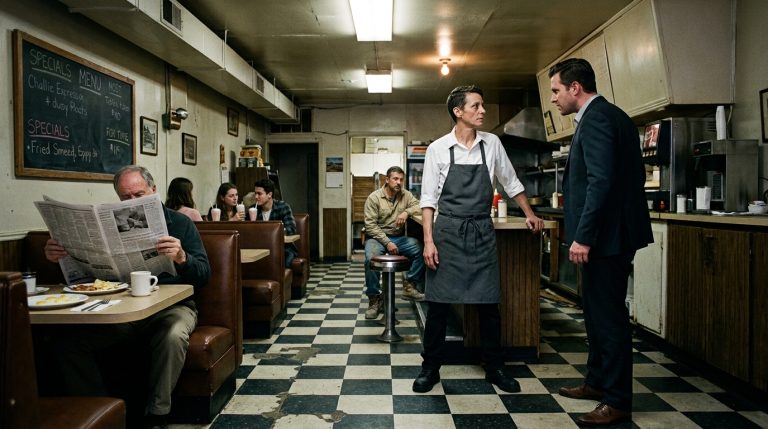
I didn’t head home. I pulled into a small, 24-hour diner on the edge of Roswell, the kind of place where the coffee is bottomless and the fluorescent lights hum with an incessant, nerve-jangling frequency. I needed a table, a laptop, and the cold clarity that only comes after the adrenaline of a site dispute fades into the ache of a long day.
I opened my laptop. The screen glowed, a harsh white rectangle in the dim booth. I started pulling the files. Every request Patricia had sent via email—the stump grinding, the fence repairs, the drainage adjustments—was logged. I cross-referenced the timestamps with my crew’s hours.
The discrepancy wasn’t just in the work; it was in the requests themselves.
I found an email from Carol, the board member who’d brought us water that first week. It was a simple “FYI” regarding the neighborhood’s master irrigation project, sent to all homeowners. But attached to it was a budget spreadsheet. I opened it. The numbers were… strange. They were bloated. Massive, recurring “Consultation Fees” paid out to a company I’d never heard of: Magnolia Holdings LLC.
I sat back, the lukewarm coffee turning bitter in my mouth. My crew had been grinding stumps for pennies while this “Holdings” company was allegedly being paid thousands for “site analysis” that had clearly never happened. If those trees had been analyzed, the work would have been contracted out months ago, long before the storm hit.
I looked at the invoices I was preparing. Patricia hadn’t just asked me to clear the road. She had asked me to clear the evidence. By grinding those stumps and filling those drainage ditches, I was effectively burying the site of whatever “Holdings” was supposed to be doing.
My phone buzzed against the table. An email notification.
It was from Patricia. The timestamp was 8:14 PM.
Mr. Drummond: Your decision to vacate the site is noted. Please be advised that your failure to complete the project as contracted constitutes a material breach. We are prepared to initiate formal legal proceedings should you not resume work by 0800 tomorrow.
She didn’t mention the equipment failure. She didn’t mention the hydraulic line contamination. She didn’t acknowledge the danger her site posed to my team. She was moving with the cold, programmed precision of an algorithm.
I started typing, but my fingers stopped. I reached into my bag and pulled out the physical copies of the emails I’d printed out—the ones David, my lawyer, had told me to keep. I laid them out on the diner table, overlapping them like a poker hand.
There was a pattern. Every time I hit a snag—a broken fence, a clogged drain—she would send a request that sounded like a simple addition to the job, but which actually required us to excavate the areas where those surveyor tags were located.
I wasn’t just a contractor. I was a distraction.
I picked up the ledger and turned to the back, where I kept my own notes. I started mapping it out. The drainage line, the gas main, the surveyor markers. If you overlaid the HOA’s “Holdings” project onto the actual topology of the street, they weren’t building an irrigation system. They were mining. Or, at the very least, they were digging holes to create the appearance of work—work that could be invoiced to a reserve fund that didn’t exist.
The waitress came by, her pot of coffee steaming, and hovered for a second, glancing at the stack of papers. “Big project?” she asked, her voice raspy.
“A mess,” I said, not looking up. “The bigger it is, the harder it is to tell who’s doing the work and who’s just holding the shovel.”
She gave a small, knowing smile and topped off my cup. “Usually, it’s the one wearing the fancy suit who’s doing the least.”
She walked away, and I turned my attention back to the screen. I needed to know more about Magnolia Holdings. I fired up a search, digging into the Georgia Secretary of State business registry. It was a private entity, registered three years ago, with a single managing partner: Patricia Morrison.
The coffee cup hit the table with a soft thud. It wasn’t just corruption; it was an echo chamber. She was the client, the project manager, and the contractor. She was paying herself with money she didn’t have, and she was using a storm-ravaged neighborhood as the laundering facility.
I didn’t feel angry anymore. The anger had been replaced by a cold, sharpened clarity. This wasn’t a contract dispute. It was a game of chicken, and she thought I was the one who was going to blink first because I was the one who needed the money.
She didn’t know about the ledger. She didn’t know about the photos of the surveyor tags. She didn’t know that I had been documenting her “Holdings” company’s phantom work since the moment I walked onto the site.
I pulled out my phone and dialed David. It rang three times before he picked up, his voice groggy.
“Ethan? It’s two in the morning.”
“I have the trail, David,” I said, my voice steady. “But I need you to tell me one thing. If I finish this job, and I have proof she’s cooking the books with her own phantom company, does that leverage change the payment terms?”
There was a long silence, the sound of the diner’s ventilation fan whirring in the background.
“If you have proof of self-dealing, Ethan, the contract doesn’t just change,” David said, his voice dropping into a professional register. “The contract becomes a crime scene. But be careful. If you step onto that site tomorrow, you’re not just a contractor. You’re a witness.”
“I was a witness the moment I stepped into the mud,” I said.
I hung up. I closed the laptop, the screen going dark, leaving me in the reflection of the booth’s window. Outside, the rain had started again, a steady, relentless drumming on the roof of the diner. It was going to be a long night, and tomorrow, the ground was only going to get softer.
CHAPTER 5: The Invoice Wall
The neighborhood looked different in the dawn light. It wasn’t the pristine suburban dream I’d seen on day one. It was a stage set, the paint peeling away to reveal the raw, unvarnished rot beneath. I drove slowly, my tires hissing against the rain-slicked asphalt. My phone sat in the cradle, silent, but the weight of the last few hours sat heavy in my chest. David’s warning—you’re not just a contractor, you’re a witness—echoed with every rotation of the wheels.
I pulled up to the main gate. Patricia was there again. This time, she wasn’t in the Lexus. She was standing outside, under a large, black umbrella, talking to a man in a dark, tailored coat—someone who looked like he belonged to a different world than the suburban sprawl of Roswell. A lawyer, or maybe just a debt collector.
I didn’t park. I pulled the truck right up to the edge of the curb, the heavy engine idling with a deep, throaty rumble. I didn’t get out immediately. I watched them through the windshield, the wipers swatting back and forth in a rhythmic, mechanical trance.
The memory hit me then—my father, thirty years ago, standing over the carcass of a blown transmission in a shop that smelled exactly like this: ozone, wet asphalt, and the sharp, acidic tang of impending failure. He had looked at me, his face gaunt, and said, “Ethan, the man who cheats you doesn’t care about the quality of your work. He cares about the speed of your silence.”
The man in the coat turned and looked at me. His face was a closed door. He said something to Patricia, and she nodded, a sharp, bird-like motion. Then, she walked over to my truck.
I rolled the window down. The rain lashed at the cab, spraying cold mist over the dashboard.
“You’re in breach, Mr. Drummond,” she said, her voice stripped of all pretense. The ice had melted into something much more dangerous—a cold, calculated malice. “The board has authorized a termination of contract. You will remove your equipment from this property by noon, or we will hold you liable for the cost of bringing in a new crew to correct your… errors.”
“Errors?” I echoed, my voice steady, anchored by the weight of the ledger sitting on the passenger seat. “Is that what we’re calling the hydraulic contamination? Or are we going to talk about the ‘consultation fees’ for the drainage work that never happened?”
Her hand tightened on the umbrella handle, the knuckles turning white. She didn’t blink. “You have no idea what you’re dealing with. This isn’t a job. It’s an infrastructure development project, and you’re a minor player who’s decided to play a game you don’t understand.”
“I understand numbers, Patricia,” I said, leaning forward into the light. “And I understand when a ledger doesn’t balance. You’ve been running this ‘Holdings’ project into the red since before the storm hit. You didn’t hire me to fix the neighborhood. You hired me to provide a receipt for work that doesn’t exist.”
She stared at me, and for a heartbeat, the world seemed to freeze. The rain continued to fall, a steady, deafening roar against the metal roof, but in the small space between us, there was only the sound of our breathing.
She leaned in, the umbrella dipping to shield her face from the man in the coat. “If you think those emails matter, you’re more naive than I thought. You don’t have a witness. You have a stack of paper that will be shredded before you reach your lawyer’s office.”
“Maybe,” I said, shifting the truck into drive. “But it’s a lot of paper. And the truth is, I’ve got a backup of everything on a drive that’s sitting in a safe in downtown Atlanta, handled by people who don’t know how to shred.”
I didn’t wait for her response. I eased off the brake, the heavy tires crunching over a loose piece of gravel. I watched her in the side mirror as I drove past. She stood there, a small, dark shape in the middle of the boulevard, the umbrella still held high against the wind.
I didn’t head for the entrance. I turned the truck toward the drainage ditch—the site of the markers. I had one more piece of the puzzle to collect, and I didn’t care about the contract anymore. I was going to finish this, not as a contractor, but as a guy who had finally learned how to fight back.
I reached the culvert and cut the engine. The silence that followed was heavy, expectant. I stepped out into the rain, the cold water soaking through my jacket, and knelt by the mud. I needed that grit—the sample I’d promised myself I’d collect. If it was chemical, if it was toxic, if it was anything other than what the HOA records claimed it to be, I wouldn’t just have a breach of contract. I’d have a reason for the state to step in.
My hands plunged into the cold, viscous muck. The smell was overpowering—a stagnant, metallic rot that turned my stomach. I found a solid chunk of the aggregate, packed tight and jagged, and pulled it free.
As I stood up, the man in the coat was standing on the other side of the ditch. He wasn’t running. He wasn’t shouting. He was just waiting.
“That belongs to the association, Mr. Drummond,” he said, his voice as smooth and flat as a concrete floor. “Putting that in your pocket is theft.”
“It’s not theft,” I said, holding the chunk of grit up to the gray morning light. “It’s evidence.”
The air crackled, the static electricity in the atmosphere building toward a flash. I didn’t know what he was going to do next, but I knew one thing: I wasn’t leaving until I had what I came for. The contract was dead, but the fight had only just begun.
CHAPTER 6: The Weight of Evidence
The man in the coat didn’t move. He stood on the opposite bank, his posture relaxed, almost clinical. The rain didn’t seem to bother him; he simply stood there, a dark, vertical line against the gray, blurred landscape of Magnolia Heights. He knew the chunk of aggregate in my hand wasn’t just dirt. He knew it was the signature of the fraud.
“I’m not a thief,” I said, my voice cutting through the hiss of the rain. I tightened my grip on the sample. “And you’re not an HOA representative. You’re the cleanup crew.”
He tilted his head, a gesture of mild, condescending interest. “You have a vivid imagination, Mr. Drummond. It’s that kind of creativity that makes small business owners so… unpredictable. And, unfortunately, so prone to accidents.”
He didn’t make a move toward me, but I felt a sudden, sharp prickle at the back of my neck. I looked at the drainage line, at the series of surveyor markers that seemed to form a perimeter around the backhoe’s last position. The realization hit me with the force of a physical blow: they hadn’t just been marking the work site. They were marking the containment site.
The ground beneath my boots felt unstable. The grit I’d collected—it wasn’t just industrial waste. It was saturated with a thick, oily residue that didn’t wash away in the rain. I glanced at the backhoe, parked twenty yards back, its hydraulic lines weeping dark, viscous fluid into the mud. The machine hadn’t failed due to age. It had been sabotaged to keep us away from the culvert.
I turned and started walking toward the truck, my movements stiff, calculated. I didn’t look back at him. My pulse thrummed in my ears, a frantic, irregular beat that threatened to drown out the sound of the rain. I felt disoriented, the perspective of the street stretching and narrowing until the houses looked like jagged, teeth-like shadows looming over me.
Stay focused, I told myself. The ledger. The proof. Get to the truck.
“You really should consider the settlement, Ethan,” the man called out, his voice unbothered, carrying effortlessly over the wind. “The board is prepared to increase the offer to 90,000. It’s a very generous path for someone who’s about to lose his license.”
I reached the truck and pulled the handle, the metal slick with water. I tossed the sample onto the passenger seat next to the ledger. I didn’t bother responding. I slammed the door shut, the sound booming like a gunshot in the empty street. I didn’t feel the rain anymore. I felt the cold, hard reality of the steel steering wheel.
I fired the engine. It turned over, but it sounded… different. A faint, high-pitched whine was emanating from the rear axle—the sound of something rubbing against the housing. I shifted into reverse, and the truck lurched, a sickening jolt running through the frame.
He’d done something to the vehicle while I was at the culvert.
I didn’t panic. I slammed the truck into drive and pushed the pedal. The engine roared, a protest of gears and straining steel, as I navigated the winding road toward the exit. The steering was heavy, pulling hard to the left, but I didn’t let up. I treated the truck like a tool—a worn-out, beaten, but functional instrument of survival.
I saw Patricia at the main gate. She was standing by the stone monument, her silhouette stark and unforgiving. As I approached, she stepped out into the middle of the road, her hands buried in the pockets of a raincoat. She wasn’t holding an umbrella anymore.
She wanted me to stop. She wanted the confrontation, the final negotiation.
I didn’t stop. I kept the truck aimed straight at her, my foot steady on the accelerator. I didn’t accelerate, but I didn’t brake. I kept the momentum constant, a physical assertion of my own movement. At the last possible second, she stepped aside, her eyes locked on mine with a look of pure, unadulterated hatred.
I passed through the gate, the tires hitting the smooth, dry pavement of the main road outside the community. I was out. I was breathing. But I wasn’t clear. The whining in the rear axle was getting louder, a persistent, rhythmic protest that told me I wouldn’t make it to downtown Atlanta at this speed.
I pulled over onto the shoulder of the highway, the hazard lights flashing in the gloom—a frantic, rhythmic pulse of orange in the dark. I climbed out into the rain, my legs shaky, and scrambled to the back of the truck to check the damage.
There, jammed into the brake line housing, was a steel rod—a precision-cut piece of metal, rusted and jagged, designed to slowly grind through the rubber until the fluid drained. It wasn’t an accident. It was a surgical strike.
I looked back toward the neighborhood. The entrance to Magnolia Heights was just a dark gash in the trees, a place where the rules of the world seemed to have been rewritten to favor those who could pay the price. I reached for my phone to call David, but the signal was gone.
I was alone, on the side of a highway, with a sabotaged truck and a handful of evidence that someone was willing to kill for. The “financial mismanagement” I’d suspected was a smoke screen. This was something deeper, something embedded in the very foundation of that place. And now, I was the only thing standing between them and the total silence they needed to complete their work.
CHAPTER 7: The Fracture
The highway was a blur of headlights and rushing spray. I left the truck where it sat, its hazard lights clicking like a dying heartbeat against the deluge. My jacket was saturated, the cold seeping into my shoulders, but the leather-bound ledger in my inner pocket stayed dry. That was the only thing that mattered.
I walked the three miles to the nearest service station, my boots heavy with sludge. Each step was a rhythm of survival. The man in the coat—the “cleanup crew”—was likely still watching from the shadows of Magnolia Heights, but he couldn’t stop the narrative. The evidence was moving.
I reached the station, a bright, garish oasis of neon and asphalt. Inside, I used the payphone. I didn’t call David this time; I called Carol.
The phone rang for a long time. When she finally answered, her voice was thin, brittle. “Ethan? It’s three in the morning.”
“The truck’s dead, Carol,” I said, my voice hoarse. “Someone sabotaged the brake lines. I know about Magnolia Holdings. I know about the phantom site analysis. I’m going to the District Attorney’s office as soon as the sun hits the horizon.”
There was a silence so profound it felt like the line had gone dead. Then, a sharp, ragged intake of breath. “You don’t understand, Ethan. You think this is just Patricia. It’s not just her. The whole board… we’re all tied into the funding model. If you go to the D.A., it doesn’t just sink her. It sinks the neighborhood.”
“Then the neighborhood should have built its foundation on something other than a crime,” I countered. I felt a strange, cold detachment. The “Sovereign Protector” mindset I’d adopted—that heavy, rusted burden of keeping a secret—had finally fractured. I wasn’t protecting anything anymore. I was simply ending it.
“Wait,” she said, her voice dropping to a desperate whisper. “There’s an envelope in the glovebox of the white Lexus. Patricia hid it there. It contains the real audit—the one before she altered the numbers to create the Holdings ledger. If you have that, you have everything. But you have to move before she realizes you’re at the station.”
I stared out the window at the rain-lashed parking lot. The realization hit me: Carol wasn’t the “friendly” board member. She was a co-conspirator who was finally realizing that the ship was taking on too much water to stay afloat. She was throwing the captain overboard.
“Why tell me now?” I asked.
“Because I want to retire,” she said, and for the first time, her voice sounded truly old. “And I don’t want to go to jail for her mistakes.”
I hung up the phone and walked out into the rain. I didn’t go to the D.A. yet. I headed back. I walked the three miles in the dark, the storm beginning to break, the sky turning a sickly, bruised purple. By the time I reached the entrance to Magnolia Heights, the sun was just beginning to bleed over the horizon.
The neighborhood was silent, a graveyard of brick and pretense. The white Lexus was parked at the curb, exactly where Patricia had left it before the confrontation at the gate. I moved through the shadows of the hedges, the smell of wet earth and iron filling my lungs. I was a ghost in their machine.
I reached the Lexus. The driver’s side window was slightly cracked. I used a thin, flat piece of steel from my pocket—a tool for opening jammed locks—and worked the latch. It clicked, a soft, final sound.
I opened the glovebox. There, nestled beneath a stack of parking passes and insurance cards, was the envelope. It was heavy, sealed with a thick, wax-like adhesive. I didn’t open it. I knew what was inside. It was the weight of the neighborhood’s collapse.
As I pulled the envelope out, a shadow fell over the car. I turned, my heart hammering against my ribs, expecting the man in the coat, or perhaps Patricia herself.
It was Carol. She was standing on the sidewalk, a small, dark figure in the early morning light. She held a heavy, black handgun, pointed not at me, but at the ground. Her hand was shaking.
“I can’t let you walk out with that, Ethan,” she said, her voice hollow. “It’s not just her. I’m on every one of those secondary accounts.”
I stood up, the envelope tight in my hand. The weight of the world felt compressed into that single, physical object. “It’s over, Carol. The audit is here. The grit is in my pocket. The truck is a crime scene.”
“It doesn’t have to be,” she said, her eyes welling up. “Just give it to me. We can fix this.”
I looked at the house behind her—the beautiful, expensive, hollow home she was so desperately trying to protect. Then I looked at my own hands, caked in the mud and oil of their neighborhood. The “rusted truth” wasn’t that the world was broken. It was that you had to be willing to get dirty to see the gears for what they really were.
“I’m not a contractor anymore,” I said, taking a step toward her. “I’m the audit.”
She raised the gun, but she didn’t fire. She couldn’t. She was just another piece of the machinery, and the machinery had finally ground to a halt.
CHAPTER 8: The Clearing
Carol’s hand was a mess of tremors, the barrel of the pistol tracing erratic, uncertain circles in the morning air. She looked at me, then at the envelope in my hand, and the mask finally disintegrated. It wasn’t the look of a killer; it was the look of a woman who had spent years convincing herself that if she just kept running, she would never have to stop.
“It’s not just an envelope, Carol,” I said, my voice dropping, stripping away the defensive grit I’d worn for the last few weeks. “It’s the end of the line. If you pull that trigger, you’re not protecting the board. You’re just guaranteeing that everything I have goes straight to the District Attorney. Every ledger entry, every fake invoice, every cent you siphoned—it all goes in the box.”
She blinked, a slow, hollow movement. “They’ll ruin me, Ethan. Patricia will make sure I take the fall for everything.”
“Patricia’s going down either way,” I said, taking a slow, steady step forward. The gravel crunched under my boots—a loud, abrasive sound that seemed to shatter the tension. “But if you hand over the gun, if you help me finish the statement, you aren’t the architect. You’re the witness. There’s a difference.”
She stared at me, the pistol finally lowering, resting against her hip. The fight didn’t end with a bang; it ended with a wet, ragged sob. She let the weapon slip from her fingers. It hit the pavement with a soft, dull thud, sliding away into the gutter.
I picked it up, feeling the heavy, cold weight of it, and tucked it into my belt. I didn’t feel like a hero. I felt like a man who had finally finished a job.
We didn’t say another word. We walked toward the white Lexus. Carol unlocked it with a shaky hand. Inside, the car smelled of expensive leather and stale perfume—the scent of a life built on a foundation of sand. I sat in the passenger seat while she drove. We didn’t head for the D.A.’s office immediately. We drove to the back of the neighborhood, to the site of the drainage project, where the backhoe sat, silenced and rusting in the rain.
I took out the ledger and the envelope. I laid them out on the dashboard. The audit Patricia had hidden was damning—a clear, itemized history of systematic looting.
When we finally walked into the District Attorney’s office three hours later, the building was just beginning to stir. The air was sterile, smelling of coffee and floor wax. We didn’t need to say much. I handed over the ledger, the aggregate sample, and the envelope. I watched the lead investigator’s face change as he began to flip through the pages—the slow, dawning realization that he wasn’t looking at a simple contract dispute, but a case that would reach into the city’s highest offices.
The payoff wasn’t a sudden explosion of triumph. It was the slow, methodical process of reality catching up to fantasy. By the end of the week, the news was out. The audit had gone public.
Patricia was arrested at her home on a Tuesday. I stood on the sidewalk near the entrance of Magnolia Heights and watched as the cruiser pulled away, her face—hollowed out, stripped of its practiced ice—looking out at a neighborhood that was already beginning to move on. There was no poetic justice in the sight; just the cold, hard fact of consequence.
The HOA eventually settled the invoice. They paid every dollar, plus interest and legal fees.
The following month, I was back on site, but not for the HOA. A new, court-appointed management firm had hired us to finish the drainage properly. The work was slow, honest, and heavy. Miguel and the boys treated the equipment with a new sense of care, as if they knew the value of a machine that worked because it was built on a solid foundation.
One afternoon, I found myself standing by the old oak, the one that had started the entire mess. We had planted a young sapling in its place, a fragile, green thing held up by wooden stakes. I knelt, pushing the soil down around the roots with my hands.
The earth felt good—solid, real, and finally honest.
My father’s ledger sat on the stump of the old tree, closed. I didn’t need it anymore. The books were balanced. I looked around the neighborhood. It looked like any other place now—not a dream, not a battlefield, just a collection of houses where people lived and worked and, eventually, paid their dues.
I walked back to the truck. I felt lighter than I had in months. The grind, the pressure, the relentless push-and-pull of the last year had left its marks, but standing there in the quiet, atmospheric peace of the afternoon, I knew I had done exactly what I set out to do. I had stood my ground.
I started the truck, the engine purring with a clean, steady rhythm, and pulled out onto the road. I didn’t look back at the houses. I just looked at the road ahead, where the work was waiting, and for the first time in a long time, the path was entirely my own.