The Sweet Taste of Deep Mud and Hard Ground: How a Retired Marine Taught a Suburban Tyrant the Real Meaning of Boundaries
CHAPTER 1: THE COLD BOUNDARY
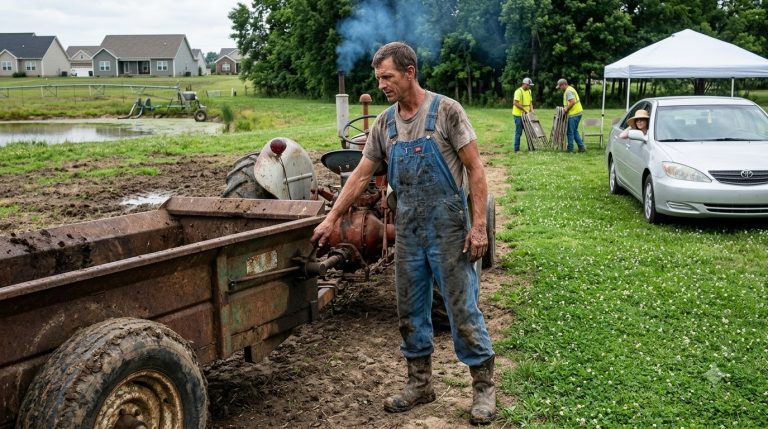
The March air carried the sharp, clean scent of melting snow and wet earth. Marcus Thorne kept his fingers steady on the iron handle of the evaporator skim-pan, watching the sweet, thick steam rise from the boiling maple sap. The rhythmic thump-hiss of the wood fire beneath the flue was the only sound that belonged out here on the back fifteen acres.
“This hobby farm of yours is an unregistered commercial enterprise,” a voice cut through the steam, hard and jarring as an ungreased gate hinge. “You have exactly seventy-two hours to cease all operations, or the association will begin fining you one thousand dollars a day.”
Marcus didn’t drop the skimmer. He set it down deliberately on the side tray, wiped his palms against his worn work pants, and turned toward the old, stacked-stone wall marking the western edge of his woods.
Karen Miller stood just on the other side of the boundary, her boots resting securely on the manicured turf of Oak Haven Estates. She wore a bright lavender tracksuit that looked absurdly bright against the gray winter brush, her jaw set with the rigid posture of someone who spent her life policing the exact height of neighborhood lawn grass.
Marcus let his hand slip into his pocket, his thumb catching the rough, scratched brass of his old service Zippo. He didn’t click it open. He just held the cold metal, grounding himself against the sheer, unearned audacity drifting over the rocks.
“The Shack sits clear of your survey line, ma’am,” Marcus said, his voice flat, retaining the quiet weight of twenty-five years in the dirt.
“The line is ambiguous, Mr. Thorne,” she countered, pointing a short, manicured finger at the post-and-beam timber structure he’d raised with his own hands. “And the smoke is a visual nuisance to the estates on the hill. Dismantle the outbuilding, or the paperwork will simply outrun your retirement.”
She turned on her heel, her heavy white sneakers sinking slightly into the soft edge of her association’s grass as she walked back toward the cul-de-sac. Marcus stood perfectly still in the rising steam, his thumb rolling over the scarred brass in his pocket, calculating the weight of the war she had just dragged to his porch.
CHAPTER 2: THE CLUBHOUSE REJECTION
The sterile, beige clubhouse smelled of industrial lemon cleaner and stagnant coffee. Marcus stood at the back of the room, his jacket zipped tight, his thumb pressing into the worn edge of the Zippo in his pocket to keep his presence anchored.
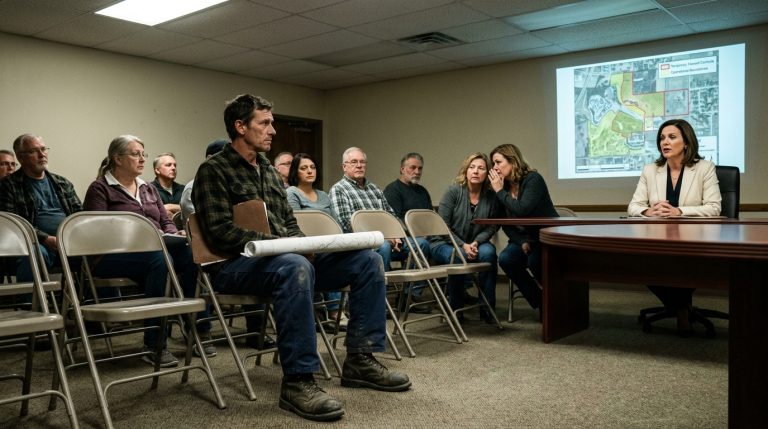
Thirty residents sat in padded folding chairs, their eyes pinned to the front table where Karen Miller presided over the Oak Haven Estates board with the rigid posture of a prison warden. The two men flanking her looked entirely hollowed out, their eyes locked onto their legal pads while Karen scanned the room for dissent.
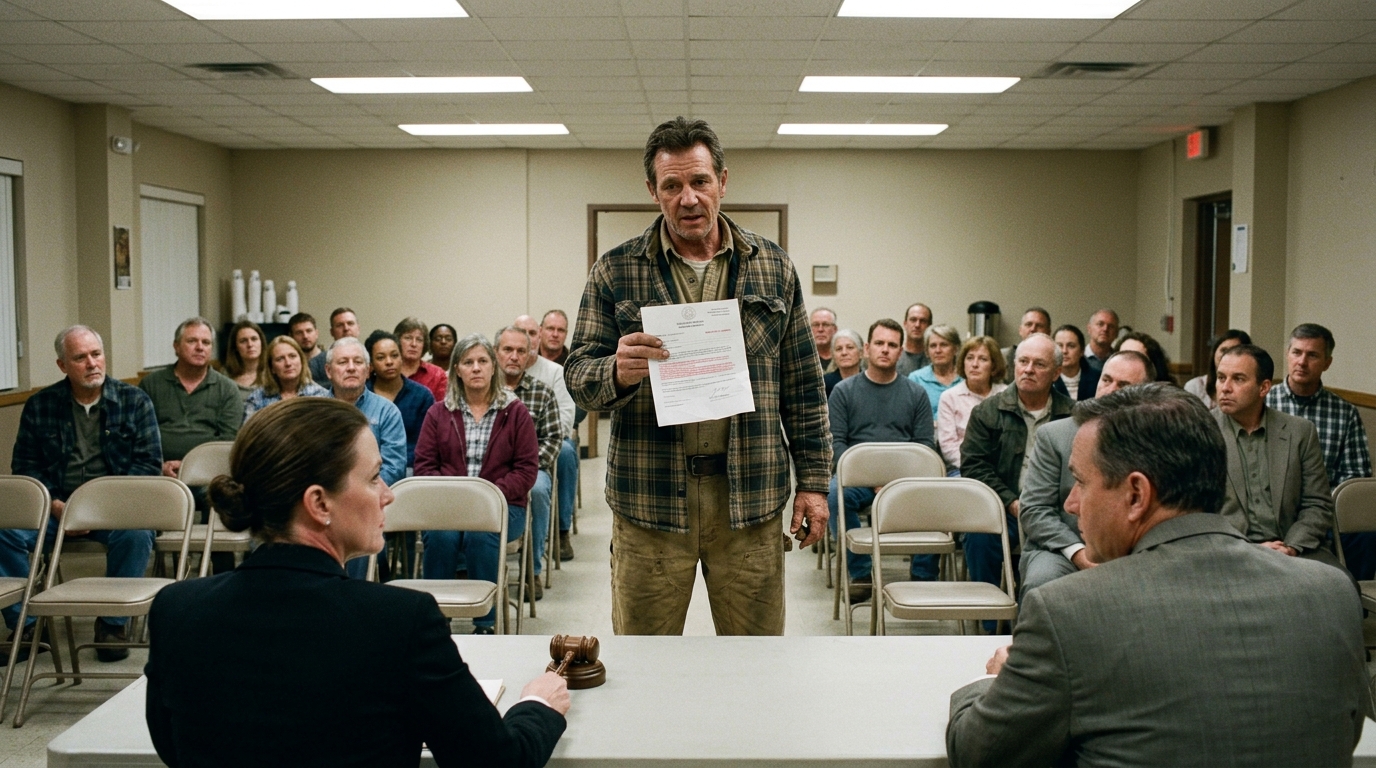
“Ma’am,” Marcus said, his voice cutting clean through the low murmur of the crowd. He took three deliberate steps down the center aisle. “Marcus Thorne. I live at eleven-twenty Old County Road.”
Karen’s head snapped up, her manicured fingers clamping down instantly on the handle of her gavel. “You are not a member of this association, Mr. Thorne. This floor is strictly reserved for deeded residents.”
Marcus pulled the thick, cream-colored violation notice from his pocket, the embossed Oak Haven logo stark against his calloused skin. He didn’t drop it on her desk; he held it right where the front row could see the red ink. “Your association sent me a demand for forty-five thousand dollars in backdated fines for a structure that has stood for forty years. I’m here to resolve this like a neighbor.”
A sudden, sharp rustle passed through the rows of chairs as three homeowners leaned forward to whisper.
“That is a private enforcement action,” Karen snapped, a sudden flush of dark magenta creeping up from the collar of her tracksuit. “The board’s position is absolute. Dismantle the illegal commercial structure and clear the balance, or the fines will escalate daily.”
“With all due respect, ma’am,” Marcus said, letting the military courtesy hang between them like cold smoke. “I’ve spent twenty-five years following chains of command that actually mattered. My operation produces fifty gallons of syrup a year. It’s a traditional craft on land that’s been farmed since the dawn of the last century.”
“Your past employment is completely irrelevant to the architectural standards of this community,” Karen countered, her voice rising to a shrill, defensive edge as she lifted the gavel again. “This is a pristine residential development, not a industrial zone. We have guidelines, and we will compel compliance.”
—”Without a certified survey?” Marcus hijacked her momentum, his voice dropping into a hard, quiet register that forced the room into absolute silence.
The gavel cracked down against the wood with a hollow, echoing bang that split the air.
“This matter is closed!” Karen barked, her knuckles white around the wood handle. “Security will escort you out if you utter another word.”
Marcus looked at her for three long seconds, watching the slight tremor in her hand as she tried to maintain her imperial stance. He gave her a single, slow nod, turned on his heel, and walked out into the cold night air, the battle lines formally drawn.
CHAPTER 3: THE UNBRANDED ORDER
Tom slammed the trunk lid shut, the grease-stained cuff of his mechanic’s jacket leaving a faint smudge against the salt-crusted bumper. He wiped his hands on a rag, his face tight under the flickering buzz of the diner’s exterior sign.
“Ten gallons, cash upfront, Marcus,” Tom said, slapping a thick manila envelope into my palm. “The same lady came by the back kitchen door. Carol, her little assistant. Kept looking over her shoulder like she was running contraband across a state border instead of breakfast syrup.”
I weighed the envelope in my hand, feeling the solid bulk of hundred-dollar bills through the cheap paper. I pulled out my scarred brass Zippo with my other hand, turning the cold metal casing over and over in my palm, the click silenced by my thumb pressure.
“Did she say who the order was for this time, Tom?” I asked, my voice flat, grounded in the damp gravel beneath my boots.
“Same line as last year—a private corporate retreat up the mountain,” Tom murmured, spitting a toothpick onto the gravel. “Told me the client demands absolute discretion. No labels, no branding, no local names on the jugs. Just pure Vermont amber, delivered in plain plastic.”
I glanced down at the envelope, then back toward the dark highway stretching out toward the high, manicured hills of Oak Haven Estates. The logic was clean, brutal, and entirely transactional.
“She paid six hundred cash for the lot,” Tom added, leaning against the side of his delivery van. “But something felt off. The assistant had a smudge of wood-ash carbon right across the silk sleeve of her pastel tracksuit, identical to the charcoal I scrape out of my grill. A high-end corporate retreat doesn’t involve hauling firewood in luxury clothes.”
The realization settled in like cold mud under a boot heel. Karen Miller wasn’t just trying to zone my land into oblivion; she was using her nervous assistant to clear the local market of my inventory under the cover of a third-party catering buffer.
“Keep the cash envelope in your safe, Tom,” I said, my thumb releasing the Zippo lid with a tiny, sharp snap. “We aren’t spending a dime of it yet. I need to see the association’s public disclosures before that morning breakfast kicks off.”
CHAPTER 4: THE SHARED LEDGER
Sarah Jenkins leaned over the wide oak surface of my dining table, her pencil tip tapping aggressively against a single row of data. David Chen sat right beside her, his reading glasses pushed up into his gray hair, his face locked in a hard frown as he studied the numbers.
“Look right here, Marcus,” Sarah murmured, her thumb tracing the paper’s edge until it hit the line item for the upcoming pancake breakfast. “The board allocated exactly two hundred dollars for catering supplies and syrup. To feed three hundred people real, high-quality local product, it would take thousands. They’re telling the community they’re serving premium local goods, but they’re barely reporting any expenses.”
I pulled out my brass Zippo, my thumb pressing down hard on the metal casing, feeling the cold weight anchor me to the absolute reality of my kitchen floor. I didn’t click it open; the silence in the room was weapon enough.
“And look at the legal budget,” David chimed in, pointing a long, thin finger at the bottom row. “Fifty thousand dollars already moving toward the Blackwood firm to fight you. The community’s emergency reserves are entirely wiped out to fund this push against your sugar shack.”
I let the Zippo roll across my knuckles, the calculation completing itself in the quiet spaces between their breathing. Karen Miller was using off-the-books cash to intercept my supply line through Tom’s diner, keeping the transaction off the official ledger completely so she could pocket the massive difference from the ticket sales under the guise of an event buffer.
“She’s hiding the labor and the product cost entirely to protect her flagship image,” Sarah said, her voice dropping into a flat, businesslike tone. “If the community sees that she’s spending fifty grand to destroy the exact operation supplying their breakfast, the whole administration collapses.”
I picked up the manila envelope full of Tom’s cash, setting it squarely down over the fraudulent financial summary like a paperweight. “Then we don’t argue with her lawyers anymore. We let her take the delivery, let her set the tables, and we let the neighborhood see exactly what they’re paying for.”
CHAPTER 5: THE AMBUSH AT THE BUFFET
The main hall of the clubhouse was a sea of pastel linen and gold banners, completely insulated from the biting morning cold outside. At the center of the longest table stood three large, elegant crystal pitchers, filled to the brim with a deep, viscous amber liquid that caught the glare of the overhead chandeliers.
Karen Miller stood just behind the serving line, her chest puffed out beneath a floral silk jacket, her loud laughter ringing over the clink of porcelain plates as she counted the crowd.
I cleared my throat, the heavy weight of my dress blue uniform drawing every pair of eyes in the immediate vicinity as I stepped into the light of the buffet line.
“Mr. Thorne,” Karen’s voice dropped instantly into a harsh, venomous hiss, her fingers locking so tightly around the edge of a serving tray that her knuckles went stark white. “You are completely out of order. This is a private, residents-only function, and your presence is a direct violation.”
I didn’t answer right away. I reached out, lifted one of the heavy crystal pitchers by its handle, and swirled the dark amber liquid inside with a slow, deliberate motion.
“Forty dollars a plate, Karen,” I said, my voice carrying clean across the immediate tables as the room began to fall completely silent. “And you told these people this syrup was imported from a commercial wholesale distributor out of state.”
“Put that down!” she barked, stepping forward, her breath coming in short, ragged bursts as her face flushed a dark, violent shade of magenta. “Security, remove this man immediately!”
—”The cash envelope your assistant Carol handed to Tom at the diner has my name stamped on the inner seal,” I hijacked her shriek, setting the heavy glass pitcher back down on the table with a solid, echoing thud. “You spent fifty thousand dollars of their neighborhood reserve funds on a legal war to demolish my sugar shack, while secretly buying the exact same product off the books to clear your budget deficit.”
Sarah Jenkins stepped forward from the aisle, slapping a thick stack of printed financial ledgers directly onto the table next to the plates.
Karen’s eyes bulged, her mouth opening and closing in absolute silence as she looked from the papers to the crowd of residents now standing up from their chairs. She didn’t drop her head; her hands began to tremble with pure, unadulterated rage as she leaned over the table, cornered but entirely defiant.
CHAPTER 6: THE NEW BORDER
Dennis, her quiet husband, stood by the rear bumper of a moving truck parked two hundred yards down the cul-de-sac, his head down as he hauled the last of their patio chairs inside. Karen Miller didn’t look back from the passenger seat, her eyes fixed strictly ahead as the vehicle rolled out of the neighborhood for the final time.
The interim board had acted before the ink on the headline even dried. With Sarah Jenkins running the treasury and David Chen managing the legal filings, the frivolous sixty-thousand-dollar lien vanished from the county books within forty-eight hours.
I leaned against the weathered post of the sugar shack, the early morning sun cutting low through the maple branches to melt the remaining patches of frost. My thumb brushed the cold casing of the brass Zippo in my pocket, the metallic weight no longer holding back an imminent storm, but simply resting in the quiet.
The local newspaper clipping sat on the small wooden side table next to a freshly sealed jar of dark amber syrup. The headline read exactly how the community needed to remember it, cementing the transition from a neighborhood fiefdom back into an honest community.
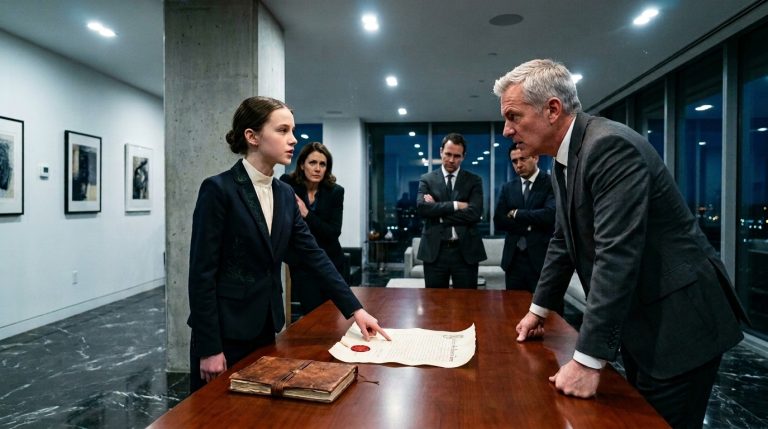
There were no more late-night strategy sessions over dense financial ledgers, no more tracking cash envelopes, and no more dealing with the unhinged entitlement of an absolute board president. The new plat maps were officially indexed at the county office, correcting the old surveyor’s mistake from the seventies with a permanent, legally binding line that completely protected the grove.
I picked up the iron skimmer, dipped it lightly into the cooling pan to check the clarity of the fluid, and watched the golden syrup drip steadily back into the basin without a single ripple.
The steam rose slow and fragrant into the crisp air, drifting freely past the stone wall without anyone standing on the other side to count the cost.