The Iron Foundation: How Common Sense and a Steel I-Beam Brought Down a Corrupt Neighborhood Tyrant
CHAPTER 1: THE CEDAR PORCH
The air in the valley smelled of linseed oil and damp cedar. My grandfather built this farmhouse with his own two hands back in 1943, and every timber still seemed to hold a quiet, steady memory of men who valued hard work over noise.
I sat on the wraparound porch with a heavy ceramic mug, watching the morning mist burn off the gravel drive. At the edge of the property sat my grandfather’s pride and joy—a hand-painted blue mailbox with white numbers touched up year after year until his hands shook too much to hold a brush.
A sharp, staccato clack broke the morning silence. High heels on gravel. That sound didn’t belong out here.
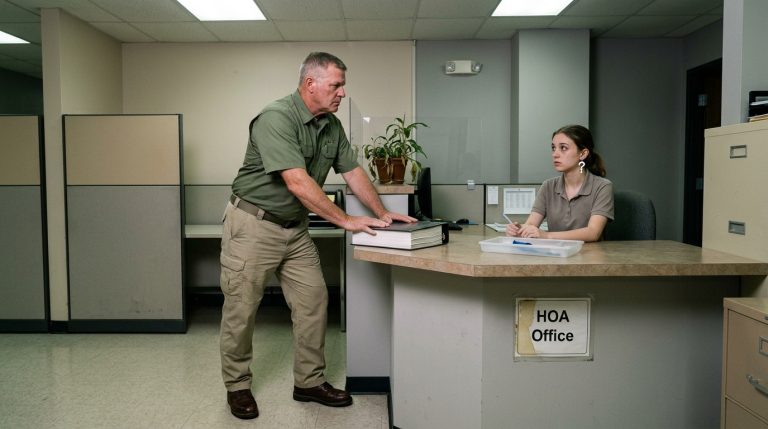
A woman in a pristine white blazer and bleached hair marched up the steps like she was inspecting a military barracks. She didn’t knock. She just stopped four feet from my chair and snapped a plastic clipboard against her thigh.
“Mr. Dominic, I presume,” she said, her voice cutting through the quiet morning like a rusty saw. “I’m President Delgado of the Willowbrook Estates Homeowners Association.”
I took a slow sip of coffee. The mug felt heavy and warm against my palms, grounding me against the sudden spike of irritation in my chest.
“Morning, ma’am,” I said, keeping my voice flat. “You’re a couple miles off the main development. This is county land.”
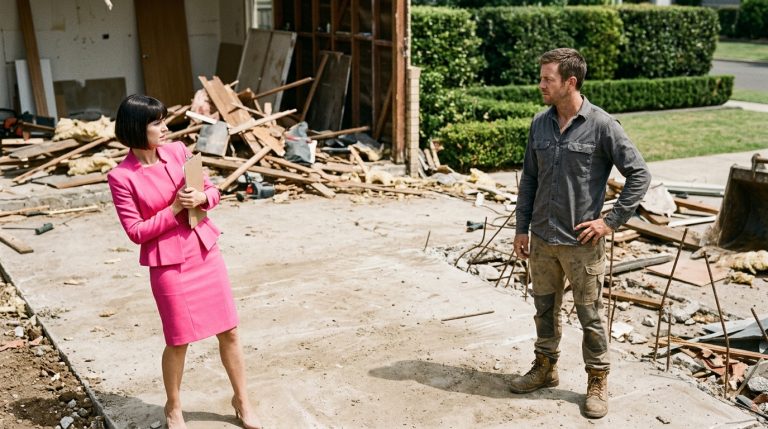
“This is an aesthetic blight,” she retorted, thrusting the clipboard toward my face. “Your chicken coop is a biological hazard. Your squash patch is unkempt. And that mailbox at the end of your drive violates neighborhood covenants three through nine.”
I looked down at the paper. It was covered in neat, aggressive red ink.
“I’m not in your HOA,” I said quietly, setting the mug down on the weathered wood table. “My grandfather built this place sixty years before your developers paved over the apple orchards.”
She narrowed her eyes, stepping closer as if sheer audacity could rewrite property deeds. “Every single parcel in this zip code falls under our jurisdiction. Compliance is mandatory. You have forty-eight hours to cure these violations, or face severe legal consequences.”
She spun on her heel, the four-inch heels clicking a furious rhythm back down the steps. I didn’t chase after her or raise my voice. I just picked up my coffee mug, feeling the rough ceramic between my fingers, and watched her climb into a white Escalade that idled right in the middle of my gravel turn-out.
CHAPTER 2: THE RED LETTERS
Two in the morning is a strange hour in the valley. The fog rolls down off the timber ridges, swallowing the property lines and turning the old gravel drive into a silent gray channel.
I didn’t hear the footsteps over the hum of the old refrigerator in the kitchen. I only caught the faint, chemical bite of spray paint cutting through the damp night air.
I stepped out onto the porch in my stocking feet, the floorboards cold beneath my arches. At the edge of the drive, a figure in a heavy dark jacket stood beside my grandfather’s historic blue mailbox, the hissed rattle of an aerosol can echoing off the pasture fence.
The beam of my heavy-duty work flashlight cut through the mist. The white light caught her mid-motion, the aerosol can gripped in a manicured hand.
“That’s private property,” I said, my voice carrying flat and heavy across the gravel.
She didn’t drop the can. She turned slowly, the pale light washing out her face, and smiled a thin, tight smile. The red paint ran down the side of the weathered wood like fresh blood, spelling out a jagged word across the family name.
“It’s an aesthetic nuisance, Dominic,” she whispered, her voice carrying the shrill edge of exhaustion. “Just like everything else you refuse to fix.”
She slipped back into the fog before I could reach the end of the drive, leaving behind the reek of chemical red and a community that was beginning to wake up to her shadow.
The next morning, Mrs. Elise from down the lane pulled her garden cart to a stop by my fence, her knuckles white around the handles.
“She did the exact same thing to the Hendersons before they packed up and left,” she muttered, not looking me in the eye. “Started with the painted warnings, ended with code enforcement seizing their livestock.”
I didn’t argue. I pulled out a heavy leather-bound notebook and my grandfather’s brass plumb bob, tapping the cold metal rhythmically against my palm.
“Not this time,” I said, looking down at the fresh red stains on the wood. “We’re going to measure every inch of this road by the law, not her clipboard.”
CHAPTER 3: THE BOGUS SURVEY
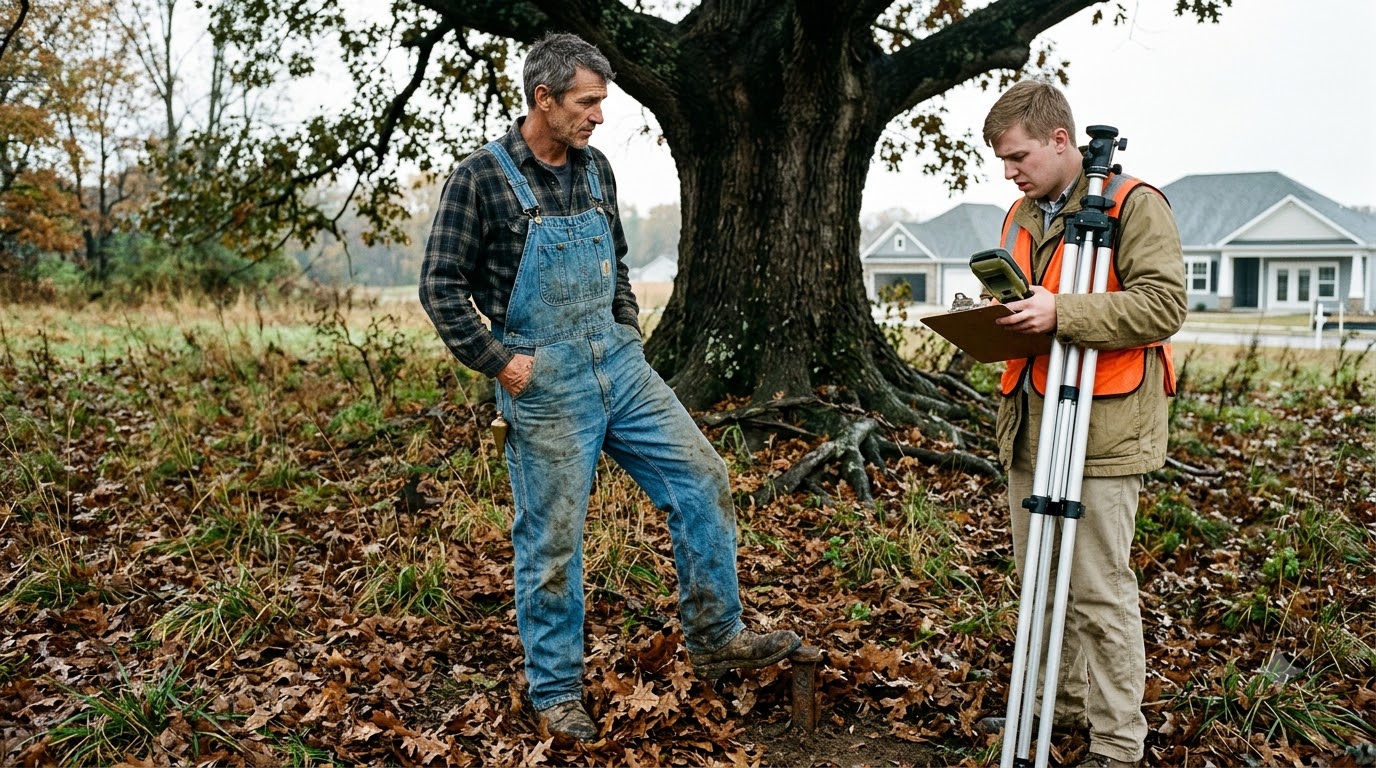
The morning air smelled of wet asphalt and diesel when the blue pickup truck rumbled to a halt near the gravel turnaround. A young man in a stiff, high-visibility vest stepped out, clutching a brand-new aluminum tripod like it was a shield.
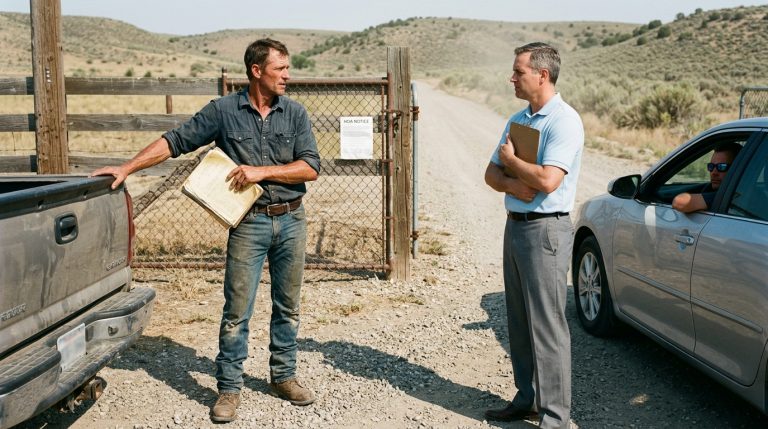
“You’re encroaching on association easement by six inches,” the surveyor called out, his voice cracking slightly as he checked his clipboard. “We have official markings right here.”
I didn’t step off the porch. I let the heavy brass plumb bob slide back into my coat pocket, feeling its reassuring weight against my thigh.
“Whose markers are those, son?” I asked, keeping my voice level. “Because the ones my grandfather set into the bedrock aren’t made of orange plastic.”
“Mr. Sullivan’s office,” the young man stammered, tapping a peg driven deep into my side lawn. “State-certified layout.”
“Take a walk with me down to the north corner,” I said, gesturing toward the old oak tree by the fence line. “Let’s see what else Mr. Sullivan forgot to check.”
We walked over the damp grass together, the young surveyor breathing heavily under the weight of his gear while I paced out the distance with steady, deliberate strides.
When we reached the roots of the grand old oak, I kicked aside a layer of fallen leaves to expose a weathered stone marker stamped into the dirt back in 1943.
“That’s the original government monument,” I said, pointing down at the rusted iron pin. “Your 1987 survey didn’t miss by six inches. It missed by three whole feet into my grandfather’s land.”
The young surveyor went pale, staring down at his GPS unit before looking back at the iron pin in the dirt.
“I… I was just given the coordinates by the board,” he muttered, fumbling with his tripod legs.
“I know you were,” I replied, my eyes fixed on the distant roof of the subdivision office. “Now pack up your gear before I file a formal professional complaint with the state licensing board for negligence.”
CHAPTER 4: THE UNPERMITTED DECK
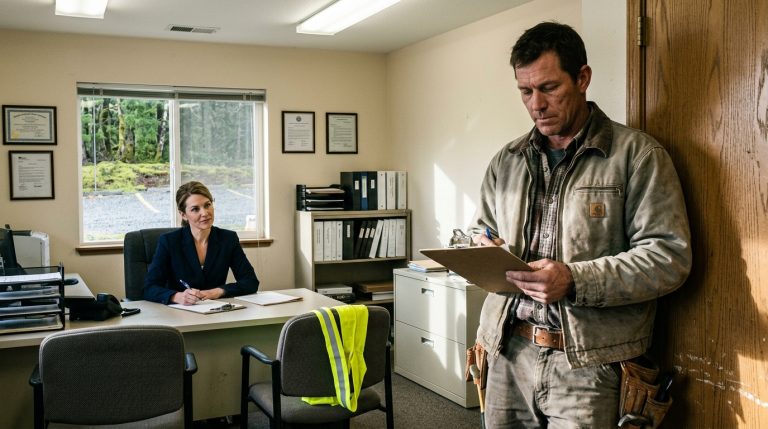
The municipal office smelled of stale toner and damp wool. I laid out three separate topographical plats across the counter, sliding them toward the zoning clerk without a word.
“Looking for historical building variances on parcel four-zero-two,” I said, my thumb tracing the red parcel line of the subdivision’s main property.
The clerk adjusted his glasses, scanning the folio before tapping a thick finger against an attached blueprint.
“That’s President Delgado’s address,” he muttered, frowning at the margin notes. “Big multi-level cedar deck overlooking the back ravine. What about it?”
“Check the setback measurements against the municipal code,” I replied quietly. “Specifically the rear property line buffer.”
The clerk pulled a scaled plastic ruler from his desk drawer, aligning the edge with the blueprint grid. His eyes widened as the numbers clicked into place.
“It crosses the setback line by four whole feet,” he whispered, looking up. “There’s no variance requested. No permit on file either. This entire structure is illegal.”
I didn’t smile or gloat. I just folded up my copies and tucked them back into my weathered leather folder.
“File the citation,” I said. “And make sure it gets delivered by certified mail before the end of the business day.”
The weapon she had tried to use against my grandfather’s garden shed had just turned in her hands. By Friday afternoon, municipal inspectors were standing on her oversized deck with clipboards in hand, while her face turned a bright, furious purple through the kitchen window.
CHAPTER 5: THE POISONED GROUND
The morning dew was still heavy on the pasture grass when I stepped out to check the chicken coop, my fingers wrapped tight around a heavy metal feed scoop.
A pungent, unnatural chemical smell hung sharp and bitter right beside the water trough. A pale blue puddle shimmered in the morning light, surrounded by a ring of dead insects.
I didn’t yell. I didn’t run across the yard. I crouched down slowly, my knees popping in the quiet air, and rubbed a dry leaf against the damp earth to test the residue.
Antifreeze.
“Looking for a shortcut, neighbor?” a sharp voice called out from behind the fence line.
Karen stood on the other side of the wire, her hands jammed into the pockets of an expensive wool coat, her face twisted into a tight, frantic sneer.
“You can cite my deck all you want,” she spat, her fingers twitching against her coat lining. “But pests don’t belong in a residential corridor. I’m protecting the property values of everyone on this block.”
I stood up, wiping my palm against my work trousers, keeping my voice completely level.
“That’s a felony offense under state agricultural law, Mrs. Delgado,” I said, pointing down at the blue puddle. “And you left your empty container right over there by your own compost bin.”
Her sneer faltered for a fraction of a second, her jaw tightening as the reality of what she had just admitted settled into her chest.
“You have zero proof,” she snapped, her voice rising in a sharp, defensive screech. “Nobody saw anything!”
“Detective Wong is already turning onto our gravel road,” I replied, gesturing toward the dust cloud rising down the lane. “And local animal control takes poisoned livestock very seriously around here.”
CHAPTER 6: THE STEEL IMPACT
The diesel exhaust rolled over the gravel drive in a thick, choking cloud. High up in the cab, Karen pointed a manicured finger straight at my grandfather’s historic blue mailbox, her mouth locked in a triumphant snarl.
She wanted to wipe out eighty years of family history in one stroke of engine power. What she didn’t know was what sat four feet down in the bedrock beneath the wooden post.
I stood motionless on the edge of the porch, my hands shoved deep into my pockets, watching the heavy front bumper line up for the final push.
The truck surged forward, tires grinding hard against the loose gravel. The impact didn’t sound like wood splintering; it sounded like a heavy iron vault door slamming shut in an empty hall.
The reinforced steel I-beam held firm, driving straight through the radiator block and shredding the front axle into twisted scrap metal. Steam hissed violently into the cold air, wrapping the cab in a thick, choking white fog.
Karen slammed against the steering wheel, her face turning a furious, blotchy purple as the door jammed shut against the twisted fender.
“You engineered this!” she shrieked through the cracked window, her voice cracking with sheer panic. “You set a trap to destroy my vehicle!”
Detective Wong stepped out from behind the shelter of the pasture fence, his notepad already open in his hand.
“Ma’am, that’s a properly installed property marker that just withstood a vehicular assault,” Wong said calmly, his pen scratching against the paper. “Why did you drive a rental semi into a private residential post?”
“He’s not even in the HOA!” she screamed, her face pressed against the side glass as she realized every single lever of her authority had just snapped in half.
I didn’t say a word. I pulled a thick manila folder from under my arm and handed it across to the detective.
Inside were the bank records, the missing ledger sheets, and the undeniable proof of one hundred forty-four thousand dollars drained directly from the community accounts over two years. The financial insolvency she had tried so desperately to hide behind her aggressive citations was suddenly laid wide open for the county prosecutor to see.
The neighborhood board members crowded down the lane, their eyes widening as the numbers added up. Karen was led away in handcuffs before the noon sun could burn off the frost, her Escalade parked empty and her unpermitted deck facing immediate municipal seizure.
The morning after the towing crews finally cleared the scrap metal from the drive, I walked down to the edge of the property with a fresh brush and a tin of bright blue paint.
The new steel post stood solid and immovable against the cool valley wind, ready for whatever came next.